
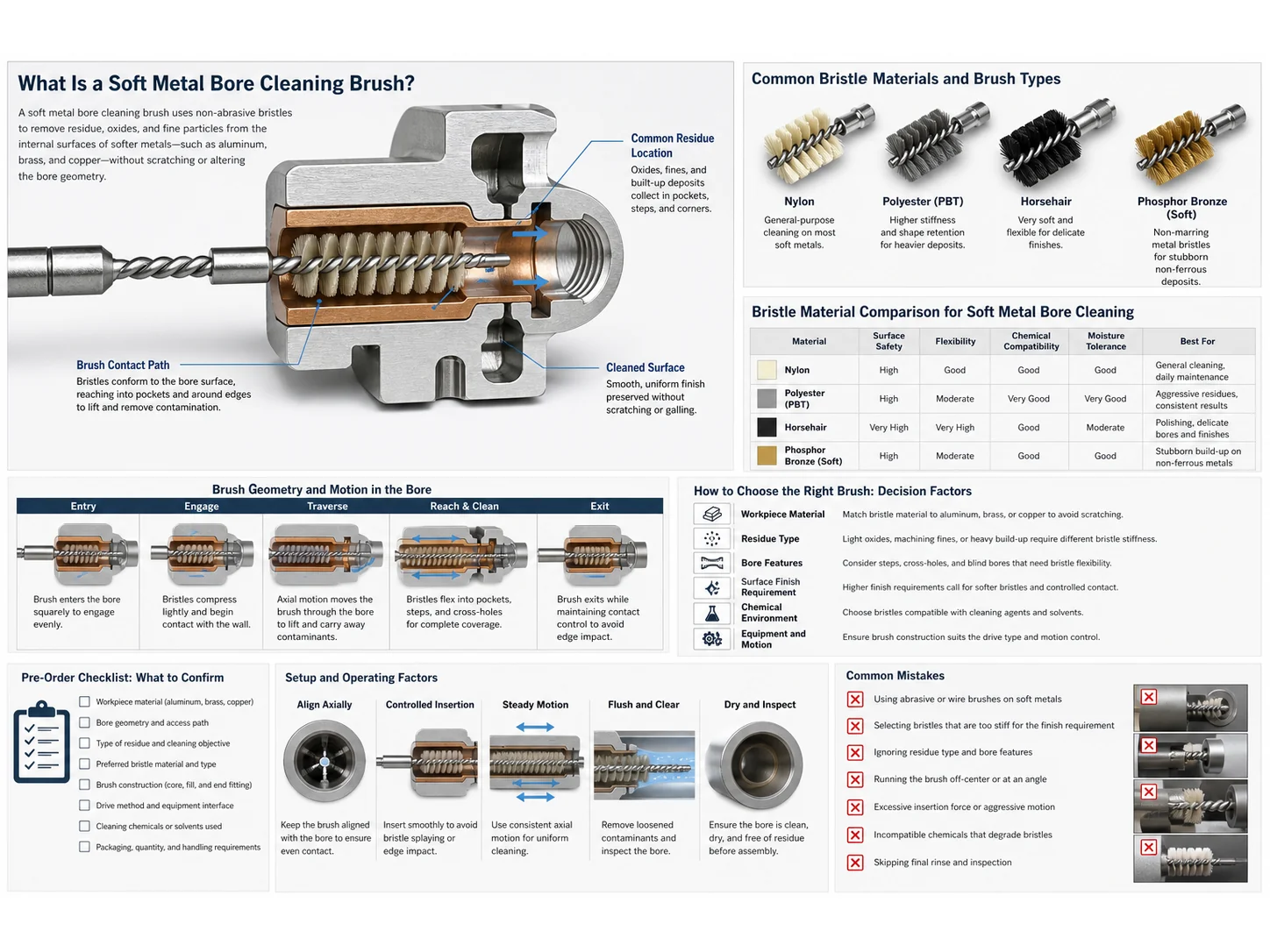
What Is a Soft Metal Bore Cleaning Brush?
A soft metal bore cleaning brush is a rotating, cylindrical tool used to remove contaminants—chips, cutting fluid, light oxides, and loose debris—from the inside diameter of a machined hole. It typically mounts in a CNC spindle, a drill press, or a dedicated cleaning station, and it relies on gentle mechanical contact rather than abrasion to avoid scratching the base metal.
These brushes are most common in high-precision metal finishing, especially on soft, easily marred materials such as aluminum, brass, copper, magnesium, and mild alloys.
Common Bristle Materials and Brush Types
Soft metal bores call for non-metallic filaments. The main options fall into three groups:
- Natural fibers: Horsehair, Tampico, and other plant-based bristles. Good for removing light dust and coolant residue; very gentle but wear faster.
- Synthetic soft filaments: Nylon (PA 6, PA 6.6), polyester, and polypropylene. Excellent for wet or dry cleaning, good chemical resistance, and available in a range of stiffness grades.
- Abrasive-filled synthetics: Nylon with embedded silicon carbide, aluminum oxide, or diamond grit. Used only when a light deburr or surface preparation step is required, not for simple cleaning.
Crimped or straight wire brushes (steel, stainless steel, brass-coated steel) should be avoided for soft metal bores. Even a “soft wire” can gouge aluminum or copper.
Bristle Material Comparison for Soft Metal Bore Cleaning
| Bristle Material | Hardness / Scratch Risk | Dry Use | Wet Use | Temperature Limit | Chemical Resistance | Best Use Case |
|---|---|---|---|---|---|---|
| Horsehair | Very soft – near zero | Yes | Yes (water, mild cleaners) | ~120°C | Limited | Dust and light film removal on polished aluminum |
| Tampico | Soft – near zero | Yes | Yes | ~150°C | Moderate | General bore cleaning with coolant residues |
| Nylon 6.6 (unfilled) | Soft to medium – low risk | Yes | Excellent | ~150°C | Good (oils, mild acids/alkalis) | Most soft metal wet cleaning jobs; cost-effective |
| Polyester | Soft to medium – low risk | Yes | Good | ~150°C | Good | Where higher moisture resistance is needed |
| Abrasive nylon | Medium – moderate scratch risk | Yes | Often used wet | ~150–200°C | Good | Controlled deburr + clean; not for scratch-sensitive surfaces |
Unless the specification explicitly requires a light surface roughening or small burr removal, always default to non-abrasive synthetic or natural bristles.
How to Choose the Right Brush: Decision Factors
Work through these questions before requesting a quote or placing an order:
- Bore diameter and length: Brush must fill the bore without being forced. A typical fill is 10–30% interference, but this depends on bristle stiffness.
- Bristle material and stiffness: Match to base metal hardness and surface finish requirements.
- Wet or dry operation: Many CNC cleaning cycles use coolant or oil flushing. Verify bristle material absorption and swelling properties.
- Temperature and chemical exposure: Check filament rating against the machine environment.
- Rotational speed and line speed: Excessive RPM can fling bristles outward, reducing contact. Slower is often better.
- Mounting method: Stem, arbor hole, threaded shank, or quick-change mandrel. Must match your machine spindle or tool holder.
- Maintenance access: Can the brush be changed quickly? Does it need to be cleaned or trimmed periodically?
Pre‑Order Checklist: What to Confirm
Before you send an RFQ, have these details ready:
- Bore dimensions: minimum and maximum ID, length, and any step or cross‑hole features.
- Base material and surface finish spec: Example: 6061‑T6 aluminum, Ra 0.8 µm max, no scratch permitted.
- Contaminant type: Chip size, coolant type, presence of oil or grease.
- Mounting interface: Shank diameter, rotation direction, maximum spindle speed, and tool holder style.
- Expected cycle time or production rate: Helps determine bristle fill density and diameter.
- Sample or drawing reference: If you have an existing brush that nearly works, a photo with measurements saves time.
When contacting a supplier, ask for a bristle sample test first if the application is critical.
Setup and Operating Factors
Even the best brush underperforms if it is not set up correctly:
- Brush alignment: Center the brush in the bore. An off‑center path causes uneven wear and possible scratching.
- Feed rate and dwell time: Slower passes give bristles time to wipe and lift debris. Too fast and you just plow chips together.
- Coolant flow: In wet systems, aim the coolant nozzle inside the bore ahead of the brush to flush loosened debris away.
- Break‑in period: New brushes often shed loose bristles in the first few cycles. Run a short break‑in on a scrap part.
Common Mistakes
- Using a wire brush on soft metals. Even a quick “test” can ruin a finished bore. Stick with non‑metallic filaments.
- Ignoring bristle stiffness. Two brushes can look identical but have different stiffness grades. Overly stiff bristles may score the ID.
- Undersizing or oversizing the brush. Too small won’t clean; too large causes the bristles to fold over and lose effectiveness or break.
- Choosing by cost per brush instead of cost per part. A slightly more expensive brush that lasts 3× longer and reduces scrap is cheaper overall.
- Skipping the sample test. A 5-minute test on actual parts reveals fit, cleaning quality, and compatibility issues that drawings cannot show.
When a Soft Metal Bore Cleaning Brush Is the Wrong Choice
A bore brush is a mechanical wiper. It excels at removing loose, dry, or light debris, but it does not:
- Remove baked‑on carbon or oxide scale (may require chemical soak or abrasive blasting).
- Extract chips from deep blind holes (combine with vacuum or a chip extraction tool).
- Capture fine airborne dust (add a vacuum hood or air extraction).
- Achieve pharmaceutical‑ or semiconductor‑grade cleanliness (pair with ultrasonic cleaning, CIP, or a validated rinse process).
- Remove heavy, embedded abrasive particles (pre‑clean with high‑pressure coolant or a scraper first).
If your cleaning requirement is more stringent than simple chip and coolant removal, plan to use the brush as one stage in a multi‑step process—for example: high‑pressure flush → bore brush → air blow‑off → rinse.
Final Takeaway
Select the softest bristle material that effectively removes your contaminant without damaging the bore surface. Validate with a real part sample, always define the mounting and dimensional requirements up front, and consider whether the brush needs any secondary cleaning step to meet your spec. A well‑chosen bore brush saves rework and keeps soft‑metal parts moving through the cell.
Frequently Asked Questions
Can I use the same bore brush for different soft metals?
Yes, but only if the bristle material is soft enough for the most sensitive metal in your mix. A nylon 6.6 brush that works on 6061 aluminum will also work on brass, but you must avoid cross‑contamination of abrasive particles between material families.
How do I know when a bore brush needs replacing?
Look for permanent bristle set (loses its “spring back”), excessive filament breakage, poor cleaning results, or visible core wear. Run a periodic gage part and measure debris removal quality after a fixed number of cycles.
What is the difference between a cleaning brush and a deburring brush?
A cleaning brush uses non‑abrasive filaments to wipe away loose residue. A deburring brush contains abrasive grains and is intended to remove or round off small burrs, which also removes base metal.
Can I use a soft metal bore brush in a blind hole?
Yes, but the brush must be designed for blind holes—usually a stem‑mounted type with bristles that can reach the bottom. You will also need a way to evacuate debris (vacuum or blow out) because the bottom traps chips.
What mounting style works best for automated CNC cleaning?
Through‑hole ball‑drive or arbor‑mounted brushes are common on multi‑spindle heads. A keyless chuck with a straight shank works well for single‑spindle machining centers. Always confirm maximum RPM with the brush supplier.
Is it safe to use a bore brush in a wet machining environment?
Usually, yes. Nylon and Tampico handle water‑based coolants well. However, some natural bristles may swell and soften over time, so check the filament’s moisture absorption rating before running continuously submerged.
How do I store bore brushes between runs to extend life?
Clean the brush after use to remove chips and coolant, dry it thoroughly if not used daily, and hang it or store it in a way that doesn’t deform the bristles. Avoid resting the brush on its bristle tips.
Technical References
Which bristle material fits this job — Nylon PA, AISI 304 Stainless Steel Wire or Horsehair?
| Material | Continuous temperature (°C) | Peak temperature (°C) | Water absorption | Hardness |
|---|---|---|---|---|
| Nylon PA | 93 | 121 | 0.3–9% by PA grade and conditioning | Medium to firm; filament diameter and trim length control bending force. |
| AISI 304 Stainless Steel Wire | 400 | 500 | 0% | Rockwell B 70–95 depending on temper and cold work |
| Horsehair | 60–80 | 100–120 | 8–15% | — |
| Abrasive Nylon | 120 | 150 | 0.1–1.0% | Abrasive filament; stiffness and cutting level is controlled by PA base, grit type, grit size, filament diameter and trim height. |
Figures as published by Brushtec / DuPont; Alleima; Perlon. Confirm the exact grade against the supplier datasheet before ordering.
What should replace Nylon PA when it stops working?
- Nylon PA — Compare Nylon PA with PP, PBT, PET. Change material when wet stiffness, temperature, chemical resistance, conductivity, particle shedding, or surface marking becomes the limiting factor.
- AISI 304 Stainless Steel Wire — Use AISI 316 stainless steel wire for chloride, marine, dairy, beverage, chemical washdown, or higher pitting-resistance requirements. Use carbon steel for dry aggressive cutting and brass or abrasive nylon for lower marking risk.
- Horsehair — Compare Horsehair with Boar bristle, goat hair, microfiber. Change material when wet stiffness, temperature, chemical resistance, conductivity, particle shedding, or surface marking becomes the limiting factor.
- Abrasive Nylon — Compare Abrasive Nylon with PP, PBT, PET. Change material when wet stiffness, temperature, chemical resistance, conductivity, particle shedding, or surface marking becomes the limiting factor.