
What Is a Steel Wire Brush?
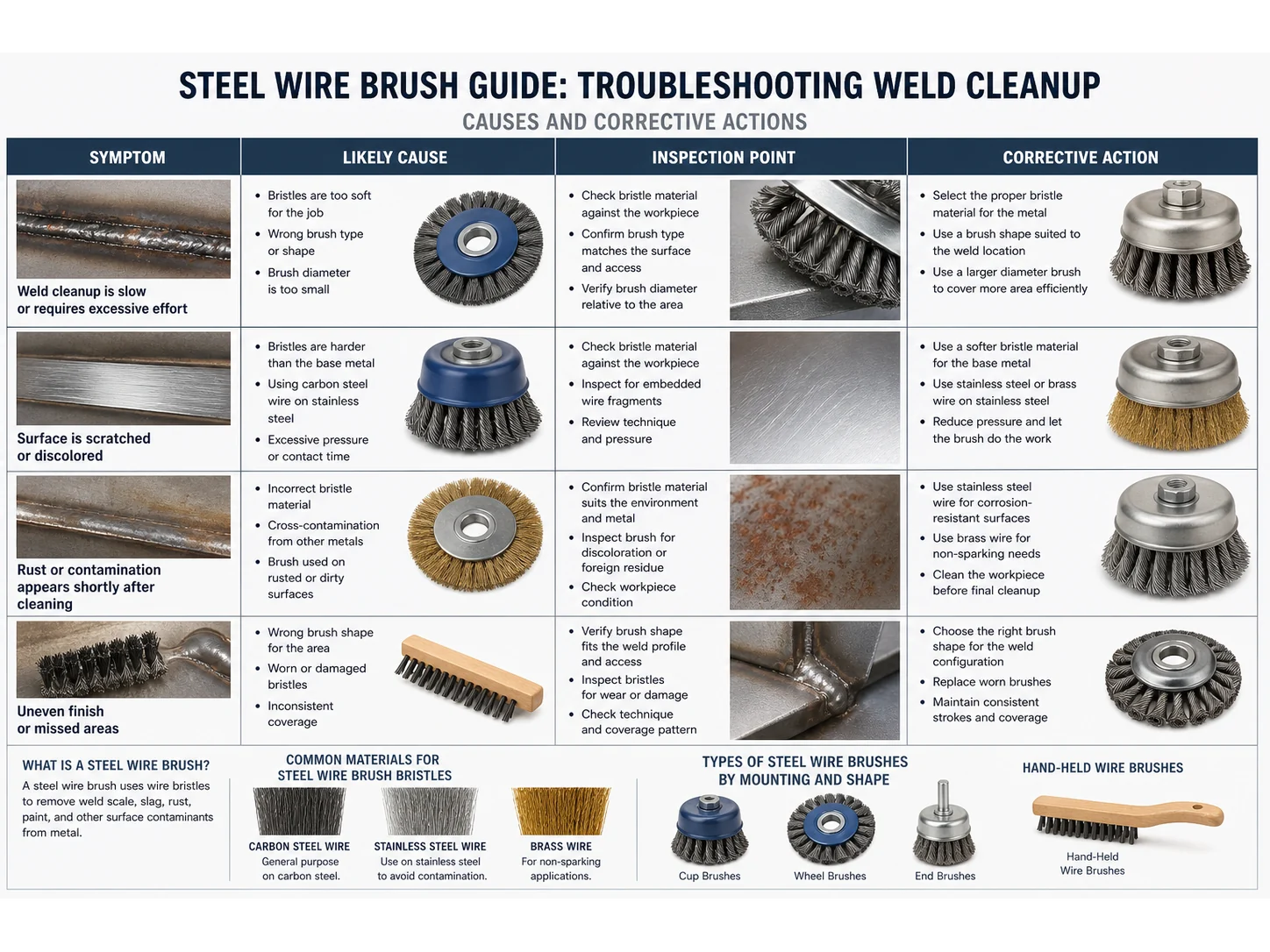
A steel wire brush uses individual metal wires (bristles) held in a handle, cup, wheel, or twisted shank to scrub or scour a surface. In weld cleanup, it is used to remove welding byproducts such as slag from stick electrodes, spatter from MIG welding, and discoloration from TIG welding. The wire bristles are typically made from carbon steel, stainless steel, or sometimes brass, and they can be straight, crimped, or knotted depending on the aggression required.
These brushes come in many forms: hand-held brushes with wooden or plastic handles, small detail brushes for tight corners, rotary brushes that mount on angle grinders or drills, and specialty brushes for specific base metals. The goal is always the same—clean metal without introducing contamination that could cause corrosion or compromise a weld joint.
Common Materials for Steel Wire Brush Bristles
The wire material determines the cleaning aggressiveness, the risk of leaving behind rust-triggering particles, and compatibility with different base metals. Below are the three most common materials used in metal cleaning brushes.
Carbon Steel Wire
Carbon steel wire brushes are the workhorses for general-purpose weld cleanup on mild steel. The bristles are hard and aggressive, making fast work of heavy slag and scale. However, they wear quickly, can shed wire fragments, and must never be used on stainless steel or aluminum because they will embed carbon steel particles into the surface, causing galvanic corrosion and rust spots later.
Stainless Steel Wire
Stainless steel wire brushes—typically made from 304 or 316 stainless—are non-corrosive and suitable for cleaning stainless steel and aluminum welds. They are less aggressive than carbon steel but essential when contamination control matters. In food-grade, pharmaceutical, or marine applications, stainless brushes prevent cross-contamination that could lead to pitting or premature failure.
Brass Wire
Brass wire brushes are the gentlest option. They are used on softer, non-ferrous metals like copper, brass, or delicate surfaces where even stainless wire might scratch. Brass bristles do not spark, making them safer in certain environments, but they wear out faster and are not suitable for heavy weld slag removal.
| Material | Best Use Case | Surface Risk | Corrosion Resistance | Typical Cost Factor |
|---|---|---|---|---|
| Carbon Steel | Mild steel weld cleanup; heavy slag and scale | Will embed particles in stainless/aluminum | Low—rusts if left damp | $ |
| Stainless Steel | Stainless steel, aluminum, high-corrosion-risk joints | Can scratch if too aggressive | High | $$ |
| Brass | Copper, brass, delicate surfaces, spark-free zones | Very low, but leaves brass traces | Good (tarnishes) | $$ |
Types of Steel Wire Brushes by Mounting and Shape
The brush format—how it connects to the operator or tool—dictates speed, reach, and the kind of cleaning you can perform. Selecting the right type prevents operator fatigue and ensures effective cleaning of the weld zone.
Hand-Held Wire Brushes
These include a handle and a block or frame of bristles. Handles may be wood, plastic, or formed from the wire itself. A long handle steel wire brush keeps hands away from heat and sharp edges, while a mini steel wire brush or small stainless steel wire brush allows detailed work in corners, around pipe joints, or inside tight assemblies.
Cup Brushes
Cup brushes mount onto angle grinders or drills. They have a cup shape that allows cleaning of larger flat or curved surfaces. A crimped steel wire brush cup is less aggressive than a knotted version; knotted cups are used for heavy stock removal and weld scale.
Wheel Brushes
Wheel brushes are also grinder- or drill-mounted, with wire bristles radiating from a central hub. They excel at cleaning edges, inside fillets, or long seams. Rotary steel wire brushes running at high RPM can remove surface rust quickly but demand careful speed matching to avoid wire breakage.
End Brushes
End brushes are narrow, pointed brushes for internal diameters, keyways, and hard-to-reach weld roots. They are often used with die grinders or drills. A rotating steel wire brush in an end configuration helps clean the root pass of a pipe weld before the hot pass.
How to Choose a Steel Wire Brush
Selecting a steel wire brush is not a matter of grabbing whatever is on the shelf. Use the following decision factors to match the brush to the job and the base metal.
- Base metal compatibility: Never use a carbon steel brush on stainless or aluminum.
- Residue type: Heavy slag and spatter call for carbon steel or knotted cups; light discoloration can be handled with a crimped stainless brush.
- Surface sensitivity: Cosmetic surfaces or polished finishes need softer wires (brass or fine stainless).
- Equipment interface: Thread size, shank diameter, and maximum rated RPM must match the tool. A circular steel wire brush with a 1/4-inch shank fits a die grinder; a 5/8-11 threaded cup fits an angle grinder.
- Wet or chemical exposure: In washdown or outdoor environments, stainless steel bristles and a plastic handle or stainless handle are preferred to avoid rusting of the brush itself.
- Hygiene expectations: Food and pharmaceutical applications require dedicated stainless brushes, often with color coding and traceability.
- Maintenance frequency: Heavy production may favor low-cost carbon steel brushes that can be discarded frequently, while a high-quality stainless brush can be cleaned and reused for months.
- Custom size requirements: For non-standard weld joints or automated systems, the brush diameter, trim length, and bristle pattern may need to be specified from a supplier drawing.
Sizing and Fit: Diameter, Length, and Handle Options
Getting the physical dimensions right is just as important as the material choice. A common mistake is choosing a brush that is too large to fit into a fillet or too small to be efficient.
- Brush length and bristle reach: A 6 inch steel wire brush refers to the overall length of a hand brush, including handle. Longer handles provide leverage but can reduce control. For rotary tools, the brush diameter must fit within the joint geometry—a 3-inch cup brush cannot clean the inside of a 2-inch pipe.
- Handle material: Wooden handle steel wire brushes are common and affordable, but they can crack or absorb moisture. A stainless steel wire brush with plastic handle resists chemicals and moisture, making it suitable for repeated washing. Stainless steel wire brushes with wood handles combine comfort with some chemical resistance but should be dried after use.
- Bristle trim length and density: Short trim lengths feel stiffer and are more aggressive; longer trims are more conformable. Crimped wire is flexible and good for light cleaning; knotted wire is stiffer and more aggressive.
- Pack quantities: When brush wear is high, buying a 3pcs steel wire brush set can be cost-effective, but ensure each brush in the pack matches the material and size you need. “3pcs” may include different shapes, but check that all are, for instance, stainless if that is your requirement.
Common Mistakes When Selecting a Steel Wire Brush
Even experienced welders and buyers fall into predictable traps. Here are the most costly errors and how to avoid them.
- Using the wrong wire material on base metal. Carbon steel bristles on stainless or aluminum cause rust contamination that often appears days or weeks after the weld is accepted.
- Choosing by cost drivers or availability alone. A budget brush that sheds wires into a critical weld zone creates more rework than the cost drivers difference ever covers.
- Ignoring maximum RPM ratings. Running a rotary brush faster than its rated speed ejects wires at high velocity, creating a safety hazard and uneven cleaning.
- Neglecting handle material in wet or washdown environments. A standard wooden handle can splinter or harbor bacteria; a marine or food environment demands a sealed plastic or stainless handle.
- Assuming one brush fits all welds. A large cup brush cannot clean root passes in a pipe, and a tiny end brush is too slow for a 10-foot seam. Keep a selection tailored to the joint types in your shop.
- Not specifying the correct trim length. Ordering a generic “steel wire brush for cleaning” without defining crimped vs. knotted or trim length can result in a brush that is too aggressive or too soft for the slag you need to remove.
- Forgetting to match brush shank or thread to the tool. A brush built for a 1/4-inch collet die grinder will not mount on an angle grinder with a 5/8-11 arbor. Always confirm the interface.
When a Steel Wire Brush Is the Wrong Choice
Steel wire brushes excel at removing surface deposits, but there are clear limits to what they can achieve. Recognizing these boundaries prevents wasted time and damaged parts.
- Thick mill scale or heavy rust pitting: A needle scaler, abrasive disc, or chemical pickling may be required before a wire brush can finish the surface.
- Precision surface finish requirements: If a specification calls for a specific roughness (Ra) or a polished surface, a wire brush alone cannot Help confirm the finish. Post-brush polishing or grit blasting may follow.
- Contamination-sensitive alloys: In some nuclear, pharmaceutical, or aerospace applications, even a dedicated stainless steel wire brush may not be enough; brushes must be lot-tracked, stored in sealed bags, and used only with documented cleaning procedures. Here, consult the material or process specification rather than relying on a brush alone.
- Deep crevices and blind holes: Wire bristles need a certain clearance to flex and clean effectively. Ultrasonic cleaning or liquid honing may be required for intricate internal passages.
- When drawings or supplier agreements require a specific brush P/N: Sometimes the end customer or engineer specifies an exact brush part number, brand, or bristle geometry. In that case, you must follow the print—a general-purpose steel wire brush is not a substitute.
If you are unsure about the correct brush for a critical application, request a sample from the supplier and perform a test on scrap material before committing to a bulk order. A quick drawing review between your engineering team and the brush manufacturer can catch interface mismatches early.
Final Takeaway
Selecting a steel wire brush for weld cleanup is not complicated when you approach it systematically. Determine the base metal and select a compatible bristle material—carbon steel for mild steel, stainless steel for stainless and aluminum. Match the brush type and mounting to your tool and joint accessibility. Pay attention to trim length, handle material, and RPM rating. Avoid the common mistake of cross-contamination and never buy on cost drivers alone for critical welds. When the limits of a wire brush are exceeded, pair it with another method or follow the engineering specification. A well-chosen brush saves rework time, protects weld integrity, and keeps your operation running smoothly.
Frequently Asked Questions
Can I use a carbon steel wire brush on stainless steel?
No. Carbon steel bristles will leave tiny iron particles on the stainless surface. These particles rust and cause pitting or crevice corrosion, especially in moist or corrosive environments. Always use a dedicated stainless steel wire brush for stainless steel.
What size wire brush is best for cleaning welding spatter?
For heavy spatter on flat or slightly curved surfaces, a 3–4 inch knotted cup brush on an angle grinder offers fast removal. For tight fillets or corners, a smaller end brush (1–2 inch diameter) or a hand-held brush with a blade-and-bristle design may work better. Match the brush size to the joint geometry, not just the spatter severity.
Should I choose a crimped or knotted wire brush?
Crimped wire brushes are more flexible and conform to irregular surfaces, making them suitable for light cleaning and paint preparation. Knotted wire brushes are stiffer and more aggressive, ideal for heavy slag, thick rust, and mill scale removal. If you need light surface conditioning on a sculpted part, choose crimped; for tough weld cleanup on structural steel, choose knotted.
Are brass wire brushes suitable for weld cleanup?
Brass brushes are too soft for most weld slag and spatter removal. They are best reserved for cleaning copper, brass, or delicate non-ferrous surfaces after welding. Brass bristles can also be used to prevent sparks in hazardous atmospheres, but they will not effectively scour a typical MIG or stick weld bead.
How do I know if a rotary wire brush will fit my grinder?
Check the thread size or arbor mount. Common angle grinder cup brushes use a 5/8-11 threaded hub. Die grinders often accept 1/4-inch or 6 mm shanks. Before purchasing, compare the brush’s mount specification with your tool’s spindle. Never use adapters that increase overhang—they can cause dangerous vibration and brush failure.
Can I wash a steel wire brush with water?
Stainless steel wire brushes with plastic handles can be washed and sanitized, but they must be dried thoroughly to avoid water spotting on stainless bristles. Carbon steel wire brushes will rust if exposed to water; they should be kept dry and stored in a low-humidity environment. Wooden handles may swell, crack, or absorb moisture, so limit water exposure.
Why does my brush shed wires so quickly?
Excessive wire shedding is usually caused by running the brush above its maximum RPM, pressing too hard during use, or using a brush with a trim length and wire diameter that are too light for the job. Always wear safety glasses and gloves, and if shedding continues, check the tool speed or switch to a brush rated for the application.
Technical References
- OSHA — 1910.242 Hand and Portable Powered Tools
- OSHA — Personal Protective Equipment
- World Stainless — Corrosion Resistance of Stainless Steels
- ASME — Y14.5 Dimensioning and Tolerancing
Which bristle material fits this job — AISI 304 Stainless Steel Wire, Carbon Steel Wire or Brass Wire?
| Material | Continuous temperature (°C) | Peak temperature (°C) | Water absorption | Hardness |
|---|---|---|---|---|
| AISI 304 Stainless Steel Wire | 400 | 500 | 0% | Rockwell B 70–95 depending on temper and cold work |
| Carbon Steel Wire | 200–300 | 350–450 | 0% | Rockwell C 40–60 |
| Brass Wire | 150–200 | 250–300 | 0% | Rockwell B 40–90 |
Figures as published by Alleima. Confirm the exact grade against the supplier datasheet before ordering.
What should replace AISI 304 Stainless Steel Wire for weld cleanup: materials, sizes, mistakes?
- AISI 304 Stainless Steel Wire — Use AISI 316 stainless steel wire for chloride, marine, dairy, beverage, chemical washdown, or higher pitting-resistance requirements. Use carbon steel for dry aggressive cutting and brass or abrasive nylon for lower marking risk.
- Carbon Steel Wire — Compare Carbon Steel Wire with Carbon steel wire, brass wire, abrasive nylon. Change material when wet stiffness, temperature, chemical resistance, conductivity, particle shedding, or surface marking becomes the limiting factor.
- Brass Wire — Compare Brass Wire with Steel wire, stainless wire, nylon. Change material when wet stiffness, temperature, chemical resistance, conductivity, particle shedding, or surface marking becomes the limiting factor.