
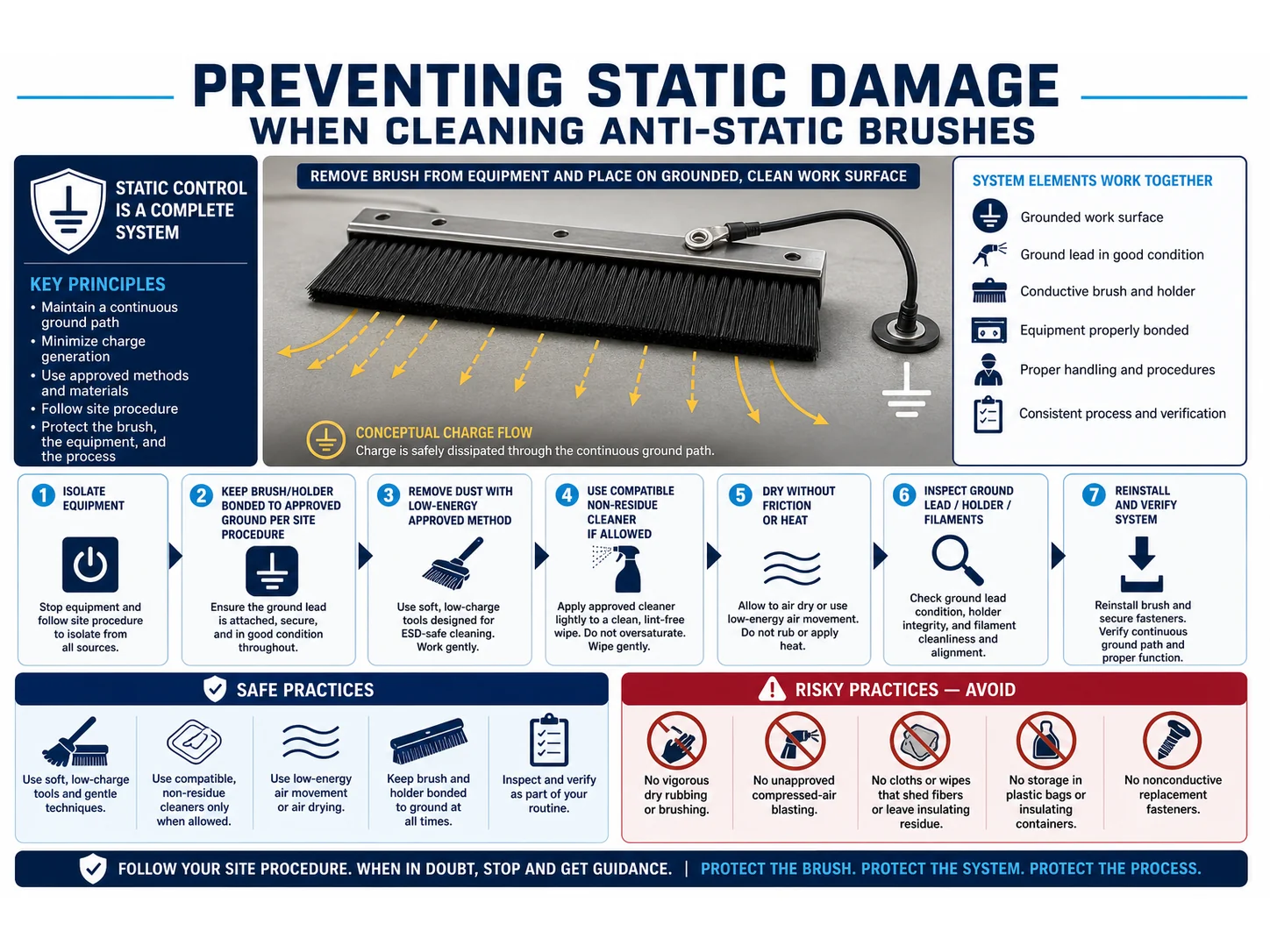
What Is an Anti‑Static Brush and Why Cleaning Matters
An anti‑static brush carries away surface dust while simultaneously draining static charge to ground. Its bristles typically contain conductive carbon-infused fibers or a special grounding core. If the bristles become coated with oils, moisture, or chemical residues from the surfaces they touch, the brush loses its ability to dissipate static effectively. Regular, proper cleaning restores performance but must never strip away the conductive coating or damage the fiber structure.
Understanding Conductive Properties and Static Dissipation
Most anti‑static brushes operate in the static dissipative range, usually defined as a surface resistance between 10⁶ and 10⁹ ohms. Conductive filaments create a path for charges to flow gently to ground, avoiding sudden discharges. Anything that insulates the bristles (waxy residue, sticky dust, or certain cleaning agent films) will increase resistance and turn the brush into a static generator. Cleaning decisions must preserve the original surface resistance and mechanical integrity of the fibers.
Safe vs. Unsafe Cleaning Agents
Not all cleaning fluids are compatible with anti‑static brush materials. The table below compares common agents used in workshop and lab environments.
| Cleaning Agent | Risk Level | Effect on Conductive Properties | Best Practice |
|---|---|---|---|
| Distilled or deionized water | Low | No residue; evaporates cleanly | Lightly dampen a lint-free cloth; wipe bristles gently |
| Isopropyl alcohol (≥99%) | Low | Dissolves oils, dries fast, leaves minimal residue | Use high-purity grade; avoid prolonged soaking |
| Mild pH‑neutral detergent solution | Moderate | Residues can leave insulating film if not rinsed thoroughly | Rinse with distilled water; dry completely before testing |
| Specialized ESD mat/brush cleaner | Low (when formulated correctly) | Designed to maintain dissipative properties | Follow product instructions; verify compatibility with manufacturer |
| Acetone, lacquer thinner, or harsh solvents | High | Can dissolve carbon fibers or strip conductive layers | Never use on anti‑static brushes |
| Tap water | High | Minerals and chlorine leave insulating deposits | Avoid; use distilled water only |
Step‑by‑Step Safe Cleaning Methods
- Dry removal first. Tap the brush gently against a clean surface to dislodge loose dust. Use a can of clean, dry air (or a vacuum with a HEPA‑filtered soft brush attachment) to pull particles from the bristle base.
- Prepare the cleaning cloth. Moisten a lint‑free microfiber cloth with a small amount of high‑purity isopropyl alcohol or distilled water. Wring the cloth until it feels almost dry to the touch.
- Wipe the bristles in one direction. Spread the bristle tips over the cloth and draw the brush toward you with light pressure. Do not scrub back and forth; scrubbing can break fibers and force dirt deeper.
- Inspect for sticky residues. If residues remain, repeat wiping with a fresh area of the cloth. Avoid submerging the brush head in liquid; liquid can wick into the handle and corrode internal grounding components.
- Dry immediately. Leave the brush bristles‑down on a clean, dry surface in a dust‑free area until completely dry. Using a cool‑air fan speeds drying without heat damage.
- Test before reuse. Perform a surface resistance check (see next section) before returning the brush to sensitive work.
Testing Conductivity After Cleaning
A basic conductivity check gives confidence that the brush remains ESD‑safe. Use either a surface resistance meter or a digital multimeter capable of reading megohm ranges.
- Surface resistance meter: Place the brush bristles against the meter’s parallel‑bar electrodes or use two 5‑lb probe contacts placed 1 inch apart along the bristle bundle. The reading should fall within the brush’s original specification (commonly 10⁶–10⁹ ohms).
- Multimeter method: Set the meter to resistance mode (auto‑ranging or appropriate megohm scale). Touch one probe to the bristle tips and the other to the brush’s grounding point (metal handle or grounding snap). A working anti‑static brush will show continuity—typically a few megohms to a few hundred megohms, depending on the brush design.
If the resistance reading is significantly higher than the original specification or reads “open,” the brush may no longer function as intended.
Common Mistakes That Damage the Brush
- Using soap‑based cleaners without thorough rinsing. Soap films dry into an insulating layer that prevents static dissipation.
- Soaking the brush. Submerging the head introduces moisture into the handle where it can corrode the conductive connection.
- Scrubbing aggressively. Bending or twisting fibers during cleaning causes mechanical fatigue and breaks the conductive coating.
- Blowing with un‑filtered compressed air. Shop air often contains oil mist and moisture that contaminate the bristles.
- Storing the brush wet. Trapped moisture encourages oxidation and can permanently increase resistance.
When Has the Brush Permanently Lost Its Properties?
An anti‑static brush should be considered worn out when cleaning and drying no longer restore an acceptable resistance reading, when carbon‑infused bristles appear frayed or broken, or when the grounding path is physically interrupted. Conductive coatings on some brush models can abrade over time, and no amount of surface cleaning will restore them. If you must clean the brush more frequently to maintain performance, or if static‑related issues return after cleaning, it is time to replace the brush.
Final Takeaway: Prolonging Brush Life
Preventing static damage while cleaning anti‑static brushes comes down to the right agents, gentle techniques, and routine testing. Stick with high‑purity alcohol or distilled water, avoid soaking, dry thoroughly, and verify conductivity before each critical use. Proper care extends the service life of the brush and keeps your static‑sensitive work environment safe.
Frequently Asked Questions
Can I use tap water to rinse my anti‑static brush?
No. Tap water contains dissolved minerals that leave a thin insulating film when the water evaporates. This film can raise surface resistance high enough to compromise static control. Use only distilled or deionized water if a water rinse is necessary.
How often should I clean an anti‑static brush?
Clean the brush whenever you notice visible dust buildup, after heavy use on dirty surfaces, or if a conductivity test shows elevated resistance. For brushes used in clean‑room environments, cleaning after each shift is common. Light‑use vinyl record brushes may only need cleaning every few months.
Is isopropyl alcohol safe for all anti‑static brush models?
High‑purity isopropyl alcohol (99% or higher) is generally safe for carbon‑fiber and conductive‑filament brushes because it evaporates quickly and leaves little residue. However, always check the manufacturer’s care instructions; some brushes use adhesives that can be weakened by prolonged alcohol exposure.
What should I do if the brush loses its grounding clip or snap?
The grounding path is essential for static dissipation. If the grounding connector is damaged, the brush can no longer drain charges effectively. Replacement of the brush is usually the safest course, as field repair of the grounding component can alter the brush’s electrical properties.
Can I use a hair dryer to speed up drying?
No. Heat from a hair dryer can melt binding agents in the bristle base, warp the handle, or cause uneven drying that stresses the fibers. Use a cool‑air fan or simply let the brush air‑dry in a dust‑free area.
Why does my brush still attract dust after cleaning?
If the brush attracts dust after cleaning, the fibers may have developed an insulating coating from a cleaning residue, the brush may not be fully dry, or the conductive properties may have degraded beyond restoration. Perform a surface resistance test to diagnose the problem.
When is it time to replace instead of clean?
Replace the brush if resistance measurements remain outside the acceptable range after cleaning, if bristles are missing or severely worn, or if the handle grounding connection is loose and cannot be tightened securely. No cleaning method can rebuild mechanically damaged conductive fibers.
Technical References
Which conductive and antistatic filament fits this job — Carbon Fiber, Conductive Nylon or Anti-static Filament?
| Filament | Continuous temperature (°C) | Peak temperature (°C) | Water absorption | Hardness |
|---|---|---|---|---|
| Carbon Fiber | 200–350 | 400–500 | ≤0.10% | — |
| Conductive Nylon | 80–110 | 130–160 | 0.5–2.5% | Shore D 75–88 |
| Anti-static Filament | 80–110 | 130–160 | 0.5–2.5% | Shore D 72–86 |
| Thunderon Conductive Fiber | 80 | 110 | 1–4% | — |
| Antistatic PBT Filament | 120–140 | 160–180 | 0.05–0.25% | Shore D 80–90 |
Figures as published by Material manufacturer TDS / ISO / ASTM / industry reference. Confirm the exact grade against the supplier datasheet before ordering.
When is Carbon Fiber the wrong choice?
- Carbon Fiber — Brittle fiber fragments, conductive contamination and incomplete grounding can make carbon fiber unsuitable for exposed electronics or cleanliness-critical areas.
- Microfiber — Not suited to heavy scale, sharp burrs, rough debris or processes where textile lint and retained contamination cannot be controlled.
What should replace Carbon Fiber when it stops working?
- Carbon Fiber — Compare Carbon Fiber with Conductive nylon, anti-static filament, stainless micro-wire, standard nylon. Change material when wet stiffness, temperature, chemical resistance, conductivity, particle shedding, or surface marking becomes the limiting factor.
- Microfiber — Compare Microfiber with Cotton yarn, wool, felt, soft PBT filament. Change material when wet stiffness, temperature, chemical resistance, conductivity, particle shedding, or surface marking becomes the limiting factor.