
What Is a Brass Safety Brush?
Maintaining brass Brushes Used in Spark-Sensitive Maintenance Areas means preserving cleaning action without turning the brush into a source of wear, shedding, contamination, or unsafe handling. Start with surface finish, solvent exposure, access angle, scratch tolerance, and soil severity, then set an inspection and replacement routine that matches real working conditions.
A brass safety brush is a cleaning tool with bristles made from brass wire—a soft, non‑sparking alloy—designed to remove debris, oxide layers, or light deposits from metal surfaces without damaging the workpiece or creating ignition hazards. Production teams turn to these brushes when they need to clean sensitive equipment, food‑grade machinery, or combustible‑atmosphere tools where a standard steel brush would risk sparks or deep scratches.
Why Maintenance Matters for Brass Safety Brushes
Even though brass is corrosion‑resistant, regular use wears it down. The main enemies are not just friction—they include contamination, chemical exposure, and incorrect operating pressure. When bristles bend or break, the brush loses its cleaning pattern. Clogged bristles trap debris that can redeposit onto workpieces. A deformed core or loose ferrule changes brush stability, leading to uneven wear. And if cleaning chemistry is too aggressive, the brass itself can become brittle or discolored. Ignoring these signs eventually affects cycle time, product quality, and operator safety.
Inspection Checklist for Brass Safety Brushes
Use this checklist during routine line checks. A quick visual assessment is enough to catch most problems before they interrupt production.
| Check Point | What to Look For | What It Means |
|---|---|---|
| Bristle condition | Bends beyond 15°, permanent splay, missing tips, kinks | Loss of cleaning contact; risk of scratching |
| Core / holder integrity | Cracks, dents, corrosion at the base, loose ferrule | Unstable brush action; possible detachment |
| Uneven wear patterns | One side shorter or more flared than the other | Improper mounting angle or machine misalignment |
| Bristle shedding | Multiple loose bristles near the station after each cycle | Excessive pressure or material fatigue |
| Clogging / packing | Debris wedged deep between bristles, cannot be shaken out | Reduced cutting action; contamination crossover |
| Cleaning result change | Streaks, incomplete coverage, longer required cycle time | Systemic brush performance drop |
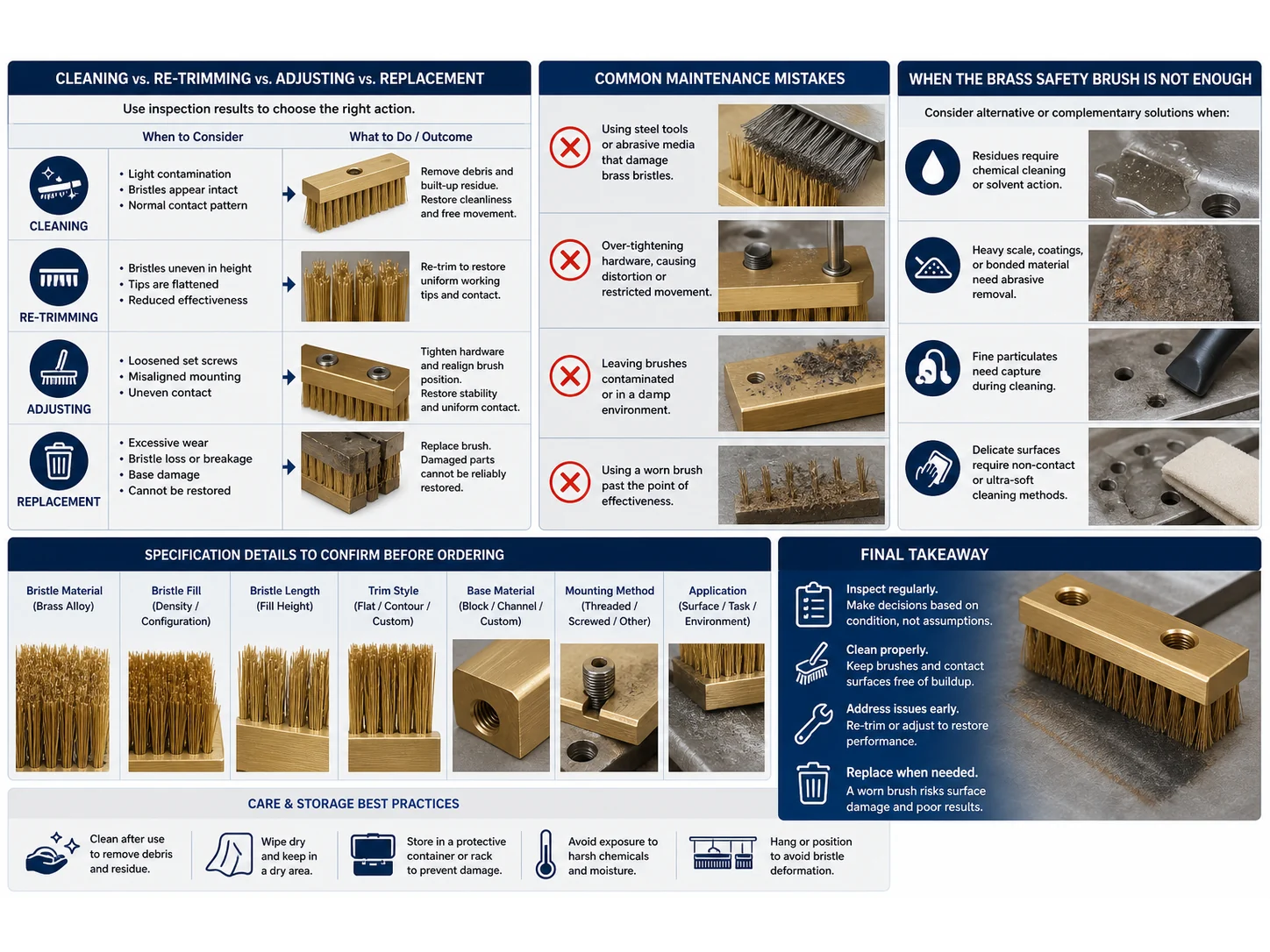
Cleaning vs. Re‑trimming vs. Adjusting vs. Replacement
When an inspection turns up issues, the next decision is which level of corrective action to take. The table below helps choose without arbitrary fixed‑lifetime assumptions.
| Symptom | Action | Notes |
|---|---|---|
| Light dust, dry powder residue | Clean with compressed air or mild solvent | Use only brass‑safe solvents; avoid water if core is carbon steel |
| Oily or sticky buildup | Soak in non‑corrosive degreaser, then brush out gently | Test a single brush first; avoid strong alkaline baths |
| Minor bristle splay at tips | Re‑trim with dedicated trimmer or trim jig | Do not use side cutters; keep bristle length uniform |
| Persistent uneven wear | Adjust brush holder angle or pressure | Check machine alignment; record before/after pattern |
| Severe bristle loss, cracked core, or permanent deformation | Replace the brush | Replace the set if batch wear is obvious; review process settings |
Common Maintenance Mistakes
Even experienced teams can fall into these traps. Watch out for:
- Using harsh chemicals. Strong acids, caustic cleaners, or chlorinated solvents attack brass and can cause stress‑corrosion cracking.
- Ignoring moisture. Storing brushes in a damp cabinet leads to tarnish and, eventually, loss of bristle flexibility. Dry storage is essential.
- Applying excessive working pressure. More force doesn’t mean faster cleaning—it bends bristles permanently and shortens brush life.
- Neglecting bristle trimming tools. Trimming with improvised cutters leaves sharp edges that can scratch workpieces.
- Replacing brushes one at a time on multi‑head stations. If one brush is worn, the whole set may be near the end of useful life. Mismatched brushes create uneven results.
When the Brass Safety Brush Is the Wrong Choice
A well‑maintained brass safety brush handles the majority of gentle surface cleaning tasks. But there are limits. If you see rapid, recurring wear even after correcting operating pressure, or if bristles show chemical attack after every shift, it’s time to look at the bigger picture. The brush material may not be right for the contaminant (e.g., hardened deposits that require stainless steel), the machine speed may be too high for brass fine wire, or the process design could be introducing abrasive media that overloads the brush. In these cases, consult with the process engineer or supplier about alternative bristle materials, pre‑cleaning steps, or tooling modifications.
Final Takeaway
Maintaining brass safety brushes is not about following a calendar schedule—it’s about reading the tool’s condition and the results it produces. A simple inspection checklist, paired with the discipline to clean, trim, adjust, or replace based on real wear indicators, keeps production consistent and workplace risk low.
Frequently Asked Questions
How often should I inspect brass safety brushes?
At minimum, inspect at the start of each shift or during planned line changeovers. High‑cycle or contamination‑heavy applications may require inspection every few hours.
Can I reshape bent bristles?
Slight bending can sometimes be corrected by gentle re‑aligning with a comb, but bristles that have taken a permanent set will not regain their original spring. It’s usually more reliable to trim or replace.
What cleaning solutions are safe for brass brushes?
Mild soaps, neutral pH degreasers, isopropyl alcohol, and mineral spirits (in a well‑ventilated area) are generally safe. Always avoid ammonia‑based or chlorine‑based cleaners, which can cause stress cracking.
Does a worn brass brush become a sparking hazard?
Brass is inherently non‑sparking, but a brush with a steel core or a broken steel ferrule can create sparks. If the base material is exposed due to wear or damage, replace immediately in hazardous locations.
How should I store brass safety brushes?
Store dry, away from floor moisture, and hung or laid so bristles are not compressed. Humid or chemically active atmospheres (like near plating baths) will accelerate corrosion.
Can I use a brass safety brush on stainless steel?
Yes, brass is often chosen to avoid scratching or embedding ferrous particles into stainless steel. However, the soft brass bristles have a shorter life on extremely abrasive surfaces. Monitor wear closely.
When is it better to replace a brush rather than clean it?
Replace when the core is cracked, more than 15% of bristles are missing or broken, the bristle length has shortened by more than 30%, or if cleaning results remain unacceptable after thorough cleaning and re‑trimming.
Technical References
- Copper Development Association — Brasses: Copper-Zinc Alloys
- World Stainless — Corrosion Resistance of Stainless Steels
Which bristle material fits this job — AISI 304 Stainless Steel Wire, Brass Wire or Carbon Steel Wire?
| Material | Continuous temperature (°C) | Peak temperature (°C) | Water absorption | Hardness |
|---|---|---|---|---|
| AISI 304 Stainless Steel Wire | 400 | 500 | 0% | Rockwell B 70–95 depending on temper and cold work |
| Brass Wire | 150–200 | 250–300 | 0% | Rockwell B 40–90 |
| Carbon Steel Wire | 200–300 | 350–450 | 0% | Rockwell C 40–60 |
Figures as published by Alleima. Confirm the exact grade against the supplier datasheet before ordering.
What should replace Tube & Pipe Bore Brushes for brass safety brush?
- Tube & Pipe Bore Brushes — Tube and bore brushes work by radial contact inside a confined diameter; wire wheels and cups work mainly on external edges, profiles, welds, and broad surfaces.
- AISI 304 Stainless Steel Wire — Use AISI 316 stainless steel wire for chloride, marine, dairy, beverage, chemical washdown, or higher pitting-resistance requirements. Use carbon steel for dry aggressive cutting and brass or abrasive nylon for lower marking risk.
- Brass Wire — Compare Brass Wire with Steel wire, stainless wire, nylon. Change material when wet stiffness, temperature, chemical resistance, conductivity, particle shedding, or surface marking becomes the limiting factor.
- Carbon Steel Wire — Compare Carbon Steel Wire with Carbon steel wire, brass wire, abrasive nylon. Change material when wet stiffness, temperature, chemical resistance, conductivity, particle shedding, or surface marking becomes the limiting factor.