
What Is Tube Brush Cleaning and Storage?
Tube brush cleaning and storage refers to the practices used to remove debris, residues, and moisture from a tube brush after use and to keep it in a condition that preserves filament integrity and minimizes contamination risk until the next use. Proper cleaning prevents hardened deposits from damaging filaments, stops corrosion of the stem or handle, and reduces the chance of transferring material between different tubes or process batches.
For industrial parts-cleaning process selection, contaminant classes, mechanical cleaning systems, and residue removal, this article cites ASM International — Choosing a Cleaning Process, ASM International, 1996; contaminant classes and mechanical cleaning process selection.
Common Types of Tube Brushes and How They Affect Cleaning
Not all tube brushes can be cleaned the same way. The brush material, filament type, and stem construction determine which cleaning agents and methods are safe:
- Nylon or polyester filament brushes: Used for general-purpose cleaning, laboratory glassware, and light-duty applications. Nylon absorbs very little water but can be damaged by strong acids, alkalis, or solvents that soften the filament.
- Wire brushes (steel, stainless steel, brass): Common in boiler tube cleaning, heat exchanger descaling, and industrial pipe work. Wire filaments tolerate harsher cleaning chemicals but are prone to rust if the stem or ferrule is not corrosion-resistant. Brass wire is softer and less likely to scratch delicate metal surfaces.
- Natural bristle brushes (Tampico, horsehair): Often used where a non-abrasive, absorbent brush is needed. Natural fibers can swell, lose stiffness, or harbor bacteria if not dried thoroughly.
- Abrasive filament brushes (grit-impregnated nylon, silicon carbide): Designed for aggressive cleaning; can hold debris in the filament matrix and require more thorough rinsing.
Cleaning Methods Comparison
Different residue types and brush materials call for different cleaning approaches. Use this table to match the method to the situation:
| Cleaning Method | Best for Residue Type | Compatible Brush Materials | Risk Factors |
|---|---|---|---|
| Dry brushing / knock-out | Dry powders, loose scale, lint | All types; particularly wire brushes | Airborne dust; may not remove sticky films |
| Warm water rinse with mild detergent | Water-soluble residues, light oils | Nylon, polyester, natural bristle, stainless steel | Natural bristle may swell; must dry fully |
| Solvent wipe or immersion (IPA, mineral spirits) | Grease, heavy oils, adhesives | Wire brushes, some nylon types (check chemical compatibility) | May dissolve handle coatings or adhesives; fire hazard; ventilation required |
| Ultrasonic cleaning | Fine particles, complex brush tips | Stainless steel stem, nylon, polyester | Not for natural bristle or delicate handles; can loosen filament knots |
| Acid or alkaline solution | Mineral scale, rust, protein deposits | Only brushes labeled for chemical resistance (e.g., stainless steel, certain nylons) | Can attack bristles, stem, and handle; requires neutralization and thorough rinse |
How to Choose the Right Cleaning Method
Walk through these questions for each brush after each use:
- What is the residue? Is it dry and loose? Water-soluble? Greasy or sticky? An aggressive scale or hard deposit?
- What is the brush made of? Check the filament type, stem material, and handle. Nylon can handle many mild detergents but not harsh solvents. Wire brushes need rust prevention.
- Where is the brush used? A laboratory test tube brush used for biological media requires a higher level of cleaning and drying care than a brush used for boiler tube descaling in a non-food environment.
- What are the next-use requirements? If the brush will contact a sensitive surface, high-purity fluid, or food-contact area, the cleaning method must be validated and documented. General maintenance brushes can typically be cleaned more simply.
- What resources are available? Ultrasonic tanks, drying ovens, and purified water rinses are excellent but not always practical. Choose a method you can perform consistently.
Practical Cleaning, Drying, Inspection, and Storage Checklist
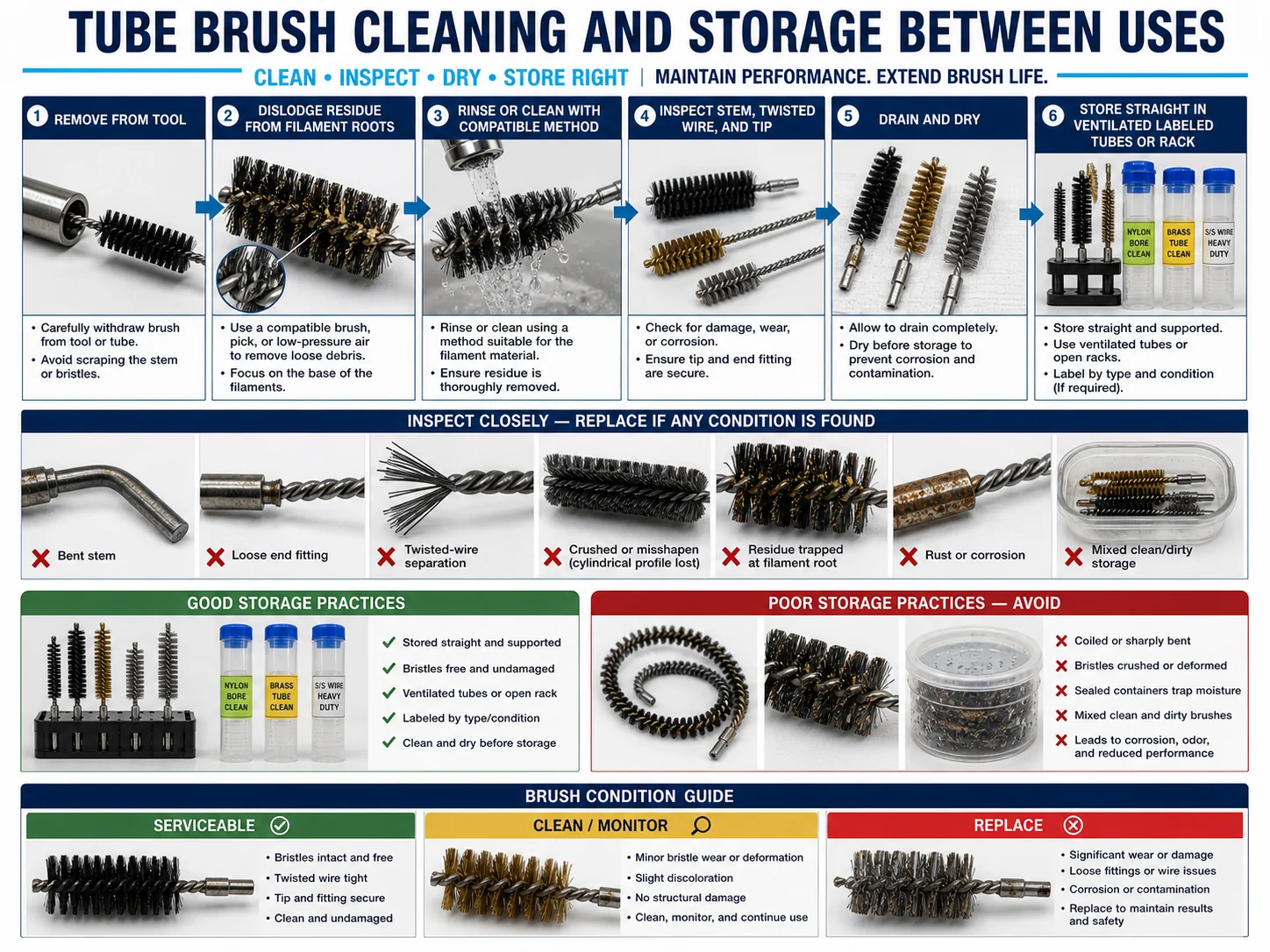
Follow these steps after every use to keep your tube brushes in reliable condition:
- Remove heavy debris immediately. Tap the brush gently against a waste container or use compressed air (wear eye protection) to knock out loose particles before wet cleaning.
- Choose the right cleaning solution. Use the mildest effective option—warm water and a neutral detergent work for most residues. Avoid bleach or strong acids unless the brush manufacturer confirms compatibility.
- Clean in the direction of the filaments. Avoid back-and-forth scrubbing against a hard surface that can bend or splay filaments.
- Rinse thoroughly. Residual cleaner can degrade bristles or contaminate the next tube. Rinse with clean water until no suds or residue remain.
- Dry completely. Hang brushes bristle-end down, or lay them horizontally on a clean, absorbent surface. Use a low-temperature drying oven if available (below 150°F / 65°C for most plastics). Never store in a closed container while damp.
- Inspect under good light. Check for broken, bent, or matted bristles; rust on the stem; cracks in the handle; or embedded debris that rinsing missed.
- Store properly. Keep each brush type in a dedicated tube, rack, or hook—separated by material and application. Label storage locations if the same brush style is used for multiple processes.
Common Mistakes to Avoid
- Storing wet brushes. This is the fastest way to ruin a brush. Moisture causes rust on wire stems, weakens natural fibers, promotes mold, and creates a breeding ground for bacteria.
- Mixing brushes across incompatible materials. Using a wire brush that previously cleaned a steel pipe to brush a copper tube can embed iron particles and cause galvanic corrosion. Keep separate brushes for different metals and processes.
- Using harsh chemicals on sensitive filaments. Acetone, strong acids, or high-pH solutions can quickly embrittle nylon or dissolve natural bristle bindings. Always check the brush manufacturer’s chemical resistance data.
- Skipping inspection. A brush with a broken filament left inside a tube can cause downstream equipment damage. A rusting stem can scratch the next workpiece.
- Assuming a visual rinse equals clean. Clear water does not support removal of oil films or microbial biofilms. Use a gloved finger or white cloth to check for residues on a small area of the brush.
When Tube Brush Cleaning Is the Wrong Choice
In food, pharmaceutical, medical device, or laboratory environments where validated sanitation is required, the simple checklist above is only a starting point. These applications often require:
- Validated cleaning procedures with defined critical parameters (time, temperature, concentration, rinse volume).
- Sterilization or high-level disinfection after cleaning (autoclave, chemical sterilant, dry heat) for the brush itself if it touches product-contact surfaces or sterile zones.
- Single-use brushes or dedicated brushes per batch to eliminate cross-contamination risk.
- Documented inspection and sign-off by quality assurance.
If the brush shows corrosion, pitting, or cannot be verified clean, discard and replace it. No cleaning method can restore a brush that has structural damage or embedded contamination that can’t be removed.
Final Takeaway
Extending the life of your tube brushes—and protecting the surfaces they clean—comes down to matching the cleaning method to the residue and brush material, drying thoroughly before storage, and inspecting before the next use. For general maintenance and many laboratory tasks, the checklist above will keep brushes functional far longer than a rinse-and-drop habit. When the application requires validated hygiene, your internal procedures must govern every step; the brush is only as clean as the documented process that supports it.
Frequently Asked Questions
How often should I clean a tube brush?
Clean the brush after every use. Even a light film left to dry can harden and damage bristles during the next pass, or contaminate the next tube you clean.
Can I use the same tube brush for different types of tubes?
Only if the tubes are made of the same material and carry similar, non-reactive substances. For critical applications, dedicate a brush to each material type or process to prevent cross-contamination.
What is the best way to dry a tube brush without damaging it?
Hang the brush bristle-end down so water drips away from the handle or stem ferrule. Good air circulation speeds drying. A low-temperature drying oven (below 150°F / 65°C) can be used for synthetic bristles, but avoid heat for natural fibers unless specified by the manufacturer.
How do I clean a wire brush used for boiler tube cleaning?
Remove loose soot or scale with a dry wipe or compressed air. If oily deposits are present, use a compatible solvent, then dry thoroughly. Apply a light protective oil to the stem only if the next use permits it, and store in a dry area. Inspect for crimped or broken wires.
Is an ultrasonic cleaner safe for all tube brushes?
No. Ultrasonic cleaning can loosen knots on twisted-in-wire brushes or damage natural bristles. It usually works well for stainless steel stems with nylon or polyester bristles, but always check with the brush supplier.
Can I sterilize a tube brush by boiling or autoclaving?
Boiling can deform many nylon and plastic handles. Autoclaving may be acceptable for some all-metal brushes and heat-tolerant plastics, but you must follow a validated cycle from your quality procedure. Do not assume boiling or autoclaving alone achieves sterilization unless you can verify it.
What should I look for during a brush inspection?
Look for broken or missing bristles, bristles that are matted and no longer spring back, rust or corrosion on the stem, loose ferrules, cracked handles, and any discoloration that indicates chemical attack. If you find any of these, replace the brush.
How do I store brushes when space is limited?
Use wall-mounted clips, labeled tubes, or dedicated brush racks. The key is to keep wet brushes separated and to prevent different brush types from touching each other. Never pile brushes loose in a drawer where filaments can become permanently deformed.
Technical References
Which bristle material fits this job — Nylon PA, AISI 304 Stainless Steel Wire or Brass Wire?
| Material | Continuous temperature (°C) | Peak temperature (°C) | Water absorption | Hardness |
|---|---|---|---|---|
| Nylon PA | 93 | 121 | 0.3–9% by PA grade and conditioning | Medium to firm; filament diameter and trim length control bending force. |
| AISI 304 Stainless Steel Wire | 400 | 500 | 0% | Rockwell B 70–95 depending on temper and cold work |
| Brass Wire | 150–200 | 250–300 | 0% | Rockwell B 40–90 |
| Horsehair | 60–80 | 100–120 | 8–15% | — |
| Carbon Steel Wire | 200–300 | 350–450 | 0% | Rockwell C 40–60 |
Figures as published by Brushtec / DuPont; Alleima. Confirm the exact grade against the supplier datasheet before ordering.
What should replace Tube & Pipe Bore Brushes for tube brush?
- Tube & Pipe Bore Brushes — Tube and bore brushes work by radial contact inside a confined diameter; wire wheels and cups work mainly on external edges, profiles, welds, and broad surfaces.
- Nylon PA — Compare Nylon PA with PP, PBT, PET. Change material when wet stiffness, temperature, chemical resistance, conductivity, particle shedding, or surface marking becomes the limiting factor.
- AISI 304 Stainless Steel Wire — Use AISI 316 stainless steel wire for chloride, marine, dairy, beverage, chemical washdown, or higher pitting-resistance requirements. Use carbon steel for dry aggressive cutting and brass or abrasive nylon for lower marking risk.
- Brass Wire — Compare Brass Wire with Steel wire, stainless wire, nylon. Change material when wet stiffness, temperature, chemical resistance, conductivity, particle shedding, or surface marking becomes the limiting factor.