
What Is an Abrasive Nylon Brush?
An abrasive nylon brush is a filament-based tool where abrasive grains are embedded directly into heat-stabilized nylon strands. As the brush rotates or oscillates, the filaments flex and expose fresh abrasive, providing a controlled cutting action that can deburr, blend, radius edges, or produce a uniform matte finish. Because the filaments give way under pressure, abrasive nylon brushes tend to be more forgiving than rigid grinding wheels or coated abrasives, making them ideal for contoured parts, threads, and delicate surfaces where gouging must be avoided.
Common Abrasive Types for Nylon Brushes
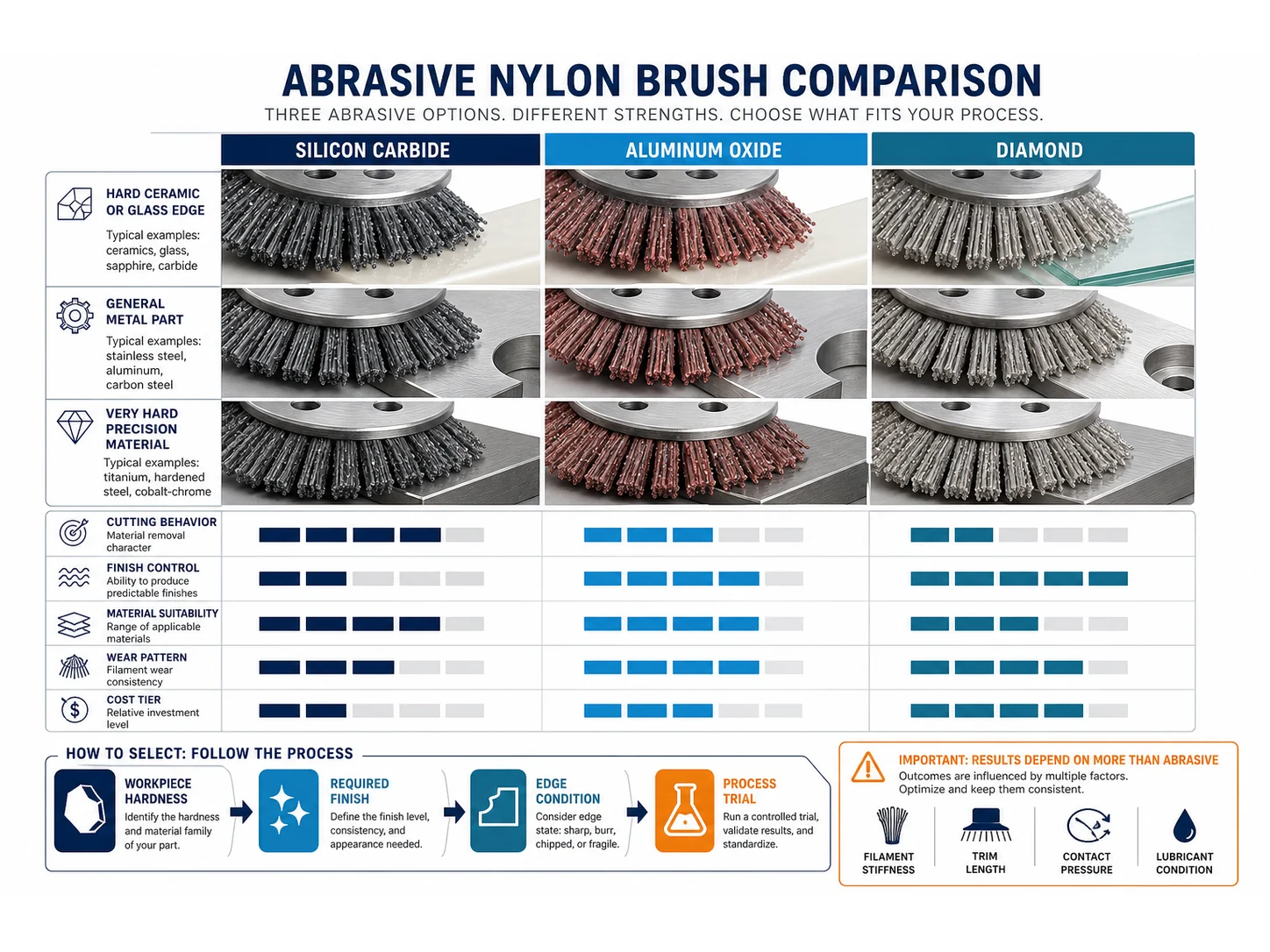
The performance of an abrasive nylon brush is largely determined by the type of abrasive grain and its grit size. The three primary abrasive types are:
- Silicon carbide (SiC) – a sharp, friable synthetic mineral with a Mohs hardness of about 9.5. It fractures easily to present new cutting edges, making it aggressive on hard, brittle materials.
- Aluminum oxide (Al₂O₃) – a tough, blocky grain with a Mohs hardness of about 9. It is more durable than silicon carbide and works well on ferrous and non-ferrous metals.
- Diamond – the hardest industrial abrasive (Mohs 10), often used as synthetic diamond for grinding ceramics, carbides, glass, and other extremely hard substrates.
Each abrasive type is available in a range of grit sizes, from coarse (around 36–60 grit) for rapid stock removal, to fine (180–320 grit and higher) for polishing and final surface conditioning. The choice of abrasive directly affects cutting speed, heat generation, and the resulting surface roughness (Ra).
Silicon Carbide vs. Aluminum Oxide vs. Diamond: Comparison Table
| Factor | Silicon Carbide | Aluminum Oxide | Diamond |
|---|---|---|---|
| Typical grit range | 36–600+ | 24–600+ | 60–3,000+ |
| Hardness (Mohs) | ~9.5 | ~9 | 10 |
| Cutting aggressiveness | High on brittle materials; self-sharpening | Moderate; durable, controllable | Highest; aggressive on hard substrates |
| Best material match | Glass, ceramics, stone, composites, hard coatings | Carbon steel, stainless steel, aluminum, brass, titanium | Tungsten carbide, advanced ceramics, hardened tool steels, glass, PCD |
| Surface finish range (Ra) | 32–8 µin or lower with fine grits | 32–12 µin typical; can reach 4–8 with fine grits | 16–2 µin or mirror finishes possible |
| Heat generation | Moderate | Low to moderate | Low if properly cooled |
| Wear resistance / life | Low; grain fractures quickly | Medium; grain rounds but lasts | High; diamond grits last many times longer |
| Cost (relative) | $–$$ | $ | $$$$ |
| Not recommended for | Ferrous metals (risk of reaction), soft ductile metals | Hardened steels above 65 HRC, ceramics, glass | Soft ductile metals; cost overkill on mild steel |
How to Choose the Right Grit Based on Surface Finish Target
Grit selection directly controls the depth of scratches left on the workpiece. Use this general guide to match grit to finish requirement:
| Grit Range | Typical Surface Roughness (Ra) | Application Example |
|---|---|---|
| Coarse (36–60) | 32–64 µin | Heavy burr removal, weld scale, casting cleanup |
| Medium (80–120) | 16–32 µin | General deburring, edge blending, pre-plate finish |
| Fine (150–220) | 8–16 µin | Light blending, cosmetic finishes, pre-paint preparation |
| Very Fine (240–400) | 4–8 µin | Satin finishes, polishing, final surface conditioning |
| Extra Fine (500–600+) | 2–4 µin or lower | Mirror finishing, critical sealing surfaces |
Note that actual finish depends on material hardness, brush speed, and filament stiffness. For the same grit, a silicon carbide brush will often yield a slightly rougher finish on ductile metals than an aluminum oxide brush because of its sharper, more aggressive cutting action.
Setup and Usage Factors That Influence Selection
Beyond abrasive type and grit, several operational factors determine whether an abrasive nylon brush performs as expected:
- Filament diameter and trim length: Thicker, shorter filaments are stiffer and more aggressive. For fine finishes on delicate contours, a finer filament with longer trim reduces cutting pressure.
- Brush speed (SFPM): Higher speeds increase cutting action but also heat. Diamond abrasive often performs best at moderate speeds to prevent thermal damage.
- Coolant or lubricant: Wet operations reduce loading, wash away swarf, and extend brush life. Diamond brushes on glass almost always require a coolant flow.
- Workpiece geometry: For complex shapes, a brush with high filament density and flexible mounting (cup, wheel, tube) reaches into recesses without gouging adjacent surfaces.
- Compound loading: Many shops use abrasive nylon brushes with polishing compounds to achieve ultra-fine finishes without embedding large particles.
Common Mistakes When Selecting an Abrasive Nylon Brush
- Choosing grit by grit number alone. Abrasive type changes the effective scratch depth. A 120-grit silicon carbide brush can leave deeper scratches on aluminum than a 120-grit aluminum oxide brush, even though the grit size is identical.
- Using silicon carbide on ferrous metals without caution. At high temperatures, silicon carbide can react with iron, leading to accelerated grain wear, sparking, and possible metallurgical damage on sensitive alloys.
- Assuming diamond is always better. Diamond is extreme overkill for mild steel or aluminum and can load quickly with soft material. The cost/performance ratio does not favor diamond for ductile metals.
- Neglecting filament stiffness. A very fine grit on an overly stiff filament can still produce deep scratches because the high pressure drives the abrasive in too aggressively.
- Skipping a grit sequence. Jumping from a coarse (60-grit) deburring step directly to a fine (220-grit) finish often leaves coarser scratch marks that are not completely removed, causing a visually inconsistent surface.
- Ignoring brush direction. Final finishing should always be done with the brush running parallel to the desired grain direction to avoid cross-hatching that catches the light differently.
When Abrasive Nylon Brushes Are the Wrong Choice
Abrasive nylon brushes excel at light to medium conditioning tasks, but they have limits. Consider bonded abrasives (grinding wheels), coated abrasives (belts, discs), or hard tooling when:
- Stock removal exceeds 0.010 inches per side. Nylon brushes are not designed for heavy material removal; a grinding wheel or belt is much more efficient.
- Tight dimensional tolerances (±0.0005 in or less) must be held. The compliance of nylon filaments makes precision profiling unreliable.
- Deep pits or heavy scale from castings, forgings, or heavily rusted surfaces must be removed. These require a more aggressive bonded abrasive first.
- Workpiece geometry is flat and large. A wide belt sander or surface grinder will give a faster, more uniform result on extensive flat areas.
- Mirror finishing below 2 µin Ra may demand lapping, honing, or specialized polishing processes after the nylon brush step.
Final Takeaway
Selecting an abrasive nylon brush comes down to three core decisions: material compatibility, grit sequence, and filament stiffness. Match the abrasive to the workpiece—silicon carbide for glass, ceramics, and stone; aluminum oxide for ferrous and non-ferrous metals; diamond for tungsten carbide, hardened steel above 65 HRC, and advanced ceramics. Then choose a grit that bridges the existing surface condition and the desired finish, stepping through grits logically. Finally, tune filament parameters and operating conditions to avoid common mistakes like deep grit-shadow scratches or premature brush wear. When in doubt, test on a scrap piece under production conditions, because no selection chart replaces real-world feedback.
Frequently Asked Questions
Can I use a silicon carbide nylon brush on stainless steel?
It is generally not recommended. Silicon carbide can react with ferrous metals at high contact temperatures, leading to grain dulling and possible contamination. For stainless steel, aluminum oxide provides a safer and more consistent cut.
What is the best abrasive nylon brush for removing mill scale?
A coarse aluminum oxide bristle brush (36–60 grit) is a durable option for removing mill scale from hot-rolled steel. Silicon carbide can also work but wears faster on ferrous material, making aluminum oxide more cost-effective.
Can a diamond nylon brush be used on glass without scratching?
Yes, with the right grit and coolant. A fine diamond grit (e.g., 200–400) and a continuous water flow can produce a frosted or matte finish on glass without deep scratches. However, achieving a clear, optical finish often requires additional polishing steps.
How do I avoid deep scratches when blending a weld?
Start with a medium grit (80–120) aluminum oxide brush, keep the brush moving lightly, and always finish with the brush rotation running parallel to the final aesthetic grain direction. Jumping directly to a very coarse grit or using excessive pressure are the most common causes of deep scratching.
Can I use an abrasive nylon brush for internal threads or small bores?
Yes, tube brushes and small-diameter cup brushes are designed for this. Choose a filament stiffness that can conform to the thread profile without jamming, and use an aluminum oxide or silicon carbide abrasive depending on the material. Diamond is rarely needed for common metals.
Does brush speed affect grit performance?
Absolutely. Too high a surface speed can soften the nylon, reduce grain hold, and generate excess heat that dulls the abrasive or damages the workpiece. Always follow the manufacturer’s recommended SFPM range for the specific abrasive type and grit.
Can I use a non-abrasive nylon brush for the same applications?
Non-abrasive nylon brushes rely on the friction and stiffness of the filaments alone. They are suitable for light cleaning, dusting, or very mild deburring of soft metals but will not produce the controlled finish and stock removal of an abrasive-impregnated brush.
Technical References
- World Stainless — Corrosion Resistance of Stainless Steels
- British Plastics Federation — Thermoplastics
Which bristle material fits this job — Abrasive Nylon, Nylon PA or PA6 Nylon?
| Material | Continuous temperature (°C) | Peak temperature (°C) | Water absorption | Hardness |
|---|---|---|---|---|
| Abrasive Nylon | 120 | 150 | 0.1–1.0% | Abrasive filament; stiffness and cutting level is controlled by PA base, grit type, grit size, filament diameter and trim height. |
| Nylon PA | 93 | 121 | 0.3–9% by PA grade and conditioning | Medium to firm; filament diameter and trim length control bending force. |
| PA6 Nylon | 80–100 | 130–160 | 1.5–3.0% | Shore D 75–85 |
| PBT | 120–140 | 160–180 | 0.05–0.20% | Shore D 80–90 |
Figures as published by Perlon; Brushtec / DuPont. Confirm the exact grade against the supplier datasheet before ordering.
What should replace Handheld Detail Brushes when they stop working?
- Handheld Detail Brushes — Handheld detail brushes cover general precision cleaning; auto-detailing brushes impose tighter controls for painted, polished, leather, display, and trim surfaces.
- Abrasive Nylon — Compare Abrasive Nylon with PP, PBT, PET. Change material when wet stiffness, temperature, chemical resistance, conductivity, particle shedding, or surface marking becomes the limiting factor.
- Nylon PA — Compare Nylon PA with PP, PBT, PET. Change material when wet stiffness, temperature, chemical resistance, conductivity, particle shedding, or surface marking becomes the limiting factor.
- PA6 Nylon — Compare PA6 Nylon with PA66, PP, PBT. Change material when wet stiffness, temperature, chemical resistance, conductivity, particle shedding, or surface marking becomes the limiting factor.