
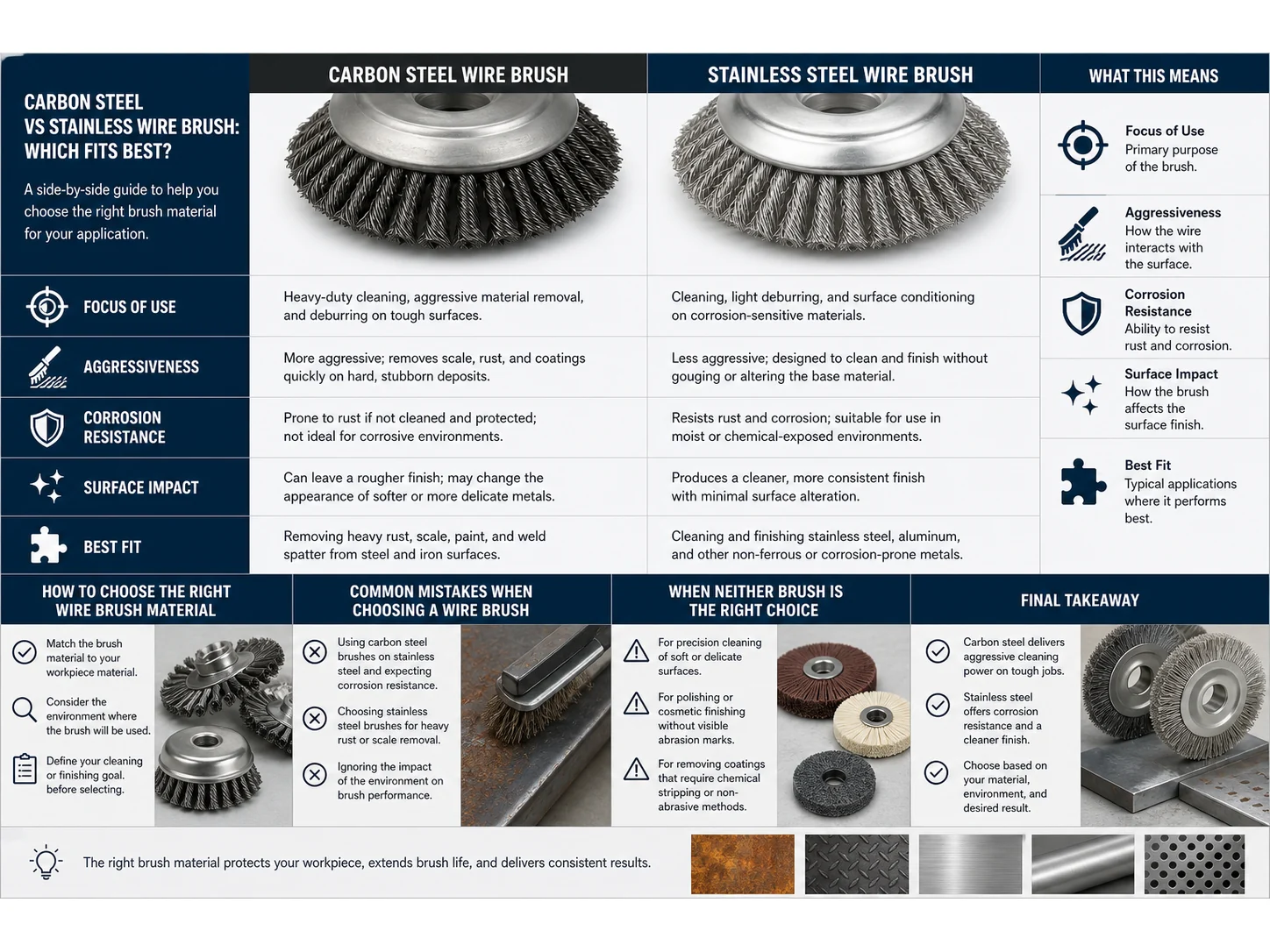
What Is a Carbon Steel Wire Brush?
A carbon steel wire brush uses bristles made from high‑carbon steel wire, typically with a tensile strength that provides aggressive cutting power. These brushes are excellent for removing heavy rust, thick paint, weld slag, and scale from iron, steel, and other ferrous workpieces. The bristles are stiff and hold their shape well under high manual or machine pressure. However, carbon steel bristles rust quickly if exposed to moisture, and they can leave tiny iron particles embedded in softer or non‑ferrous surfaces, causing after‑rust or galvanic corrosion.
What Is a Stainless Steel Wire Brush?
A stainless steel wire brush uses bristles made from stainless steel alloy, usually 304 or 316 grade. These bristles offer good corrosion resistance and are typically less aggressive than carbon steel. Stainless steel wire brushes are the first choice when you need to clean stainless steel, aluminum, or other non‑ferrous metals without introducing iron contamination. They also resist rust in wet or humid environments, making them suitable for food‑grade areas, marine applications, and outdoor maintenance. Because the bristles are slightly softer, they may wear faster when used on extremely hard scale, but their contamination‑free performance often outweighs this trade‑off.
Carbon Steel vs Stainless Steel Wire Brush: Key Differences
The table below compares the two materials across the factors that matter most in everyday industrial cleaning.
| Factor | Carbon Steel Wire Brush | Stainless Steel Wire Brush |
|---|---|---|
| Bristle hardness | High – aggressive cutting | Medium – less aggressive |
| Corrosion resistance | Poor – rusts quickly when wet | Good – resists rust and chemicals |
| Contamination risk | High – leaves iron particles on non‑ferrous metals | Very low – safe for stainless and aluminum |
| Typical workpiece | Mild steel, cast iron, heavy rust removal | Stainless steel, aluminum, copper, brass, finished surfaces |
| Dry vs wet use | Best kept dry; avoid prolonged moisture | Suitable for wet environments and wash‑down areas |
| Wear life in harsh conditions | Longer initial life if kept dry; brittle bristles can break | Slightly softer; may wear faster on hard scale but does not rust |
| Cost per brush (relative) | Lower upfront cost | Higher upfront cost |
How to Choose the Right Wire Brush Material
Start with three simple questions:
- What is the workpiece material? If it is stainless steel, aluminum, copper, or any non‑ferrous metal, use stainless steel bristles to prevent iron contamination. For mild steel or cast iron where a little surface rust afterwards is acceptable, carbon steel is a solid choice.
- What type of residue are you removing? Heavy rust, thick mill scale, and tough weld slag favor carbon steel’s cutting power. Light oxidation, paint, or delicate cleaning on finished surfaces benefit from the gentler touch of stainless steel.
- Will the brush be used wet or in a damp area? For outdoor work, wash‑down zones, or any job where moisture is present, stainless steel resists rusting between uses and does not stain the workpiece. Carbon steel brushes can leave rust stains and degrade faster.
Also consider how the brush is mounted – cup brush, wheel brush, hand brush – because the bristle pattern and trim length affect aggression. The material choice, however, remains the foundation for a safe, clean result.
Common Mistakes When Choosing a Wire Brush
- Using a carbon steel brush on stainless steel or aluminum. Tiny iron particles embed into the metal and later rust, causing unsightly orange spots and potential corrosion. This is one of the costliest mistakes in fabrication shops.
- Choosing by cost alone. A cheaper carbon steel brush that ruins an expensive stainless steel part ends up costing far more than a dedicated stainless brush.
- Using the same brush for multiple materials. Cross‑contamination happens quickly. Keep separate brushes for carbon steel and stainless steel workpieces – label or color‑code them if possible.
- Ignoring moisture and storage. Letting a carbon steel brush sit wet on a bench shortens its life. Stainless steel brushes still benefit from drying but are far more forgiving.
- Assuming stainless bristles are always softer. While many are less aggressive, some hardened stainless wire alloys (like type 302) come close to carbon steel in cutting ability while retaining corrosion resistance. Match the exact grade to the job.
When Neither Brush Is the Right Choice
A carbon steel or stainless steel wire brush can handle most general surface cleaning, but some situations call for a different approach:
- Highly sensitive substrates such as polished aluminum or thin stainless cladding may need a non‑abrasive pad or chemical cleaner to avoid scratching.
- Extreme temperatures or harsh chemicals can degrade standard wire bristles. Inconel or brass bristle brushes might be necessary.
- Intricate geometries with deep recesses often demand a custom‑designed brush shape, not just a different material.
- High‑speed automated lines may require a specific knot wire or encapsulated design for consistent pressure and safety – here the mounting and wire type matter just as much as the material.
- Cross‑contamination is absolutely forbidden in nuclear, pharmaceutical, or food‑grade environments; dedicated tooling and verified material certificates become essential.
If you are unsure, start by testing a small inconspicuous area and consult the brush manufacturer’s application guide for your specific substrate.
Final Takeaway
Match the wire brush material to the metal you are cleaning. Carbon steel excels at heavy ferrous work when a little surface rust is acceptable and the brush can stay dry. Stainless steel is the safe, versatile choice for non‑ferrous metals, wet conditions, and any job where contamination is a risk. A small upfront difference in brush cost is nothing compared to the cost of reworking a contaminated part.
Frequently Asked Questions
Can I use a carbon steel wire brush on stainless steel?
No. Carbon steel bristles will leave microscopic iron particles embedded in the stainless surface. When exposed to oxygen and moisture, those particles rust, creating orange spots and potentially initiating pitting. Always use a dedicated stainless steel wire brush on stainless workpieces.
Can you use a stainless steel wire brush on aluminum?
Yes, and it is often the recommended choice. Stainless steel bristles do not contaminate aluminum with iron. However, be aware that aggressive brushing can embed small amounts of stainless into the aluminum surface, which may later show galvanic corrosion if the part is exposed to electrolytes. For critical aerospace or marine aluminum, passivation or chemical cleaning after brushing is sometimes required.
Which wire brush lasts longer, carbon steel or stainless steel?
It depends on the environment. In dry conditions on ferrous metal, carbon steel bristles may stay sharp longer because they are harder and cut more aggressively. In damp or wet conditions, carbon steel rusts and weakens quickly, while stainless steel maintains its integrity and can outlast carbon steel several times over. The total cost per hour of use often favors stainless in corrosive settings.
How do I clean and store a wire brush?
After use, knock out loose debris and rinse if necessary. Dry carbon steel brushes thoroughly and store in a dry place to prevent rust. Stainless steel brushes can be air‑dried without rusting but should still be kept clean to avoid cross‑contamination if used on different metals.
Is a stainless steel wire brush more expensive than carbon steel?
Generally, yes. Stainless steel wire is costlier than carbon steel wire, so the upfront cost of a stainless brush is higher. However, for jobs where contamination is unacceptable or wet conditions prevail, the cost of ruining even one workpiece far exceeds the brush cost difference. Compare cost per job, not just cost per brush.
Can I use a wire brush on a chimney with a stainless steel liner?
Only if the brush is made of stainless steel bristles. A carbon steel brush will scratch and embed iron particles into the liner, leading to rust and premature failure. Stainless steel chimney brushes are available and designed specifically for that purpose.
What about brass vs stainless steel wire brushes?
Brass bristles are softer than both carbon and stainless steel, and they are spark‑resistant and non‑magnetic. They are excellent for cleaning softer metals and for use in explosive atmospheres. Brass leaves no iron contamination, but it wears faster on tough scale. The choice between brass and stainless steel depends on the workpiece hardness and spark safety requirements, not covered in this guide. If you need a comparison, look for an article titled “Brass vs Stainless Steel Wire Brush.”
Technical References
Which steel wire grade fits this job — AISI 304 Stainless Steel Wire, AISI 316 Stainless Steel Wire or Carbon Steel Wire?
| Wire grade | Continuous temperature (°C) | Peak temperature (°C) | Water absorption | Hardness |
|---|---|---|---|---|
| AISI 304 Stainless Steel Wire | 400 | 500 | 0% | Rockwell B 70–95 depending on temper and cold work |
| AISI 316 Stainless Steel Wire | 400 | 500 | 0% | Rockwell B 70–95 depending on temper and cold work |
| Carbon Steel Wire | 200–300 | 350–450 | 0% | Rockwell C 40–60 |
| Galvanized Steel Wire | 150–200 | 250–300 | 0% | Rockwell B 70–100 |
Figures as published by Alleima; Material manufacturer TDS / ISO / ASTM / industry reference. Confirm the exact grade against the supplier datasheet before ordering.
When is AISI 304 Stainless Steel Wire the wrong choice?
- AISI 304 Stainless Steel Wire — Avoid using AISI 304 as the default in marine, brine, hypochlorite, and persistent chloride environments; use AISI 316 when higher pitting and crevice-corrosion resistance is required.
- Carbon Steel Wire — Not for soft plastic, glass, PCB, coated solar glass or polished paint.
What should replace AISI 304 Stainless Steel Wire when it stops working?
- AISI 304 Stainless Steel Wire — Use AISI 316 stainless steel wire for chloride, marine, dairy, beverage, chemical washdown, or higher pitting-resistance requirements. Use carbon steel for dry aggressive cutting and brass or abrasive nylon for lower marking risk.
- Carbon Steel Wire — Compare Carbon Steel Wire with Carbon steel wire, brass wire, abrasive nylon. Change material when wet stiffness, temperature, chemical resistance, conductivity, particle shedding, or surface marking becomes the limiting factor.