
What Is a Drill Brush?
A drill brush is a wheel, cup, or end brush with a shank or threaded mount designed to be rotated by a power drill. It typically uses steel, stainless steel, brass, or nylon bristles for surface cleaning, paint removal, weld cleaning, or deburring. The mount—the part that connects the brush to the drill—determines how the brush fits into the tool’s chuck or spindle and must be selected to match the drill’s drive type and intended use.
Shaft-Mount vs Thread-Mount: How They Differ
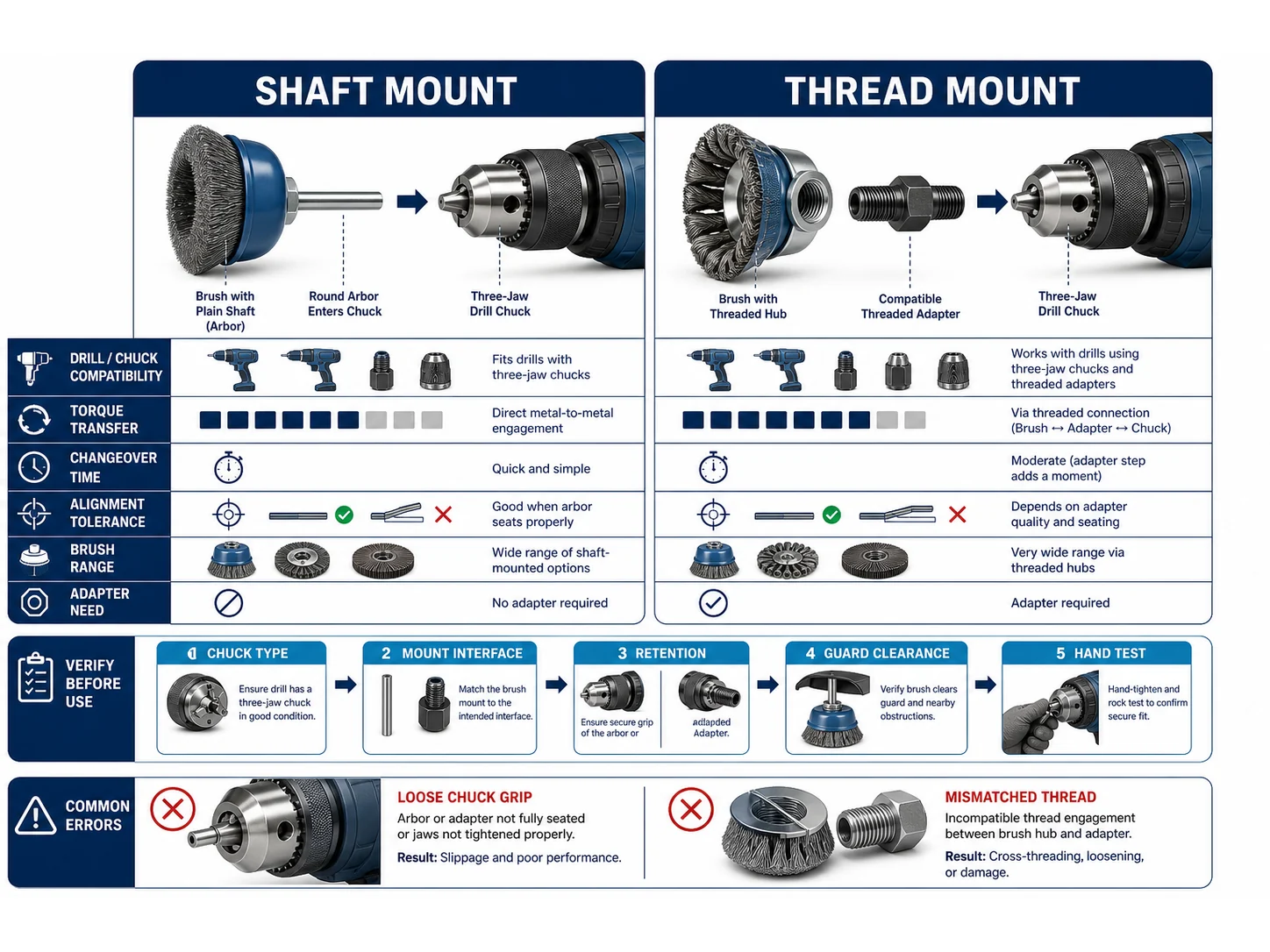
Drill brushes commonly come with one of two primary mount styles:
- Shaft-mount (or shank-mount) brushes have a smooth, cylindrical shank that is clamped directly into a drill chuck. These are the most common for small to medium-sized brushes and are compatible with any standard keyed or keyless chuck that can grip a round shank.
- Thread-mount brushes feature an internally or externally threaded hub that screws onto a matching spindle or arbor. They are often found on larger-diameter brushes, cup brushes, and some wire wheels. They require a drill with a threaded arbor or a compatible adapter, and they are less likely to slip under high torque than a purely friction-grip shank.
Comparison Table: Shaft-Mount vs Thread-Mount
| Feature | Shaft-Mount (Shank) | Thread-Mount |
|---|---|---|
| Attachment Method | Clamped in chuck by friction | Screwed onto threaded arbor/spindle |
| Typical Brush Sizes | Small to medium (up to 4 in.) | Medium to large (3 in. and above) |
| Drill Compatibility | Any drill with a chuck that tightens securely on the shank | Drills with a threaded spindle or those accepting a thread adapter |
| Torque Handling | May slip if not tightened properly or under high load | Positive mechanical lock reduces slip risk |
| Changeover Speed | Fast—loosen chuck, swap, re-tighten | Slower—requires unthreading; may need a wrench |
| Common Misuse | Using oversized brush on low-torque drill | Cross-threading; forcing onto wrong thread pitch |
How to Verify Compatibility with Your Drill and Chuck
Before purchasing a drill brush, check the actual specifications of your drill and chuck instead of assuming “standard” sizes. Follow these steps:
- Determine your chuck type and capacity. Measure the maximum shank diameter your chuck can accept (commonly 3/8 in. or 1/2 in.). For thread-mount brushes, note any spindle thread size (e.g., M10, 5/8-11).
- Check the brush’s shank or thread specs. Many shaft-mount brushes use a 1/4 in. shank, but larger wire brushes may have a thicker shank. Never force an oversized shank into a small chuck.
- For thread-mount, match the thread pitch and diameter exactly. Even a slight mismatch can damage threads or cause the brush to fly off. If your drill lacks a threaded arbor, you may need a thread adapter—verify it is rated for the brush’s recommended RPM.
- Consider runout. A poorly seated shank or a bent thread can cause wobble, uneven wear, and excessive vibration. Always visually check that the brush spins true before applying load.
Common Mistakes in Drill Brush Selection
- Using a large-diameter brush on a low-torque or compact drill. Large wire brushes demand more torque and can stall a cordless drill, overheat the motor, or cause rapid battery drain. Always match brush diameter to the drill’s rated capacity.
- Ignoring runout. If the brush wobbles, it will cut unevenly, damage the workpiece, and put side load on the drill bearings. A bent shank, low-cost adapter, or incorrect seating can all cause runout.
- Assuming all shanks fit all drills. A 1/2 in. shank will not fit a 3/8 in. chuck. Always measure or check specs before ordering.
- Over-tightening a thread-mount brush. Excessive force can strip threads or crack the brush hub. Tighten firmly but without exceeding the tool’s specification.
- Using the wrong bristle material for the job. While not a mount issue, using a carbon steel wire brush on stainless steel can cause contamination and rust. Match brush material to workpiece and cleaning goal.
- Forcing a thread-mount brush onto an incompatible drill without a quality adapter. Poor-quality adapters can introduce runout or fail at speed. Use factory-recommended adapters when available.
When a Standard Drill Brush Is the Wrong Choice
There are situations where a standard shaft- or thread-mount brush in a hand-held drill is not the best choice:
- Deep or narrow access. If you need to clean inside a pipe, cylinder, or deep recess, a long flexible shaft tube brush or a rotary tool with an extended mandrel may be necessary. A standard drill brush simply cannot reach.
- High-speed deburring or fine finishing. A dedicated rotary tool (die grinder) spinning at 20,000 RPM or more can be more controllable and offer a better finish than a drill limited to 2,500 RPM.
- Extremely large or heavy wire brushes. Cup brushes 5 in. or larger, or heavy knot-type wheels, may exceed the safe speed limit for most drills and require a bench grinder or a dedicated wire wheel spindle.
- Continuous production work. In an industrial setting where brush changeover is frequent, a quick-change arbor system or a flexible shaft setup can reduce downtime and operator fatigue.
- Sensitive surfaces or fine threads. Brass or nylon brushes used on soft metals may require a more delicate speed control than a standard on/off drill can provide; a variable-speed rotary tool might be safer.
Final Takeaway: Matching the Mount to the Job
For most general cleaning and surface prep jobs with a drill, a shaft-mount brush with a correctly sized shank is the simplest and fastest choice. Switch to a thread-mount brush when you need to run larger diameter wheels, when you experience slippage under load, or when your drill has a dedicated threaded spindle. Always verify real shank or thread dimensions against your drill’s chuck and never force a fit. A few extra minutes checking compatibility will prevent broken tools, damaged workpieces, and safety hazards.
Frequently Asked Questions
Can I use a thread-mount brush in a standard keyless chuck?
No. A thread-mount brush requires a mating threaded arbor. If you try to clamp the threaded part directly in a chuck, the chuck jaws will not grip it securely and you risk damaging the chuck and the brush. Use a properly rated thread adapter only if your drill manufacturer supports it.
What size shank fits a typical cordless drill?
Most cordless drills have a 3/8 in. or 1/2 in. chuck. A 1/4 in. shank fits both, but larger shank brushes may require the larger 1/2 in. chuck. Always check the maximum capacity stamped on your drill’s chuck.
How do I stop a shaft-mount brush from slipping?
Ensure the shank is clean and free of oil. Tighten the chuck fully using all three key holes if it’s a keyed chuck, or hand-tighten a keyless chuck firmly. If slipping persists, the brush may be too large for the drill’s torque, or the shank may be worn or undersized.
What is runout and why does it matter?
Runout is the amount of wobble or eccentric rotation a brush has when spinning. Excessive runout causes vibration, uneven wear, and poor surface finish. It can be caused by a bent shank, mis-threaded mount, or a poor-quality adapter. Always test the brush at low speed before use.
Is a flexible shaft brush attachment better than a standard drill brush?
A flexible shaft setup can reach confined spaces that a standard drill-mounted brush cannot, but it also introduces additional joints that can vibrate or wear. For deep pipe cleaning or odd angles, a flexible shaft tube brush can be the right tool, but for most open surfaces, a rigid mount gives better control and brush life.
Can I use a large wire brush on a cordless drill?
Large wire brushes (over 4 in. diameter) often require more torque than a compact cordless drill can sustain, and they may exceed the safe RPM range. Check the brush’s maximum RPM rating and your drill’s no-load speed. Large brushes are better suited to corded drills or dedicated rotary tools with higher power and speed control.
How do I safely change a thread-mount brush?
Unplug the drill or remove its battery first. If the brush has a locking button or the drill has a spindle lock, engage it. Use a wrench if required and unscrew the brush in the direction opposite to rotation. Never use pliers on the bristles; grip only the hub. Inspect threads for damage before mounting a new brush.
Do I need a special adapter for a 1/4 in. shank brush?
Not normally. A 1/4 in. shank is designed to fit directly into a standard drill chuck. However, if you are using a collet-style tool that only accepts small bits (like a die grinder), you may need a collet adapter. For most drills, no adapter is needed.
Technical References
- OSHA — 1910.242 Hand and Portable Powered Tools
- OSHA — 1910.215 Abrasive Wheel Machinery
- OSHA — Personal Protective Equipment
Which bristle material fits this job — AISI 304 Stainless Steel Wire, Nylon PA or Carbon Steel Wire?
| Material | Continuous temperature (°C) | Peak temperature (°C) | Water absorption | Hardness |
|---|---|---|---|---|
| AISI 304 Stainless Steel Wire | 400 | 500 | 0% | Rockwell B 70–95 depending on temper and cold work |
| Nylon PA | 93 | 121 | 0.3–9% by PA grade and conditioning | Medium to firm; filament diameter and trim length control bending force. |
| Carbon Steel Wire | 200–300 | 350–450 | 0% | Rockwell C 40–60 |
Figures as published by Alleima; Brushtec / DuPont. Confirm the exact grade against the supplier datasheet before ordering.
What should replace AISI 304 Stainless Steel Wire for power drills?
- AISI 304 Stainless Steel Wire — Use AISI 316 stainless steel wire for chloride, marine, dairy, beverage, chemical washdown, or higher pitting-resistance requirements. Use carbon steel for dry aggressive cutting and brass or abrasive nylon for lower marking risk.
- Nylon PA — Compare Nylon PA with PP, PBT, PET. Change material when wet stiffness, temperature, chemical resistance, conductivity, particle shedding, or surface marking becomes the limiting factor.
- Carbon Steel Wire — Compare Carbon Steel Wire with Carbon steel wire, brass wire, abrasive nylon. Change material when wet stiffness, temperature, chemical resistance, conductivity, particle shedding, or surface marking becomes the limiting factor.