
What Is Mold Cleaning Brush Selection?
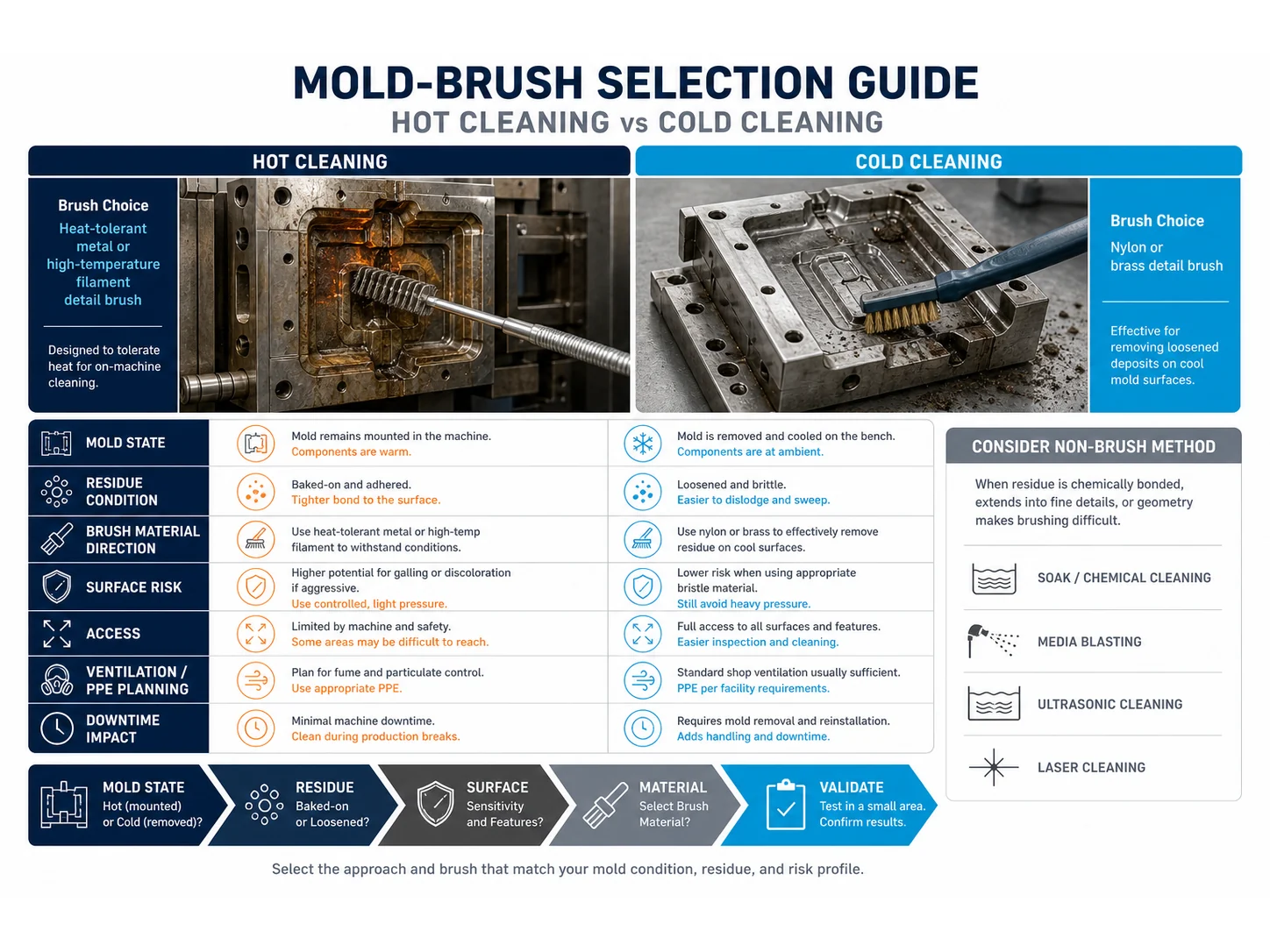
Mold cleaning brush selection is the practical decision of matching brush bristle material, stiffness, handle design, and size to the cleaning task. The goal is effective residue removal without damaging the mold surface or leaving contaminating debris. Two distinct scenarios exist: cleaning a hot mold immediately after production, and cleaning a cold mold during scheduled maintenance. Each scenario demands different brush characteristics.
Hot Cleaning vs Cold Cleaning: Key Differences
Hot cleaning happens while the mold is still at elevated temperature—often just after the last cycle. Residues such as gases, carbon deposits, and plastic outflow are softer and easier to remove. However, the heat can melt, warp, or degrade brush materials not designed for high temperatures. Cold cleaning takes place after the mold has cooled to ambient temperature. Residues are hardened, and the risk of thermal damage to the brush is absent, but more aggressive mechanical action may be needed. The choice of brush must consider both the removal task and the mold temperature window.
Heat-Resistant vs Standard Brush Materials
Not all brush filaments handle heat the same way. The table below compares common materials used in mold cleaning brushes. Use it as a general decision aid—always verify the manufacturer’s maximum service temperature for the exact product.
| Material Type | Heat Resistance | Typical Use | Key Considerations |
|---|---|---|---|
| Stainless Steel Wire | Excellent (≥ 500°F) | Heavy deposits on hot molds; carbon removal | Can scratch polished surfaces; use only when necessary |
| Brass Wire | Very Good (≥ 450°F) | Moderate residue on hot molds; softer than steel | Less aggressive than steel; still can mar very fine finishes |
| High‑Temperature Nylon (e.g., PEEK) | Good (350‑500°F) | General hot‑mold cleaning; plastic residues | Resists melting; chemical‑resistant; stiffer than standard nylon |
| Standard Nylon (PA6/PA66) | Low (≤ 200°F) | Cold molds only; light debris | Will melt and smear on hot molds; affordable, good chemical resistance |
| Polypropylene | Very Low (≤ 180°F) | Cold molds; light‑duty cleaning | Soft, inert; poor for heavy residue; melts easily |
| Natural Fibers (Horsehair, Tampico) | Very Low (≤ 150°F) | Cold molds; polishing, dusting | Gentle on surfaces; absorbent; degrade with solvents; not for hot work |
How to Select Based on Mold Temperature and Residue Type
Use this step‑by‑step logic to narrow your brush choice without guessing:
- Confirm the mold temperature at cleaning time. Is the mold above 200°F? If yes, go to Step 2 with heat‑resistant materials only. If it has cooled below 150°F, you can consider standard materials.
- Identify the residue type. Is it light dust, release‑agent film, plastic outgassing, burnt carbon, or sticky colorant buildup? Heavier, baked‑on residues need more aggressive brushing; light dust tolerates soft bristles.
- Match bristle stiffness to residue and mold hardness. Use the table above: steel or brass for tough carbon on hot molds; high‑temp nylon for moderate residues; soft natural fibers or polypropylene for delicate polished surfaces on cold molds.
- Check chemical compatibility. If solvents or cleaners will be used, ensure the bristle material and brush body withstand them. Some nylons swell or weaken with certain solvents.
- Consider brush shape and handle. Angled, narrow, or twisted‑wire brushes reach vents and crevices better. Handles must provide a firm grip, especially when brushing hot areas.
Common Mistakes in Mold Cleaning Brush Selection
- Using a standard nylon brush on a hot mold – Bristles melt almost instantly, leaving plastic smear on the mold surface that can contaminate the next production run.
- Choosing a brush by cost or handle color alone – Without checking the maximum temperature rating, you risk downtime and mold damage.
- Applying a harsh steel wire brush on polished or textured mold surfaces – Fine details can be scratched, reducing part quality or causing sticking.
- Neglecting to clean while the mold is still warm – Many residues soften between 150‑200°F but harden when cold. Postponing cleaning forces you to use more aggressive (and riskier) tools later.
- Ignoring solvent interaction – Some brushes dissolve or degrade when exposed to common mold cleaners, leaving behind broken bristle fragments.
- Assuming all “heat‑resistant” brushes are equal – “Heat‑resistant” is not a formal rating. Check the stated operating temperature range and material composition.
When Dry Ice Blasting Is a Better Choice
Brush cleaning is effective for many molds, but certain situations call for dry ice blasting—a non‑contact method that uses compressed air and solid CO₂ pellets to remove residues. Consider dry ice blasting when:
- Mold geometry includes deep, narrow vents or intricate contours that brushes cannot reach without disassembly.
- The mold surface is extremely susceptible to scratching, and even soft brushes pose a risk.
- Production volumes are high, and manual brushing would cause unacceptable downtime.
- Residues are tenacious and require a thermal shock to crack and lift them off.
- Hot molds must be cleaned in place without allowing them to cool, and no brush material can safely handle the continuous temperature.
Dry ice blasting leaves no secondary waste (the pellets sublimate), reduces wear on the mold, and can be performed while the mold is still mounted. However, it requires capital equipment, proper ventilation, and operator training. For many routine cleaning tasks, a correctly chosen brush remains the faster, lower‑cost option.
Final Takeaway
Mold cleaning brush selection boils down to two questions: “How hot is the mold?” and “What residue needs to come off?” Always match brush material to mold temperature—stick to steel, brass, or high‑temperature nylon for hot molds; keep standard nylons and natural fibers for cold work. Test on a non‑critical area first when trying a new brush type, and treat “heat‑resistant” as a clue, not a support. When manual brushing falls short or poses too great a risk, dry ice blasting offers a powerful alternative.
Frequently Asked Questions
Can I use the same brush for hot and cold mold cleaning?
It is not recommended. Brushes safe for high temperatures may be overly stiff for cold cleaning, while soft brushes will degrade on hot molds. Keep separate sets designated by temperature range.
What bristle materials are safe for hot molds?
Stainless steel, brass, and engineered high‑temperature polymers (like PEEK) are commonly used. Always check the product’s specified maximum operating temperature.
How do I know if a brush is heat‑resistant?
Look for a manufacturer’s stated temperature range on the packaging or datasheet. If none is provided, assume it is only suitable for ambient temperature. Visual clues—like metallic bristles—can hint, but verification is safest.
What happens if I use a standard nylon brush on a hot mold?
The bristles will likely melt, leaving a residue on the mold that can transfer to parts, causing defects and requiring additional cleanup. In extreme cases, the melted plastic can fill small vents and require rework.
Is a brass brush always safe for mold surfaces?
Brass is softer than steel and less likely to scratch, but it can still leave marks on highly polished or plated surfaces. Always test on a non‑visible area first, and consider a softer option if surface finish is critical.
When should I switch from brush cleaning to dry ice blasting?
Switch when molds are large, complex, have tight crevices brushes can’t reach, or when the risk of surface damage from manual contact is too high. Also, if cleaning time must be reduced for high‑volume production, dry ice blasting can be faster overall.
Can I use solvents with any mold cleaning brush?
Not always. Some solvents degrade nylon, polypropylene, or natural bristles. Check chemical compatibility charts for both the bristle and the brush block. When in doubt, use a brush with stainless steel or brass bristles, which are generally solvent‑resistant.
How often should mold cleaning brushes be replaced?
Replace when bristles become bent, splayed, contaminated with melted residue, or when they no longer clean effectively. Frequency depends on usage intensity and operating temperature. Inspect brushes before each use and set a replacement schedule based on observed wear.
Technical References
Which bristle material fits this job — Nylon PA, AISI 304 Stainless Steel Wire or Brass Wire?
| Material | Continuous temperature (°C) | Peak temperature (°C) | Water absorption | Hardness |
|---|---|---|---|---|
| Nylon PA | 93 | 121 | 0.3–9% by PA grade and conditioning | Medium to firm; filament diameter and trim length control bending force. |
| AISI 304 Stainless Steel Wire | 400 | 500 | 0% | Rockwell B 70–95 depending on temper and cold work |
| Brass Wire | 150–200 | 250–300 | 0% | Rockwell B 40–90 |
| Horsehair | 60–80 | 100–120 | 8–15% | — |
Figures as published by Brushtec / DuPont; Alleima. Confirm the exact grade against the supplier datasheet before ordering.
When is Nylon PA the wrong choice?
- Nylon PA — The nylon family spans several grades, so heat, moisture and chemical limits should follow the selected PA resin rather than a generic nylon value.
- AISI 304 Stainless Steel Wire — Avoid using AISI 304 as the default in marine, brine, hypochlorite, and persistent chloride environments; use AISI 316 when higher pitting and crevice-corrosion resistance is required.
- Brass Wire — Avoid on stainless surfaces where copper contamination is restricted and on delicate coatings that mark under metal contact.
- Horsehair — Not for aggressive scrubbing or wet chemical process cleaning.
What should replace Nylon PA when it stops working?
- Nylon PA — Compare Nylon PA with PP, PBT, PET. Change material when wet stiffness, temperature, chemical resistance, conductivity, particle shedding, or surface marking becomes the limiting factor.
- AISI 304 Stainless Steel Wire — Use AISI 316 stainless steel wire for chloride, marine, dairy, beverage, chemical washdown, or higher pitting-resistance requirements. Use carbon steel for dry aggressive cutting and brass or abrasive nylon for lower marking risk.
- Brass Wire — Compare Brass Wire with Steel wire, stainless wire, nylon. Change material when wet stiffness, temperature, chemical resistance, conductivity, particle shedding, or surface marking becomes the limiting factor.
- Horsehair — Compare Horsehair with Boar bristle, goat hair, microfiber. Change material when wet stiffness, temperature, chemical resistance, conductivity, particle shedding, or surface marking becomes the limiting factor.