
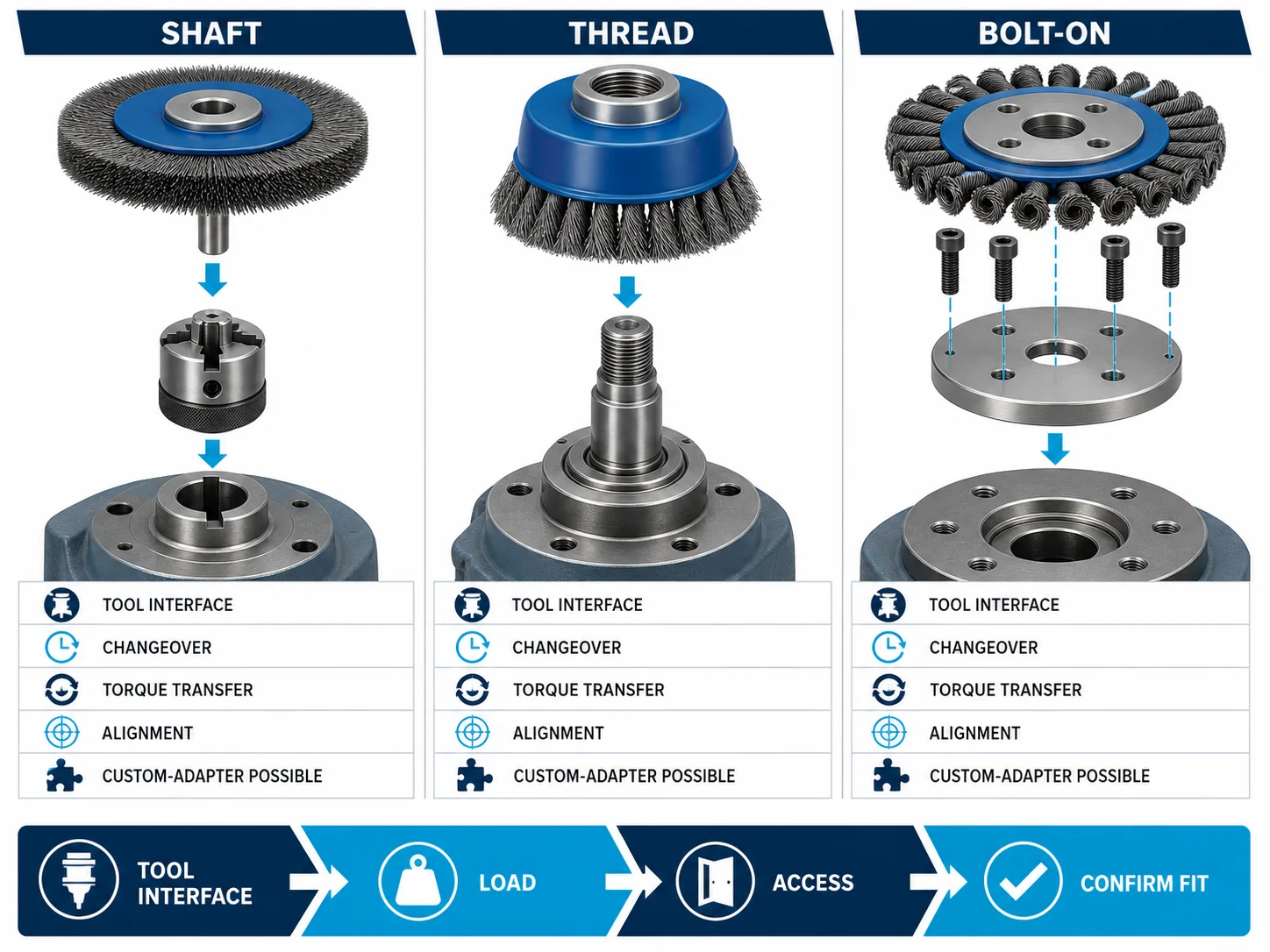
What Are the Three Main Brush Mounting Methods?
Shaft-Mounted: A cylindrical shank is inserted into a tool’s collet or chuck and tightened. This style is common on die grinders, rotary tools, and small bench grinders. Shaft diameters may range from 1/8 inch to 1/2 inch, and the brush is held by friction. Shaft-mounted brushes are typically used for light deburring, polishing, or low-load cleaning.
Thread-Mounted: The brush has a female threaded hub that spins onto the tool’s male threaded spindle. The thread pitch and diameter are standardized for the tool type—most angle grinders use either M14 (metric) or 5/8″-11 UNC. Thread-mounted attachments like angle grinder wire cup brushes and wheel brushes are very common for surface prep, weld cleaning, and rust removal because they lock securely under rotation.
Bolt-On: The brush has a central bore and is placed over a spindle or hub, then secured with a retaining nut or a series of bolts. This method is found on larger stationary equipment such as pedestal grinders, floor buffers, and heavy industrial machines. Bolt-on designs handle high side loads and long operating cycles without working loose.
Comparison of Shaft, Thread, and Bolt-On Mounting Methods
| Factor | Shaft-Mounted | Thread-Mounted | Bolt-On |
|---|---|---|---|
| Typical Tool | Die grinders, rotary tools, small bench grinders | Angle grinders (4″, 4.5″, 5″, 9″), polishers | Pedestal grinders, floor buffers, fixed equipment |
| Attachment Method | Insert shaft into collet/chuck, tighten | Spin onto threaded arbor; hand-tighten or use lock nut | Place over spindle, secure with nut or bolts |
| Changeover Speed | Fast (collet) or medium (chuck) | Fast, often tool-free | Slower, requires wrench |
| Holding Security | Moderate; can slip under high torque or side load | High; rotation tightens the thread | Very high; designed for heavy continuous use |
| Best Applications | Light-duty, small-diameter brushes, intermittent use | General surface prep, weld cleaning, rust removal | Heavy material removal, long run times, fixed setups |
| Limitations | Cannot handle high side loads; shank may bend | Requires exact thread match; not for tools without threaded spindle | Less portable; multiple bolts can be stripped if over-tightened |
How to Choose the Right Mounting Method for Your Equipment
Equipment Interface: Examine the tool’s spindle. If it has a collet or keyed chuck, you need a shaft-mounted brush. If you see a threaded arbor (often with a lock nut or backing flange), the tool is designed for thread-mounted accessories. For large stationary machines with a flanged shaft and bolt holes, bolt-on is the standard.
Speed and Torque: High-RPM tools like angle grinders generate centrifugal force that tries to unscrew an accessory. A properly threaded brush actually tightens during use. Shaft-mounted brushes at high speeds can whip or slip if the shank is too long or the collet isn’t fully tightened.
Changeover Frequency: If you frequently swap between brushes, a thread-mounted system on an angle grinder is the fastest—most spin on and off by hand. Bolt-on setups require wrench time. Shaft-mounted brushes in a collet are quick, but a drill chuck is slower.
Brush Size and Type: Small wire brushes (1–2 inches) often have shafts. Standard angle grinder wire cup brushes and wheel brushes use threads. Large-diameter industrial brushes for floor or pedestal machines are bolt-on. Always match the mounting style to the brush’s intended tool.
Safety: Never modify a brush’s mounting to fit an incompatible tool. Adapters exist (e.g., a collet-to-thread adapter), but they must be rated for the tool’s RPM and the brush’s diameter. Using an unrated adapter can cause the brush to break apart or the tool to kick back.
Common Mistakes When Selecting or Using Brush Mountings
- Mismatched Thread Pitch: Confusing M14 (metric) with 5/8″-11 (UNC) is a frequent error. Attempting to force the wrong thread damages both the brush and the spindle, often leading to a loose connection. Always verify the thread specification stamped on the brush or tool.
- Using a Shaft-Mounted Brush in an Angle Grinder: Without a proper, RPM-rated threaded arbor adapter, clamping a shank in a grinder’s collet or chuck is extremely dangerous. The side load can bend the shaft and cause ejection.
- Over-tightening Bolt-On Brushes: Excessive torque when tightening the retaining nut or bolts can crack the brush hub or distort the mounting plate, leading to imbalance and premature failure.
- Ignoring Speed Ratings: Every brush has a maximum safe RPM. The tool’s no-load RPM must not exceed the brush’s rating. This is critical for all mounting types, especially when using high-speed angle grinders.
- Worn or Damaged Threads: Using a brush with stripped internal threads or mounting it on a spindle with worn external threads can cause the brush to wobble or spin off. Inspect threads before each use.
When a Standard Mounting Won’t Work: Custom Adapters
In some cases, the ideal brush for your application doesn’t match your tool’s interface. Adapters can bridge the gap, but they come with risks. For example, to use a thread-mounted wire cup brush on a shaft-driven die grinder, you can install a collet-mounted threaded arbor adapter. However, this increases the overall length and may lower the safe RPM rating. Similarly, a bolt-on brush might be mounted on a threaded spindle using a flange adapter, but the adapter must be specifically designed for that brush’s bore and the tool’s thread. When no safe, rated adapter exists, the correct decision is to purchase a brush with the mounting method your tool requires. Forcing an incompatible setup compromises safety and results.
Final Takeaway
Choosing between shaft, thread, and bolt-on mounting methods starts with your tool’s spindle and the work you need to do. For angle grinders, thread-mounted wire brushes—including cup brushes and wheel brushes—are the standard choice. For lighter, more precise work with a die grinder or rotary tool, a shaft-mounted brush is appropriate. For heavy-duty fixed equipment, bolt-on designs provide the necessary security. Always confirm thread pitch, RPM limits, and adapter compatibility before making a selection. A correct mount ensures safe operation and better results.
Frequently Asked Questions
Can I put a threaded wire brush on a drill?
Most drills have a keyed chuck, not a threaded spindle. There are thread-mount arbors that can be gripped by a chuck, but this setup is not ideal for high side loads. For light brushing with a drill, look for a shaft-mounted wire brush with a shank that fits your chuck.
How do I know if my angle grinder needs an M14 or 5/8″-11 brush?
Check your grinder’s manual or the marking on the spindle. M14 is metric (14 mm diameter, 2 mm pitch) and common on European tools. 5/8″-11 is UNC (5/8 inch diameter, 11 threads per inch) and more common on tools sold in North America. Never guess—using the wrong thread will damage both the brush and the grinder.
What is the difference between a wire cup brush and a wire wheel brush when it comes to mounting?
Both are typically thread-mounted for angle grinders. A wire cup brush has a recessed threaded hub that shrouds the nut, while a wire wheel brush has an exposed arbor hole and often uses a separate lock nut. The cup design protects the threads from damage and allows flush surface work. Always confirm thread size before purchasing either type.
Can I use a bolt-on brush on an angle grinder?
Not directly. Angle grinders lack the mounting flange and bolt pattern for bolt-on brushes. There are special backing pads with threaded centers that accept some small bolt-on accessories, but these are uncommon for wire brushes. It is safer to use a thread-mounted wire brush designed for angle grinders.
How often should I check the tightness of a thread-mounted brush?
Check before every use. Most angle grinder wire brushes are hand-tightened until snug, and rotation keeps them tight. Some have a locking nut that requires a wrench; ensure it is secure but do not overtighten. If a brush loosens during use, stop immediately and re-tighten.
What if my brush’s shaft diameter doesn’t match my tool’s collet?
Do not use the brush. Using a shaft that is too small risks slippage; a shaft too large cannot be inserted. You can buy a collet adapter set for some die grinders to accept different shank sizes, but always ensure the brush’s RPM rating is compatible with the tool.
Are all 4-inch angle grinder wire brushes thread-mounted?
Most are, especially the most common 4-inch angle grinder wire cup brushes and angle grinder wire wheel brushes. However, there are some shaft-mounted brushes used in die grinders that are sometimes mistakenly called 4-inch. Always check the product description: if it has a threaded nut or shows an M14 or 5/8″-11 specification, it is thread-mounted.
Can I use a shaft-mounted brush in a cordless drill?
Yes, if the shank fits your drill’s chuck. Keep in mind that cordless drills often have lower RPM than angle grinders, but they may lack the side-load durability for heavy brushing. Use light pressure and let the brush do the work to avoid bending the shank or damaging the drill’s bearings.
When are Wheel Brushes the wrong choice?
- Wheel Brushes — Use a cup brush for broad open surfaces, an end brush for confined recesses, or a non-brush process when the target finish or surface cannot tolerate rotating filament contact.
- Cup Brushes — Use a wheel brush for a narrow edge or profile, an end brush for a confined recess, or a non-brush method when the surface cannot tolerate rotating filament contact.
What should replace Wheel Brushes when they stop working?
- Wheel Brushes — Wheel brushes give narrow edge contact; cup brushes cover a broader open face, while end brushes concentrate contact at the end of a small stem for recesses.
- Cup Brushes — Cup brushes cover a broader face than wheel brushes; end brushes are better for small recesses or pockets where the cup body blocks access.