
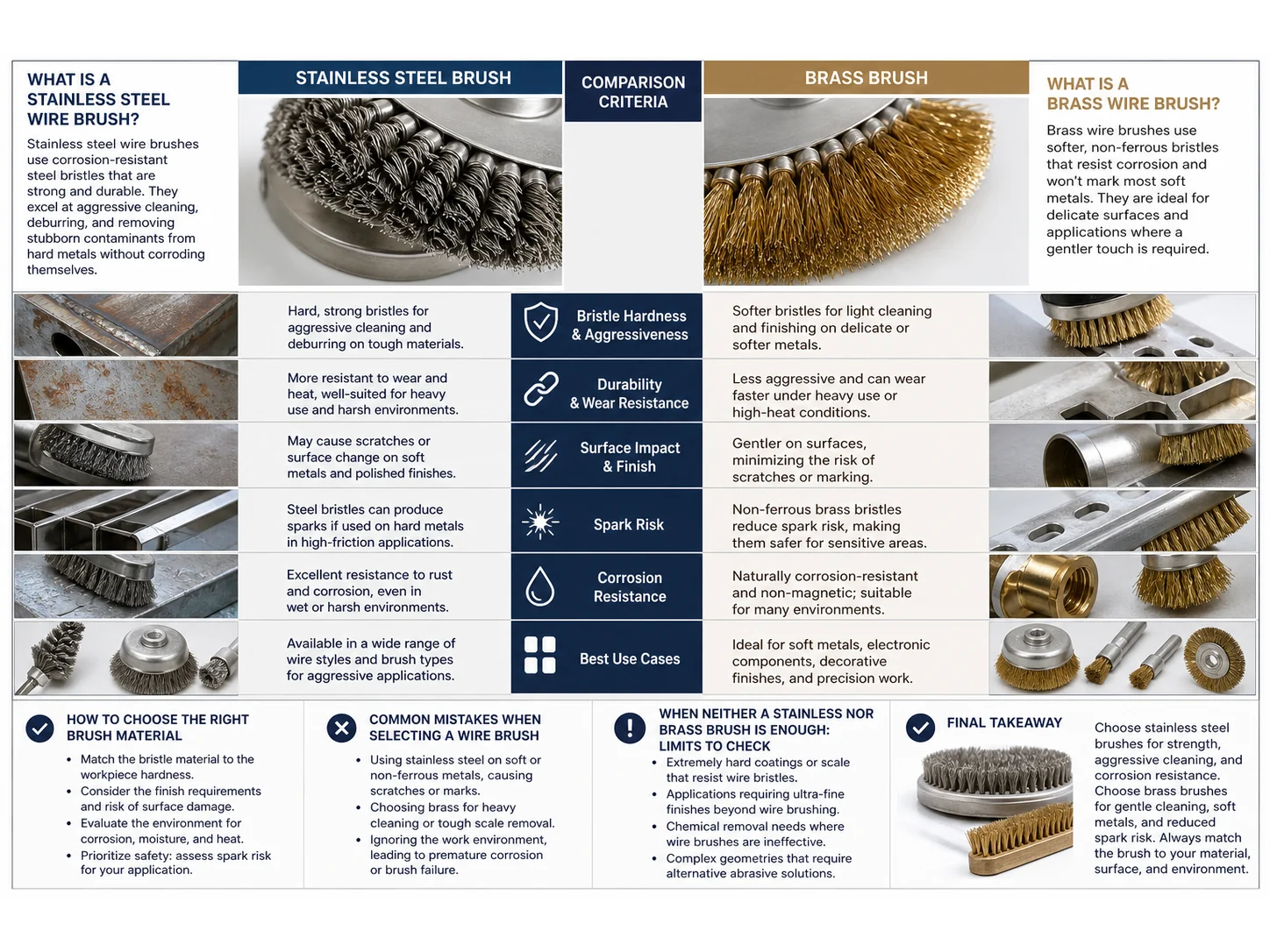
What Is a Stainless Steel Wire Brush?
A stainless steel wire brush is a cleaning or finishing tool with bristles made from stainless steel wire. The bristles are hard, wear-resistant, and naturally resistant to corrosion. Stainless steel brushes are commonly used for aggressive deburring, weld cleaning, rust removal, and surface texturing on ferrous metals. They can withstand higher temperatures and frequent use in dry or lubricated environments without degrading quickly.
What Is a Brass Wire Brush?
A brass wire brush uses brass bristles, an alloy of copper and zinc, to provide a softer, non-sparking cleaning action. These brushes are widely chosen for surface-sensitive applications where preserving the base material is critical. Brass bristles reduce the risk of scratching or embedding foreign particles into softer metals, and the non-spark property makes them safer for use near flammable atmospheres. Common tasks include cleaning softer metals, electrical contacts, and delicate surfaces where a gentler touch is needed.
Stainless Steel vs Brass Brush: Key Differences
| Factor | Stainless Steel Brush | Brass Brush |
|---|---|---|
| Bristle hardness | Hard and aggressive | Softer, more flexible |
| Spark risk | Can spark on impact | non-sparking |
| Corrosion resistance | Excellent | Good, but may discolor over time |
| Surface impact | Can scratch or gouge soft metals | Gentle, preserves base material |
| Typical uses | Weld cleaning, rust removal, deburring steel | Cleaning soft metals, electrical components, delicate parts |
| Wear life | Long under heavy use | Shorter due to softer bristle material |
| Mounting options | Widely available in hand, cup, wheel, and end brushes | Commonly hand, cup, and wheel; less variety in heavy-duty styles |
How to Choose the Right Brush Material
Start with the workpiece material. If the surface is a soft metal like aluminum, copper, brass, or a delicate alloy, a brass brush is almost always the safer choice to avoid surface scoring. For hard ferrous metals such as carbon steel, stainless steel, or cast iron, a stainless steel brush provides the cutting power needed for effective cleaning and deburring.
Consider the type of residue you are removing. Thick rust, heavy scale, or hard weld spatter typically require a stainless steel brush. Light oxidation, dust, or gentle surface cleaning favors brass. Also factor in the operating environment: if you are working near flammable vapors or gases, brass eliminates sparking hazards. Wet or dry use does not heavily favor one material, but brass may wear faster in wet, abrasive slurries.
Replacement constraints matter too. In high-production settings where downtime is costly, stainless steel brushes may outlast brass by a wide margin, reducing changeover frequency. However, if surface finish quality is paramount, the shorter life of a brass brush may be an acceptable cost to avoid rework.
Mounting method is another consideration. Both materials are available in handheld, cup, wheel, and end brush configurations, but stainless steel brushes are more common in heavy-duty knot-twist and crimped styles for power tools. Brass brushes are often found in fine-wire versions for gentle scrubbing.
Common Mistakes When Selecting a Wire Brush
- Assuming all wire brushes are interchangeable: Using a stainless steel brush on aluminum can leave deep scratches and embed abrasive particles that later corrode.
- Ignoring spark risk: Choosing a steel brush for a job near fuel vapors or in a combustible dust area creates a fire or explosion hazard. Brass is the correct choice in these environments.
- Overlooking bristle contamination: A brush used on carbon steel can transfer particles to stainless steel, causing after-rust. If cross-contamination is a concern, dedicate brushes by material group.
- Selecting by cost alone: A cheaper brass brush may initially save money but wear out quickly in a heavy-duty job, driving up total cost. Evaluate life cycle, not just purchase cost.
- Using a brass brush where high cutting force is needed: Trying to remove heavy rust with brass bristles results in slow progress and rapid brush wear. Match the aggressiveness to the task.
When Neither a Stainless Steel nor Brass Brush Is Enough
Some applications fall outside the performance envelope of both materials. If you need extreme material removal rates, abrasive blasting or coated abrasive brushes may be more effective. For ultra-fine polishing without any scratch risk, non-woven or bristle-free polishing pads are a better fit. In cases where the workpiece geometry is complex and standard brush sizes cannot reach critical areas, a custom brush design with specialized bristle material, pattern, or mounting may be required. Also, if cleaning involves chemical residues or sanitary requirements, a dedicated cleaning process like ultrasonic cleaning or electropolishing might be necessary instead of a mechanical brush.
Final Takeaway
Stainless steel and brass wire brushes each serve clear, distinct purposes. Choose stainless steel when you need aggressive cleaning on hard metals without surface sensitivity or spark restrictions. Pick brass when soft metals, spark safety, or surface finish preservation are the priority. Always verify bristle compatibility with the base material, account for environmental safety, and weigh long-term cost against performance. When neither fits, explore alternative cleaning technologies before forcing a brush that will underperform or damage the workpiece.
When a Stainless Steel vs Brass Brush Is the Wrong Choice
This brush is not enough when the main problem is blocked access, unsafe working conditions, damaged equipment, incompatible chemicals, or a process setting that keeps recreating the residue. In those cases, review access, residue type, surface sensitivity, brush stiffness, operating environment, and replacement routine and confirm the surrounding cleaning method before increasing brush stiffness or contact pressure.
Frequently Asked Questions
Can I use a stainless steel brush on aluminum?
It is not recommended. Stainless steel bristles can deeply scratch aluminum and leave behind steel particles that may cause galvanic corrosion. Use a brush with brass, nylon, or other non-metallic bristles instead.
Is brass wire brush safe for stainless steel?
Yes, a brass brush is generally safe for cleaning stainless steel without scratching, but be aware that brass particles can smudge or transfer onto the surface. For food-grade or cosmetic finishes, a dedicated stainless steel wire brush may be preferred.
Does a stainless steel brush rust?
Quality stainless steel brushes resist corrosion well, but they can rust if exposed to chlorides or if the stainless alloy is of low grade. Store them dry and clean to extend life.
Can I use a wire brush on a chimney liner?
For stainless steel chimney liners, a poly brush or a soft brass brush is safer. A standard carbon steel brush can scratch and damage the liner. Always match the brush to the liner material; a stainless steel brush may be acceptable if it’s specifically designed for stainless liners and used with caution.
What is the best brush for cleaning stainless steel water bottles?
A bottle brush with soft nylon or gentle bristles is best. If you prefer a wire brush for stubborn residue, choose a brass bottle brush to avoid scratching the interior. Stainless steel bristles may damage the bottle’s finish.
Do stainless steel brushes spark?
Yes, stainless steel on some materials can produce sparks, especially at high speeds. For spark-free environments, brass, bronze, or non-metallic brushes are required.
How do I choose between a cup brush, wheel brush, and hand brush?
The choice depends on the work surface shape and access. Cup brushes cover flat, open areas; wheel brushes clean corners and edges; hand brushes offer precision for small, detailed work. The material selection (brass vs. stainless steel) remains independent of the brush form and should follow the workpiece and residue type.
Technical References
- World Stainless — Corrosion Resistance of Stainless Steels
- Copper Development Association — Brasses: Copper-Zinc Alloys
- British Plastics Federation — Thermoplastics
Which bristle material fits this job — AISI 304 Stainless Steel Wire, AISI 316 Stainless Steel Wire or Brass Wire?
| Material | Continuous temperature (°C) | Peak temperature (°C) | Water absorption | Hardness |
|---|---|---|---|---|
| AISI 304 Stainless Steel Wire | 400 | 500 | 0% | Rockwell B 70–95 depending on temper and cold work |
| AISI 316 Stainless Steel Wire | 400 | 500 | 0% | Rockwell B 70–95 depending on temper and cold work |
| Brass Wire | 150–200 | 250–300 | 0% | Rockwell B 40–90 |
Figures as published by Alleima. Confirm the exact grade against the supplier datasheet before ordering.
What should replace AISI 304 Stainless Steel Wire when it stops working?
- AISI 304 Stainless Steel Wire — Use AISI 316 stainless steel wire for chloride, marine, dairy, beverage, chemical washdown, or higher pitting-resistance requirements. Use carbon steel for dry aggressive cutting and brass or abrasive nylon for lower marking risk.
- AISI 316 Stainless Steel Wire — Use AISI 304 for general wet service without persistent chlorides. Use duplex, 904L, or higher-alloy wire when AISI 316 is insufficient for chloride stress-corrosion, severe crevice conditions, or aggressive acids.
- Brass Wire — Compare Brass Wire with Steel wire, stainless wire, nylon. Change material when wet stiffness, temperature, chemical resistance, conductivity, particle shedding, or surface marking becomes the limiting factor.