
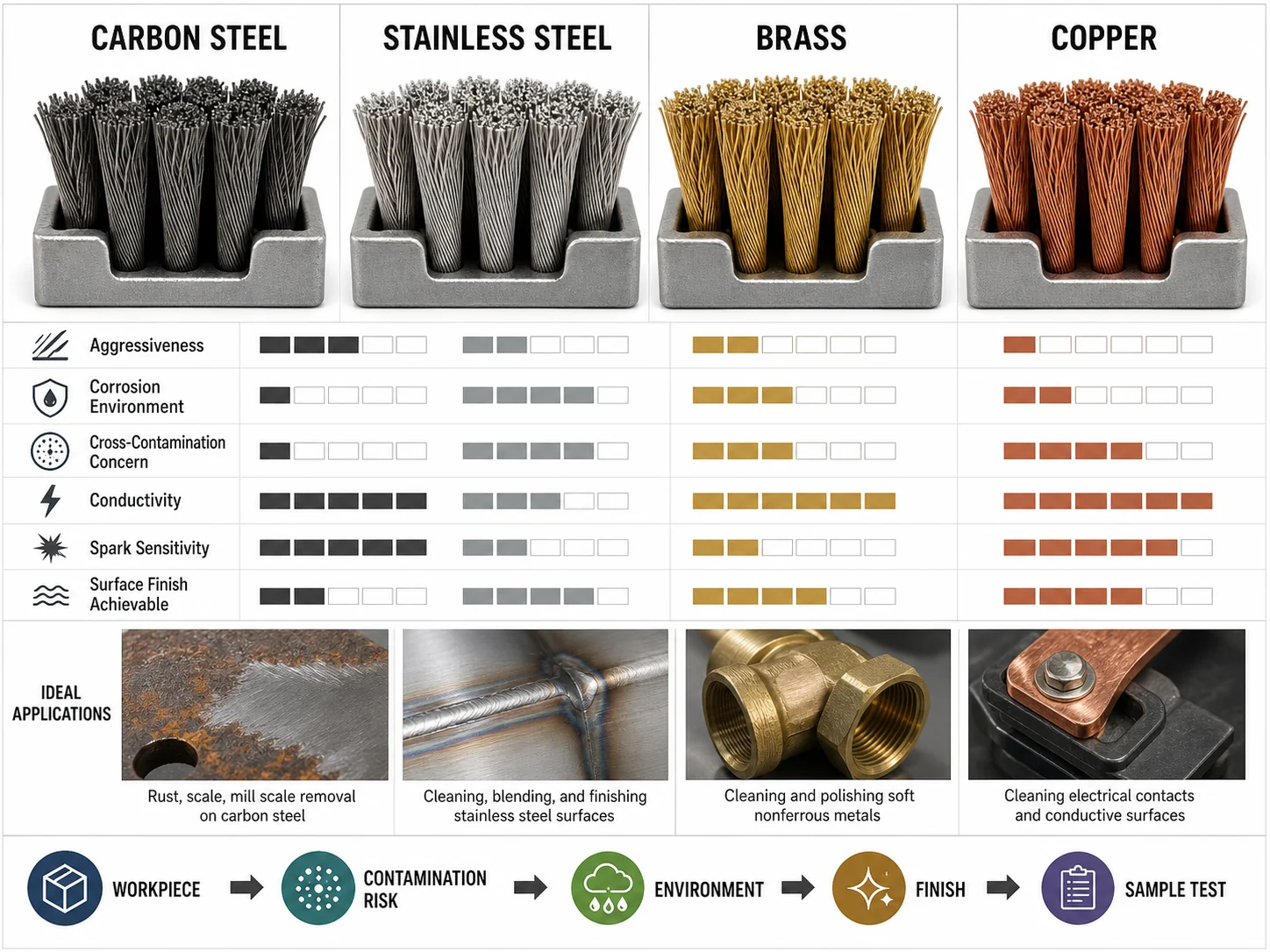
What Is a Wire Brush?
A wire brush is a hand-held or power-driven tool that uses metal bristles to clean, deburr, remove rust, or prepare surfaces. The bristle material determines how aggressively the brush cuts, what surfaces it can safely touch, and whether it can be used around sparks or in corrosive environments. While all wire brushes share the same basic function, the material choice is what separates a successful surface treatment from a damaged workpiece.
Wire Brush Material Properties at a Glance
| Material | Hardness | Corrosion Resistance | Electrical Conductivity | Spark Risk | Typical Applications |
|---|---|---|---|---|---|
| Carbon Steel | High | Low – rusts if wet | Moderate | Sparks on impact | General steel cleaning, weld slag removal, rust and paint removal on carbon steel parts |
| Stainless Steel | High | Excellent – resists most chemicals and moisture | Lower than carbon steel | Sparks on impact | Food processing equipment, chemical plants, marine surfaces, stainless steel fabrication |
| Brass | Medium | Good – tarnishes but does not rust | Moderate | non-sparking | non-sparking environments, cleaning softer metals like aluminum or copper, decorative work |
| Copper | Low–Medium | Good – patina forms over time | Excellent | non-sparking | Electrical components, commutator cleaning, soldered joints, fine surface finishing where conductivity matters |
How to Select the Right Wire Brush Material
Effective steel wire brush selection — and the choice between brass, copper, and stainless — comes down to three practical questions:
- What is the base metal? Never use a wire brush made of a material that can corrode or contaminate the workpiece. Carbon steel bristles on stainless steel leave carbon deposits that cause rust staining and pitting corrosion — a classic and costly mistake.
- Is sparking allowed? In areas with flammable gases, vapors, or dust, only non-sparking tools are permitted. Brass and copper wire brushes are safe choices; carbon and stainless steel generate friction sparks and must be avoided.
- What is the end-use environment? If the cleaned surface will be exposed to moisture, chemicals, or high humidity, choose a wire material that matches or exceeds the corrosion resistance of the base metal. For food-contact surfaces, stainless steel is often mandatory.
Additional factors include brush form (hand, wheel, cup, end brush), trim length, and fill density, but material selection is always the first filter.
Common Mistakes in Wire Brush Selection
- Using carbon steel wire brushes on stainless steel. This is the most frequent and damaging error. Carbon particles embed in the stainless surface, quickly forming rust spots and compromising the passive layer. Always use a dedicated stainless steel wire brush for stainless workpieces.
- Choosing brass for hard steel surfaces. Brass bristles wear out rapidly against hardened steel, requiring frequent brush replacement and leaving fine brass residues that may interfere with coatings or plating.
- Ignoring spark potential. Operators sometimes reach for whatever brush is at hand. In a flammable atmosphere, a steel wire brush can become an ignition source. Brass or copper must be specified for hazardous area work.
- Overlooking conductivity requirements. When cleaning electrical contacts or commutators, a copper wire brush maintains the surface’s electrical properties without introducing resistive films. A stainless steel brush would be a poor substitute.
- Assuming one brush fits all metals. Cross-contamination from shared brushes can cause galvanic corrosion or unacceptable finish changes. Dedicate brushes by material family or clean them thoroughly between tasks.
When a Coated Wire Brush Is the Better Choice
In some applications, even the right base wire material is not enough. Coated wire brushes — with abrasive grains bonded to the bristles — can solve specific problems:
- Extremely hard surfaces: Abrasive-coated stainless or brass brushes can cut through hard oxides, scale, or coatings that would quickly wear down plain wire bristles.
- Delicate substrates: Nylon-web or abrasive-impregnated brushes may be less aggressive than metal wire, preventing damage to soft alloys or thin coatings.
- Contamination-sensitive processes: When even stainless steel is not acceptable, ceramic or diamond-coated filament brushes eliminate metallic residue entirely.
Coated brushes are not always necessary, but they deserve consideration when material hardness, surface finish requirements, or contamination risk exceeds what the base wire can handle.
Final Takeaway
Start your steel wire brush selection by matching the brush material to the base metal and the environment. Carbon steel for general-purpose steel work; stainless steel when corrosion resistance and hygiene matter; brass for non-sparking safety; copper when electrical conductivity is critical. Avoid the classic mistake of using carbon steel on stainless, and remember that coated wire brushes extend the range when plain wire falls short. A few seconds of checking material compatibility can prevent hours of rework and costly part rejection.
Frequently Asked Questions
Can I use the same wire brush on different metals?
It is not recommended. Metal particles from a previous workpiece can embed in the brush and transfer to the next surface, causing contamination or galvanic corrosion. Dedicate brushes to specific material groups (carbon steel, stainless steel, brass/copper alloys) whenever possible.
What surface finish can I expect from a wire brush?
Wire brushing produces a scratch pattern that varies with bristle hardness and wire diameter. Stainless steel and carbon steel brushes leave a more pronounced mark than brass or copper. For a uniform matte finish, use the same wire material as the base metal and control pressure and speed.
How do I clean and maintain a wire brush?
Remove loose debris by tapping the brush or using compressed air. Avoid wetting carbon steel brushes, as they will rust. Stainless steel and brass brushes can be washed with mild solvents. Never share a brush that has been used on carbon steel with a stainless steel workpiece.
Are wire brushes safe for food-contact surfaces?
Only stainless steel wire brushes should be used for food-contact cleaning, and they must be dedicated to that purpose. Carbon steel, brass, and copper can introduce contaminants or tarnish. Always follow local food safety regulations and material traceability requirements.
What is a non-sparking wire brush, and when is it required?
A non-sparking wire brush is one made of brass or copper, which do not produce hot friction sparks when struck against hard surfaces. These are required in environments with flammable gases, vapors, or combustible dusts. Never use steel wire brushes in such hazardous areas.
How does passivation relate to wire brushing stainless steel?
After wire brushing stainless steel, the passive chromium oxide layer may be disturbed. For critical applications, a passivation treatment should follow to restore full corrosion resistance. Using a carbon steel brush on stainless will embed contaminants and make passivation ineffective.
Can a wire brush cause rust on stainless steel?
Yes, if the brush itself is made of carbon steel. The iron particles left behind oxidize and form rust stains, a defect known as “free iron contamination.” Always use a stainless steel wire brush on stainless workpieces and store it separately.
When should I choose a hand wire brush over a power brush?
Hand brushes offer greater control for detail work, small areas, or delicate surfaces where a power tool might be too aggressive. Power brushes — wheel, cup, or end — are better for speed and large surface area cleaning. The material selection rules remain the same regardless of brush form.
Technical References
- World Stainless — Corrosion Resistance of Stainless Steels
- Copper Development Association — Brasses: Copper-Zinc Alloys
- Copper Development Association — Electrical Conductivity of Copper
Which bristle material fits this job — AISI 304 Stainless Steel Wire, AISI 316 Stainless Steel Wire or Copper Wire?
| Material | Continuous temperature (°C) | Peak temperature (°C) | Water absorption | Hardness |
|---|---|---|---|---|
| AISI 304 Stainless Steel Wire | 400 | 500 | 0% | Rockwell B 70–95 depending on temper and cold work |
| AISI 316 Stainless Steel Wire | 400 | 500 | 0% | Rockwell B 70–95 depending on temper and cold work |
| Copper Wire | 150–200 | 250–300 | 0% | Rockwell B 20–80 |
Figures as published by Alleima. Confirm the exact grade against the supplier datasheet before ordering.
When is AISI 304 Stainless Steel Wire the wrong choice?
- AISI 304 Stainless Steel Wire — Avoid using AISI 304 as the default in marine, brine, hypochlorite, and persistent chloride environments; use AISI 316 when higher pitting and crevice-corrosion resistance is required.
- AISI 316 Stainless Steel Wire — AISI 316 is not immune to chloride stress-corrosion cracking, concentrated hypochlorite, strong reducing acids, or crevice attack; duplex or higher-alloy grades may be required in severe conditions.
- Copper Wire — Too soft for heavy scale removal and prone to wear or metal transfer; not suitable where copper contamination is unacceptable.
What should replace AISI 304 Stainless Steel Wire when it stops working?
- AISI 304 Stainless Steel Wire — Use AISI 316 stainless steel wire for chloride, marine, dairy, beverage, chemical washdown, or higher pitting-resistance requirements. Use carbon steel for dry aggressive cutting and brass or abrasive nylon for lower marking risk.
- AISI 316 Stainless Steel Wire — Use AISI 304 for general wet service without persistent chlorides. Use duplex, 904L, or higher-alloy wire when AISI 316 is insufficient for chloride stress-corrosion, severe crevice conditions, or aggressive acids.
- Copper Wire — Compare Copper Wire with Compare with brass for greater spring and wear, phosphor bronze for resilience and stainless steel for aggressive corrosion-resistant cutting. Change material when wet stiffness, temperature, chemical resistance, conductivity, particle shedding, or surface marking becomes the limiting factor.