
What Is a Thread Cleaning Brush?
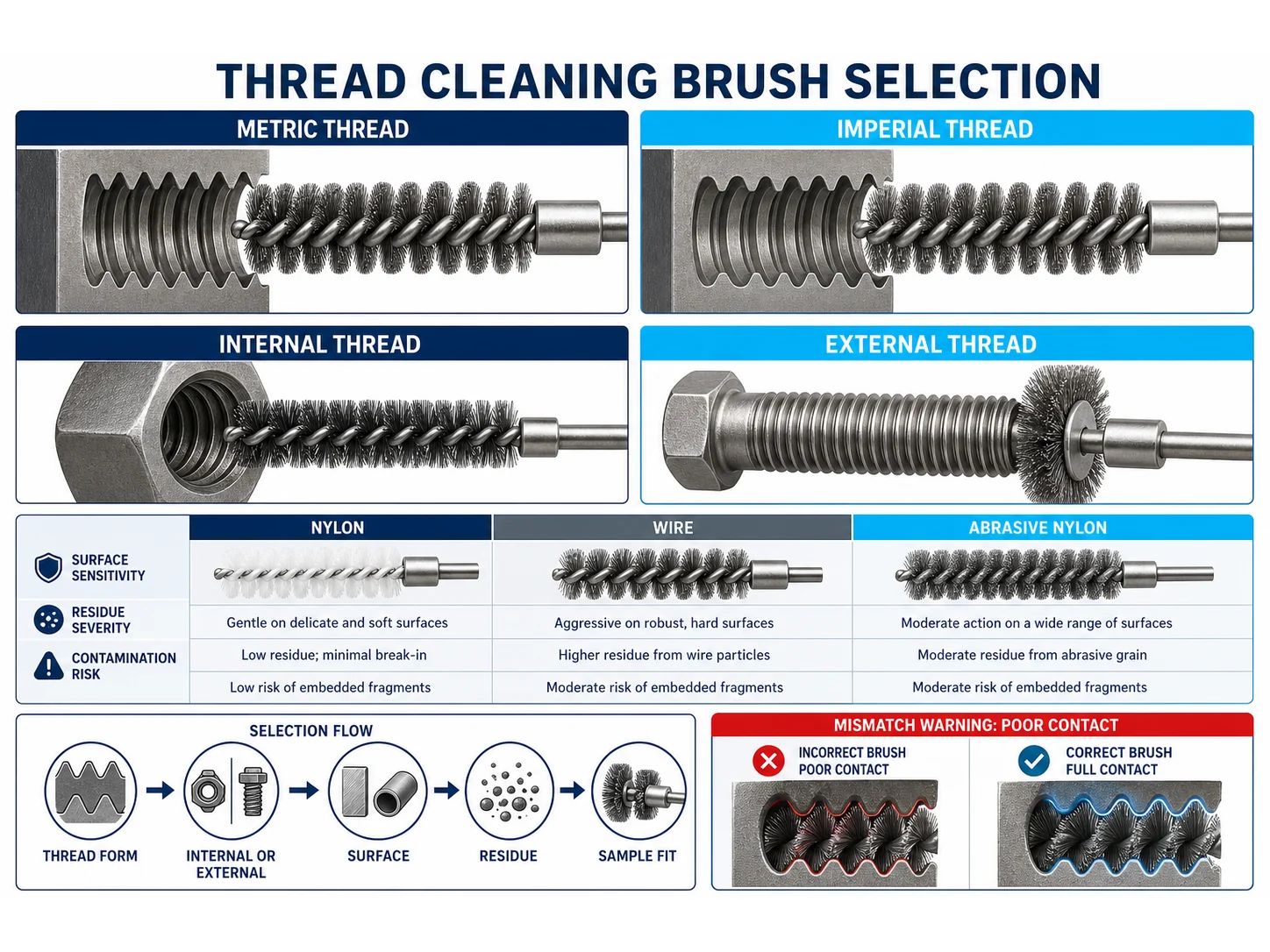
A thread cleaning brush is a tool that removes debris, rust, old sealant, and corrosion from screw threads. It uses bristles—typically wire, nylon, or abrasive-impregnated fibers—that conform to the thread profile without altering it. Unlike taps or dies, a cleaning brush is designed to preserve the thread form while restoring a clean mating surface. Brushes come in two basic configurations: internal, for female threads, and external, for male threads.
Common Types of Thread Cleaning Brushes
- Internal spiral brushes (tube brushes). A twisted wire stem with bristles radiating outward. Pulled or twisted through a hole to clean female threads.
- External block brushes. Handled brushes with bristles angled to wrap around male threads. Often used on bolts and studs.
- Miniature end brushes. Small cups or wheels for cleaning internal threads in tight spaces.
- Nylon abrasive brushes. Impregnated with silicon carbide or aluminum oxide; used where metal brushes could scratch soft alloys or plating.
- High‑speed wire cup/knot brushes. Power-tool mounted for heavy rust removal on large external threads, requiring careful speed control to avoid thread damage.
Metric vs Imperial Threads: Why Matching Matters
Metric threads are defined by major diameter (mm) and pitch (mm/thread). Imperial threads—UNC, UNF, UNEF—are defined by diameter (inch) and threads per inch (TPI). A brush sized for an M10×1.5 thread will not correctly engage a 3/8‑16 (0.375″‑16 TPI) thread; the difference in pitch and flank angle can leave residue or, worse, distort the thread crests. Always identify the thread standard before choosing a brush.
How to Match Thread Cleaning Brush Size
For internal threads, select a brush whose outside diameter (OD) is approximately 0.1–0.3 mm smaller than the thread’s minor diameter. For external threads, choose a brush with an inside diameter (ID) that fits over the major diameter without excessive play. The bristle length and density should allow the tips to reach the thread root without bottoming out or splaying uncontrollably.
The table below provides starting‑point diameters for common metric and imperial coarse threads. Use a thread gauge to confirm actual pitch and size before cleaning.
| Thread Standard | Thread Size | Pitch | Internal Brush OD (approx.) | External Brush ID (approx.) |
|---|---|---|---|---|
| Metric coarse | M6 | 1.0 mm | 5.0–5.2 mm | 6.2–6.5 mm |
| Metric coarse | M8 | 1.25 mm | 6.8–7.0 mm | 8.2–8.5 mm |
| Metric coarse | M10 | 1.5 mm | 8.5–8.8 mm | 10.3–10.6 mm |
| Metric coarse | M12 | 1.75 mm | 10.2–10.5 mm | 12.3–12.6 mm |
| Metric coarse | M16 | 2.0 mm | 13.8–14.2 mm | 16.4–16.8 mm |
| Metric coarse | M20 | 2.5 mm | 17.5–18.0 mm | 20.5–20.9 mm |
| UNC | 1/4″‑20 | 20 TPI | 5.0–5.2 mm | 6.5–6.8 mm |
| UNC | 5/16″‑18 | 18 TPI | 6.4–6.6 mm | 8.1–8.4 mm |
| UNC | 3/8″‑16 | 16 TPI | 7.7–8.0 mm | 9.7–10.0 mm |
| UNC | 7/16″‑14 | 14 TPI | 9.0–9.3 mm | 11.3–11.6 mm |
| UNC | 1/2″‑13 | 13 TPI | 10.4–10.7 mm | 12.9–13.2 mm |
Note: Fine‑thread variants (e.g., UNF, metric fine) require correspondingly finer brush filaments and tighter diameter fits. Always verify with a thread pitch gauge.
Internal vs External Thread Cleaning: Brush Selection
Internal threads trap debris and are harder to inspect, so a spiral or twisted‑wire tube brush that pulls contaminants out of the hole is preferred. For through holes, use a brush that can be pulled all the way; for blind holes, choose a brush with a compact tip that won’t bottom out easily. External threads are easier to access but risk bristle damage if a brush is forced against the crests. Cup brushes, end brushes, and matched‑block brushes work well, especially if rotated in the thread direction to avoid lifting bristles.
Comparison Table: Wire Brush vs Nylon Brush vs Abrasive Brush
| Brush Material | Best For | Risk of Thread Damage | Reusable | Typical Application |
|---|---|---|---|---|
| Stainless steel wire | Steel, cast iron threads | Low if used with correct size | Yes | Hydraulic fittings, engine studs |
| Brass wire | Brass, bronze, aluminum | Very low | Yes | Electrical connectors, marine hardware |
| Carbon steel wire | General‑purpose steel | Moderate (can rust if left wet) | Limited | Construction bolts, farm equipment |
| Nylon (non‑abrasive) | Soft alloys, plated threads | Negligible | Yes | Anodized aluminum, chrome‑plated fittings |
| Nylon with abrasive grit | Light rust, carbon deposits | Low–moderate | Degrades with use | Spark plug threads, exhaust sensors |
Common Mistakes in Thread Cleaning Brush Selection
- Using a brush that’s too large. A brush that’s oversized will crush bristles and can deform thread crests, especially on fine threads.
- Choosing a steel wire brush for aluminum or brass. Hard wire scratches soft metals, removes protective coatings, and invites galvanic corrosion.
- Ignoring thread pitch. Coarse-bristle brushes skip over fine threads, leaving residue behind. Fine threads need finer, denser bristles.
- Re‑using a dirty brush. Metal chips, old sealant, or abrasive particles embedded in the bristles score the next thread. Rinse and inspect brushes after each use.
- Using a rotary brush at excessive speed. Power brushes run too fast create overheating, bristle flaring, and uncontrolled material removal.
- Not testing on a bolt or gauge first. Trying a new brush directly on a critical part risks hidden damage. Always verify fit on a known‑good fastener or thread gauge.
When a Thread Chaser Is the Right Tool (Not a Brush)
Thread cleaning brushes remove loose contamination, but they cannot fix mechanical thread damage. If threads are crossed, flattened, burred, or heavily rusted, a thread chaser—not a cutting tap or die—should be used. Chasers are designed to reform the existing thread without removing base metal. Using a cutting tap for cleaning will shave material, weaken the joint, and alter tolerances. Consider a thread chaser when:
- Fasteners will not start by hand after brushing.
- Visible dents or burrs remain on thread flanks.
- Assembly torque readings fluctuate unpredictably.
- Threads have been previously cross‑threaded and forced.
If you are unsure about thread chaser use, consult a machinist or use a thread restoration kit with go/no‑go gauges.
Final Takeaway: Simple Steps for Correct Brush Selection
- Identify the thread standard (metric/imperial) and measure its size with a caliper and pitch gauge.
- Decide internal or external and choose the corresponding brush style.
- Select brush material based on the component metal—softer wires for soft metals, abrasive‑nylon for stubborn carbon.
- Pick a diameter that gives 0.1–0.3 mm interference on internal threads, and a snug slip fit on external threads.
- Test the brush on a scrap fastener or gauge, clean it, and inspect the result before moving to the actual part.
- If debris remains or the thread feels rough, step up to a thread chaser; do not force a brush of the wrong size.
When a Thread Cleaning Brush Is the Wrong Choice
This brush is not enough when the main problem is blocked access, unsafe working conditions, damaged equipment, incompatible chemicals, or a process setting that keeps recreating the residue. In those cases, review access, residue type, surface sensitivity, brush stiffness, operating environment, and replacement routine and confirm the surrounding cleaning method before increasing brush stiffness or contact pressure.
Frequently Asked Questions
Can I use the same brush for metric and imperial threads?
No. The difference in pitch and flank angle means a brush designed for one standard will not fully engage the other. For example, a brush sized for M10×1.5 will likely skip over the narrower crests of a 3/8″‑16 thread, leaving residue. Keep separate brush sets for metric and imperial work.
How do I measure thread pitch?
Use a thread pitch gauge (a set of thin leaves with serrated edges). For metric, find the leaf that seats fully in the threads and read the millimeter marking. For imperial, count threads per inch with a ruler or use an imperial pitch gauge. Digital calipers with thread‑measuring modes can also help.
What brush material is safe for aluminum threads?
Brass wire or non‑abrasive nylon brushes are safe on aluminum, brass, and other soft metals. Avoid steel wire—it scratches the surface and can embed iron particles that promote corrosion. Abrasive‑nylon brushes can be used if the grit is fine (< 180 grit) and light pressure is applied.
Can I use a wire brush on stainless steel threads?
Yes, but use a stainless steel brush that matches the alloy family of the fastener (e.g., 304 or 316). Carbon steel wire can leave deposits that rust on stainless surfaces, especially in wet environments.
How often should I replace a thread cleaning brush?
Replace a brush when bristles are bent, flattened, or missing, or when it no longer cleans effectively after rinsing. A worn brush reduces contact pressure and may smear contaminants into the thread rather than removing them. For critical assemblies, consider single‑use nylon brushes to support cleanliness.
Is a thread chaser better than a brush for cleaning threads?
They serve different purposes. A brush removes loose debris, old sealant, and light corrosion. A thread chaser reforms the thread profile and removes mechanical burrs or galled material. Start with a brush; if the fastener still binds or feels rough, move to a chaser.
How can I clean internal threads without a brush?
Flush with a suitable solvent and blow out with compressed air; use a plastic or wooden pick to dislodge stubborn debris from the thread roots. For fine threads, a dental‑style cleaning pick or a purpose‑made plastic thread cleaner can work. However, a correctly sized brush is still the most thorough method for batch work.
Technical References
Which bristle material fits this job — Nylon PA, AISI 304 Stainless Steel Wire or Abrasive Nylon?
| Material | Continuous temperature (°C) | Peak temperature (°C) | Water absorption | Hardness |
|---|---|---|---|---|
| Nylon PA | 93 | 121 | 0.3–9% by PA grade and conditioning | Medium to firm; filament diameter and trim length control bending force. |
| AISI 304 Stainless Steel Wire | 400 | 500 | 0% | Rockwell B 70–95 depending on temper and cold work |
| Abrasive Nylon | 120 | 150 | 0.1–1.0% | Abrasive filament; stiffness and cutting level is controlled by PA base, grit type, grit size, filament diameter and trim height. |
| Carbon Steel Wire | 200–300 | 350–450 | 0% | Rockwell C 40–60 |
Figures as published by Brushtec / DuPont; Alleima; Perlon. Confirm the exact grade against the supplier datasheet before ordering.
What should replace Nylon PA when it stops working?
- Nylon PA — Compare Nylon PA with PP, PBT, PET. Change material when wet stiffness, temperature, chemical resistance, conductivity, particle shedding, or surface marking becomes the limiting factor.
- AISI 304 Stainless Steel Wire — Use AISI 316 stainless steel wire for chloride, marine, dairy, beverage, chemical washdown, or higher pitting-resistance requirements. Use carbon steel for dry aggressive cutting and brass or abrasive nylon for lower marking risk.
- Abrasive Nylon — Compare Abrasive Nylon with PP, PBT, PET. Change material when wet stiffness, temperature, chemical resistance, conductivity, particle shedding, or surface marking becomes the limiting factor.
- Carbon Steel Wire — Compare Carbon Steel Wire with Carbon steel wire, brass wire, abrasive nylon. Change material when wet stiffness, temperature, chemical resistance, conductivity, particle shedding, or surface marking becomes the limiting factor.