
Custom Cleaning Brush
Horizontal Flow Pack Brush
Custom horizontal flow pack brush for film guiding, product alignment, and crumb/film-scrap sweeping on flow wrappers.
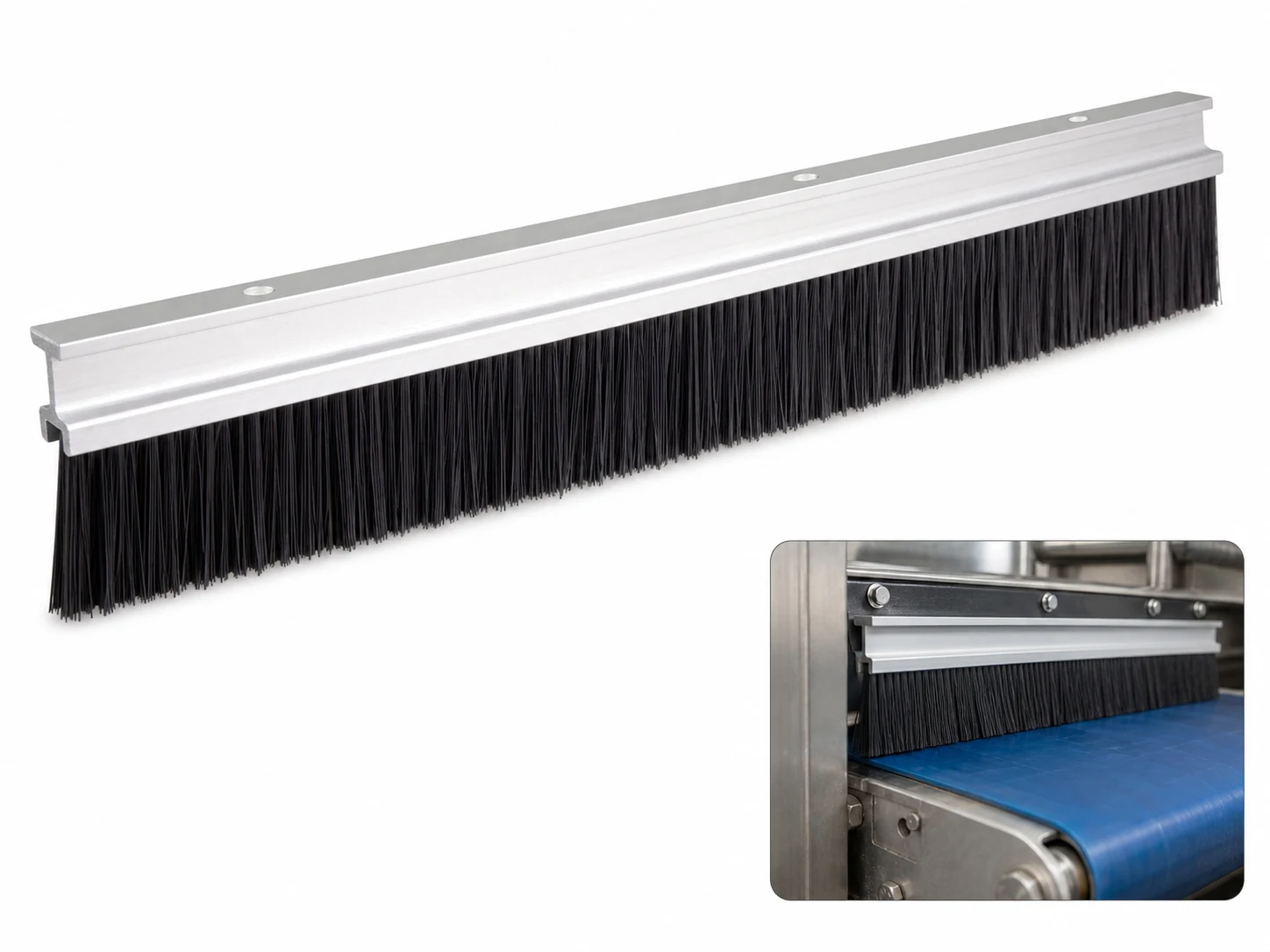
Large-format brush
100 pcs
Minimum order
Built one at a time on a core or channel: full-width rollers, sweeper brooms and long strip.
Production lead time, once the specification is confirmed
- Up to 100 pcsWithin 20 days
- 101–1,000 pcsWithin 30 days
- Over 1,000 pcsConfirmed with your quotation
Peak season can extend these times; the shipping date is confirmed in writing with your quotation. Sampling and shipping are quoted separately.
For horizontal flow-pack and flow-wrapper lines, this brush provides light-touch film guidance, product alignment, and localized crumb/film-scrap sweeping along infeed, film web, and sealing approach zones. Configurable as strip, plate, or roller with nylon, PBT, or PP fill to match film sensitivity, product surface, and static-control requirements.
What can this brush do for you?
Guides the film web without marking it
Soft-tipped filaments with controlled trim length apply a broad, low-pressure contact that keeps the film flat and tracking straight through the forming shoulder and fin-seal area. The brush prevents wrinkles and wandering without scratching or stretching the film, so seal quality stays consistent.
Sweeps crumbs and film scraps away from the sealing jaws
Mounted just upstream of the cross-seal station, the filament row dislodges product crumbs, broken film edges, and light carryover before they reach the jaws. Removing this loose material reduces seal defects, jaw contamination, and unplanned stops for cleaning.
Aligns and stabilizes products at the infeed
Along the product-transfer path, a lightly loaded brush row acts as a compliant side guide, keeping packets, bars, or trays centered and spaced before they enter the film tube. The result is fewer misfeeds and less product shifting during the forming step.
Dissipates static on film and product
For machines where static makes film cling or attracts dust, a conductive-filament version with a grounded holder bleeds charge away from the moving surface. This option reduces film misalignment, dust pickup, and product bridging at the infeed.
Fits existing rail and bracket positions
Strip, plate, and roller forms are machined to the original equipment mounting pattern, so the brush replaces worn sections on guide rails, plate brackets, or roller cores without changing machine structure or timing.
What is a Horizontal Flow Pack Brush?
A horizontal flow pack brush is a linear or rotary brush assembly installed along the film web, product infeed, or sealing approach of a horizontal form-fill-seal (HFFS) machine. Its primary job is light contact guidance and sweeping, not aggressive scrubbing. The filament face touches the moving film or product continuously, so the fill material, trim length, and density are selected to apply just enough force to guide, align, or dislodge loose debris without marking or abrading the contact surface.
The brush can be supplied as a strip or lath that bolts to a rail, a plate with a machined mounting face, or a roller that rotates with the film or product. In all forms, the filament is set at a consistent trim length and the holder is matched to the existing bracket or shaft. Contact clearance and set-back are critical: the tip line should make light contact with the moving surface, never drag heavily.
This is not a brush for removing baked-on residues, heavy product buildup, or sticky films. It is a process-contact component that keeps the wrapper’s film path and product flow clean, aligned, and predictable.
Technical Specifications
Dimensions and interfaces are taken from the flow-wrapper drawing. The table below lists the parameters we typically configure for each machine zone.
| Parameter | Options / Range |
|---|---|
| Machine zone | Infeed / product transfer, film web, sealing approach, guide rail |
| Brush form | Strip (lath), plate, or roller |
| Working width | Cut to machine drawing; typical sections 300–1200 mm |
| Trim length | 15–50 mm, shorter for firmer contact, longer for soft film smoothing |
| Fill material | Nylon PA6/PA6.6, PBT, PP; heat-stabilized grades available; carbon-filled conductive option |
| Filament diameter | 0.10–0.50 mm, selected by contact pressure and film/product sensitivity |
| Holder / backing | Aluminum, galvanized steel, stainless steel, or PVC/PP extrusion |
| Shaft / core (roller form) | Steel, stainless steel, or hollow tube with bearing journals per housing |
| Mounting interface | Existing rail brackets, bolt slots, or custom CNC-machined bracket |
| Operating temperature | PP/PBT: up to 100°C continuous; Nylon: up to 120°C; heat-stabilized grades for higher exposure; keep clear of sealing jaws unless temperature-qualified |
| Static control | Conductive filament with grounded metal holder and grounding path |
| Chemical exposure | Dry or light oil; specify cleaning agents to verify filament compatibility |
| Brush type | Custom Roller and Conveyor Brushes |
| How it is driven | Machine-driven, mounted in the equipment |
| Cleaning target | infeed conveyor and product-transfer section, film web path, and sealing approach zone cleaning |
| Surface or part | roller, webs, rails, jaws, guide rails, bars, shoulders, and trays |
| Residue or debris | crumbs, dust, and loose debris |
| Mounting / connection | Existing rail brackets, bolt slots, or custom CNC-machined bracket |
Actual values are set per machine zone after we receive the flow-wrapper drawing or sample mounting bracket.
Where does this brush work best?
- Infeed conveyor and product-transfer sections where products must be centered, spaced, and prevented from skewing before entering the film tube.
- Film web path after unwinding, guiding the film flat over the forming shoulder and through the fin-seal rollers without wrinkles or wander.
- Sealing approach zone, sweeping product crumbs, film scraps, and light carryover away from the cross-seal jaws to reduce seal defects and jaw contamination.
- Guide rails along the product path where a compliant side contact keeps packets, bars, or trays in line without scuffing the package surface.
- Static-prone film areas where a grounded conductive brush reduces film cling, dust pickup, and product misalignment.
How do I choose the right one?
Start by defining what the brush must do in its mounting position. Then match the fill, trim, and form to that duty.
| Duty | Recommended fill | Trim length | Notes |
|---|---|---|---|
| Gentle film guiding | PP or fine Nylon | 25–50 mm | Long, soft contact; no film marking |
| Product alignment / side guide | PBT or medium Nylon | 15–30 mm | Stiffer, shorter trim for controlled side force |
| Crumb / scrap sweeping | Nylon or PBT | 20–35 mm | Durable, easy to clean; mount upstream of jaws |
| Static dissipation | Carbon-filled conductive Nylon | 20–40 mm | Requires grounded holder |
Check the temperature at the mounting point. If the position is within 300 mm of the heat-seal jaws or the film web is hot after the forming box, specify heat-stabilized filament or move the brush upstream. Standard PP and PBT soften above 100°C, and even nylon loses stiffness near its continuous-use limit.
Choose the form factor by mounting surface. Strip brushes fit flat rails and existing bolt channels. Plate brushes provide a wider machined face for multiple rows or custom hole patterns. Roller brushes are used where continuous rotary contact is needed on moving film or product, and they can be driven or idler.
Specify static control only when static is actually causing a problem. Conductive filament costs more and requires a secure grounding path; if the film does not cling or attract dust, a standard non-conductive fill is sufficient.
When this brush is not the right tool: For heavy adhesive residues, use a scraper or rotary cleaning brush. For repositioning large, heavy products that require strong side force, a stiffer roller guide or mechanical pusher is more suitable. If the environment includes aggressive chemicals or wet washing, verify filament compatibility before ordering.
Can I customize this brush?
Yes. Horizontal flow pack brushes are built to the machine drawing, not off the shelf. To configure one, we need the mounting zone, a drawing or photo of the existing bracket/rail, the film or product surface material, and the required contact duty (guide, sweep, align, or static control).
- Working width and length – cut to the rail or shaft length of the flow wrapper
- Trim length and filament diameter/density – tuned for contact pressure and surface sensitivity
- Fill material – PP, PBT, Nylon PA6/PA6.6, heat-stabilized, or carbon-filled conductive
- Holder / backing profile – aluminum, steel, stainless, or plastic extrusion with machined slots or bolt holes
- Roller core and shaft – diameter, length, keyway, bearing journals, end fittings
- Mounting brackets – re-use existing bracket pattern or supply custom CNC brackets
- Color and marking – filament color, holder color, laser marking, or identification labels
- Packaging – bulk, individually wrapped, or project-specific packing for installation kits
If your project requires material declarations, inspection reports, or third-party testing, we can support those requirements during the customization process.
Which filament lasts longest on a horizontal flow pack brush?
How much clearance should I leave between the brush tips and the film or product?
The tip line should make light contact with the moving surface. For film guiding, a deflection of 2–5 mm from the free trim height is typical. Too much deflection creates drag and may mark the film; too little means the brush does not guide or sweep effectively. Run a short test with the actual film and line speed to set the final position.
How can I tell if the filament is too stiff or too soft for my film?
Run a short length of film through the brush contact area and inspect for surface marks, scratches, or stretching. If the film shows any change, the filament is too stiff, trim is too short, or contact pressure is too high. If the film still wanders or wrinkles after contact, the brush is too soft or set too far away.
Does the brush need to touch the product or just the film?
That depends on the duty. For film guiding and crumb sweeping, the brush should contact only the film. For product alignment on the infeed, it contacts the side of the product lightly. Never let the brush press on the sealing jaws or the sealed package while the seal is still warm unless the filament is temperature-qualified.
What are the signs that the brush needs replacement?
Inspect for filament breakage, permanent flattening, uneven trim, or loss of stiffness. If the contact line becomes shorter than specified, the brush no longer covers the full film or product width. If the holder or shaft is bent, or the mounting holes have elongated, replace the assembly to avoid inconsistent contact.
Can the brush be mounted near the heat-seal jaws?
Standard PP, PBT, and unbranded nylon are not recommended within about 300 mm of the jaw area unless the local temperature stays below the material’s continuous-use rating. For closer positions, specify heat-stabilized filament or relocate the brush upstream. Confirm the maximum temperature at the mounting point before ordering.
How do I verify the brush is grounded when using the conductive option?
Use a multimeter to check continuity between the filament face and machine ground. Resistance should be low and stable, typically below a few ohms. If the reading is high, check the holder fasteners, ground strap, and any anodized or painted surfaces that may interrupt the path.
Guides that go deeper on this
Custom Manufacturing RFQ
Describe Your Application
To quote this brush accurately, send the size, material, cleaning target, residue, quantity, and any available drawing or sample photo.
Drawing or photo optional — it speeds things up, it does not gate the enquiry.
Custom Brush RFQ
Send Your Brush Project
Upload a drawing, product photo, or sample photo and provide the core dimensions and cleaning conditions.
“We need a brush to remove wet residue from a stainless steel conveyor, about 800mm wide. The current brush wears quickly. We can send photos.”
“We sell drinkware and need a cleaning brush to include with the product. Quantity around 5,000 pieces.”