
Custom Cleaning Brush
Nylon Gun Brush
Nylon PA bristles on a brass core, caliber-matched with threaded or loop ends, lifting carbon and powder fouling with no bronze or steel on the bore.
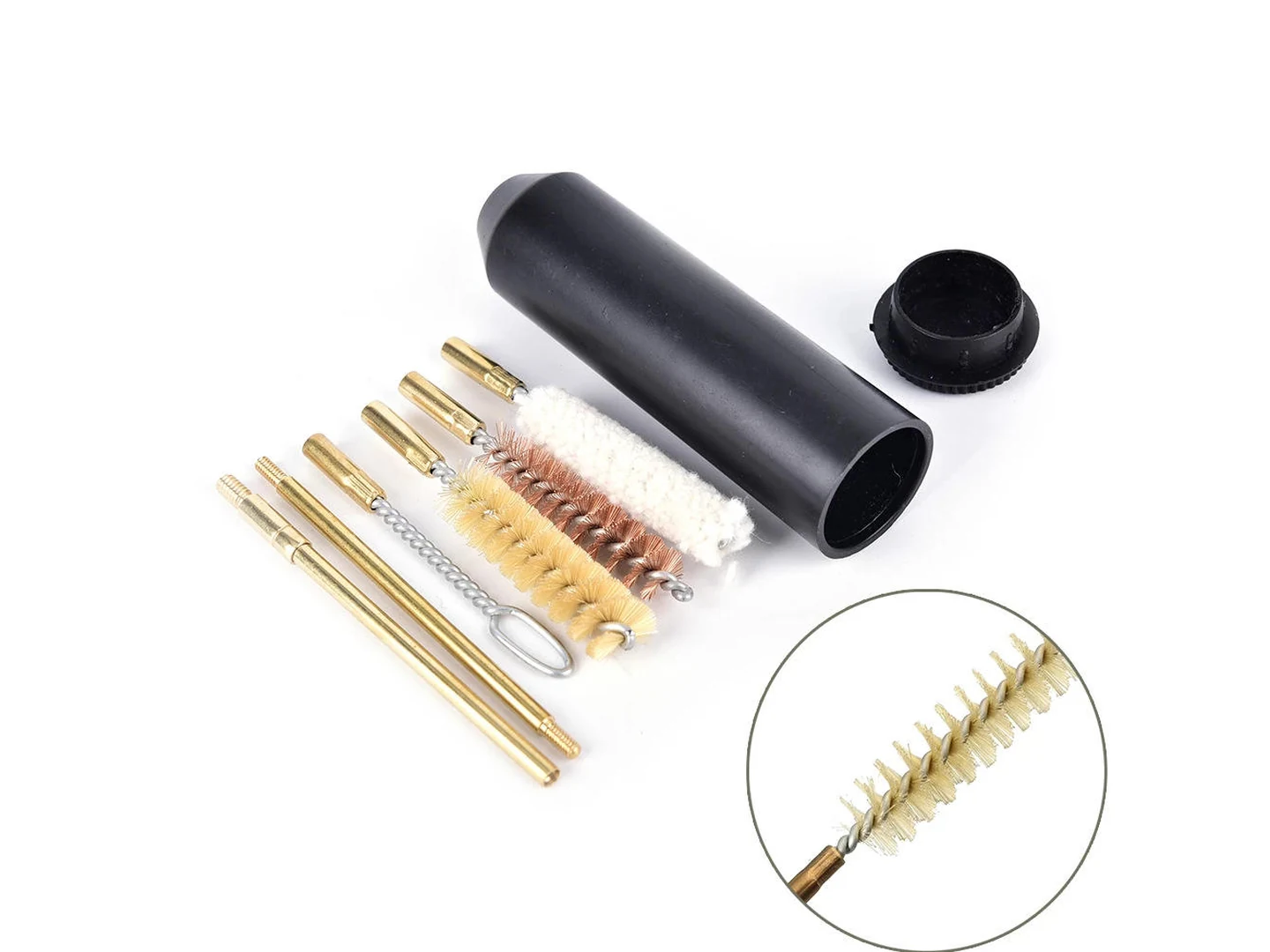
Small brush
500 pcs
Minimum order
Held in one hand: tube, bottle, detail and swab brushes — including long-handled ones with a small head.
Production lead time, once the specification is confirmed
- Up to 500 pcsWithin 7 days
- 501–50,000 pcsWithin 14 days
- Over 50,000 pcsWithin 21 days
Peak season can extend these times; the shipping date is confirmed in writing with your quotation. Sampling and shipping are quoted separately.
A caliber-matched twisted-wire bore brush with nylon PA bristles on a brass wire core, built for pistol, rifle, and shotgun barrels where carbon, powder fouling, and oil residue need to be lifted without exposing the bore steel to bronze or stainless bristle contact. Threaded or loop-end configurations fit common cleaning rods and automated maintenance fixtures.
What can this brush do for you?
Follows the Rifling, Not Just the Bore Centerline
The radial nylon pack flares under compression and recovers into the grooves, so each pass reaches the corners where powder residue and carbon hide. The brass twist core stays centered, keeping cleaning force on the fouling instead of the lands.
Soft Enough for Match Barrels and Chrome-Lined Bores
Nylon PA is far softer than barrel steel and will not cut or scratch the bore finish under normal hand pressure. That makes this brush a daily-cleaning option for precision rifle barrels and chrome-lined duty guns where bronze brushes are reserved for deeper cleaning.
Carries Solvent to the Fouling and Wipes It Away
The bristle pack holds a thin solvent film against the residue longer than a patch alone, softening carbon and powder fouling before the return stroke wipes it clear. Use it with standard bore solvents, CLP cleaners, or light lubricants.
Threads Directly onto Standard Cleaning Rods
Available with 5-40, 8-32, 10-32, M3, or M4 threads, so the brush threads directly onto the rod the operator already uses. No stacked adapters, no loose fit in the barrel, and no stripping under pull pressure.
Flexible Core Handles Chamber-to-Muzzle Strokes Without Kinking
The twisted-wire construction keeps the brush straight under push and pull yet allows enough flex to follow the bore axis through chamber transitions. Operators can complete a continuous stroke without the brush folding or binding at the throat.
What is a Nylon Gun Brush?
A Nylon Gun Brush is a firearm maintenance brush built by capturing radial nylon PA filaments between two twisted wire cores. The wire core forms the stem and terminates in a threaded adapter or loop end for use with standard cleaning rods. During cleaning, the brush is screwed onto the rod, passed through the bore, chamber, or cylinder, and pulled back to mechanically dislodge carbon, powder fouling, and oil residue.
Unlike patch-only cleaning, the brush provides mechanical contact on every surface, including the bottom of rifling grooves, chamber shoulders, and cylinder charge holes, while the nylon filament tips, not the metal core, do the scrubbing. This is a routine maintenance tool for carbon and powder soils. It is not designed to replace bronze or brass brushes for hard copper and lead fouling, or wire brushes for heavy rust and scale removal.
Operating notes: apply solvent before brushing, use smooth push-pull strokes in the same direction as the cleaning rod, and rinse the brush with solvent or alcohol after use so hardened residue does not build up in the filament pack.
Technical Specifications
The table below lists the standard build range for nylon gun brushes. Diameters, working lengths, and thread interfaces are matched to the firearm platform, not selected from a single fixed shelf.
| Parameter | Value / Options |
|---|---|
| Brush diameter | 2–20 mm, caliber-matched; custom diameters available |
| Working length | 20–80 mm |
| Overall length | 50–150 mm excluding threaded adapter |
| Thread / interface | 5-40, 8-32, 10-32, M3, M4, loop end, or custom |
| Bristle material | Nylon PA (PA6, PA66, or PA612 selected for solvent exposure) |
| Filament diameter | 0.05–0.25 mm |
| Core / stem | Brass twisted wire core; stainless steel or coated core available |
| Fill pattern | Spiral radial fill on continuous stem; density and trim length custom |
| Contact setting | Near-size for wipe-on and solvent distribution; 5–20% oversize for active scrubbing; custom interference on request |
| Operating environment | Compatible with common bore solvents, CLPs, and light oils; confirm filament and core grade for aggressive copper solvents or ultrasonic cleaning |
| Brush type | Custom Tube & Pipe Bore Brushes |
| How it is driven | Hand-guided |
| Cleaning target | semi-auto pistol barrel, ar-platform and bolt-action rifle bore, and revolver cylinder and forcing cone cleaning |
| Surface or part | bores, chambers, grooves, thread, cylinders, fixtures, holes, and shoulders |
| Residue or debris | carbon, powder, oil, powder residue, rust, and scale |
| Mounting / connection | 5-40, 8-32, 10-32, M3, M4, loop end, or custom |
Where does this brush work best?
- Semi-auto pistol barrels (9mm, .40, .45 ACP) — clears carbon and unburned powder from bore, chamber mouth, and feed ramp shoulders without altering the chamber finish.
- AR-platform and bolt-action rifle bores (.223/5.56, .308, 6.5mm) — daily or post-range scrubbing where carbon builds in the grooves and throat of high-round-count or suppressed rifles.
- Precision rifle barrels — non-metallic contact for between-match maintenance when bore finish preservation is as important as fouling removal.
- Revolver cylinders and forcing cones — short working sections reach the charge holes and powder rings without scoring the cylinder walls.
- Shotgun barrels and choke tubes (12–20 gauge) — larger diameter builds wipe plastic wad fouling and powder residue from bore and choke threads.
- Suppressor baffles and muzzle devices — carbon in accessible internals can be scrubbed with nylon contact before solvent soak or ultrasonic cleaning.
How do I choose the right one?
Start with the bore and chamber dimensions. Measure the groove diameter at the muzzle and the chamber diameter at the throat; choose brush diameter using the table below. Thread selection is next: most modern cleaning rods use 8-32, older military equipment uses 5-40, metric systems use M3 or M4. Confirm the rod thread before ordering to avoid adapters.
Then match the stem and working length to the cleaning method. Pistol and revolver work usually needs 20–40 mm working length; rifle bores benefit from 50–80 mm of brush contact for faster carbon removal. If your process uses aggressive copper solvents or ultrasonic tanks, specify a stainless steel core and confirm the nylon grade with our team. The standard brass core is suitable for common CLPs, bore solvents, and light oils.
| Cleaning condition | Brush diameter vs. bore | Filament diameter | Core recommendation |
|---|---|---|---|
| Light carbon film / wipe-down | Near-size (0–5% over groove diameter) | 0.05–0.10 mm | Brass core standard |
| Moderate powder fouling after range use | 5–10% oversize | 0.10–0.15 mm | Brass core standard |
| Stubborn carbon in chamber, throat, or suppressor | 10–20% oversize | 0.15–0.25 mm | Brass or stainless, depending on solvent |
| Copper/lead fouling | Use bronze/brass brush instead | — | — |
Do not select this nylon brush for copper or lead fouling, rust removal, barrel lapping, or abrasive bore conditioning. Use a bronze or brass bore brush for metallic fouling, a stainless or carbon steel brush for corrosion removal only after validating the risk to the bore finish, and a patch or jag for final solvent and oil control.
Can I customize this brush?
Nylon gun brushes are built to the firearm platform, not taken from a one-size shelf. To quote a custom configuration, we need the bore/groove diameter, chamber diameter, barrel length, the cleaning rod thread, the solvents used, and whether the brush is for hand cleaning or an automated fixture. A sample brush or drawing speeds the process.
We can adjust the following:
- Brush diameter and geometry — 2–20 mm or outside this range for specialty chambers; straight, tapered, stepped, or dual-diameter profiles for chamber-plus-bore cleaning.
- Bristles — nylon PA6, PA66, or PA612; filament diameter 0.05–0.25 mm; trim length; fill density; spiral pitch; and bristle color for caliber coding.
- Core and stem — brass twisted wire standard; stainless steel or coated wire for aggressive chemical environments; overall stem length and flexibility to match the fixture or rod.
- Thread and interface — 5-40, 8-32, 10-32, M3, M4, loop end, or a custom adapter for non-standard rods or automated cleaning machines.
- Marking and packaging — pad-printed or labeled packaging, color-coded bristles, individual bags, bulk, kit packs, or retail-ready layout.
If your project requires material declarations, dimensional inspection reports, or third-party test support for OEM or distributor supply, we can coordinate those requirements during the customization process.
What size should a nylon gun brush be, and how long does it last?
Does the brass core ever contact the bore wall during cleaning?
In a correctly sized brush, the bristle tips contact the bore and the core stays centered even through slight curvature. The core can touch the crown or muzzle only if the operator uses excessive force or reverses the brush sharply inside the bore; inspect the muzzle after use. If core contact is a concern, choose a slightly larger brush diameter so bristles remain the contact surface.
Can I use this brush with copper-removing solvents?
Nylon PA is generally stable with commercial bore solvents and CLPs, but the brass core can be attacked by strong ammonia-based copper solvents over repeated long soaks. For those chemicals, specify a stainless steel core and confirm the nylon grade with our team. In factory systems, run a compatibility sample against the actual solvent before volume use.
How many cleaning passes should one brush last?
With normal hand cleaning, a nylon gun brush typically lasts 50–150 complete bore passes before the bristle tips show visible flattening or the core begins to untwist, depending on bore condition and interference. In high-volume armorers using 10–20% oversize brushes, replacement happens earlier. Inspect under magnification; replace when bristles no longer spring back or contact becomes uneven.
Do I still need a chamber brush if the bore brush is longer?
Usually yes. A bore-diameter brush will not scrub the larger chamber walls, shoulder, or leade with full contact. If you want one brush for both, we can build a stepped or dual-diameter brush with a larger chamber section and smaller bore section, but most facilities keep separate bore and chamber brushes to avoid cross-contact and uneven wear.
How do I verify the barrel is clean without a borescope?
After solvent brushing, run dry patches until they come out with no visible gray or black residue. Then check the muzzle and chamber under bright light with a white patch wipe; if patches show color, repeat brush passes in the same direction and re-patch. A borescope is still the best confirmation for final inspection in precision applications.
Guides that go deeper on this
Custom Manufacturing RFQ
Describe Your Application
Please share the brush dimensions, working area, residue type, material direction, quantity, and a drawing or photo for quotation.
Drawing or photo optional — it speeds things up, it does not gate the enquiry.
Custom Brush RFQ
Send Your Brush Project
Upload a drawing, product photo, or sample photo and provide the core dimensions and cleaning conditions.
“We need a brush to remove wet residue from a stainless steel conveyor, about 800mm wide. The current brush wears quickly. We can send photos.”
“We sell drinkware and need a cleaning brush to include with the product. Quantity around 5,000 pieces.”