
Custom Cleaning Brush
PA66 Grout Brush
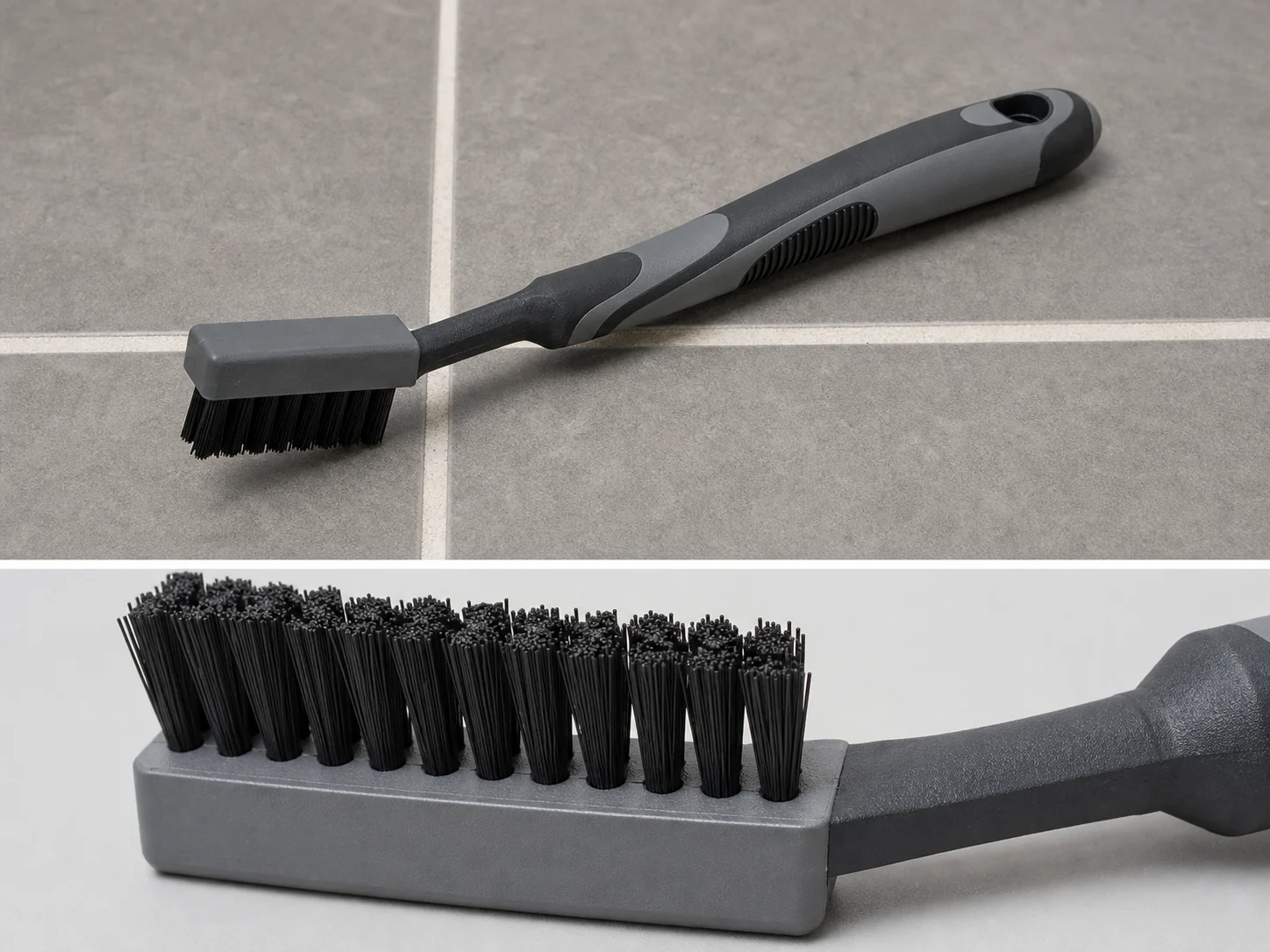
Stiff, chemical-resistant PA66 nylon brush reaches tile grout lines, joints, and corners to remove soap film, mineral scale, mold, and embedded dirt.
Small brush
500 pcs
Minimum order
Held in one hand: tube, bottle, detail and swab brushes — including long-handled ones with a small head.
Production lead time, once the specification is confirmed
- Up to 500 pcsWithin 7 days
- 501–50,000 pcsWithin 14 days
- Over 50,000 pcsWithin 21 days
Peak season can extend these times; the shipping date is confirmed in writing with your quotation. Sampling and shipping are quoted separately.
A stiff, chemical-resistant PA66 nylon hand brush built for scrubbing tile grout lines, joints, corners, and recessed seams. The narrow rectangular head concentrates filament pressure into the seam, lifting soap film, mineral scale, mold residue, grease, and packed-in dirt without scratching glazed tile.
What can this brush do for you?
Stiff PA66 filaments hold their edge in packed residue
PA66 nylon is stiffer and more abrasion-resistant than standard nylon 6 or polypropylene bristles, so the filament tips keep their shape and bite inside narrow grout channels instead of folding over. That keeps scrubbing pressure on dried soap film, mineral deposits, and embedded dirt instead of letting the brush glide across the surface.
Narrow rectangular head follows the grout line, not just the tile face
The 100 mm rectangular working face keeps a consistent contact patch along long grout runs, while the trimmed leading edge reaches the bottom of the joint where flat brushes ride over the seam. Corners and edge transitions receive the same pressure as straight runs, reducing the need for a second tool.
Works with the tile cleaners your facility already uses
The PA66 bristles and the PP core with TPE/TPR overmold tolerate diluted bleach, all-purpose cleaners, and mild acid-based tile cleaning products. You can apply the normal cleaning solution during manual scrubbing without the brush softening, discoloring, or breaking down mid-job.
Non-slip grip stays controllable with wet hands and gloves
The 150 mm handle with a 25 mm TPE/TPR overmold provides a secure hold even when hands, gloves, and tile surfaces are wet. The compact length keeps hand pressure directed into the joint and reduces wrist strain during long wall or floor cleaning sessions.
Fixed head transfers every push into the grout channel
The head is molded into the handle as a single unit with no hinge or pivot point to loosen over time. That direct connection puts more of the scrubbing force from your grip into the bristle tips, which is what actually releases the residue in the recessed seam.
What is a PA66 Grout Brush?
A PA66 Grout Brush is a hand-guided cleaning tool with PA66 nylon filaments set into a narrow rectangular head, purpose-built to clean recessed tile grout lines, joints, and corner seams. It is not a general surface brush; the working head is shaped to enter the channel between tiles and remove residue that mops, sponges, and flat scrub brushes pass over.
In use, the operator applies tile cleaner or water, inserts the leading edge of the head into the grout line, and works short push-pull or back-and-forth strokes. The stiff filament tips loosen soap film, mineral scale, mold residue, grease, and embedded dirt from the recessed seam; loosened material is then wiped or rinsed away. The same stroke works along tile edges, around corners, and across textured or matte surfaces with visible joint channels.
This brush is designed for manual tile maintenance. It is not a powered grout cleaning system, and it does not replace chemical descaling for heavy mineral buildup or re-grouting for cracked or missing grout. It is the contact tool that improves the result of the cleaning chemicals and water already in the process.
Technical Specifications
The standard configuration below covers most residential and commercial tile grout cleaning jobs. Dimensions, bristle trim, stiffness, and handle detail are project-adjustable when the site conditions require it.
| Parameter | Standard Configuration |
|---|---|
| Head shape | Rectangular, narrow trim profile |
| Head length | 100 mm |
| Bristle material | PA66 nylon filament |
| Bristle trim length | 8–12 mm, selected for standard grout joint depth |
| Handle core material | Polypropylene (PP) |
| Handle overmold | TPE/TPR, non-slip texture |
| Handle length | 150 mm |
| Grip diameter | 25 mm |
| Connection | Fixed head |
| Overall length (approx.) | 250 mm |
| Operating environment | Water, diluted bleach, all-purpose cleaners, mild acid-based tile cleaners; not intended for concentrated solvents or prolonged chemical soaking |
| Brush type | Custom Handheld Detail Brushes |
| How it is driven | Hand-guided |
| Cleaning target | commercial kitchen and restroom tile wall, healthcare bathroom, and pool deck cleaning |
| Surface or part | tile, joints, seams, grout lines, corners, molds, channel, and edges |
| Residue or debris | grease, soap film, mold, mineral scale, embedded dirt, mold residue, mineral deposits, and body-oil film |
| Mounting / connection | Fixed head |
If your grout joints are wider, deeper, or narrower than typical, provide the joint width and target residue so the bristle trim, density, and handle geometry can be adjusted before sampling.
Where does this brush work best?
- Commercial kitchen and restroom tile walls — cleans the grout channels between glazed ceramic and porcelain tiles where grease, soap film, and daily cleaning residue collect along the seams.
- Hotel, institutional, and healthcare bathrooms — reaches shower stall joints, floor-to-wall transitions, and corner grout where mold and mildew develop in damp seams.
- Pool decks, locker rooms, and spa areas — removes mineral deposits and body-oil film from grout lines in wet areas, especially where foot traffic has pressed residue into the joint.
- Food processing and restaurant floor lines — a manual follow-up tool after mopping to lift embedded dirt and grease from recessed grout that flat floor brushes leave behind.
- Textured and matte tile edges — cleans the recessed transition between tile edges and grout where surface-polishing tools cannot reach.
How do I choose the right one?
Most selection decisions for a PA66 grout brush come down to the joint, the residue, and the operator’s working position.
Measure the grout joint before specifying bristle trim and density
Standard trim and density suit common 3–6 mm grout joints. For narrower joints, choose a shorter trim and higher filament density so the bristle tips enter the seam without splaying over the tile face. For wider or deeper joints, a longer trim and slightly firmer filament improve penetration into the channel. If the joint is under 2 mm or hairline, this brush may not be the most efficient tool; a detail tip, scraper, or pointed brush will usually perform better.
Match stiffness to what is actually in the grout
Soap film, light mold, and fresh grease respond to medium-firm PA66. Mineral scale, hardened grease, and long-embedded dirt need the firm end of the range. If mineral deposits are thick and cured, pretreat with a suitable acid-based tile cleaner and allow dwell time; the brush then removes the softened residue rather than doing all the mechanical work.
Confirm the cleaning chemical before committing to material
PA66 bristles and the PP/TPE handle assembly tolerate most diluted tile cleaners well, but concentrated acids, strong solvents, or long hot chemical soaks can shorten filament life. If your process includes daily bleach immersion or solvent-based degreasers, tell us the chemical, concentration, and contact time so the material grade can be verified for your actual process.
Consider the operator’s hand and working position
The standard 150 mm handle and 25 mm grip are suited for close hand work on walls and floors. For overhead ceiling-to-wall transitions, long runs of floor tile, or operators wearing heavy gloves, a longer handle, larger grip, or extension configuration often reduces fatigue. We can adjust the handle without changing the working head.
When a different brush makes more sense
Use a wider deck brush or floor scrubber brush for large open floor areas where grout is not the limiting surface. Use a brass or stainless wire brush with a chemical stripping process for epoxy grout haze or heavy cement-based deposits, but only after confirming the tile surface can tolerate metal contact. Use a chemical grout cleaner or re-grouting repair for deeply stained, cracked, or crumbling grout that brushing alone cannot restore.
Can I customize this brush?
Yes. The standard PA66 grout brush is a starting configuration, not a fixed catalog item. We can adjust the working head, bristle system, handle, and finishing details to the tile type, joint dimensions, cleaning chemical, and operator requirements in your facility or product line.
- Head geometry — length, width, corner radius, head thickness, and bristle field shape; can be made narrower for tight joints or wider for faster coverage of straight runs.
- Bristle system — PA66 filament diameter, trim length, density, stiffness, and tip finish; if your chemical or thermal exposure is outside PA66’s comfort zone, we can evaluate alternative bristle materials in consultation with you.
- Handle and grip — length, diameter, contour, thumb rest, hanging hole, overmold texture, or extended-reach configuration.
- Connection style — standard fixed head, or replaceable-head construction for high-use commercial programs.
- Color and marking — custom handle and bristle colors, molded-in logo, pad printing, laser marking, or color coding by department or cleaning zone.
- Packaging — bulk, individual bag, retail card, private label pack, or project-specific kitting.
To quote a custom configuration, provide the grout joint width and depth, tile or stone type, the residues you need to remove, cleaning chemicals and concentrations, and the operator’s working position. A photo of the grout line or a sample of the residue shortens the sampling loop. We can also support project-specific material documentation, inspection requirements, and third-party testing as part of the project scope.
Which filament survives the cleaning and still lasts on a PA66 grout brush?
Will PA66 bristles scratch polished porcelain or glazed ceramic tile?
No, under normal hand pressure. PA66 nylon is softer than fired tile glaze and porcelain surfaces, so the filament tips will not scratch the tile itself. With that said, if the tile has gold leaf, foil accents, or very soft natural stone, test in an inconspicuous corner first, and avoid dragging embedded abrasive grit across the surface when the brush has not been rinsed.
How do I know when the brush is worn out?
Check the bristle tips after heavy use. If the tips are permanently bent over, splayed outward, or shortened so they no longer bottom out in the grout channel, the brush has lost its working edge. Also inspect the handle overmold for cracking or separation. Replace the brush when the bristle field no longer stays inside the joint under normal pressure.
What should I do before scrubbing a grout line?
Remove loose dirt and debris first, then pre-wet the tile or apply the cleaning solution according to the chemical manufacturer’s instructions. Work in small sections so the cleaner does not dry on the tile surface before rinsing. This keeps the brush from grinding loose grit into the grout and prevents cleaned residue from re-setting in the joint.
Can this brush remove old epoxy grout or repair damaged grout?
No. The brush removes surface film, stain, and embedded residue from intact grout lines. It will not grind out cured epoxy grout, rebuild missing grout, or repair crumbling joints. If the grout is cracked, loose, or deeply stained below the surface, re-grouting or professional repair is required before normal brushing will help.
How should the brush be maintained between cleaning shifts?
Rinse the bristle field with clean water after use to remove cleaning chemicals and loosened residue, then shake off excess water and hang the brush to dry. Avoid leaving the brush soaking in concentrated chemical solutions overnight. Store it with the bristles protected from being flattened under other tools, and check that no debris is packed into the base of the filaments before the next shift.
Can I attach this brush to a drill, floor machine, or extension pole?
The standard PA66 grout brush is a hand tool with a fixed handle and is not set up for machine mounting or pole attachment in the base configuration. If you need a powered grout cleaning attachment or a long-reach pole brush, we can evaluate a machine-mount interface or extended-handle configuration as a special build, but the standard unit is intended for manual hand scrubbing.
Guides that go deeper on this
We have not written a guide specific to this one yet. The material that covers selection, filament, dimensions, maintenance and sourcing is collected in the technical resources library.
Custom Manufacturing RFQ
Describe Your Application
Please share the brush dimensions, working area, residue type, material direction, quantity, and a drawing or photo for quotation.
Drawing or photo optional — it speeds things up, it does not gate the enquiry.
Custom Brush RFQ
Send Your Brush Project
Upload a drawing, product photo, or sample photo and provide the core dimensions and cleaning conditions.
“We need a brush to remove wet residue from a stainless steel conveyor, about 800mm wide. The current brush wears quickly. We can send photos.”
“We sell drinkware and need a cleaning brush to include with the product. Quantity around 5,000 pieces.”