
Custom Cleaning Brush
100x1000mm PBT Textile Lint Roller Brush
100x1000mm PBT textile lint roller brush for continuous lint and fiber removal on belts, rollers, chains, rails, and transfer points.
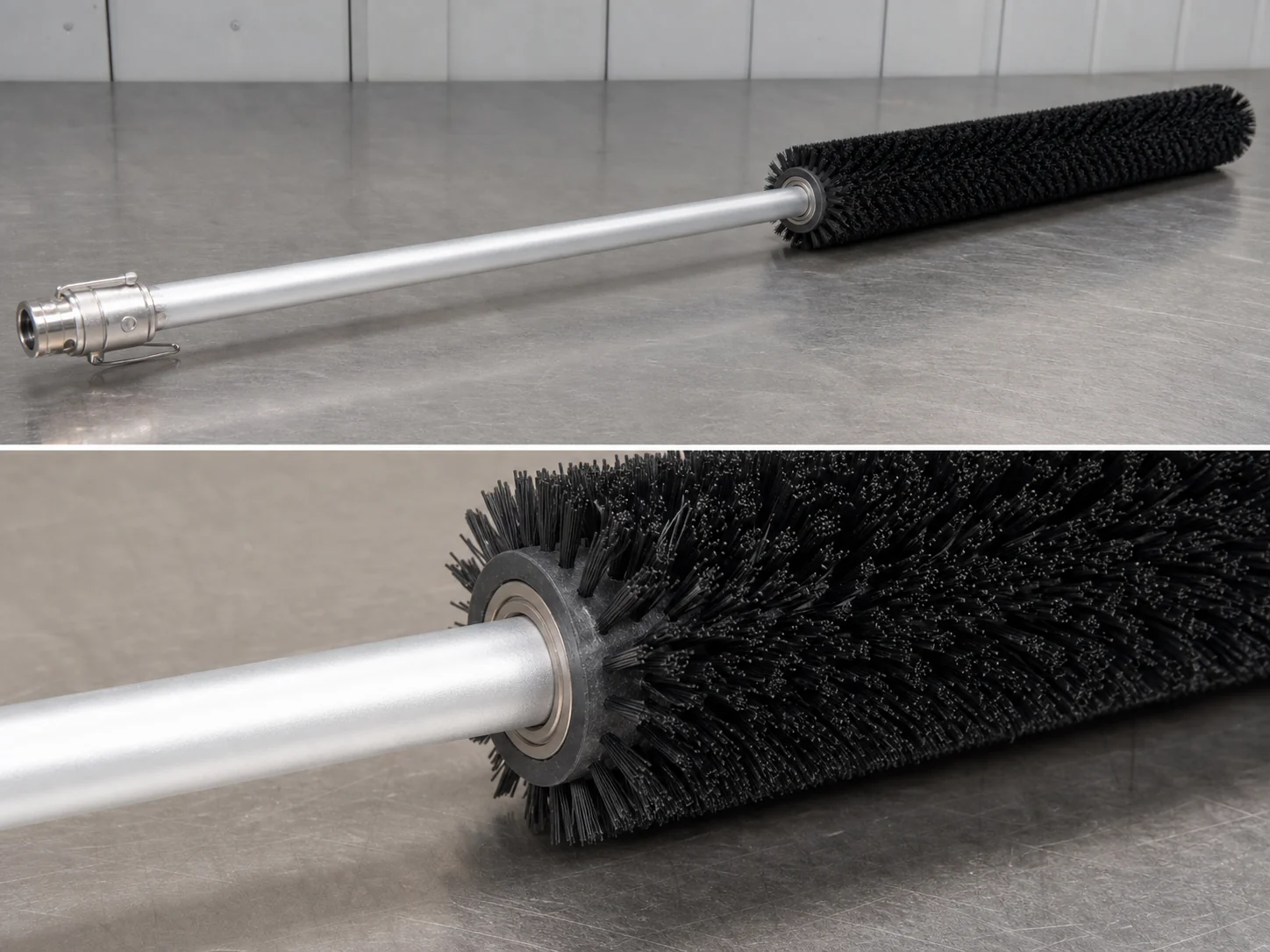
Large-format brush
100 pcs
Minimum order
Built one at a time on a core or channel: full-width rollers, sweeper brooms and long strip.
Production lead time, once the specification is confirmed
- Up to 100 pcsWithin 20 days
- 101–1,000 pcsWithin 30 days
- Over 1,000 pcsConfirmed with your quotation
Peak season can extend these times; the shipping date is confirmed in writing with your quotation. Sampling and shipping are quoted separately.
A 100 mm diameter × 1000 mm working-face cylindrical roller brush built with PBT filament for continuous lint and fiber removal from belts, rollers, chains, rails, and transfer points in textile dyeing and finishing lines. The 6061 aluminum core and quick-change coupling keep replacement fast on lines that run around the clock.
What can this brush do for you?
Cleans the full 1000 mm face in continuous contact
The one-meter working face spans the full fabric or web width, so lint is stripped from the entire belt, guide rail, or transfer plate in a single installed position. Operators do not need to stop the line for edge-to-edge hand cleaning.
PBT filaments stay resilient in humid finishing rooms
PBT absorbs very little moisture, so the bristles do not soften and flatten in the damp air around dryers, steam boxes, and wash modules. Dilute dye auxiliaries and common finishing chemicals have limited effect, allowing the brush to keep consistent contact pressure through long production shifts.
Removes powder, fiber, film fragments, and light sticky carryback
The PBT tips flex around sticky film and label fragments, then flick off dry powder, lint, and crumbs. The contact is stiff enough to clean belt surfaces but soft enough to avoid cutting rubber belts or coated guide rollers the way wire or abrasive brushes can.
Lightweight core and quick-change coupling shorten changeovers
The 6061 aluminum alloy core keeps a one-meter-long roller manageable for a single maintenance person. The quick-change coupling lets the used roller be dropped from the machine shaft without dismantling the drive, adjacent rollers, or the belt path.
Optional dynamic balancing for high line speeds
A 1000 mm working face can amplify vibration at speed. Optional dynamic balancing matched to the operating speed reduces bounce, uneven bristle wear, and extra load on the shaft bearings.
What is a 100x1000mm PBT Textile Lint Roller Brush?
A 100x1000mm PBT Textile Lint Roller Brush is a cylindrical industrial roller brush whose overall outside diameter is 100 mm and whose bristle-filled working face is 1000 mm long. It is a machine component, not a hand tool. The brush mounts onto a machine shaft through a quick-change coupling and is positioned across the face of a belt, roller, chain rail, or web transfer point. As the target surface runs, the PBT filament tips wipe away lint, fiber, powder, film fragments, and light sticky carryback before the debris can transfer back onto the product.
In dyeing and finishing lines, fabric sheds fiber at dryers, compactor belts, inspection frames, plaiting machines, and winding stations. That material collects on transport belts, guide rollers, chains, and rails, then causes marks, creases, tracking problems, and quality defects. This brush is installed in those lint collection zones to keep the surfaces clean during continuous operation. The dislodged debris falls into a collection tray or vacuum duct, not onto an adhesive sheet.
PBT is chosen for this job because it keeps its stiffness after wetting, resists fatigue from repeated flexing, and tolerates many of the chemicals used in textile finishing. The brush works best as part of a regular machine-cleaning setup. It is not intended to cut through hardened deposits, remove baked-on coatings, or replace extraction equipment that captures airborne dust.
Technical Specifications
| Parameter | Value / Options |
|---|---|
| Brush outside diameter | 100 mm |
| Working face length | 1000 mm |
| Brush geometry | Cylindrical roller, straight or spiral fill pattern |
| Bristle material | PBT (polybutylene terephthalate) |
| Filament diameter | 0.20–0.50 mm, selected for residue and surface sensitivity |
| Fill density | Dense fill for fine powder; open spiral fill for long fibers and sticky residue release |
| Core material | 6061 aluminum alloy |
| Connection | Quick-change coupling; bore, keyway, and end geometry machined to the machine drawing |
| Handle / grip | Not applicable — machine-mounted roller |
| Operating temperature, dry heat | Up to 120°C continuous for PBT bristle |
| Chemical exposure | Resists water, dilute acids, and common dyehouse detergents; confirm strong alkaline or solvent contact separately |
| High-speed service | Dynamic balancing and end-support check recommended at elevated surface speeds |
| Brush type | Custom Roller and Conveyor Brushes |
| How it is driven | Machine-driven, mounted in the equipment |
| Cleaning target | stenter pin/clip chain and guide rail, folding machine belt, and inspection frame cleaning |
| Surface or part | roller, belts, rails, chains, transfer points, aluminum, webs, and frames |
| Residue or debris | lint, fiber, powder, sticky carryback, film fragments, crumbs, loose films, and adhesive |
| Mounting / connection | Quick-change coupling; bore, keyway, and end geometry machined to the machine drawing |
Where does this brush work best?
- Stenter pin/clip chains and guide rails in dyeing and finishing ranges, where fiber and finish residue accumulate on moving components and pack into tracks.
- Compactor, plaiting, and folding machine belts that carry knit or woven fabric and collect lint and powder on the return run.
- Inspection frame, winding, and rewinding transfer rollers where lint, label fragments, and loose film from fabric rolls settle on the roll face and can mark the cloth.
- Drying and heat-setting conveyor paths where powder and fiber from dried fabric cover supporting belts and rollers.
- Nonwoven and interlining transfer points where chips, crumbs, film fragments, and sticky carryback from coated or laminated substrates accumulate.
The brush is designed for places where a surface is moving continuously and the cleaning action should run with the machine. It is not a hand-held spot-cleaning tool for garment or furniture lint.
How do I choose the right one?
Confirm the 100 mm envelope and 1000 mm face
Check the maximum fabric or web width, including expected edge wander. The 1000 mm face must cover the full contact zone plus allowance for side-to-side movement. Also confirm that the 100 mm swept circle clears adjacent rollers, guards, and extraction hoods after bristle deflection is included.
Match filament stiffness to the residue and surface
PBT provides good stiffness, moisture resistance, and chemical tolerance, but the filament diameter and fill pattern still need to match the job. Thin filaments with dense fill work for fine lint and powder on soft rubber or coated surfaces. Thicker filament with open spiral fill handles sticky carryback, label fragments, and compacted powder without loading as quickly.
| Residue / surface condition | Suggested PBT configuration |
|---|---|
| Fine lint and powder on coated or polished rollers | 0.20–0.30 mm filament, dense fill, light contact |
| Sticky carryback, film, label fragments on machine belts and rails | 0.40–0.50 mm filament, open spiral fill, firmer contact |
| Long fibers that tend to wrap | Open spiral or segmented fill, reduced density |
| Humid wash modules or dilute chemical spray | PBT with anodized aluminum or stainless core |
| High-speed continuous line | Dynamically balanced core with confirmed shaft support |
| Hardened mineral or cured deposits | Use abrasive-filled nylon or wire brush instead of PBT |
Check the core and coupling against your process
6061 aluminum keeps the roller light, but it can corrode under strongly alkaline conditions or prolonged washdown contact. If the brush will see high-pH detergent, steam cleaning with aggressive chemicals, or continuous wet service, specify an anodized core or switch to a stainless core. The quick-change coupling is machined to the existing shaft, so provide the shaft diameter, keyway size and depth, journal length, and retaining method. The brush is a cleaning element, not a load-bearing drive shaft.
Set contact pressure correctly
After a short run, inspect the filament tips and the wear band. Uniformly straight tips and a clear cleaned path indicate correct setup. Permanently folded or flattened filaments mean the contact pressure is too high. A narrow dirty band in the center or at the edges means the engagement is uneven or the fill density is not suitable for that residue.
When another brush or cleaning method is more suitable
Use an abrasive-filled nylon, wire, or ceramic brush when the deposit is hard, baked on, or mineralized. Use vacuum or air-knife extraction as the primary method when the main problem is fine airborne dust rather than deposit on a surface. For heavy adhesive or tacky residue, PBT alone may load and re-deposit; combine the brush with a scraper, solvent wash, or lower-density open fill so the material can release.
Can I customize this brush?
The 100 mm × 1000 mm PBT configuration is the base product. Most projects keep the same working envelope and adjust the filament, fill, core treatment, and coupling interface to the production line. We will need the maximum web width, target surface, residue description, operating speed, chemical exposure, shaft details, and any existing machine drawing or sample coupling.
- Dimensions and geometry: working face length, core length, brush outside diameter, straight fill, spiral fill, or segmented roller construction.
- PBT filament: diameter, stiffness, color, anti-static grade, straight or crimped filament, density, spiral pitch, and tip finish.
- Core: 6061 aluminum, anodized or coated aluminum, or stainless steel for corrosive lines; bore, keyway, journal, and coupling geometry made to the machine drawing.
- Connection: quick-change coupling halves, clamp style, taper, flange, or a matched form to the existing coupling.
- Balancing and runout: dynamic balancing at the actual operating speed and total indicated runout limits for high-speed lines.
- Mounting accessories: bearing journals, thrust collars, and guard-compatible support details.
- Packaging: bulk pallet packing, individual export crate or tube, or consolidated project packing.
- Project support: material declarations, dimensional inspection, and third-party testing assistance can be coordinated for your project requirements.
How is a 100x1000mm PBT textile lint roller brush mounted, and when does it need replacing?
Is this the same as a consumer adhesive lint roller?
No. This is an industrial machine-mounted roller brush. It removes lint and fibers by mechanical brushing action, not with sticky tape, and it is not intended for hand use on garments or furniture.
How do I confirm that the quick-change coupling will fit my existing shaft?
Measure the shaft diameter, keyway width and depth, journal length, and retaining method, then send a drawing or sample shaft. The brush bore and coupling are machined to those dimensions. Do not modify the shaft to force a coupling that was not made for it.
How can I tell whether the contact pressure is set correctly?
Run the brush briefly at operating speed, then inspect the filament tips under light. Uniformly upright tips and a fully cleaned path across the face indicate correct pressure. Tips that are permanently folded over, a heavily compressed wear band, or a remaining narrow strip of residue means the setting or fill configuration needs adjustment.
Can the brush run wet or in high humidity?
PBT filaments keep their stiffness in humid conditions and tolerate many water-based detergent sprays. The 6061 aluminum core, however, can corrode under continuous alkaline washdown or strong cleaning chemicals. For wet or aggressive service, specify an anodized or stainless core and confirm the detergent pH and exposure pattern.
What routine maintenance does the brush need between replacements?
Remove accumulated lint with vacuum or low-pressure compressed air. Check the face for bald spots, inspect the coupling for tightness, and verify that the core still runs without visible wobble. If the line uses alkaline washdown, keep continuous chemical spray away from the aluminum core and end fittings.
Will PBT generate static on my fabric?
PBT can build static charge when sliding against certain synthetic fabrics or films at speed. If static is a production concern, specify an anti-static PBT formulation and provide a grounding path for the shaft. This should be addressed during customization rather than after the line starts showing static-related defects.
Guides that go deeper on this
Abrasive Nylon Grit and Filament Selection
Read this guideGuideBrush Roller Conveyor Mistakes with Dry Dust
Read this guideGuideBrush Speed, Engagement, and Heat
Read this guideGuideConveyor Belt Cleaning Brush Design
Read this guideGuideFloor Scrubber Brush Selection: Disc Brush vs Roller Brush
Read this guideCustom Manufacturing RFQ
Describe Your Application
Please include the main sizes, application, residue, preferred material, interface, quantity, and any drawing or sample available.
Drawing or photo optional — it speeds things up, it does not gate the enquiry.
Custom Brush RFQ
Send Your Brush Project
Upload a drawing, product photo, or sample photo and provide the core dimensions and cleaning conditions.
“We need a brush to remove wet residue from a stainless steel conveyor, about 800mm wide. The current brush wears quickly. We can send photos.”
“We sell drinkware and need a cleaning brush to include with the product. Quantity around 5,000 pieces.”