
Custom Cleaning Brush
120mm PA66 Duct Cleaning Brush
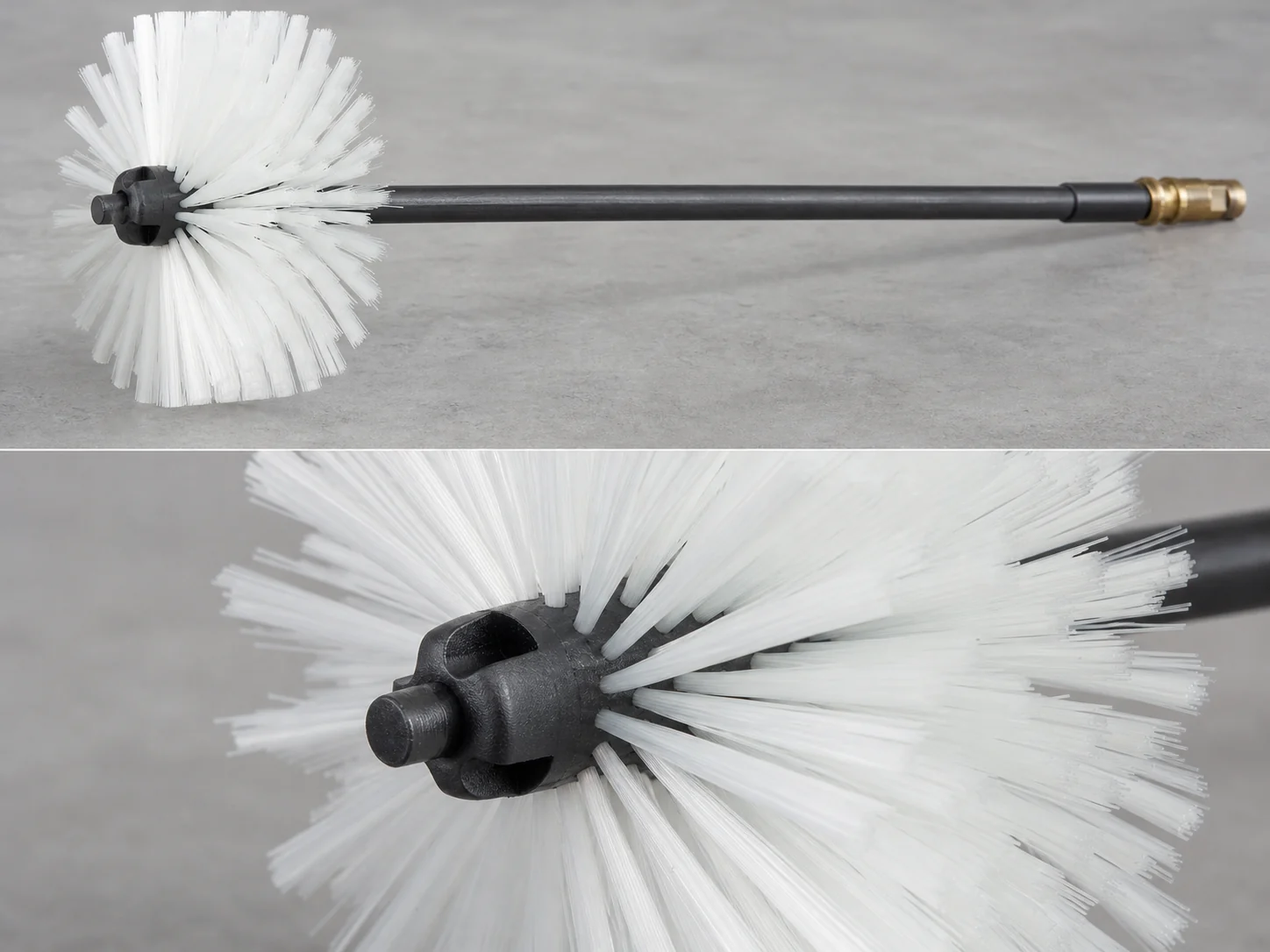
Round 120mm PA66 duct cleaning brush on a stainless twisted core for HVAC duct, vent and fin cleaning. Quick-change coupling, 600 mm shaft, custom sizes.
Medium brush
100 pcs
Minimum order
Worked with two hands or on a pole: chimney, gutter and pond-filter brushes, discs, cups and tank brushes.
Production lead time, once the specification is confirmed
- Up to 100 pcsWithin 7 days
- 101–5,000 pcsWithin 14 days
- 5,001–50,000 pcsWithin 21 days
- Over 50,000 pcsConfirmed with your quotation
Peak season can extend these times; the shipping date is confirmed in writing with your quotation. Sampling and shipping are quoted separately.
A 120mm round duct-cleaning brush with PA66 nylon bristles on a twisted stainless steel wire core, built to sweep dust, lint, pollen and light soot from air-conditioning ducts, vents and finned coils without scratching aluminum surfaces.
What can this brush do for you?
Sits into 140–160 mm duct sections without jamming
The 120 mm head diameter leaves a narrow working clearance in common 150 mm round or square duct, so the bristles stay against the walls through the stroke while the head still travels through seams and minor transitions. Wall and corner coverage takes fewer passes than a narrow tube-style brush would require.
Cleans fins and louvers without metal-on-metal contact
PA66 nylon filaments flex around coil fins, louver edges and vent slats instead of cutting into them. They lift loose dust, lint, pollen and light soot film while the aluminum or galvanized surface keeps its profile. A stainless wire brush would be far more likely to bend fins or score the face of the coil.
Holds its shape through wet air-handler work
The filaments are anchored in a twisted stainless steel wire core, and the shaft is stainless as well. Condensation, coil cleaner overspray and humid duct interiors will not rust the core or leave the staining that carbon steel parts can cause.
Changes heads in seconds
The quick-change coupling lets the operator swap to a different head diameter or a replacement head without tools while the extension rod or drive stays in service. Maintenance crews can keep one shaft and match the head to the section they are working.
Reaches the first deep section before an extension is needed
The 600 mm shaft plus a 250–350 mm brush section gives roughly 850–950 mm of working reach from the grip. That covers the coil face and the first section of many return or supply ducts; longer runs take an extension through the same coupling.
What is a 120mm PA66 Duct Cleaning Brush?
A 120mm PA66 Duct Cleaning Brush is a cylindrical duct-cleaning tool with a 120 mm diameter brush head made from PA66 nylon filaments and a stainless steel twisted-wire core. The head is fitted to a 600 mm stainless steel shaft with a 28 mm grip and a quick-change coupling at the drive end.
In use, the operator guides the head along the duct wall, across louvered openings, or over the face of an evaporator or condenser coil using push, pull and rotating strokes. It may be used dry to loosen accumulated dust and lint, or wet with a foaming coil cleaner or mild alkaline degreaser for light soot and grease film. The brush dislodges the deposit; a vacuum, rinse or wipe still carries it away.
It is a surface-deposit brush, not a heavy scraping tool. It is not intended to cut through rust scale, baked carbon or hardened grease, and it does not replace chemical sanitizing or antimicrobial treatment when those steps are part of the maintenance procedure.
Technical Specifications
The table lists the build most buyers specify for duct and coil maintenance. Dimensions and materials can be adjusted to a project.
| Parameter | Value / Options |
|---|---|
| Head diameter | 120 mm |
| Head shape | Round |
| Brush section length | 250–350 mm |
| Bristle material | PA66 nylon |
| Bristle fill and trim | Mid-density fill; trim length and filament diameter configured to the project |
| Core | Stainless steel twisted wire |
| Shaft material | Stainless steel |
| Shaft length | 600 mm |
| Grip diameter | 28 mm |
| Connection | Quick-change coupling, interface matched to existing rods or driver |
| Best-fit passage width | Approx. 140–160 mm internal cross-section; other diameters available |
| Drive method | Manual or low-speed rotary drive through the quick-change coupling |
| Chemical exposure | Compatible with common foaming coil cleaners, mild alkaline degreasers and water; verify before using strong acids or oxidizing solutions |
| Brush type | Custom Tube & Pipe Bore Brushes |
| How it is driven | Hand-driven on rods or a flexible shaft |
| Cleaning target | evaporator and condenser coil face, return and supply air duct, and diffuser and vent frame cleaning |
| Surface or part | coils, vents, walls, duct walls, aluminum, louvers, passages, and coil faces |
| Residue or debris | lint, dust, soot, pollen, grease, carbon, scale, and rust |
| Mounting / connection | Quick-change coupling, interface matched to existing rods or driver; Manual or low-speed rotary drive through the quick-change coupling |
If the brush will run continuously in wet alkaline foam, confirm the exact cleaner with us so the filament grade and core wire can be selected for that environment.
Where does this brush work best?
The combination of a 120 mm round head, PA66 filaments and a stainless twisted core fits routine HVAC and air-handling maintenance. Common uses include:
- Evaporator and condenser coil face cleaning, where dust, lint, pollen and light soot need to be loosened before a no-rinse or low-pressure rinse product finishes the job.
- Return and supply air ducts, plenums and transition sections where operators need a head that can ride the duct walls without hanging up on minor seams.
- Louvers, grilles, diffusers and vent frames where bristle ends reach into slat pockets and remove accumulated lint and surface film.
- Air handler and fan housing interiors that collect dust and light grease during normal operation.
- Flexible duct sections and other irregular passages that require a brush with some give rather than a rigid mandrel.
How do I choose the right one?
Start with the narrowest opening, not the nominal duct size. Measure every damper, turning vane, access hatch or reducer the head must pass through. The 120 mm head should have about 10–20 mm of working clearance in the actual passage; a snug head will bind, while one that is far undersized will not hold contact with the walls.
Match the bristle to the surface and residue. PA66 is the standard choice for aluminum fins, galvanized duct and coated louvers because it is stiff enough to dislodge light deposits but forgiving enough to bend around fin edges. Longer, softer trim follows irregular surfaces and protects delicate fins; shorter, denser trim scrubs flatter duct walls harder. We configure trim and fill density according to which surfaces dominate the job.
If the residue has hardened into scale or carbon, the same diameter with stainless, brass or abrasive filament will cut faster, but those filaments are usually too aggressive for finned coils. On the other side, a soft natural-fiber or extremely fine filament brush will be less effective at moving sand, grit and compacted lint in duct runs.
Confirm the connection before ordering. The quick-change coupling can be supplied to match existing extension rods, a drill adapter or a machine spindle. Keep rotary speed low on long shafts, and use an extension with enough rigidity to prevent whip.
For ducts larger than about 160 mm or smaller than about 140 mm, a different head diameter will normally work better. Heavy grease in kitchen exhaust systems is another case to review: PA66 handles light film, but oily range hood and deep duct runs often need stronger chemical-assisted cleaning and a coarser brush type.
Can I customize this brush?
The 120mm PA66 Duct Cleaning Brush is built to order within its standard configuration. To define yours, provide duct or coil dimensions, fin spacing, residue type, cleaning chemical, wet or dry use, drive method and the interface already on your equipment. A photo or sketch of the access point helps avoid fit surprises.
We can adjust:
- Head diameter — smaller or larger than 120 mm to match the actual cross-section
- Brush section length — within or beyond the 250–350 mm standard range
- Bristle fill and trim — filament diameter, density, trim length and stiffness grade
- Core and shaft material — stainless steel grade or alternative materials for special environments
- Shaft length and grip — custom reach, 28 mm or alternative grip diameter, ergonomic or loop handle
- Quick-change coupling — hex, square, threaded or bayonet interface matched to existing rods and drivers
- Color and marking — custom bristle or grip color, pad printing, laser marking or identification bands
- Packaging — bulk pack, individual bag, set or project-specific packing
If the project requires third-party testing, material declarations or inspection documentation, tell us during customization and we can support those requirements.
Which filament survives the cleaning chemicals a 120mm PA66 duct cleaning brush meets?
Can I use the brush with a power drill or rotary machine?
Yes, when the quick-change coupling is configured for the drill or spindle you use. Run at low speed until the fit is verified, especially with a long shaft. Excessive speed can cause the unsupported shaft to whip, bend the core, or hammer the head against the duct wall.
How do I check that the 120 mm head will pass my duct?
Measure the narrowest internal cross-section, including dampers, screws and seams. Allow at least 10–20 mm of clearance around the brush head. If the head binds during a dry test pass, use a smaller diameter. If it travels without touching the walls, the head is undersized for that section.
What should I inspect before cleaning an aluminum fin coil?
Check the bristle ends for melted, bent or broken filaments, confirm the core is not kinked, and make sure the coupling locks cleanly. Damaged bristle ends can catch fin edges and fold fins over. Use light pressure and let the filament tips do the work.
Does brushing replace vacuuming, rinsing or sanitizing?
No. The brush loosens and moves surface deposits, but loosened material still needs to be removed by vacuum, rinse or wiping. If the maintenance procedure calls for sanitizing, antimicrobial treatment or deodorizing, apply those products as a separate step after mechanical cleaning.
How do I clean and store the brush between service calls?
Rinse the head with water or the same coil cleaner used on the job, shake out excess liquid, and hang the brush with the bristles clear of the ground. Wipe the coupling and shaft dry. Replace the head when bristles stay flattened, sections have pulled out of the core, or the core shows a permanent bend.
When would a wire-bristle duct brush be more appropriate?
Use a stainless or brass wire brush when the deposit is hard rust scale, baked carbon or stubborn mineral buildup that PA66 cannot cut. Keep wire bristles away from finned coils, coated louvers and thin aluminum surfaces; on those areas, PA66 is the safer contact.
Guides that go deeper on this
We have not written a guide specific to this one yet. The material that covers selection, filament, dimensions, maintenance and sourcing is collected in the technical resources library.
Custom Manufacturing RFQ
Describe Your Application
To quote this brush accurately, send the size, material, cleaning target, residue, quantity, and any available drawing or sample photo.
Drawing or photo optional — it speeds things up, it does not gate the enquiry.
Custom Brush RFQ
Send Your Brush Project
Upload a drawing, product photo, or sample photo and provide the core dimensions and cleaning conditions.
“We need a brush to remove wet residue from a stainless steel conveyor, about 800mm wide. The current brush wears quickly. We can send photos.”
“We sell drinkware and need a cleaning brush to include with the product. Quantity around 5,000 pieces.”