
Custom Cleaning Brush
150mm PP Ventilation Brush
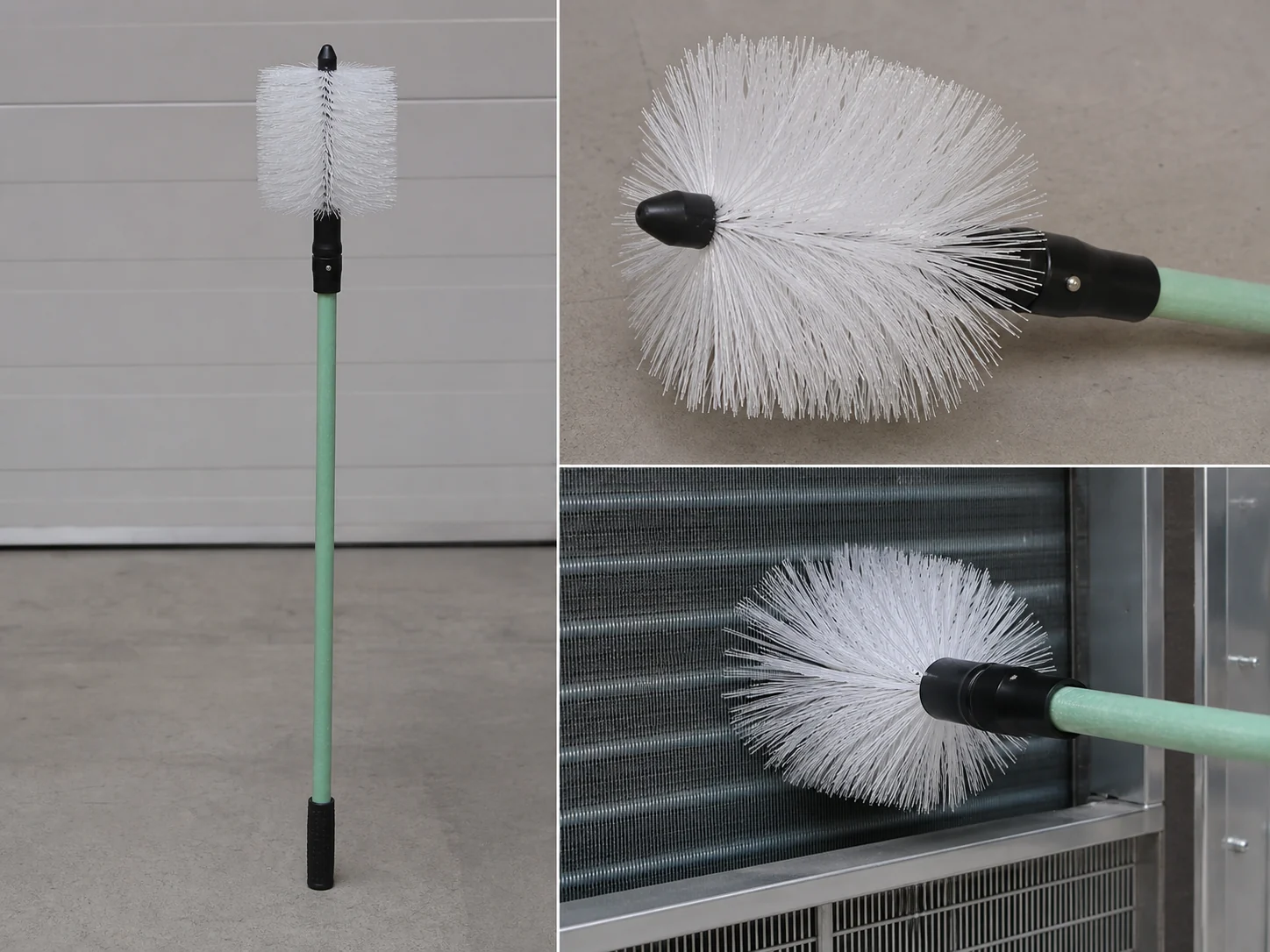
Order the 150mm PP ventilation brush with twisted stainless steel core and quick-change coupling.
Small brush
500 pcs
Minimum order
Held in one hand: tube, bottle, detail and swab brushes — including long-handled ones with a small head.
Production lead time, once the specification is confirmed
- Up to 500 pcsWithin 7 days
- 501–50,000 pcsWithin 14 days
- Over 50,000 pcsWithin 21 days
Peak season can extend these times; the shipping date is confirmed in writing with your quotation. Sampling and shipping are quoted separately.
150mm PP Ventilation Brush is a round, stainless-steel twisted-core brush with polypropylene bristles sized to sweep air-conditioner vents, coils, duct walls, and air-handling passages. The 150 mm diameter provides full-internal contact in 145-165 mm round ducts and wide coil faces, while the PP fill removes dust, lint, pollen, soot film, and loose grease without scratching fins, louvers, or coated sheet metal.
What can this brush do for you?
Full-circumference contact in round ducts and vents
A 150 mm round head sweeps the entire inner wall of a 145-165 mm duct in a single push-pull pass. In square or rectangular duct sections, the same head works corner-to-corner with short rotating strokes, so the operator does not carry two brushes for one job.
Non-scratch contact on coil fins and coated vent faces
PP bristle tips flex under load. They lift off caked dust and lint but do not fold or score aluminum evaporator fins, powder-coated grilles, or galvanized duct liners the way stiff wire fill can. The same brush can move from the outdoor condenser face to the indoor vent without changing tools.
Moisture-tolerant fill that rinses clean after wet coil cleaning
Polypropylene does not absorb water and is resistant to mild alkaline coil cleaners and common degreaser dilutions. After a wet cleaning pass, the bristle section can be rinsed and air-dried without rusting, mildewing, or losing shape, so it is ready for the next call.
Twisted stainless core holds fill during rotation and extension
The bristles are anchored between two stainless steel wire twists, not glued or stapled. When the brush is turned by hand or with a low-speed rod drive, the fill stays in place and the core resists corrosion from humid air handling spaces.
Quick-change coupling for extensions and head replacement
The standard connection accepts a matching quick-change extension or a rod/drill adapter, so the 350 mm bristled section can be pushed deeper without changing the grip. A worn head can also be swapped in seconds, and the handle and drive continue to be reused with other head sizes.
What is a 150mm PP Ventilation Brush?
A 150mm PP Ventilation Brush is a hand or rod-driven cleaning tool whose working end is a 150 mm diameter round brush head built from polypropylene bristles secured in a twisted stainless steel wire core. In use, the head is inserted through a vent opening, access door, or duct end, and moved back and forth or rotated so the bristle tips scrub the surfaces that the air stream has coated with dust, lint, pollen, soot film, or light grease.
The brush is designed for air-handling surfaces, not for wet household bottles or heavy descaling. It is most productive on accessible ventilation paths where the passage is close to 150 mm in diameter or where the area to be cleaned is at least as wide as the head: coil blocks, register interiors, plenums, duct runs, exhaust grilles, and filter housings. The PP fill is selected for surface protection and chemical tolerance, while the stainless core gives the head enough column strength to be pushed through a duct without folding over.
The brush works with pushing, pulling, and low-speed rotation. It is not a substitute for filter replacement, chemical coil flushing, or extraction equipment, and it should not be forced through bends tighter than the core can follow. When used within its design window, it clears the surface film that blocks airflow and hides coil condition.
Technical Specifications
| Parameter | Value / Options |
|---|---|
| Head diameter | 150 mm |
| Head shape | Round |
| Bristled working length | 350 mm standard; adjustable on custom orders |
| Bristle material | Polypropylene |
| Bristle diameter | 0.5 mm standard; 0.3-0.8 mm available |
| Bristle stiffness | Medium; adjustable by bristle diameter and trim length |
| Core / shaft | Twisted stainless steel wire; 304 SS standard, 316 SS optional |
| Handle | Stainless steel core with molded grip; 650 mm length, 30 mm grip diameter |
| Connection | Quick-change coupling for extension rods or low-speed rotary drive |
| Total usable reach | About 1,000 mm from grip end to brush tip in standard configuration |
| Operating temperature limit | Avoid continuous exposure above about 80 C at the bristle section |
| Chemical tolerance | Mild alkaline detergents, common coil cleaner dilutions, water; avoid strong chlorinated solvents and undiluted acids |
| Brush type | Custom Tube & Pipe Bore Brushes |
| How it is driven | Hand-guided |
| Cleaning target | evaporator and condenser coil face, return and supply grille, and round duct wall and short duct run cleaning |
| Surface or part | coils, passages, vents, fins, walls, coil faces, duct walls, and louvers |
| Residue or debris | dust, lint, grease, soot film, pollen, grease film, loose dust, and fiber |
| Mounting / connection | Quick-change coupling for extension rods or low-speed rotary drive |
Where does this brush work best?
- Evaporator and condenser coil faces – the 150 mm width covers a 150 mm-wide coil block in one pass. PP tips brush dust and lint from fin surfaces and loosen debris before rinsing, without bending the fins.
- Return and supply grilles, registers, and diffusers – clears soot film, pollen, and surface dust from painted or coated louvers without leaving scratch marks.
- Round duct walls and short duct runs – full contact in 145-165 mm round passages; in rectangular ducts, the round head cleans flat faces and corners with rotating strokes.
- Air handler cabinets, filter housings, and accessible plenums – removes loose dust and lint that accumulates between filter changes and around access panels.
- Exhaust vents and light-duty return paths – handles loose grease films and fiber buildup in accessible bathroom or kitchen exhaust passages, but not baked-on grease deposits.
How do I choose the right one?
Check the narrowest passage first
Measure the smallest internal diameter or width the brush must pass through. This 150 mm head works best in passages with a narrowest ID of about 145-165 mm. Below 140 mm the head will bind and the fill will fold against the core. Above about 170 mm it will not contact the entire wall, although it can still clean wide flat coil faces.
Match the fill to the residue and surface
PP bristles handle loose and lightly packed dust, lint, pollen, soot film, and light grease films. If you need to remove baked-on carbon, mineral scale, heavy tar, or rust, select a stiffer PBT or nylon fill or a wire brush. If the surface is a delicate coated fin pack, a thinner PP bristle diameter or shorter trim length will protect it while still lifting dry debris.
Confirm the chemical and temperature environment
Polypropylene tolerates most alkaline coil cleaners, mild acid rinses, and water. If the job uses strong aromatic or chlorinated solvents, continuous hot air above 80 C, or aggressive chemical immersion, choose nylon or PBT fill and check the core grade. Use 316 SS in chloride-heavy environments.
Decide hand or powered motion
Hand push-pull is standard for short vent and coil jobs. With a quick-change adapter, the brush can be rotated at low speed for round ducts; keep speed low and feed slowly so the head stays centered. Do not use a high-speed drill on painted or finned surfaces without testing.
| Condition | Recommended choice |
|---|---|
| Round duct ID 145-165 mm | 150 mm PP head, hand or low-speed rotation |
| Passage narrower than 140 mm | Smaller diameter brush or tube brush |
| Heavy grease, scale, or corrosion | Stiffer nylon/PBT fill or wire brush |
| Strong solvent or temperature above 80 C | Nylon/PBT fill with appropriate core |
| Delicate fin pack requiring very light touch | Softer PP bristle diameter or short fill |
Can I customize this brush?
The 150mm PP Ventilation Brush is a standard part, but most ventilation jobs have specific passage sizes, drives, and chemistry. The following variables can be adjusted. Send the narrowest duct ID, passage length, insertable depth, cleaning chemical, and whether the brush will be hand-driven, rod-extended, or rotated with a drill.
- Head diameter and head length – other diameters and bristled lengths for duct ID, coil width, or short plenums.
- Bristle fill – PP diameter from 0.3 to 0.8 mm, bristle trim length, fill density, or alternative nylon/PBT material for chemical or temperature requirements.
- Core – 304 or 316 stainless steel, or a project-specified grade for chloride exposure and humidity.
- Handle and grip – length, grip diameter, molded grip style, T-handle, loop, or dual-handle configurations.
- Connection / drive – quick-change adapters, threaded end, hex shank for drill, eye shank, or existing rod interface dimensions.
- Color and marking – custom bristle color, handle color, pad print or laser marking for brand identification.
- Packaging – bulk, polybag, display-ready hanger tag, or project-specific packing with part number labels.
If your project requires material declarations, inspection reports, or third-party testing for a specific installation, we can support those requirements during the customization process.
When is a 150mm PP ventilation brush worn out rather than just dirty?
What should I check before pushing the brush into a duct?
Confirm the duct is empty of sensor wires, fasteners, and debris that could snag the fill. Check that the quick-change coupling is fully seated and the head is not bent. If the passage ID is below 145 mm, stop and switch to a smaller head instead of forcing the brush.
Can I rotate this brush with a drill?
The quick-change coupling accepts a low-speed rod or drill adapter. Keep the speed low, roughly 400-500 rpm maximum, and feed the brush steadily. High speed can whip an unsupported core, skid the bristles over the surface, and scuff painted duct walls.
How do I know when the head should be replaced?
Replace the head when the bristle tips look rounded and shorter, the head diameter has visibly shrunk, the core shows a permanent bend, or the coupling wobbles when tightened. A good field check is to insert the brush into a known 160 mm duct and confirm the bristles still contact the wall around the full circle; if there are gaps, the fill is worn.
How should the brush be cleaned and stored after use?
Rinse the PP fill with water after wet coil cleaning or chemical exposure, shake out the water, and hang the brush to air dry. Do not soak it in strong solvents or leave it in direct sunlight for long periods. Store it straight or coiled loosely; a bent core cannot be straightened repeatedly without weakening.
Does brushing a coil or vent replace standard filter service?
No. The brush removes surface dust, lint, and film from accessible surfaces, but it does not replace the air filter, clean the blower wheel, or flush material trapped inside the drain pan. Filter replacement and chemical coil treatment should still follow the equipment schedule; brushing prepares surfaces and improves contact before and after those steps.
What is the tightest bend this brush can pass through?
The 150 mm head with the standard stainless core is meant for straight or gently curved passages. For a 90-degree elbow or tight flex-duct bend, the head must have already passed the bend; it will not turn inside the bend. Use a smaller-diameter or flexible-core brush for tight radius passages, and keep the bristled section entirely inside the straight section when rotating.
Guides that go deeper on this
Custom Manufacturing RFQ
Describe Your Application
To prepare the correct quotation, provide the dimensions, cleaning task, residue, material, mounting details, quantity, and a drawing or photo.
Drawing or photo optional — it speeds things up, it does not gate the enquiry.
Custom Brush RFQ
Send Your Brush Project
Upload a drawing, product photo, or sample photo and provide the core dimensions and cleaning conditions.
“We need a brush to remove wet residue from a stainless steel conveyor, about 800mm wide. The current brush wears quickly. We can send photos.”
“We sell drinkware and need a cleaning brush to include with the product. Quantity around 5,000 pieces.”