
Custom Cleaning Brush
600x20mm Carbon Fiber Static Eliminator Brush
600 mm fixed carbon fiber static eliminator brush with 20 mm bristle projection for grounded ESD dust removal on film, sheet, paper, web, and panel lines.
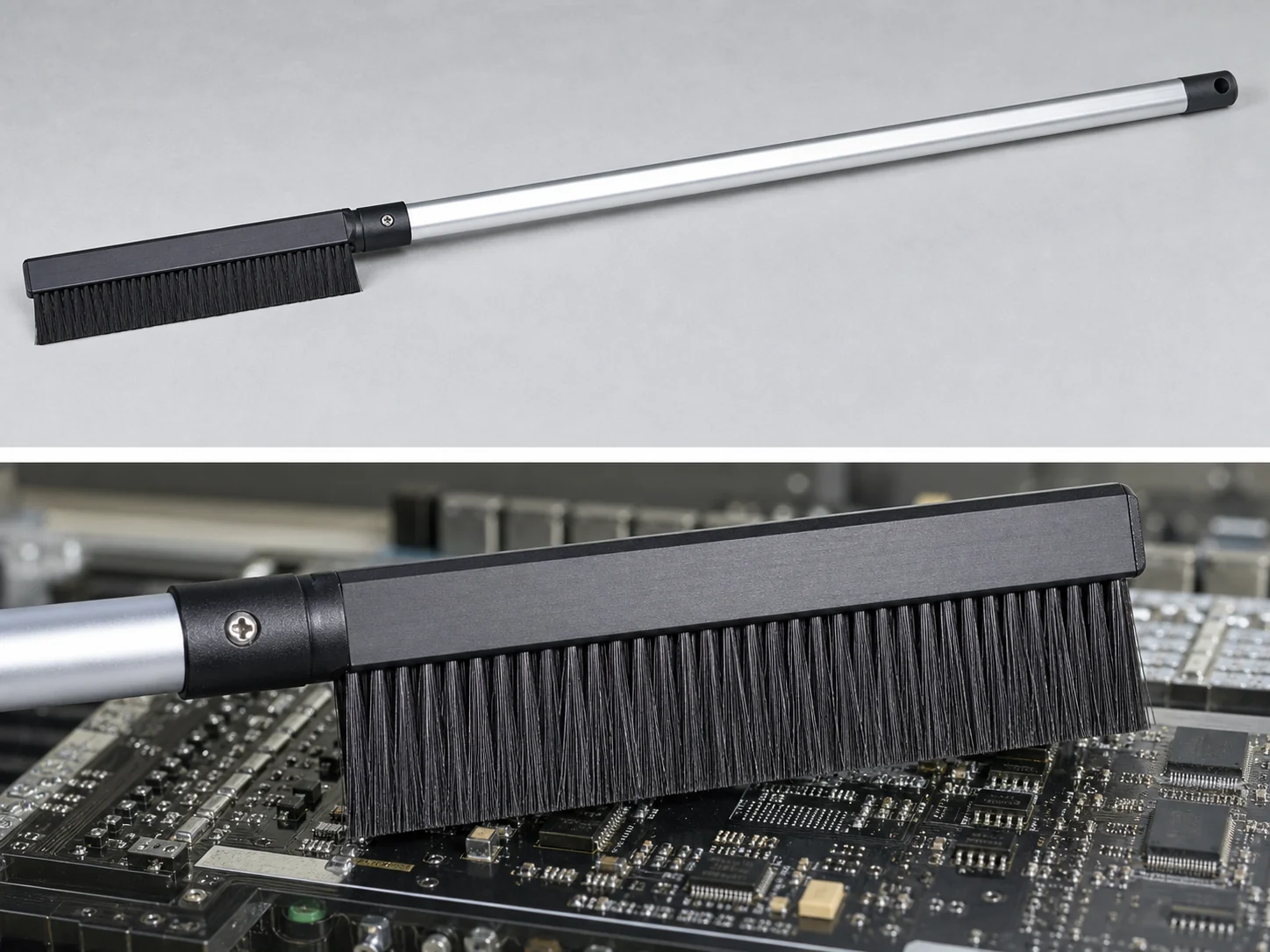
Medium brush
100 pcs
Minimum order
Worked with two hands or on a pole: chimney, gutter and pond-filter brushes, discs, cups and tank brushes.
Production lead time, once the specification is confirmed
- Up to 100 pcsWithin 7 days
- 101–5,000 pcsWithin 14 days
- 5,001–50,000 pcsWithin 21 days
- Over 50,000 pcsConfirmed with your quotation
Peak season can extend these times; the shipping date is confirmed in writing with your quotation. Sampling and shipping are quoted separately.
A 600 mm-long grounded carbon fiber linear brush with 20 mm bristle projection for neutralizing static and sweeping loosened dust from moving film, sheet, paper, web, and panel surfaces. The fixed 6061-aluminum profile mounts directly across the conveyor or web path to provide continuous, non-powered ESD dust control.
What can this brush do for you?
One continuous 600 mm contact line across the web
A single bar spans the full 600 mm working width, eliminating the uncovered lanes that appear when several short brushes are butted together. For narrow-to-medium webs, panels, sheets, and tray lines, one fixed brush covers the material in a single pass.
Dissipates static while the surface is still in contact
Each conductive carbon fiber bristle acts as a discharge point. When the bar is bonded to the machine ground, charge on the moving film or panel has a continuous conductive path through the carbon fiber and 6061 aluminum base to earth. Dust loses the static force that was holding it while the bristle tips are still touching the surface.
Removes loose dust the static was holding
Light bristle contact disturbs particulate as the surface passes. Because the charge has been drained, the released dust does not immediately reattach. Position a vacuum slot, tack roller, or extraction hood directly after the brush to capture the material it has loosened.
Soft, compliant contact for sensitive substrates
The 20 mm free bristle projection gives the brush a controlled spring range. Carbon fiber tips are far less abrasive than steel or brass and apply much lower point pressure than coarse nylon, which matters on coated films, unpopulated boards, and decorative panels where scratches would be a reject.
Rigid aluminum base keeps contact even across the length
The fixed 6061 aluminum profile resists bending and sag, so mounting height and bristle pressure stay consistent from one end to the other. Once the bar is aligned, contact does not fall off in the middle of the web.
No power supply, no emitter points, no consumables
The brush is a passive ESD tool. The only required connection is a ground bond. There is no high-voltage power supply to maintain, no ion emitter to clean or replace, and no compressed air bank to tune.
What is a 600x20mm Carbon Fiber Static Eliminator Brush?
A 600x20mm Carbon Fiber Static Eliminator Brush is a fixed linear antistatic bar built around a rectangular 6061 aluminum extrusion with conductive carbon fiber bristles projecting 20 mm from the face. It is not a hand brush and is not operated like one; it is bolted across the path of a moving web, sheet, board, or panel and works as part of the static control line.
In operation, the bristle tips touch the charged surface as it passes. Static charge on the material follows the conductive carbon fiber into the aluminum base and then to the machine ground connection. At the same time, the moving contact dislodges loose dust and fibers that static was holding on the surface. The brush itself does not collect or store that dust; it must be captured by extraction or an adhesive collector downstream.
The 600 mm length defines the standard contact width, while the 20 mm dimension defines the bristle projection from the base. Installation requires a low-resistance electrical bond between the aluminum profile and equipment earth. The brush does not generate ions by itself and is not an active AC or pulsed-DC ionizing bar; it works by direct conductive contact with the substrate.
Technical Specifications
| Parameter | Specification |
|---|---|
| Overall length | 600 mm nominal; other lengths available to drawing |
| Bristle projection / trim height | 20 mm from the base face |
| Bristle material | Conductive carbon fiber filament |
| Base material | 6061 aluminum alloy, rectangular profile |
| Mounting | Fixed mounting holes or slots through the base, pattern matched to the machine frame |
| Bristle row configuration | Single row as standard; double row or staggered pattern on request |
| Operating principle | Passive static discharge through grounded conductive bristles |
| Grounding requirement | Low-resistance electrical bond from the base to machine earth |
| Environment | Dry and general production conditions; verify for sustained high-temperature, solvent, or chemical exposure |
| Brush type | Custom Strip Seal Brushes |
| How it is driven | Fixed in place, no drive of its own |
| Cleaning target | electronics assembly esd dusting, plastic film, and laminating nip cleaning |
| Surface or part | webs, panels, sheets, bars, profiles, conveyors, aluminum, and substrates |
| Residue or debris | dust, fiber, carbon, particles, fine particles, static-attracted particles, lint, and loose dust |
| Mounting / connection | Fixed mounting holes or slots through the base, pattern matched to the machine frame |
Where does this brush work best?
- Electronics assembly ESD dusting before pick-and-place, conformal coating, AOI, or final inspection, where static-attracted particles on PCB panels and trays are a direct cause of field returns.
- Plastic film, paper, label stock, and laminate converting lines where roll-to-roll movement generates static and pulls airborne dust onto the web before slitting, coating, or printing.
- Printing, coating, and laminating nips where a dust-free, charge-neutral web reduces pinholes, voids, and bonding defects.
- Flat panel, membrane, and touch-film handling where sheets pick up contamination from rollers, conveyors, and operator handling.
- Conveyor lines for trays, panels, and sheets where static holds lint and fine particles on the product surface and standard mechanical brushes alone cannot release them.
How do I choose the right one?
Work the selection from the production line, not just from the 600x20mm designation.
Check the required contact width
The bristled area should extend past the edges of the material by about 10–20 mm on each side, or multiple bars should be butted with slight overlap. For materials up to roughly 560–580 mm wide, a single 600 mm bar provides complete coverage. Wider webs need two or more bars with a repeatable overlap.
Set the bristle interference before locking the mount
The 20 mm projection is fixed, but the installed height decides how much the bristles bend. Start with light tip engagement of 1–3 mm of deflection. Run the material and watch for missed lanes at the edges or heavy drag in the center. Add only enough height adjustment to release dust and reduce the static reading, not more.
Verify the ground path
An ungrounded carbon fiber brush does not eliminate static and can become charged itself. Measure continuity from the aluminum base to the machine earth after installation. If the bond is poor, add a braided ground strap or clean the mounting surface and retest.
Match fiber fineness and density to the substrate
Fine, dense carbon fiber bundles give more discharge tips and gentler contact for films, coated sheets, and boards. Coarser or lower-density bundles apply more mechanical brushing force for textured paper or fiberboard but may mark sensitive lacquered surfaces. Always run a sample on production material.
Plan where the loosened dust goes
The brush releases particles; it does not trap them. Place the bar immediately before a vacuum slot, extraction hood, or contact tack roller. Otherwise the loosened dust can redeposit downstream and the brush appears to underperform.
When to select a different static control method
For non-contact neutralization across large gaps, recessed areas, or formed plastic parts, an AC or pulsed-DC ionizing bar will be more suitable. For heavy abrasive particles, oily residues, or wet chemical cleaning, a powered scrubber or wipe system is the better tool. The carbon fiber bar is the right choice when the process allows light contact on a dry moving surface and the goal is passive discharge plus dust release.
Can I customize this brush?
600 x 20 mm is the production baseline. The bar can be adapted to the actual mounting position, substrate width, and process conditions. Provide the machine rail dimensions, web or panel width, line speed, surface material, available overhead clearance, and the intended ground point when requesting a custom version.
We can adjust:
- Length and segmentation — exact cut length, longer bars, multiple bars with overlap, or end-trimmed sections
- Bristle geometry — projection length, carbon fiber grade, fiber diameter, bundle density, single or double row, staggered pattern, or angled trim
- Base and mounting — 6061 aluminum profile dimensions, anodized finish, hole pitch, slot pattern, mounting brackets, shims, or height-adjustable fixings
- Grounding hardware — ground lugs, braided straps, pre-wired terminals, or dedicated earthing points
- Identification — part number engraving, labels, color marking, or batch traceability
- Packaging — bulk, individually sleeved, or project-specific packing for line-side kits
If the project requires material documentation, dimensional drawings, pre-production samples, grounding continuity verification, or third-party inspection to a customer specification, we can support those requirements during customization.
When is a 600x20mm carbon fiber static eliminator brush worn out rather than just dirty?
How can I verify the brush is actually reducing static?
Place a static field meter immediately downstream of the brush and compare the reading with the bar engaged versus lifted away from the web. Repeat the check at both edges and the center, since contact can drop off if the base is misaligned. If the reading stays high or loose dust reattaches further down the line, check the ground bond, bristle interference, and the position of the extraction point before changing the brush.
Can I cut the 600 mm bar to length on site?
The aluminum profile can generally be cut, but a site cut usually leaves an unfinished end that needs clean deburring, new mounting holes, and a re-established ground path. If you cut through the bristle row, the trimmed edge may lose fiber density and contact uniformity. Ordering the exact length with the mounting pattern ready is usually more reliable than modifying a stock bar.
Does the carbon fiber brush shed particles onto the product?
Carbon fiber can release microscopic fibers if the bristles are over-deflected, damaged, or allowed to wear against sharp edges. Use the lightest interference that still reduces static, inspect the web with a bright light after a trial run, and check the area around the brush for loose fiber fragments. If particle counts are critical, ask for a finer filament grade and add downstream inspection or cleaning.
What should I check during routine inspection?
Inspect the bristles for shortening, matting, contamination, or missing bundles. Run a continuity check from the bristle tips to the base and from the base to earth. Look for dust build-up at the base of the bristles that could insulate the conductive path. If the bristles no longer recover their original height or the static reading after the brush does not drop, replace or reset the bar.
Will the carbon fiber scratch the surface?
Carbon fiber is much softer than metal wire and usually safe for films, boards, and coated sheets when contact is light. However, very soft lacquered or decorative surfaces can still be marked if the interference is too high or the fiber bundle is too coarse. Test on a scrap sample and keep the bristle deflection to the minimum that still releases dust and reduces static.
Can the brush be used in a washdown or wet process?
It is intended for dry and clean production environments. Liquid films, oils, or heavy moisture can coat the carbon fiber and interrupt the discharge function, and harsh chemicals can attack the aluminum profile over time. For wet or chemically aggressive lines, select a scrubber or a sealed cleaning system designed for that environment.
Guides that go deeper on this
Anti-Static Strip Brushes: What Sets the Resistance?
Read this guideGuideBattery Separator Brushes: Cleaning and Static Elimination
Read this guideGuideConveyor Belt Cleaning Brush Design
Read this guideGuideCustom Brush Sampling and Validation Plan
Read this guideGuideIndustrial Brush Wear Patterns and Corrective Actions
Read this guideCustom Manufacturing RFQ
Describe Your Application
Please share the brush dimensions, working area, residue type, material direction, quantity, and a drawing or photo for quotation.
Drawing or photo optional — it speeds things up, it does not gate the enquiry.
Custom Brush RFQ
Send Your Brush Project
Upload a drawing, product photo, or sample photo and provide the core dimensions and cleaning conditions.
“We need a brush to remove wet residue from a stainless steel conveyor, about 800mm wide. The current brush wears quickly. We can send photos.”
“We sell drinkware and need a cleaning brush to include with the product. Quantity around 5,000 pieces.”