
Custom Cleaning Brush
Air Duct Cleaning Brush
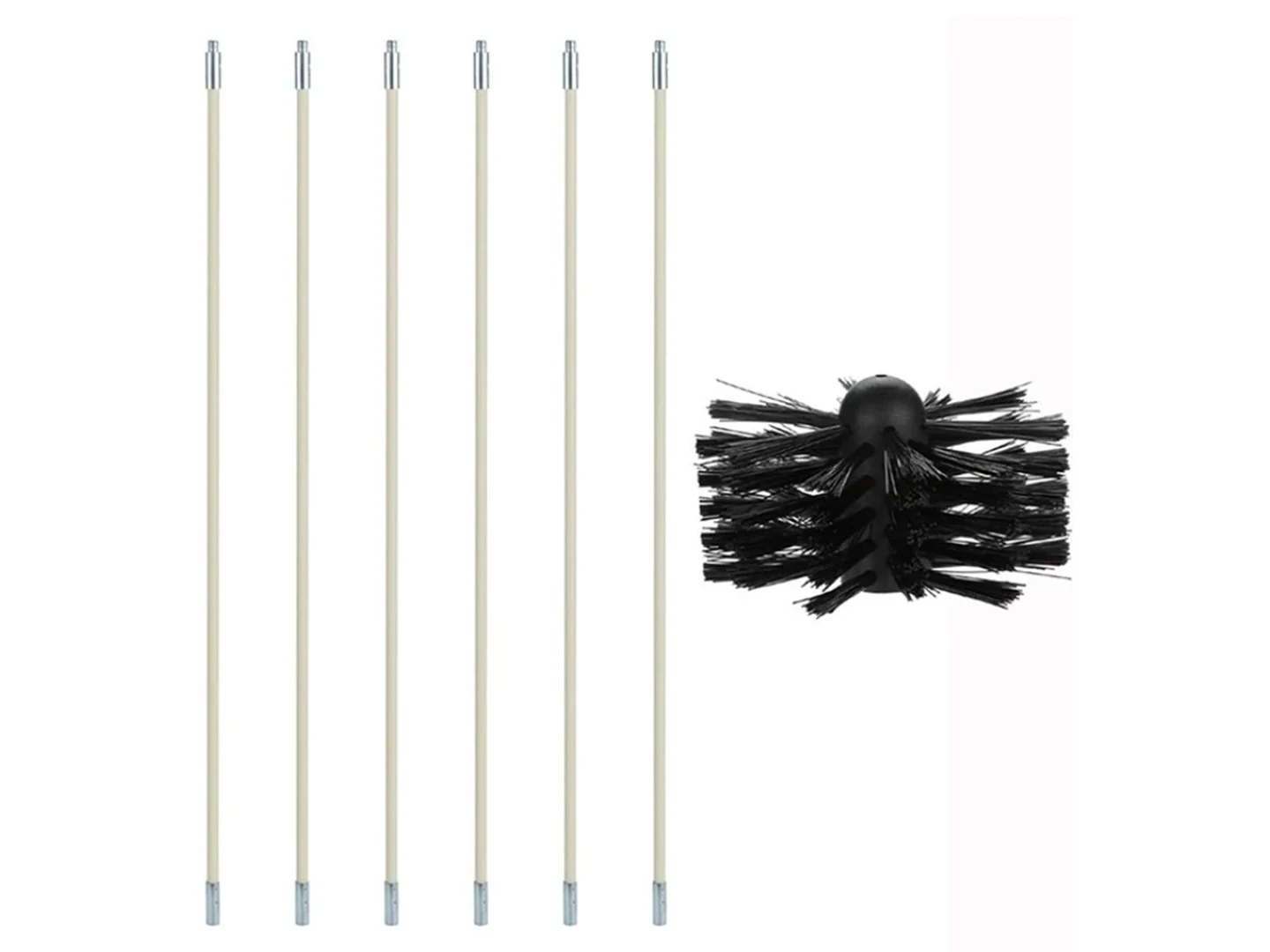
Rotary air duct cleaning brush with flexible shaft reach of 5–30 m, Nylon PA or PP filaments, and round or rectangular heads to match 100–450 mm duct IDs.
Small brush
500 pcs
Minimum order
Held in one hand: tube, bottle, detail and swab brushes — including long-handled ones with a small head.
Production lead time, once the specification is confirmed
- Up to 500 pcsWithin 7 days
- 501–50,000 pcsWithin 14 days
- Over 50,000 pcsWithin 21 days
Peak season can extend these times; the shipping date is confirmed in writing with your quotation. Sampling and shipping are quoted separately.
A machine-driven rotary brush that runs through round or rectangular duct runs to scrub accumulated lint, dust, soot, and loose deposits from the inside surfaces of the duct. The flexible shaft places a matched-diameter brush head against the duct wall so the operator can clean long, bending passages from a single access point.
What can this brush do for you?
Scrubs the entire duct wall, not just the centerline
Round and rectangular heads are sized to the duct interior, with filaments arranged to contact the circumference or all four walls. A brush that is near the duct ID or slightly oversize lets the filaments bend against the surface and wipe it, instead of leaving a dust band along the top or corners.
Reaches long runs and bends from one access point
The flexible shaft carries the head through straight sections, elbows, and offsets over a reach of 5–30 m. This removes the need to open the duct at every turn or cut additional access holes when the existing opening allows the shaft to pass.
Lifts lint, dust, and soft deposits without cutting into the liner
Nylon PA and Polypropylene PP filaments remove packed lint, loose soot, dust, light grease film, and scale without the sharp edge contact of wire. Galvanized steel, flexible duct, and internally insulated liners stay intact during repeated cleaning passes.
Forward and reverse rotation clears binding and loosens packed debris
Because the drive runs in both directions, the operator can reverse the brush when the head meets resistance at an elbow or a plug. Short forward/reverse pulses break up compacted lint and let the shaft retract without forcing it through the duct.
One shaft supports multiple duct profiles
Round heads, rectangular heads, and custom profiles can be fitted to the same flexible shaft and drive connection. A service team can switch from a 100 mm round dryer vent head to a 450 mm rectangular supply duct head without replacing the full rig.
Wet or dry cleaning with the right filament grade
Nylon PA covers dry dust and lint service. Polypropylene PP is available for wet washing, kitchen exhaust film, or chemical exposure because it absorbs less moisture and resists hydrolysis better in damp duct conditions.
What is an Air Duct Cleaning Brush?
An Air Duct Cleaning Brush is an active rotary cleaning tool, not a passive pull-through. A brush head with outward-facing filaments mounts on a flexible shaft, and the shaft is driven by an electric drill or a dedicated duct cleaning machine. The operator inserts the head through a register opening, access port, or plenum, then rotates and feeds the shaft along the duct while the filaments scrub the wall.
The brush diameter is matched to the duct ID so the filament tips deflect against the surface while the core spins. Round heads work on the full circumference; rectangular heads scrub flat sides and corners. Behind the head, loosened material moves along the duct until it is collected at an access point or by a vacuum system.
The brush loosens and transports deposits; it does not collect them. It is not a substitute for negative air collection, and it is not designed for hard, baked-on scale or cured creosote that requires metal bristles or chemical treatment before brushing.
Technical Specifications
| Parameter | Specification / Options |
|---|---|
| Compatible duct size | 100–500 mm internal diameter or equivalent rectangular dimension |
| Brush head diameter | 100–450 mm, selected to match the duct ID |
| Head profile | Round, rectangular, or custom geometry to match the duct cross section |
| Flexible shaft reach | 5–30 m, single length or coupled sections |
| Filament material | Nylon PA for dry service; Polypropylene PP for wet, greasy, or chemical exposure |
| Filament diameter | 0.30–1.00 mm, selected for residue type and liner sensitivity |
| Contact fit | Near-size for wiping; 5–20% oversize for flexible polymer scrubbing |
| Brush head working width | 10–150 mm, chosen for stroke pattern and access port size |
| Drive connection | Forward/reverse rotary; 1/4 inch hex, square, round with set screw, or project-specific coupling |
| Operating environment | Air side only for standard Nylon; wet washing supported when PP filament and corrosion-resistant fittings are specified |
| Brush type | Custom Tube & Pipe Bore Brushes |
| How it is driven | Hand-driven on rods or a flexible shaft |
| Cleaning target | hvac supply and return duct, clothes dryer vent, and bathroom exhaust and utility ventilation line cleaning |
| Surface or part | walls, passages, dryer vents, metal, duct walls, elbows, bends, and aluminum |
| Residue or debris | dust, lint, soot, grease film, scale, loose deposits, ash, and fiber |
| Mounting / connection | Forward/reverse rotary; 1/4 inch hex, square, round with set screw, or project-specific coupling |
Dimensions, filament package, and drive connections are adjustable per project. Refer to the customization section for what to provide with an inquiry.
Where does this brush work best?
- HVAC supply and return ducts — dust, fiber, and light film in galvanized, aluminum, or flexible ducts from 100 mm to 500 mm.
- Air conditioning system ducts — lint and dust accumulation behind registers, grilles, and plenums.
- Clothes dryer vents — long runs with multiple elbows where lint packs against the wall.
- Kitchen exhaust and range hood ducts — mixed grease film and dust; PP filament or wet cleaning compatible.
- Bathroom exhaust and utility ventilation lines — light lint and dust in smaller round ducts.
- Residential and light commercial flue passages — loose soot and fly ash where metal wire would risk liner damage.
How do I choose the right one?
Start with the duct cross section and access opening
Measure the minimum internal diameter for round ducts, or the width and height for rectangular ducts. Also measure the smallest access opening the head must pass through. The head profile must match the duct shape, and the head must fit through the opening without excessive force.
Set brush diameter and interference
Use a near-size head for a wiping action. For flexible polymer filaments, use 5–20% oversize to create wall pressure while still allowing the shaft to rotate. Lower interference is safer for flexible or lined ducts; higher interference scrubs harder but increases drive torque demand.
Choose filament material and diameter
Nylon PA is the standard for dry dust and lint. PP is the better choice for wet washing or grease film. Finer filaments from 0.30 to 0.50 mm give a softer, finer wipe on sensitive liners; heavier filaments up to 1.00 mm apply more pressure and survive coarser deposits.
Check shaft length, bends, and drive
Measure from the access point to the farthest section to be cleaned. Confirm the shaft can pass every bend without kinking. Match the drive coupling to the drill or machine, and make sure the power source has enough torque for the head diameter and interference. If the shaft length exceeds 30 m, add another access opening and clean in sections.
Know the limits of polymer filaments
Nylon and PP are the right contact for lint, dust, soot, and soft deposits. They are not the right contact for hard scale, baked-on carbon, or cured creosote. For those residues, use a wire brush or chemical pretreatment first, then finish with this brush if the duct surface allows.
| Cleaning situation | Recommended configuration |
|---|---|
| Dry residential HVAC, light dust | Nylon PA, near-size round head, 0.30–0.50 mm filament |
| Long dryer vent with tight bends | Flexible shaft, near-size round head, 0.40–0.60 mm filament |
| Greasy kitchen exhaust | PP filament, 10–15% oversize, round or rectangular profile |
| Rectangular duct | Rectangular head matched to internal width and height |
| Flexible or lined duct | Near-size to 5% oversize, 0.30–0.50 mm polymer filament |
| Hard scale, baked-on deposits, cured creosote | Not recommended — switch to wire brush or chemical pretreatment first |
Can I customize this brush?
This brush is built around the duct geometry, residue, and access conditions. To define the correct build, we need the minimum duct ID or width and height, duct shape, distance from the access point to the farthest reach, number and radius of bends, access opening size, drive type and power, whether the service is wet or dry, liner type, and the primary deposit. A dimensioned sketch or photos of the duct interior and access point will shorten the review.
Adjustable parameters include:
- Head geometry — round, rectangular, oval, or custom cross section; diameter 100–450 mm or project-specific; head working width 10–150 mm.
- Filament package — Nylon PA or PP, filament diameter 0.30–1.00 mm or project-specific, straight or crimped filament, trim length and density.
- Flexible shaft — reach 5–30 m or longer in coupled sections, shaft flexibility, stainless or coated construction, quick-connect or fixed couplings.
- Drive end — 1/4 inch hex, square, round with set screw, quick-release, or machine-specific coupling.
- Accessories — centering discs or guides, end caps, safety tips, color coding by duct size.
- Marking and packaging — custom color, laser marking, pad print, bulk packing, individual bags, or kitted sets.
For projects that require material declarations, inspection reports, or third-party testing support, provide the specification during configuration review and we will address the requirement before sampling.
What has to be checked before and after an air duct cleaning brush is used?
How can I confirm the brush contacts the duct wall?
After inserting the head, rotate briefly and pull back about 100 mm, then inspect the duct wall with a light from the access opening. A clean, continuous contact band with no thick residual dust line indicates proper contact. If the brush spins freely with no visible wall contact, the head is too small; if the drive labors and the head cannot reverse, it is too large or binding in a bend.
Do I need to remove registers and grilles before running the brush?
Yes. Remove all detachable registers, grilles, vent covers, and internal fittings that block the passage or have sharp edges. These parts are cleaned separately, and removing them prevents the brush head from catching or damaging the fittings.
Should the brush run in forward or reverse inside the duct?
Use forward rotation for scrubbing and advancing. Switch to reverse when retracting, when the head binds at an elbow, or when a lint plug is blocking the passage. Short forward/reverse pulses often loosen packed lint without forcing the shaft.
Does the brush collect the debris it loosens?
No. The brush dislodges and moves debris along the duct, but it is not a collection device. Run the cleaning sequence with a vacuum or negative air machine connected downstream, or collect loosened debris manually at the next access opening.
What should I inspect on the brush between jobs?
Check the shaft for permanent kinks, broken couplings, or damaged quick-connects. Inspect filaments for excessive wear, permanent flattening, or missing tufts. If the head no longer returns to its original diameter or the shaft no longer rotates freely through bends, replace the brush or the affected section.
Can this brush be used in ducts with internal insulation or flexible liner?
Yes, if the fit is near-size and the filament is selected for the liner. Use 0.30–0.50 mm Nylon PA and keep oversize at 5% or less. High interference with coarse filaments can abrade or tear the liner; confirm the liner condition before the first pass.
Guides that go deeper on this
Custom Manufacturing RFQ
Describe Your Application
Please include the main sizes, application, residue, preferred material, interface, quantity, and any drawing or sample available.
Drawing or photo optional — it speeds things up, it does not gate the enquiry.
Custom Brush RFQ
Send Your Brush Project
Upload a drawing, product photo, or sample photo and provide the core dimensions and cleaning conditions.
“We need a brush to remove wet residue from a stainless steel conveyor, about 800mm wide. The current brush wears quickly. We can send photos.”
“We sell drinkware and need a cleaning brush to include with the product. Quantity around 5,000 pieces.”