
Custom Cleaning Brush
Electronic Cigarette Mouthpiece Brush
Custom electronic cigarette mouthpiece brush for vape mouthpiece bores and air paths. Nylon PA/PBT filaments, 1–10 mm diameters, stainless steel core.
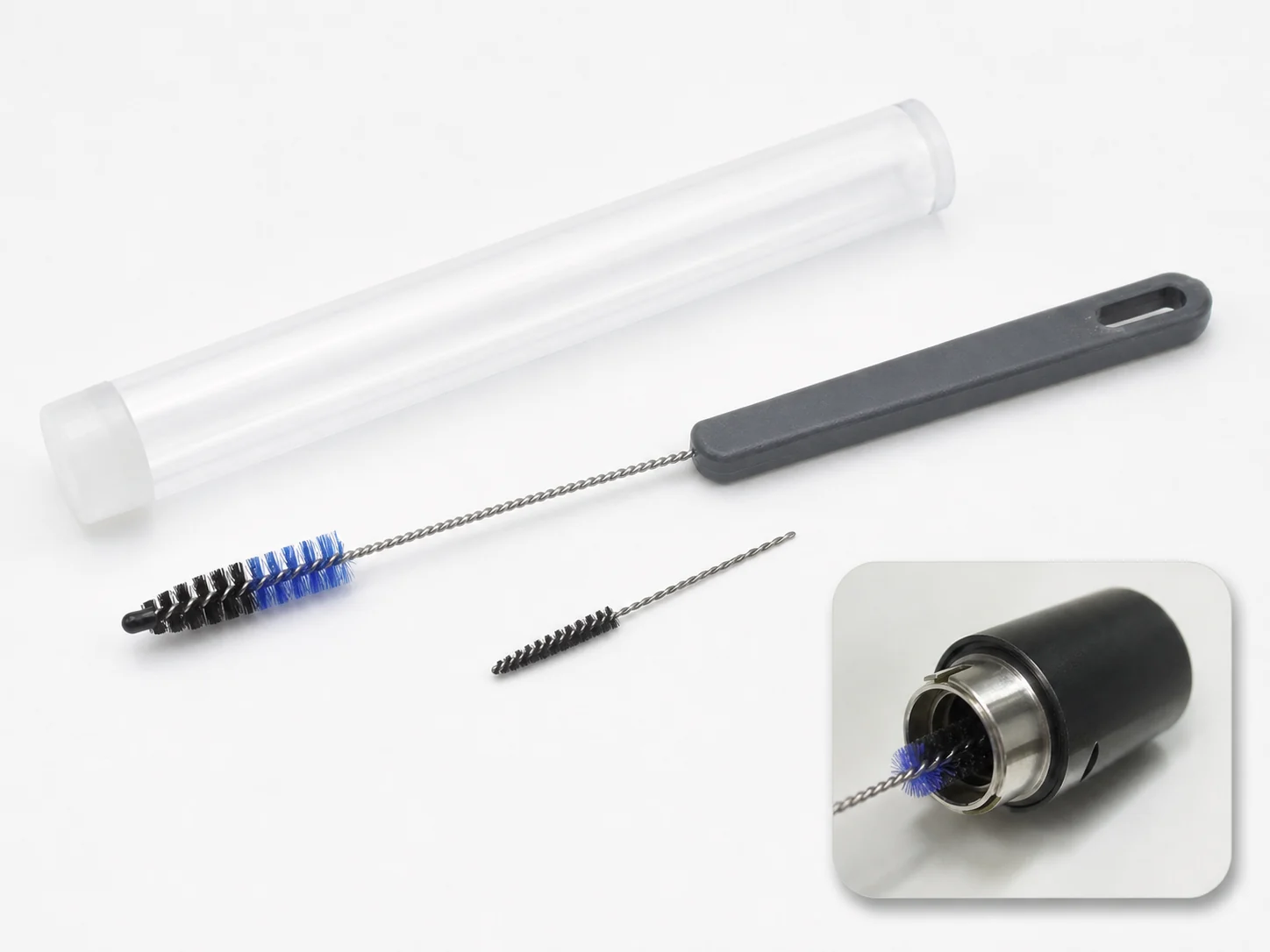
Small brush
500 pcs
Minimum order
Held in one hand: tube, bottle, detail and swab brushes — including long-handled ones with a small head.
Production lead time, once the specification is confirmed
- Up to 500 pcsWithin 7 days
- 501–50,000 pcsWithin 14 days
- Over 50,000 pcsWithin 21 days
Peak season can extend these times; the shipping date is confirmed in writing with your quotation. Sampling and shipping are quoted separately.
A small-diameter twisted-wire brush designed to clean e-cigarette and vape mouthpiece bores, drip tips, and accessible air channels. Its nylon PA or PBT filaments remove e-liquid condensate, flavor residue, and loose deposits while protecting plastic, acrylic, and coated mouthpiece surfaces.
What can this brush do for you?
Enters Narrow Mouthpiece Bores Without Forcing
Brush diameters from 1 mm to 10 mm let the tool pass through typical drip tip and mouthpiece openings while the radially arranged bristles contact the full inner wall. Light push, pull, and rotating motions cover the bore without jamming the core.
Breaks Up Sticky Condensate and Flavor Film
Nylon or PBT bristle tips loosen e-liquid residue, condensate, and flavor deposits that cling to the mouthpiece bore and nearby air channels. The bristles release the loosened material during rinsing instead of holding it, so the cleaned surface returns to normal airflow and neutral flavor faster.
Gentle on Plastic, Acrylic, and Coated Components
The bristles, not the metal core, do the contacting work. When the tip is specified as looped, crimped, or coated, no exposed wire end can touch the mouthpiece floor or sidewall — a key detail for polycarbonate, PCTG, and clear or polished components.
Follows Angled and Curved Passages
The twisted stainless steel core can be built with a smaller wire diameter for more flex, letting the brush follow the draft or curve of a mouthpiece instead of gouging the wall. This makes it practical for angled drip tips and mouthpieces with a non-straight internal path.
Resists Common Cleaning Media
Nylon PA and PBT filaments tolerate short exposure to isopropyl alcohol, warm water, and typical e-liquid constituents. Choose PBT when the brush will be wet-cleaned frequently, because it absorbs less moisture and holds its shape longer.
What is an Electronic Cigarette Mouthpiece Brush?
An electronic cigarette mouthpiece brush is a hand-guided mini brush with a twisted stainless steel wire core and radially anchored nylon PA or PBT filaments. It is sized to enter the mouthpiece bore of a vape device or drip tip and clean the accessible portion of the air path. It does the job that cotton swabs and pipe cleaners often do poorly: reaching a small cylindrical bore, contacting the full wall, and removing residue without leaving fibers behind.
In use, the operator inserts the brush through the mouthpiece opening and moves it in short push, pull, and rotating strokes. The bristles flex against the inner wall, shoulder, and transition areas, loosening e-liquid condensate and flavor residue. After brushing, a rinse carries the loosened material away.
This brush is intended for accessible mouthpiece and air-path surfaces only. It is not designed to scrub the atomizer coil, heating chamber, or deep tank compartments that cannot be reached through the mouthpiece opening. Those areas require the device to be disassembled and may need a different cleaning method.
Technical Specifications
All dimensions and materials can be adjusted to your mouthpiece bore ID, depth, and cleaning process. Typical production options are shown below.
| Parameter | Options / Notes |
|---|---|
| Brush diameter | 1–10 mm, matched to the smallest mouthpiece bore ID |
| Filament diameter | 0.20–0.40 mm (0.203–0.406 mm); finer for soft contact, heavier for more scrub |
| Filament material | Nylon PA6/PA66 or PBT; color options available |
| Filament trim | Straight, tapered, or spiral; trim profile set to bore geometry |
| Core wire | 304 stainless steel twisted wire, 0.30–0.80 mm wire diameter; 316 optional |
| Fill length | 15–80 mm typical, can extend to full bore depth |
| Overall length | 50–200 mm, including bare wire tail or handle |
| Tip configuration | Loop, crimped, coated, or plain cut end; safety tip recommended for plastic parts |
| Handle | Bare twisted wire, molded PP/TPE, or loop handle; custom color and marking available |
| Operating exposure | Suitable for intermittent contact with PG/VG, mild detergent, and isopropyl alcohol; not for strong acids, chlorinated solvents, or temperatures above 100°C |
| Brush type | Custom Tube & Pipe Bore Brushes |
| How it is driven | Hand-guided |
| Cleaning target | detachable drip tip and mouthpiece, air inlet and outlet passages behind, and after-sales maintenance kits packaged cleaning |
| Surface or part | mouthpieces, bores, channel, plastic, passages, tanks, walls, and chambers |
| Residue or debris | flavor residue, dust, loose deposits, loose debris, and fiber |
| Mounting / connection | Threaded Removable / Fixed |
Where does this brush work best?
- Detachable drip tips and mouthpieces on refillable pod systems, tanks, and rebuildable setups where e-liquid residue builds up inside the bore.
- Built-in mouthpieces on disposable and open-system devices when the mouthpiece opening provides direct access to the air channel.
- Air inlet and outlet passages behind the mouthpiece, including small-diameter cylindrical channels and internal transitions that are hard to reach with cloths or swabs.
- Production and incoming-QC cleaning of molded mouthpiece parts before assembly, removing molding dust, handling residue, and loose debris.
- After-sales maintenance kits packaged with vape devices as a reusable cleaning accessory, or sold as a replacement item by distributors and retailers.
How do I choose the right one?
Start with the bore ID
Measure the smallest internal diameter the brush must pass through. Choose a brush diameter equal to the bore ID or up to about 0.5 mm larger for positive wall contact. If the mouthpiece material is soft or flexible, stay closer to the exact ID to avoid excessive friction.
Match filament stiffness to the residue
Light condensate and dust respond well to thinner 0.20–0.25 mm nylon filaments. Sticky flavor residue benefits from thicker 0.30–0.40 mm nylon or PBT filaments that provide more scrubbing pressure. Hardened or baked-on deposits should be soaked in water or alcohol first; brushing alone will not remove them.
Set the length and tip for the specific passage
Overall length should allow comfortable handling while the fill length reaches the full bore depth. For curved or angled passages, request a smaller core wire diameter for flex and keep the fill length short enough to bend without kinking. For blind bores or concave bottoms, choose a looped, crimped, or coated tip so no bare wire end contacts the plastic.
Decide on handle style
Retail and consumer kits usually work better with a molded PP or TPE handle that identifies the product and improves grip. Production or bulk use often calls for a bare twisted wire tail that can be inserted into a fixture or cut to a repeatable length.
When another option may be better
If the smallest bore ID is below 1 mm, or the passage bends sharply right behind the mouthpiece, a brush may not recover its shape and could kink inside. In those cases, a solvent flush, a small lint-free swab, or an ultrasonic bath may be more practical. If the residue includes burnt carbon or heavy mineral scale, move to chemical or ultrasonic cleaning before brushing.
Can I customize this brush?
Yes. This brush is built around your mouthpiece geometry and cleaning process. To define a custom configuration, provide the smallest bore ID, bore depth, mouthpiece material, type of residue, cleaning chemical, and whether a handle is required. A drawing, 3D file, or sample part helps us match the fit faster.
- Brush geometry: diameter, fill length, overall length, trim shape, bristle density, and tapered or stepped profiles.
- Filament: Nylon PA6/PA66 or PBT, filament diameter, stiffness, color, and chemical exposure rating for your process.
- Core: stainless steel wire diameter, twisted pitch, 304 or 316 grade, and tip loop, crimp, or coating.
- Handle and marking: bare wire tail, molded PP/ABS/TPE handle, custom color, pad print, laser mark, or molded brand logo.
- Packaging: bulk, individual polybag, retail card, custom label, private label, or kit assembly with other accessories.
- Project support: material documentation, inspection support, and assistance with third-party testing requirements for your cleaning accessory program.
How do you confirm an electronic cigarette mouthpiece brush has actually cleaned the surface?
What should I check on the brush before using it on a mouthpiece?
Check that no wire ends are exposed at the tip or along the core. Run a finger gently along the bristles to confirm they are evenly distributed and not splayed. If the tip is plain, inspect for bent or sharp wire points. Rinse the brush before first use to remove any manufacturing dust.
How do I clean and store the brush after use?
Rinse the brush in warm water or isopropyl alcohol, then shake out excess liquid and air-dry with bristles facing down. Store it dry and away from direct sunlight. If bristles become flattened or the core takes a permanent set, replace the brush; it will no longer contact the bore evenly.
Can this brush be used with an ultrasonic cleaner or in a heated wash?
The nylon/PBT bristles and stainless core tolerate short exposure to warm water and ultrasonic baths, but prolonged exposure above 80°C or aggressive cleaning solutions can weaken filaments. If your process includes heated or ultrasonic cleaning, specify the temperature, solution, and cycle time so we can confirm the right material combination.
Will this brush leave fibers inside the mouthpiece?
When built with a properly sized core and anchored filaments, this brush does not shed like cotton swabs. However, any brush can lose a filament if the core is damaged or the brush is forced through a too-small bore. Inspect for missing bristles after each use, and discard any brush that shows loss or rusting.
Can one brush clean multiple mouthpieces without flavor carryover?
If the brush is rinsed and dried between uses, flavor carryover is low but not zero. For product testing or flavor-sensitive applications, use one brush per flavor family or specify color-coded handles to reduce cross-contamination. For heavy residues, a fresh brush is more reliable than aggressive scrubbing.
Guides that go deeper on this
We have not written a guide specific to this one yet. The material that covers selection, filament, dimensions, maintenance and sourcing is collected in the technical resources library.
Custom Manufacturing RFQ
Describe Your Application
To prepare the correct quotation, provide the dimensions, cleaning task, residue, material, mounting details, quantity, and a drawing or photo.
Drawing or photo optional — it speeds things up, it does not gate the enquiry.
Custom Brush RFQ
Send Your Brush Project
Upload a drawing, product photo, or sample photo and provide the core dimensions and cleaning conditions.
“We need a brush to remove wet residue from a stainless steel conveyor, about 800mm wide. The current brush wears quickly. We can send photos.”
“We sell drinkware and need a cleaning brush to include with the product. Quantity around 5,000 pieces.”