
Custom Cleaning Brush
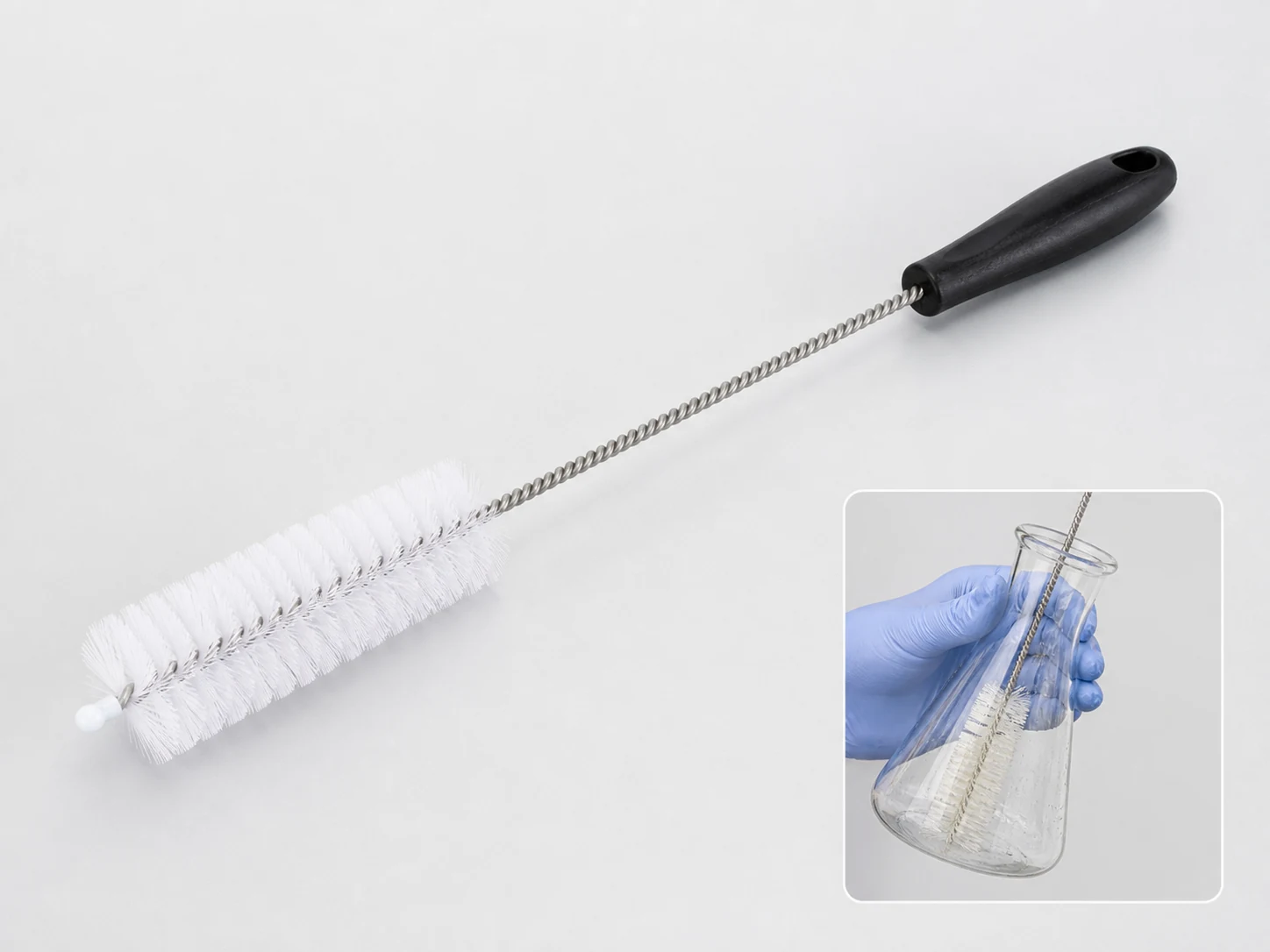
Erlenmeyer Flask Brush
Nylon Erlenmeyer flask brush for narrow-neck lab glassware. Reaches sloped shoulders and flat bottoms to remove reagent film, precipitate and detergent.
Small brush
500 pcs
Minimum order
Held in one hand: tube, bottle, detail and swab brushes — including long-handled ones with a small head.
Production lead time, once the specification is confirmed
- Up to 500 pcsWithin 7 days
- 501–50,000 pcsWithin 14 days
- Over 50,000 pcsWithin 21 days
Peak season can extend these times; the shipping date is confirmed in writing with your quotation. Sampling and shipping are quoted separately.
A nylon-bristled laboratory cleaning brush built for the narrow neck, sloped shoulder and flat bottom of an Erlenmeyer flask. It removes reagent film, precipitate, powder and detergent residue by hand without scratching standard lab glassware.
What can this brush do for you?
Flexes Through the Neck, Then Works the Full Body
Nylon bristles lay back to pass through the flask opening, then spring outward inside the conical body. Because the brush is sized to the flask body rather than the neck, you can clean wide-shouldered flasks through a comparatively small opening — the same access problem that defeats a straight sponge or an oversized cylinder brush.
Cleans the Sloped Shoulder Instead of Skipping It
The fan or bottle-form construction angles working filaments toward the angled wall of the flask. A straight tufted brush tends to spin freely in the sloped area and leave a ring of residue where the wall changes angle. This brush holds contact through the shoulder transition so reagent film and precipitate do not stay behind.
Applies Enough Pressure for Weakly Adhered Residue, Not Just Wiping
With a modest oversize fit, flexible nylon filaments press against the glass and scrub powder, fine precipitate, and soft film loose. Filament diameter and trim length can be selected for the deposit. Because nylon flexes on contact, cleaning pressure comes from the side of the bristle instead of a rigid edge against the glass.
Reaches the Flat Base Without Turning the Flask Upside Down
A tufted or covered working end carries bristles to the bottom surface, where crystalline residues and sediment collect. The operator can clean the base with vertical strokes and a short rotation instead of draining the flask into an awkward position.
Keeps Hands and Gloves Away From the Contents
An extended stem and a loop or straight handle place the grip outside the mouth while the working section is at the bottom of the vessel. For deep flasks, overall length can be matched to flask height so the operator is not holding the stem right at the rim.
What is an Erlenmeyer Flask Brush?
An Erlenmeyer flask brush is a hand-operated labware cleaning tool with a twisted-wire stem and a radial nylon filament working section formed specifically for conical narrow-neck glassware. Unlike a general-purpose bottle brush, the bristle profile is shaped to deal with three different surfaces along one stroke path: the cylindrical lower body, the angled shoulder transition, and the flat bottom.
During use, the operator inserts the working end through the neck, applies detergent or solvent, and works with push-pull and rotating strokes. Outer bristles flex along the sidewall and shoulder; the end tuft cleans the bottom. The brush is withdrawn through the neck the same way, with the bristles folding back for passage.
Because contact comes from flexible nylon filaments instead of a hard scraper, the brush removes loosely attached and lightly adherent residue without scratching standard borosilicate and soda-lime lab glass. It is not a replacement for a glassware washer or an aggressive abrading tool. Dried-on or charred deposits generally need soaking or a different contact material first.
Technical Specifications
Dimensions, filament diameter, stem material and handle form are project-adjustable. Confirm neck ID, body ID, flask depth and residue type so the brush can be sized to the flask instead of forcing a stock size.
| Parameter | Specification / Options |
|---|---|
| Brush diameter | 30–50 mm, matched to flask body ID |
| Working head length | 76–152 mm, selected to reach from shoulder to base |
| Overall length | 250–500 mm from loop or handle end to working tip |
| Filament diameter | 0.15–0.40 mm; finer for film wiping, heavier for scrubbing |
| Fill material | Nylon PA (PA6 or PA6.6 depending on chemical and wear balance) |
| End form | Tufted end, fan, cylindrical, or bottle-form |
| Stem | Twisted wire; galvanized steel or 304 stainless steel |
| Handle | Wire loop or extended straight handle; optional molded grip |
| Fill profile | Radial, tapered or fan trim for conical body contact |
| Chemical exposure | Compatible with common lab detergents, aqueous solutions and alcohol rinses; not recommended for strong mineral acids, phenols or strong oxidizers |
| Operating temperature | Suitable for routine warm detergent washing; validate for autoclave or hot solvent cycles |
| Brush type | Custom Bottle & Container Brushes |
| How it is driven | Hand-guided |
| Cleaning target | quality control and r&d laboratories cleaning erlenmeyer, glassware line, and academic and teaching labs processing multiple conical cleaning |
| Surface or part | flasks, shoulders, necks, glassware, glass, narrow necks, rims, and passages |
| Residue or debris | precipitate, powder, sediment, reagent film, detergent residue, detergent film, powder residue, and leaves |
| Mounting / connection | Threaded Removable / Fixed |
Where does this brush work best?
- Quality control and R&D laboratories cleaning Erlenmeyer flasks after reagent preparation, media mixing or titration work.
- Glassware lines where a washer leaves film at the shoulder line or sediment at the bottom and a manual touch-up is needed.
- Academic and teaching labs processing multiple conical flasks by hand between laboratory sessions.
- Environmental and water testing labs removing dried salt rings, powder residue, or detergent film from sample flasks.
- Food, beverage and microbiology support labs washing narrow-neck conical glassware before autoclaving or final rinse.
- Biotech and buffer preparation areas where soluble films and fine precipitates settle at the base and need gentle mechanical release.
How do I choose the right one?
Start with three measurements: the minimum neck ID, the widest internal body diameter, and the vertical distance from the shoulder to the bottom. These define the brush diameter, working head length and overall length. The mouth is the limiting dimension — the brush must pass through it, but all real contact happens beyond it.
Select the diameter from the body, not the neck
For nylon fill, a near-size diameter gives a light wiping action that removes thin films and loose reagent residue. A 5–20% oversize creates bristle deflection against the body and shoulder, which increases scrubbing pressure on powders and soft precipitates. The oversize range works because the polymer bristles flex as they pass the neck. If the job calls for stiff wire contact instead, the interference should be lower because wire filaments do not recover the same way — but wire is an alternative configuration, not the default for glass Erlenmeyer flasks.
Match the end form to where the residue collects
- Fan or bottle-form: best for broad shoulder contact and film lines.
- Tufted or radial end: best for the flat bottom and settled sediment.
- Cylindrical: best for the straight lower body when the shoulder slope is shallow.
- Hybrid fan with end tuft: covers the shoulder and bottom in one brush for heavily patterned flasks.
Select the stem and handle for how the flask is cleaned
Twisted-wire stems provide stiffness for push-pull motion, and a loop handle gives a natural twisting grip plus a hang point for drying. A long straight handle is better for deep flasks where the operator wants distance from the rim and chemical splash. Stainless steel stems are preferred where bleach, acid residues or repeated wet storage are normal; galvanized stems cost less but may corrode under those conditions.
Check nylon against the actual chemistry
Nylon PA handles standard laboratory detergents, aqueous solutions and alcohol rinses well. Strong mineral acids, hot phenols and strong oxidizing solutions degrade the filament over time; in those environments, specify a different filament material or plan for more frequent replacement. The cleaning chemical should be part of the selection conversation, not an afterthought.
When a different tool fits better
For an opening too narrow for the working head to pass, a straight tube brush or micro-bore brush gives better access. For hardened, baked-on or carbonized residues, a wire-fill or abrasive cleaning method may be required. For disposable cleaning or strict cross-contamination control, a single-use swab can be the better choice. Use the nylon Erlenmeyer flask brush when you need reusable, glass-safe manual cleaning of conical flasks.
Can I customize this brush?
Because Erlenmeyer flasks vary widely, the brush is usually sized to the individual flask rather than pulled from a one-size stock. To begin, provide the neck ID, body ID at the widest point, flask depth, glass type, residue to be removed, cleaning chemistry, wash temperature, and whether the brush will be autoclaved. A sample flask or a drawing with these dimensions shortens the sampling loop.
- Working head — diameter, length, taper, fan angle, tufted tip, bottle-form or hybrid geometry.
- Filament — nylon PA6/PA6.6, filament diameter, trim shape, fill density, or an alternative project-specific polymer when chemistry requires it.
- Stem — twisted-wire gauge, galvanized, 304 or 316 stainless, bare or coated, flexible or rigid, and tip finish such as covered loop, tufted or plain.
- Handle — wire loop, extended straight handle, optional molded grip, hanging feature, or ergonomic bend.
- Color and marking — color-coded bristles or grip for lab area identification, laser mark or pad print for asset codes.
- Packaging — bulk packs, individual polybags, lab kit quantities, or project-specific packing.
When your quality or purchasing group needs material declarations, batch records, inspection data, or support for project-specific testing, include those requirements in the inquiry and we can assist with the requested documentation.
Which filament survives the cleaning chemicals an erlenmeyer flask brush meets?
How do I check that the brush diameter will clear the neck before ordering?
The neck ID is the limiting dimension. If you cannot pass a simple cylinder or paper template with the intended brush diameter through the mouth, the fill is too large or the end form is too dense. For a reliable check, send the flask or a drawing with the neck ID and body ID, and we can trial the bristle deflection before full production.
What cleaning solutions are safe to use with the nylon filaments?
Standard lab detergents, neutral or alkaline aqueous cleaners, dilute alcohols and water-based rinse solutions are compatible with nylon PA. Avoid strong mineral acids, phenolic disinfectants and strong oxidizing agents, which attack the polymer. If your standard operating procedure uses one of these, note it during sizing so the filament can be specified for the chemistry.
Can the brush be autoclaved between uses?
Nylon can survive occasional steam exposure, but repeated autoclave cycles gradually reduce bristle stiffness and may damage a galvanized stem. If autoclaving is part of your routine, choose a 304 or 316 stainless steel stem and ask for an autoclave-compatible filament and grip configuration, then validate the sample under your actual cycle.
How do I know when the brush should be replaced?
Replace the brush when the bristles stay flattened after use, the stem has a permanent bend or a loose wire end, filaments are shedding, or rust appears on a galvanized stem. Also check the working end after repeated neck passes: if the tuft no longer returns to its original shape and bottom contact feels weak, it is time for a new brush.
Does the brush clean the entire inside of the flask in one pass?
No single pass can be assumed. Rotate along the sidewall, angle the stroke through the shoulder transition, and finish with vertical contact on the bottom. Then inspect the shoulder and base under good light before rinsing. If residue remains at the transition line, the end form or diameter needs adjustment, not more force.
Can I use the same brush for different Erlenmeyer flask sizes?
Only when the body diameters are close and the working length reaches the bottom of the smaller flask without excessive deflection in the larger flask. If your lab uses several flask sizes, it is normally better to assign one brush diameter and length per flask size or volume class. One oversized brush for all vessels can leave sloped walls uncleaned in larger flasks and risk jamming in smaller ones.
Guides that go deeper on this
We have not written a guide specific to this one yet. The material that covers selection, filament, dimensions, maintenance and sourcing is collected in the technical resources library.
Custom Manufacturing RFQ
Describe Your Application
To prepare the correct quotation, provide the dimensions, cleaning task, residue, material, mounting details, quantity, and a drawing or photo.
Drawing or photo optional — it speeds things up, it does not gate the enquiry.
Custom Brush RFQ
Send Your Brush Project
Upload a drawing, product photo, or sample photo and provide the core dimensions and cleaning conditions.
“We need a brush to remove wet residue from a stainless steel conveyor, about 800mm wide. The current brush wears quickly. We can send photos.”
“We sell drinkware and need a cleaning brush to include with the product. Quantity around 5,000 pieces.”