
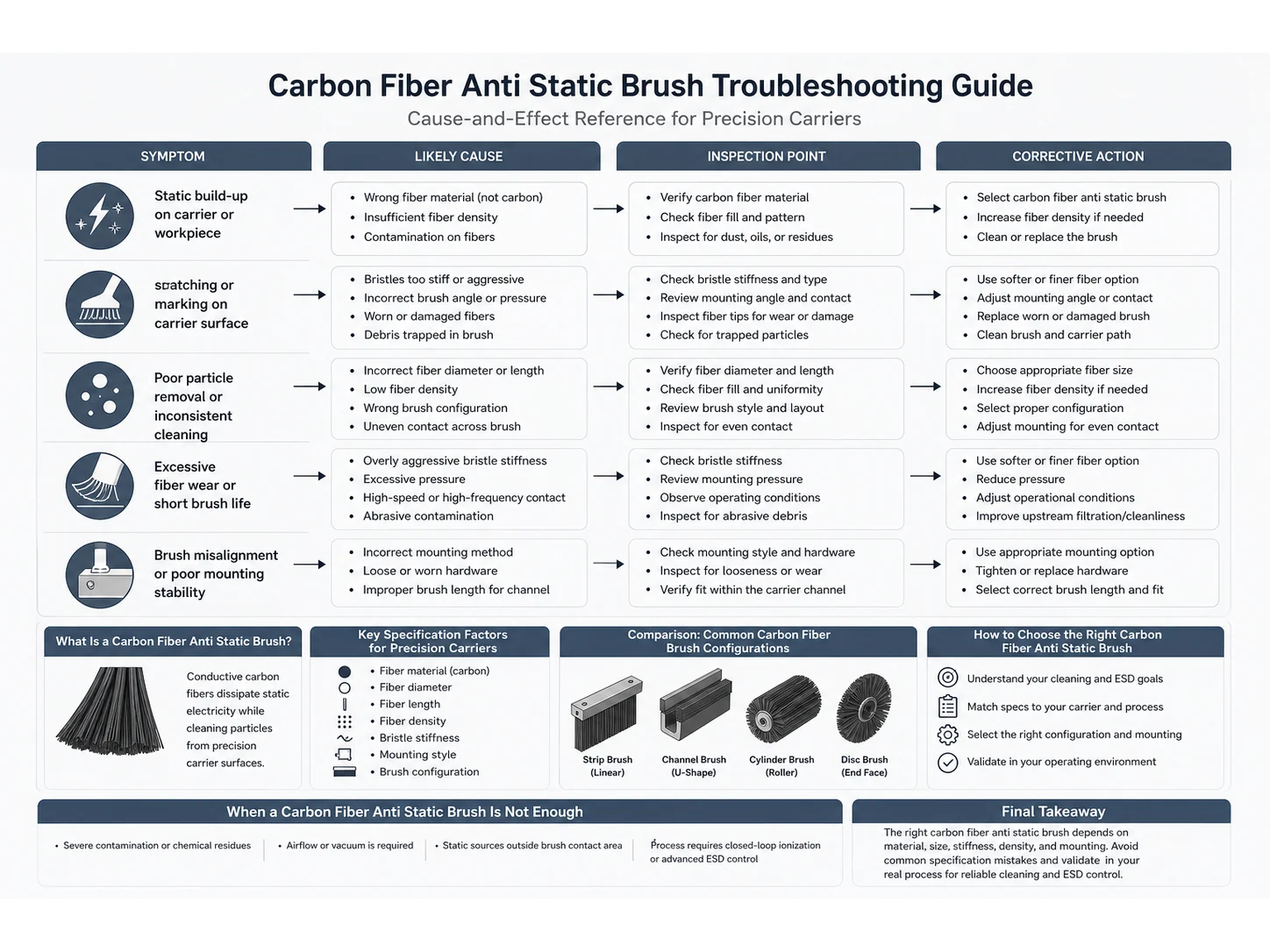
What Is a Carbon Fiber Anti Static Brush?
A carbon fiber anti static brush is a cleaning device made with bristles that incorporate conductive carbon fibers. These fibers provide a controlled electrical path, typically with surface resistivity in the range of 10³ to 10⁹ ohms, allowing static charges to bleed off harmlessly rather than building up and discharging into sensitive electronics. Unlike metal brushes that can scratch or short contacts, and unlike insulating brushes that generate and hold static charges, carbon fiber brushes offer a balanced combination of gentle surface action and reliable static dissipation. In precision carriers—such as those found in automated optical inspection (AOI), pick-and-place machines, and test handlers—this balance is critical for maintaining cleanliness without damaging fine-pitch components or conductive traces.
Common Materials and Construction Options
Not all carbon fiber brushes are the same. The base material, fiber diameter, stiffness, and handle or core construction all influence performance and suitability for different applications.
- Pure carbon fiber bristles: Best for applications needing both static dissipation and high durability. They withstand moderate temperatures and many industrial solvents.
- Carbon-filled conductive fibers: Synthetic fibers (like nylon) loaded with carbon particles. Often more flexible and cost-effective but may have slightly higher resistivity.
- Composite brushes: Combine carbon fiber with soft animal hair or other synthetic fibers to adjust stiffness, particle pickup, or fluid handling characteristics.
- Handle and core materials: Static-dissipative plastics, wood, or aluminum. The handle must complete the grounding path; conductive plastics (e.g., 10⁵–10⁷ ohms) are common for handheld units, while metal cores are often used in strip brushes for machine mounting.
- Mounting styles: Handheld brushes with ergonomic grips, strip brushes with aluminum or stainless steel backings and mounting holes, and custom-shaped brushes that conform to carrier contours.
Key Specification Factors for Precision Carriers
When selecting a carbon fiber anti static brush for a production environment, consider these variables:
- Fiber diameter: Finer fibers (5–15 µm) clean narrow gaps and delicate surfaces; coarser fibers (20–50 µm) are more robust for heavy dust or abrasive conditions.
- Bristle stiffness: Often a function of fiber length and density. A shorter, denser trim creates a stiffer brush; longer, sparser bristles are softer. Stiffness must match the surface fragility and cleaning aggressiveness required.
- Overall brush dimensions: Length, width, and trim length must fit the carrier’s geometry and cleaning mechanism.
- Resistivity range: Confirm the brush meets your ESD control plan (typically 10⁴–10⁹ ohms measured from bristle tip to handle or mounting rail).
- Chemical compatibility: If the brush will contact cleaning solvents, fluxes, or process chemicals, verify compatibility with the bristles, bonding agent, and handle material.
- Cleanroom suitability: Low-linting, non-shedding construction is required for ISO Class 5–8 cleanrooms; some carbon fiber brushes undergo special processing to reduce particle generation.
Comparison: Common Carbon Fiber Brush Configurations
| Feature | Standard Handheld Brush | Fine Detail Anti Static Brush | Machine-Mounted Strip Brush |
|---|---|---|---|
| Typical bristle material | Pure carbon fiber | Carbon-filled conductive fiber | Pure carbon fiber or composite |
| Fiber diameter (approx.) | 15–30 µm | 5–15 µm | 20–50 µm |
| Stiffness | Medium; good for general carrier cleaning | Soft; reaches tight crevices without scratching | Higher stiffness for consistent automated contact |
| Handle / core | Conductive PP or wood | Conductive plastic with small grip | Aluminum or stainless steel channel with mounting slots |
| Best for | Manual cleaning of carriers, jigs, and fixtures in electronics assembly | Cleaning connectors, delicate PCB areas, and small optical surfaces | Inline cleaning of carriers on conveyors or rotary tables |
| Typical maintenance | Periodic rinsing or wiping; replace when bristles flatten | Gentle cleaning; avoid excessive bending | Monitor bristle wear; realign or replace strip when contact pressure drops |
How to Choose the Right Carbon Fiber Anti Static Brush
Use these decision points to narrow your options:
- Residue type: Dry, loose powders and lint are ideal for carbon fiber brushes. Tacky residues or baked-on flux may require a combination of brush and solvent—check chemical compatibility first.
- Surface sensitivity: For exposed conductors, gold-plated contacts, or thin-film coatings, choose the softest bristle that effectively removes debris without abrasion.
- Equipment interface: Determine if the brush will be handheld or mounted. Machine-mounted brushes need a rigid, dimensionally stable back that mates with your fixture or bracket.
- Wet or chemical exposure: If you plan to use isopropyl alcohol or other cleaning fluids, ensure the brush’s bonding adhesive and core material resist swelling or degradation.
- Hygiene expectations: In cleanroom or medical device assembly, specify brushes with processed, low-shedding carbon fiber and sealed ends to minimize fiber release.
- Maintenance frequency: High-usage automated lines may benefit from easily replaceable strip brushes; handheld brushes in low-touch areas can last months with proper cleaning.
- Custom size requirements: If standard lengths or trim profiles do not fit your carrier, work with a brush supplier to create a custom drawing and, ideally, test samples before committing to a production run.
Common Mistakes When Specifying Carbon Fiber Brushes
Avoid these frequent pitfalls:
- Focusing only on cost drivers or bristle material: Ignoring handle conductivity, bonding method, or dimensional tolerances can lead to brushes that fail static audits or do not fit the holder.
- Choosing overly stiff bristles: This can micro-scratch carrier surfaces, causing contamination traps or optical defects in vision systems.
- Neglecting environmental factors: High humidity can cause some conductive fillers to degrade; very low humidity may increase static buildup if the brush is not properly grounded.
- Assuming all carbon fiber brushes are equally anti-static: The actual resistance must be verified against your facility’s ESD control limits (commonly ≤10⁹ ohms). A brush that measures 10¹² ohms is not truly static-dissipative.
- Using the wrong brush for automated inline cleaning: Handheld brushes typically cannot provide uniform pressure or coverage at machine speeds; use strip brushes designed for the intended speed and stroke.
- Skipping sample testing: Even a well-specified brush can perform unexpectedly on your exact carrier material and debris type. Always test with a representative carrier and your real particulate.
When a Carbon Fiber Anti Static Brush Is the Wrong Choice
While carbon fiber brushes are effective for many ESD-safe cleaning tasks, they have limits:
- Charged insulators: If the carrier itself is a highly insulating material and has become tribocharged, a brush alone may not neutralize the charge quickly enough. In such cases, add ionizing blowers or bars upstream of the brushing station.
- Sticky or greasy residues: Carbon fiber bristles do not absorb oils or fluxes. These require a solvent wipe, ultrasonic cleaning, or contact cleaning rollers with the appropriate chemistry.
- High-speed, high-contact-force cleaning: In continuous processes where the brush must scrub aggressively, carbon fiber may wear too fast or generate debris. Conductive polymer or abrasive-impregnated brushes might be more suitable—but only after evaluating ESD and contamination risks.
- Complex three-dimensional surfaces: A standard flat brush may not reach all recesses. Consider custom-contoured brushes or a multi-axis cleaning system, and involve the brush manufacturer early with a drawing review.
- Cleanroom requirements beyond particle shedding: Even “low-lint” carbon fiber brushes can release some fibers. For ISO Class 3–4 environments, alternative non-contact or enclosed cleaning methods may be required.
Final Takeaway
Choose a carbon fiber anti static brush by matching bristle stiffness, fiber diameter, handle grounding path, and mounting style to your carrier’s material, geometry, and production environment. Always validate real-world performance with your specific debris and static control limits, and recognize when complementary static neutralization or a different cleaning technology is needed. A correctly specified brush protects both your precision carriers and the sensitive components they handle, improving first-pass yield and equipment uptime.
Frequently Asked Questions
How do I know if a brush is truly “anti-static”?
Measure the resistance from the bristle tip to the handle or mounting rail using a calibrated megohmmeter. For a brush to be considered static-dissipative, the resistance should typically fall between 10⁴ and 10⁹ ohms. Brushes above 10⁹ ohms are insulative and will not bleed off static charges effectively.
Can carbon fiber brushes be used with isopropyl alcohol?
Many carbon fiber bristles and their bonding adhesives are compatible with isopropyl alcohol (IPA) and other common solvents. However, always check with the supplier. Prolonged soaking may degrade certain handle materials or epoxy bonds, so test before implementing a wet cleaning procedure.
What is the typical service life of a carbon fiber brush in automated production?
Life depends on contact pressure, speed, debris abrasiveness, and bristle quality. As a general benchmark, machine-mounted strip brushes in clean electronics environments can last 6–12 months before replacement, but inspect monthly for bristle wear, flattening, or loss of conductivity.
Are all carbon fiber brushes safe for cleanroom use?
No. Standard carbon fiber brushes may shed microscopic fibers. Cleanroom-certified versions undergo special processing to minimize particulates and are often rated for specific ISO classes. Always request cleanroom compatibility data for your application’s classification.
Can I cut or trim a carbon fiber brush to fit my carrier?
Handheld brushes are often available in standard lengths; cutting the handle may be possible but could compromise the grounding connection. Strip brushes can usually be cut from longer stock lengths, but the cut ends may expose sharp metal or loose bristles. Consult the supplier for clean finishing options.
What’s the difference between carbon fiber and conductive nylon brushes?
Both are used for anti-static cleaning, but carbon fiber generally offers lower resistivity, higher temperature tolerance, and better durability. Conductive nylon is more flexible and less expensive but may wear faster and can have higher resistance. Your choice depends on the required ESD protection level and mechanical demands.
How do I clean and maintain a carbon fiber anti static brush?
Regularly remove trapped dust by tapping, gentle vacuuming, or rinsing with a compatible solvent if approved. Avoid harsh scrubbing that could bend or break bristles. After wet cleaning, dry thoroughly before use to prevent moisture-related static issues or corrosion of metal cores.
Do I need to ground the brush during use?
Yes. The brush must be electrically connected to a reliable ground source. Handheld brushes often ground through the operator (via a wrist strap and dissipative handle) or a grounding cord. Machine-mounted brushes usually ground through the metal mounting rail, which should be tied to equipment ground.
Technical References
- EOS/ESD Association — ESD Fundamentals
- EOS/ESD Association — Principles of ESD Control
- British Plastics Federation — Thermoplastics
- NIST — Metric SI
Which bristle material fits this job — Carbon Fiber, AISI 304 Stainless Steel Wire or Conductive Nylon?
| Material | Continuous temperature (°C) | Peak temperature (°C) | Water absorption | Hardness |
|---|---|---|---|---|
| Carbon Fiber | 200–350 | 400–500 | ≤0.10% | — |
| AISI 304 Stainless Steel Wire | 400 | 500 | 0% | Rockwell B 70–95 depending on temper and cold work |
| Conductive Nylon | 80–110 | 130–160 | 0.5–2.5% | Shore D 75–88 |
Figures as published by Alleima. Confirm the exact grade against the supplier datasheet before ordering.
What should replace Carbon Fiber when it stops working?
- Carbon Fiber — Compare Carbon Fiber with Conductive nylon, anti-static filament, stainless micro-wire, standard nylon. Change material when wet stiffness, temperature, chemical resistance, conductivity, particle shedding, or surface marking becomes the limiting factor.
- AISI 304 Stainless Steel Wire — Use AISI 316 stainless steel wire for chloride, marine, dairy, beverage, chemical washdown, or higher pitting-resistance requirements. Use carbon steel for dry aggressive cutting and brass or abrasive nylon for lower marking risk.
- Conductive Nylon — Compare Conductive Nylon with Anti-static filament, carbon fiber, stainless conductive filament, standard PA6. Change material when wet stiffness, temperature, chemical resistance, conductivity, particle shedding, or surface marking becomes the limiting factor.