
What Is a Nylon Gun Cleaning Brush?
A nylon gun cleaning brush is a brush specifically designed for firearm bore maintenance, featuring bristles made from nylon polymer instead of traditional metals like bronze or brass. The core or stem is usually metal, often with a threaded end that attaches to a cleaning rod. Nylon bristles are softer and less aggressive, making them suitable for applying solvents, scrubbing light carbon, and cleaning barrels that require extra care against abrasion.
Common Nylon Gun Cleaning Brush Types and Options
Nylon bore brushes come in several forms, each suited to different cleaning approaches and firearm types. Understanding the options helps avoid mismatching a brush to the task.
- Standard bristle brushes: Spiral or twisted-wire core with nylon bristles radiating outward. Most common for general bore cleaning.
- Chamber brushes: Larger diameter, often with a thicker handle, for cleaning chambers and locking recesses.
- Mop-style brushes: Cotton or synthetic mops with a nylon core or embedded nylon threads for applying oil or finishing passes.
- Long-handle brushes: Designed for deep access in longer barrels or tubes, with extended reach.
- Mini cleaning brushes: Small-diameter brushes for .17 and .22 caliber bores, tight gas ports, or intricate firearm parts.
Key Comparison: Nylon vs. Other Bore Brush Materials
| Feature | Nylon | Brass | Bronze |
|---|---|---|---|
| Scratching risk | Very low | Low (softer than steel) | Low (slightly harder than brass) |
| Solvent compatibility | Good—resists most solvents | Good—may react with ammonia-based copper removers | Good—may react with ammonia-based copper removers |
| Cleaning power on carbon | Moderate | Good | Excellent |
| Copper or lead removal | Minimal (mechanical action only) | Moderate (abrasive action) | High (abrades fouling) |
| Barrel compatibility | Any; ideal for coated, plated, or vintage barrels | Uncoated steel; avoid on soft or plated bores | Uncoated steel; avoid on soft or plated bores |
| Longevity | Moderate—bristles may deform with heavy use | Moderate—bristles wear down | Good—bristle retention typically better than nylon |
| Typical cost | Low | Low to moderate | Moderate |
How to Choose the Right Nylon Bore Brush
Selecting a nylon brush isn’t just about matching the caliber. The following factors determine how well the brush will work and how long it will last.
- Caliber and bore diameter fit: A brush too small won’t contact the rifling; oversized brushes can bind or bend the core. Use a bore brush size chart from a reputable source or cross-reference with common listings like a Hoppe’s bore brush size chart for nominal caliber recommendations.
- Residue type: Nylon works best on powder residue and light carbon. For heavy copper or lead deposits, a nylon brush won’t provide enough mechanical abrasion—pair it with a chemical cleaner or switch to a bronze brush.
- Surface sensitivity: Choose nylon over metal when cleaning chrome-lined, nickel-plated, or carefully hand-lapped match barrels. Nylon eliminates the risk of micro-scratches.
- Brush stiffness and bristle diameter: Firmer nylon bristles (often thicker gauge) scrub more aggressively but still safer than metal. Softer bristles are ideal for applying solvents or reaching into fine grooves without snagging.
- Handle, core, and mounting type: Threaded brass or steel cores are standard for rifle and pistol cleaning rods. Some brushes come with a looped end for patches or a T-handle for manual chamber cleaning. Ensure the threading matches your rod (usually 8-32 for rifles/shotguns, smaller for pistols).
- Chemical exposure: Nylon generally resists all common bore solvents and oils, but extended soaking in aggressive copper removers can weaken bristles over time. Check the brush material if you use strong ammonia-based solutions.
- Maintenance frequency: If you clean after every range trip, nylon brushes may wear out faster than bronze alternatives. Consider disposable nylon brushes for heavy-use routines.
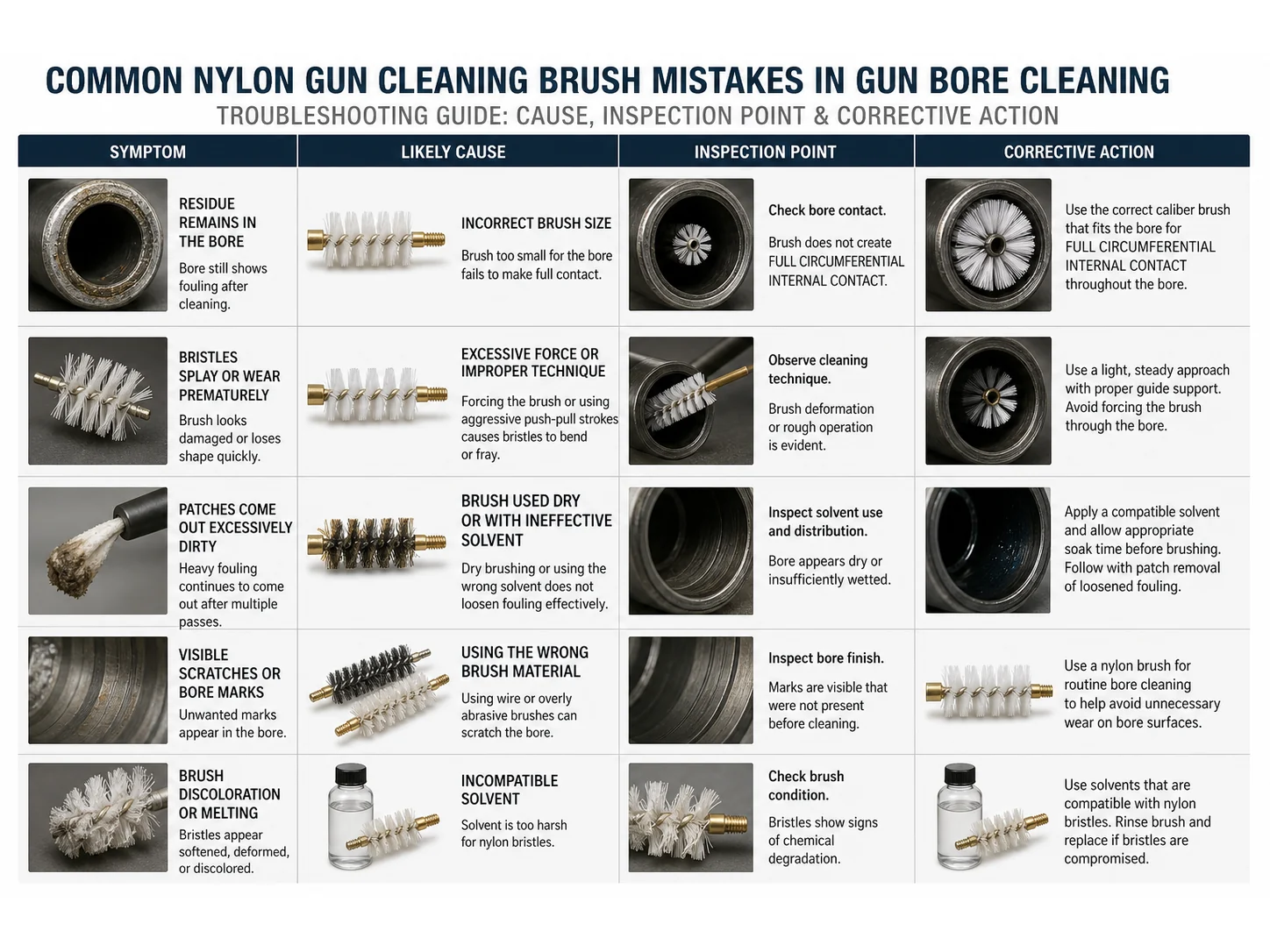
Common Mistakes When Using Nylon Bore Brushes
Mistake prevention is the key to getting the results you expect. Avoid these frequent errors.
- Using the wrong size brush. A .22 nylon bore brush jammed into a .30 caliber barrel won’t clean effectively and can break inside the bore. Always confirm the brush size against the firearm’s exact caliber—e.g., a 223 nylon bore brush for 5.56/.223 barrels, or a 30 cal nylon bore brush for .308/30-06.
- Expecting nylon to remove tough fouling. Nylon bristles lack the cutting ability of bronze. If you see copper or lead streaks after scrubbing, switch to a brass vs nylon bore brush approach: use brass/bronze for initial mechanical removal, then nylon for final clean passes.
- Neglecting brush direction and rotation. Pushing a brush straight in and out without allowing it to follow the rifling twist can bend bristles unevenly. Let the brush rotate freely as it travels to match the rifling spin.
- Using nylon on extremely hot or dry barrels. Excessive heat can soften or deform nylon bristles. Always let the barrel cool to ambient temperature. Dry scrubbing increases friction and bristle wear—always use a solvent or lubricant.
- Ignoring bristle fatigue. After repeated use, nylon bristles can lose stiffness or take a permanent set. Inspect brushes regularly and replace them when bristles lay flat or appear frayed.
- Mixing nylon with aggressive metal jags. Using a brass jag with a nylon brush can mask the fact that the jag itself might be scratching the bore. If purity of bore surface is critical, consider a completely non-metallic cleaning chain, including a polymer jag.
- Omitting a clean patch after brushing. Nylon loosens residue but doesn’t always lift it out. Skipping the final patch step leaves carbon slurry in the barrel, which can dry and harden.
When a Nylon Gun Cleaning Brush Is the Wrong Choice
Despite its advantages, a nylon brush has limits. Here are scenarios where you need something more:
- Heavy copper fouling: Copper deposits require abrasion (bronze) or chemical attack (copper solvent). Nylon alone won’t remove it. Use a dedicated copper solvent with a nylon brush as an applicator, or step up to a bronze brush.
- Lead buildup in pistol bores: Lead fouls require mechanical scraping—bronze brushes or even lead removal cloths are better suited.
- Corrosion or pitting: Rusted bores need more aggressive treatment, often with stainless steel brushes (used carefully). Nylon cannot scrub deep pits.
- High-volume, heavy-duty cleaning: For armorer-level or commercial cleaning operations, nylon brushes wear out quickly. A bronze brush may be more cost-effective and efficient.
- Calibers with non-standard bore diameters: If an off-the-shelf nylon brush for a 6.5 Creedmoor nylon bore brush or a 50 cal nylon bore brush doesn’t fit perfectly, a custom-sized brush or confirmation from a supplier drawing may be necessary. Don’t force an ill-fitting brush; it can jam and break.
Final Takeaway
A nylon gun cleaning brush is a safe, essential tool for routine bore maintenance, but it performs best when matched correctly to the task. Choose the right diameter and stiffness, use it wet, let it follow the rifling, and combine it with a bronze brush only when fouling demands more abrasion. By avoiding the common mistakes above, you protect your barrel’s integrity and get a more thorough clean every time.
Frequently Asked Questions
Can I use a nylon brush for all my firearms?
Yes, but adjust your technique: for heavy copper fouling, you may still need a bronze brush or chemical treatment. Nylon is safe for all bores, but its effectiveness is limited by fouling type.
How do I know the correct nylon brush size for my caliber?
Consult a bore brush size chart from your cleaning kit manual or a trusted resource. For example, a 22 cal nylon bore brush typically fits .22LR and .223 barrels, while a 30 cal nylon bore brush suits .308 and .30-06. When in doubt, measure the bore land-to-land diameter and match the brush diameter slightly larger than the groove diameter for proper contact.
Does nylon react with bore solvents?
Nylon is compatible with most solvents, including CLP, Hoppe’s No. 9, and mild copper removers. Prolonged exposure to strong ammonia-based copper removers may eventually degrade nylon bristles. Rinse or replace brushes regularly if using aggressive chemicals.
What is the difference between brass and nylon bore brushes?
Nylon is polymer and non-embedding; it will not leave metal residues or scratch. Brass is harder and more abrasive, better for copper removal, but it can leave minute brass traces and must be avoided on plated bores. Use nylon when surface preservation outweighs aggressive scrubbing.
How often should I replace a nylon gun cleaning brush?
Inspect before each use. Replace when bristles are flattened, frayed, or when the core begins to unwind. With frequent cleaning, a nylon brush may last 20–30 sessions; heavy-duty use shortens this. Keep spares on hand.
Can I use a nylon brush for cleaning other gun parts like the chamber or bolt carrier?
Yes, chamber-specific nylon brushes with a longer handle or larger diameter work well. Small mini cleaning nylon brushes are also useful for tight spaces, gas ports, and bolt recesses.
Will a nylon brush remove copper fouling at all?
Not mechanically—nylon bristles are too soft to scrape copper. However, when used with a copper solvent, the brush helps distribute and agitate the chemical for better penetration. The solvent does the work.
Is it safe to leave a nylon brush in the barrel during storage?
No. Any brush left in the bore can trap moisture or solvents against the steel, potentially causing corrosion. Always run a dry patch through the bore after cleaning and store the brush separately.
Technical References
- OSHA — Personal Protective Equipment
- British Plastics Federation — Thermoplastics
- NSSF — Firearm Safety Rules
- ATF — Firearms
Which bristle material fits this job — Nylon PA, AISI 304 Stainless Steel Wire or Phosphor Bronze Wire?
| Material | Continuous temperature (°C) | Peak temperature (°C) | Water absorption | Hardness |
|---|---|---|---|---|
| Nylon PA | 93 | 121 | 0.3–9% by PA grade and conditioning | Medium to firm; filament diameter and trim length control bending force. |
| AISI 304 Stainless Steel Wire | 400 | 500 | 0% | Rockwell B 70–95 depending on temper and cold work |
| Phosphor Bronze Wire | 180–220 | 280–320 | 0% | Rockwell B 70–100 |
| Carbon Steel Wire | 200–300 | 350–450 | 0% | Rockwell C 40–60 |
Figures as published by Brushtec / DuPont; Alleima. Confirm the exact grade against the supplier datasheet before ordering.
What should replace Tube & Pipe Bore Brushes for gun cleaning brush?
- Tube & Pipe Bore Brushes — Tube and bore brushes work by radial contact inside a confined diameter; wire wheels and cups work mainly on external edges, profiles, welds, and broad surfaces.
- Nylon PA — Compare Nylon PA with PP, PBT, PET. Change material when wet stiffness, temperature, chemical resistance, conductivity, particle shedding, or surface marking becomes the limiting factor.
- AISI 304 Stainless Steel Wire — Use AISI 316 stainless steel wire for chloride, marine, dairy, beverage, chemical washdown, or higher pitting-resistance requirements. Use carbon steel for dry aggressive cutting and brass or abrasive nylon for lower marking risk.
- Phosphor Bronze Wire — Compare Phosphor Bronze Wire with Compare with brass for softer copper-alloy contact, copper for conductivity and stainless wire for stronger cutting. Change material when wet stiffness, temperature, chemical resistance, conductivity, particle shedding, or surface marking becomes the limiting factor.