
Custom Cleaning Brush
Gun Cleaning Brush
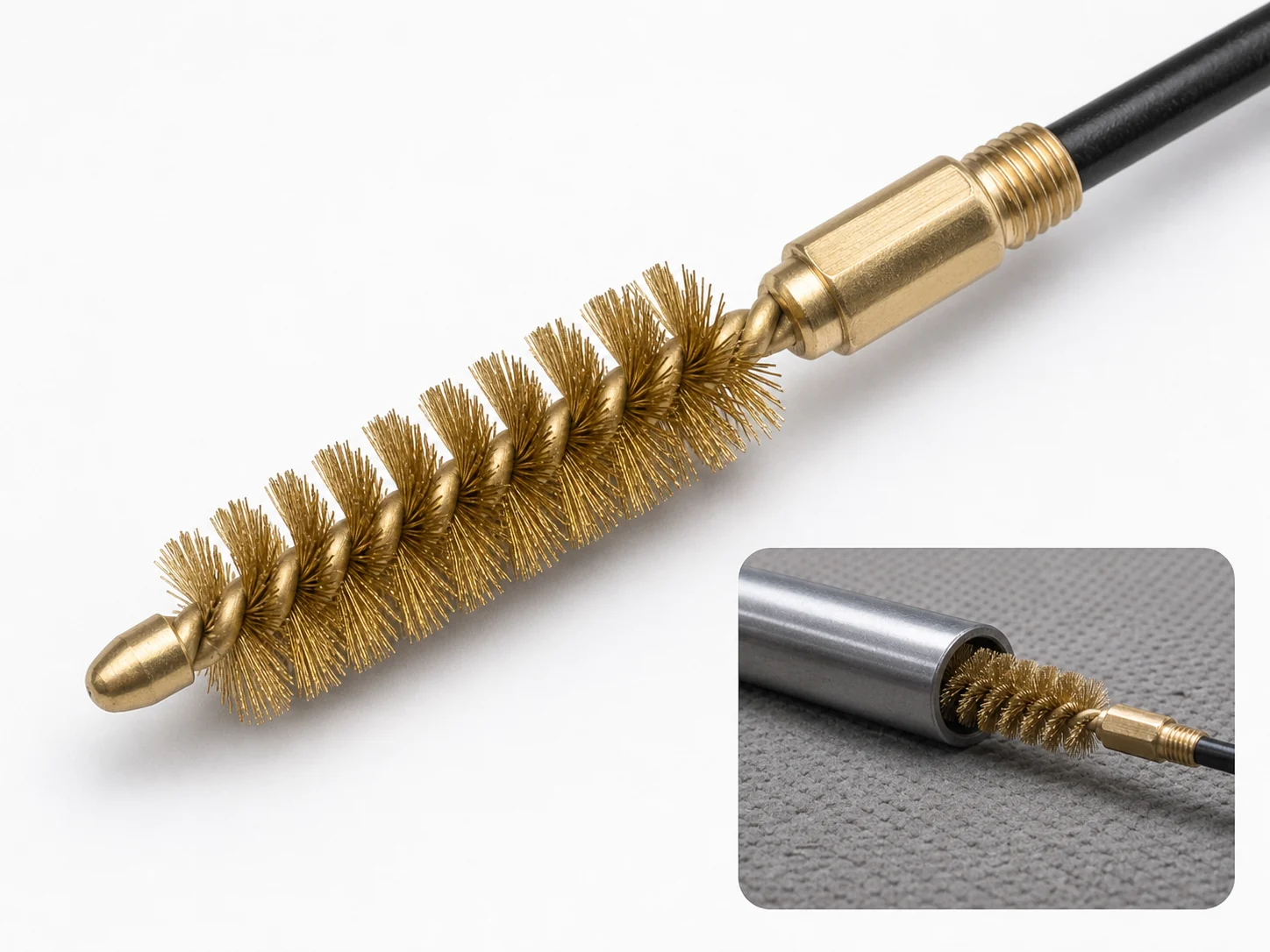
Caliber-matched gun cleaning brushes with phosphor bronze or nylon PA fill on twisted-wire cores.
Small brush
500 pcs
Minimum order
Held in one hand: tube, bottle, detail and swab brushes — including long-handled ones with a small head.
Production lead time, once the specification is confirmed
- Up to 500 pcsWithin 7 days
- 501–50,000 pcsWithin 14 days
- Over 50,000 pcsWithin 21 days
Peak season can extend these times; the shipping date is confirmed in writing with your quotation. Sampling and shipping are quoted separately.
A caliber-matched twisted-wire cleaning brush for firearm bores, chambers and action recesses. Phosphor bronze or nylon PA fill lifts carbon, powder residue, old lubricant and light copper or lead fouling that a patch-only pass would leave behind.
What can this brush do for you?
Reaches the lands, grooves and chamber shoulder where patches slide past
The twisted-wire core holds bristle fill radially around a central stem, so the working section follows the bore diameter instead of riding over the top of the rifling. Carbon and powder residue settle into groove corners and the chamber shoulder; a patch can push past those zones while the brush fill enters them and lifts the fouling loose.
Phosphor bronze fill cuts carbon and light metal fouling with less risk to bore finish
Phosphor bronze is harder than carbon residue and softer than the steel used in most barrels. That combination lets the bristles break down powder deposits and loose copper or lead fouling while staying gentler on the rifling than stainless steel fill.
Nylon PA fill for routine residue and finish-sensitive parts
Nylon PA bristles remove powder film, dried lubricant, dirt and light fouling on coated, plated, alloy or polymer components. The fill resists solvents and moisture, making it a fit for slide rails, bolt carriers, recoil assemblies and other surfaces where metal contact should be limited.
Built for push-pull and rotary motion on common cleaning rods
Standard heads use 8-32 threads that install directly on most cleaning rods. The twisted construction stays stable in straight push-pull strokes and rotating use, and the same working section can be built onto a fixed rod and handle when the project requires a complete hand tool instead of a replaceable head.
Caliber-matched diameters from .22 through .50 caliber
The brush diameter is matched to the bore so each size contacts the lands and grooves with steady pressure rather than binding or floating through the passage. Rifle and pistol working sections are matched to their action and barrel lengths, which keeps drag manageable in short barrels while still giving repeated contact in longer ones.
What is a Gun Cleaning Brush?
A Gun Cleaning Brush is a twisted-wire brush built around a central steel core that captures radial bristle fill. The working section passes through the bore, chamber or action recess and cleans internal surfaces under push, pull and rotating strokes. Solvent or lubricant works with the bristle action to release fouling that patches alone cannot remove.
Most assemblies position the brush head at the front of a cleaning rod and use an 8-32 thread at the rear for attachment. Fixed-rod versions place the same working section on a permanent shaft with a handle. The fill material sets the cleaning aggressiveness: phosphor bronze for carbon, light copper and lead on steel bores; nylon PA for routine residue and finish-sensitive parts; stainless steel fill for heavy carbon or oxide where the surface can tolerate it.
This is not a chemical bore cleaner or a patch system. Brushing loosens and lifts attached fouling; solvent soak, patch wiping and final oiling remain separate steps. It is also not meant to remove pitting or repair a damaged bore. If the barrel has deep rust, pitting or a match-grade finish that must be preserved exactly, the cleaning method should be confirmed before a more aggressive fill is introduced.
Technical Specifications
Standard configurations cover common rifle and pistol passages. Diameter, working length, fill material and interface can be adjusted to the project.
| Parameter | Standard / Configurable |
|---|---|
| Brush diameter | Caliber-matched; common .22, .25, .30, .35, .40, .45 and .50 cal plus metric equivalents; custom OD on request |
| Working brush length | Rifle: approx 3.25 in (83 mm); Pistol: approx 2.88 in (73 mm); adjusted to the contact zone |
| Fill material | Phosphor bronze, nylon PA, or stainless steel; mixed fill or dual-section combinations on request |
| Core / wire | Twisted steel core; 304 stainless or carbon steel matched to fill and cleaning environment |
| Fill trim / density | Trim length and fill density set to bore diameter and stiffness target; dense fill for heavy fouling, open fill for lower drag |
| Thread / interface | 8-32 thread standard for cleaning rod attachment; male or female end specified to match the rod; other thread sizes, loop ends, or fixed rod and handle on request |
| Cleaning action | Hand push-pull and rotary; powered use only within the specified brush speed and rotation direction |
| Chemical exposure | Phosphor bronze and nylon PA selected for common CLP and powder solvents; extended use with aggressive copper solvents should be confirmed before ordering |
| Brush type | Custom Tube & Pipe Bore Brushes |
| How it is driven | Hand-guided |
| Cleaning target | rifle and pistol bore, chamber, and extractor and lug recess cleaning |
| Surface or part | bores, recesses, chambers, grooves, thread, passages, shoulders, and rails |
| Residue or debris | carbon, lubricant, powder, powder residue, rust, and oxide |
| Mounting / connection | 8-32 thread standard for cleaning rod attachment; male or female end specified to match the rod; other thread sizes, loop ends, or fixed rod and handle on request |
Where does this brush work best?
- Rifle and pistol bores: removing carbon fouling from lands, grooves and throat after live fire or storage.
- Chambers: clearing carbon rings, case mouth residue and compacted powder at the case neck and shoulder transition.
- Bolt, extractor and lug recesses: lifting carbon and dried lubricant from recesses that patches and swabs cannot fully enter.
- Action components: slide rails, locking surfaces, spring channels and receiver recesses on semi-automatic pistols and rifles.
- Armorer and gunsmith maintenance kits: caliber-specific brush sets for inspection, repair, range servicing and post-storage prep.
How do I choose the right one?
Match the diameter to the bore, not just the chambering name
Use the nominal caliber as the starting point, then confirm the actual land and groove dimensions. A brush that fits too tightly will raise rod load, bend the core or jam at the throat; one that is too small will miss the groove corners. The correct brush enters with noticeable but steady drag and rotates without forcing.
Choose the fill by what needs to be removed and where
Phosphor bronze is the standard for carbon, powder residue and light copper or lead fouling in steel barrels. Nylon PA is the better choice for routine maintenance, plated or coated surfaces and passages where metal contact is unwanted. Stainless steel fill is reserved for heavy carbon or rust in areas that can tolerate more aggressive contact; it is not a default choice for precision bore rifling.
| Cleaning condition | Recommended fill |
|---|---|
| Routine powder residue and old lubricant | Nylon PA |
| Carbon fouling in steel bore or chamber | Phosphor bronze |
| Light copper or lead fouling | Phosphor bronze |
| Heavy baked carbon or rust on non-precision surfaces | Stainless steel, only where finish allows |
| Coated, plated or polymer components | Nylon PA, lower fill density |
Set the working section and reach for the passage
A rifle-length working section gives repeated contact over a longer barrel; a pistol-length section matches tighter actions with less drag. When the brush must reach past the chamber or into a deep recess, specify the total length from the rear of the brush head to the point the rod or handle must reach. Long passages need a core with enough support to stay centered.
Confirm the interface and cleaning motion
Standard heads use an 8-32 thread for cleaning rods. Check the rod, cable or adapter thread and gender before ordering. For fixed-rod tools, specify handle length and material. If the brush will run on powered equipment, state the tool speed and rotation direction so the core can be built and rated to match.
When to choose a different cleaning tool
Heavy copper or lead buildup should be handled with a chemical solvent and patch-and-jag sequence, not by repeated aggressive brushing. Pitted or rust-damaged barrels may need gunsmith inspection before mechanical cleaning. Very narrow passages such as gas ports and gas tubes need a smaller-diameter tube brush rather than a bore brush. If the barrel finish is critical, start with nylon and move to bronze only after confirming the maintenance protocol.
Can I customize this brush?
Gun cleaning brushes are configurable because bore dimensions, passage lengths and maintenance protocols vary between firearm types. Provide the caliber or measured bore and groove dimensions, the specific passage or area to be cleaned, the residue type, the cleaning solvent, the attachment thread or rod specification, and whether the brush will be hand or machine operated. A sample barrel, bore gauge, drawing or existing brush helps shorten the approval cycle.
- Diameter and fill trim — custom bore or groove diameter, metric calibers, shotgun gauges, chamber-specific OD, and high or low bristle density
- Working length and overall reach — rifle, pistol, long-action, short-action and fixed-rod lengths
- Fill material and mix — phosphor bronze, nylon PA, stainless steel, or dual-section mixed fill
- Core and interface — 304 stainless or carbon steel core, 8-32 or other thread sizes and genders, loop end, female coupler, fixed handle, T-handle, or bulk unthreaded brush heads
- Handle and marking — rod material, handle style and grip, custom color, pad print, laser marking or private-label packaging
- Packaging and project support — bulk boxes, hang-sell cards, retail blister, kit assembly or individual bags; material declarations, inspection support and third-party testing can be arranged to match project requirements
What size fits the opening, and how is a gun cleaning brush cleaned afterwards?
How do I know the brush diameter fits my bore?
Insert the brush from the chamber end and feel the drag. The correct diameter enters with steady, moderate resistance and rotates smoothly without bowing the rod. If the rod flexes or the brush hangs at the throat, the diameter is too large; if it slides through with little contact and the grooves still show fouling after cleaning, it is too small.
Which end should the brush enter from?
For most rifle and pistol barrels, push from the chamber toward the muzzle and pull back in the same direction so the brush travels straight along the bore. Avoid reversing direction while the brush is loaded inside the bore, because that can fold bristles or catch on the muzzle crown. If the barrel can only be cleaned from the muzzle, use a muzzle guide and a brush sized for easy passage.
Can I use the same brush for the bore and the chamber?
Not automatically. A bore brush is fitted to the lands and grooves; a chamber brush typically needs a larger diameter and sometimes stiffer fill to contact the chamber walls and cartridge shoulder. Using a bore brush in the chamber leaves much of the chamber wall untouched, while pushing a chamber-sized brush into the bore risks binding. Separate geometries are usually the better choice.
What should I check before using a brush that has been stored or shipped?
Inspect the brush head for flattened, bent or missing bristles and check that the core has not separated from the thread. Install the brush snugly on the rod and rotate it slowly in the open air to confirm it runs centered. If any bristle pulls loose or the core appears loose, discard the brush before it enters the bore.
How do I remove copper or lead fouling without over-brushing?
Use a chemical copper or lead solvent with the patch-and-jag method for the actual deposit removal, and use the brush to break up carbon and distribute the solvent through the grooves. Repeated aggressive brushing of a heavily fouled bore accelerates fill wear and will not replace solvent dwell time. If the bore still shows copper after a chemical cycle, repeat the chemical stage instead of switching to a larger or stiffer brush.
Are nylon and bronze fills affected by cleaning solvents differently?
Yes. Nylon PA tolerates most common gun cleaners and degreasers. Phosphor bronze should not be soaked or left sitting in strong ammonia-based copper solvents, because those formulations attack the bronze wire itself. Rinse bronze brushes after use and store them dry; if the process uses an aggressive copper remover, choose nylon or stainless steel fill instead.
Guides that go deeper on this
Custom Manufacturing RFQ
Describe Your Application
For an accurate quotation, please provide the main dimensions, material preference, working surface, residue, quantity, and a drawing or photo.
Drawing or photo optional — it speeds things up, it does not gate the enquiry.
Custom Brush RFQ
Send Your Brush Project
Upload a drawing, product photo, or sample photo and provide the core dimensions and cleaning conditions.
“We need a brush to remove wet residue from a stainless steel conveyor, about 800mm wide. The current brush wears quickly. We can send photos.”
“We sell drinkware and need a cleaning brush to include with the product. Quantity around 5,000 pieces.”