
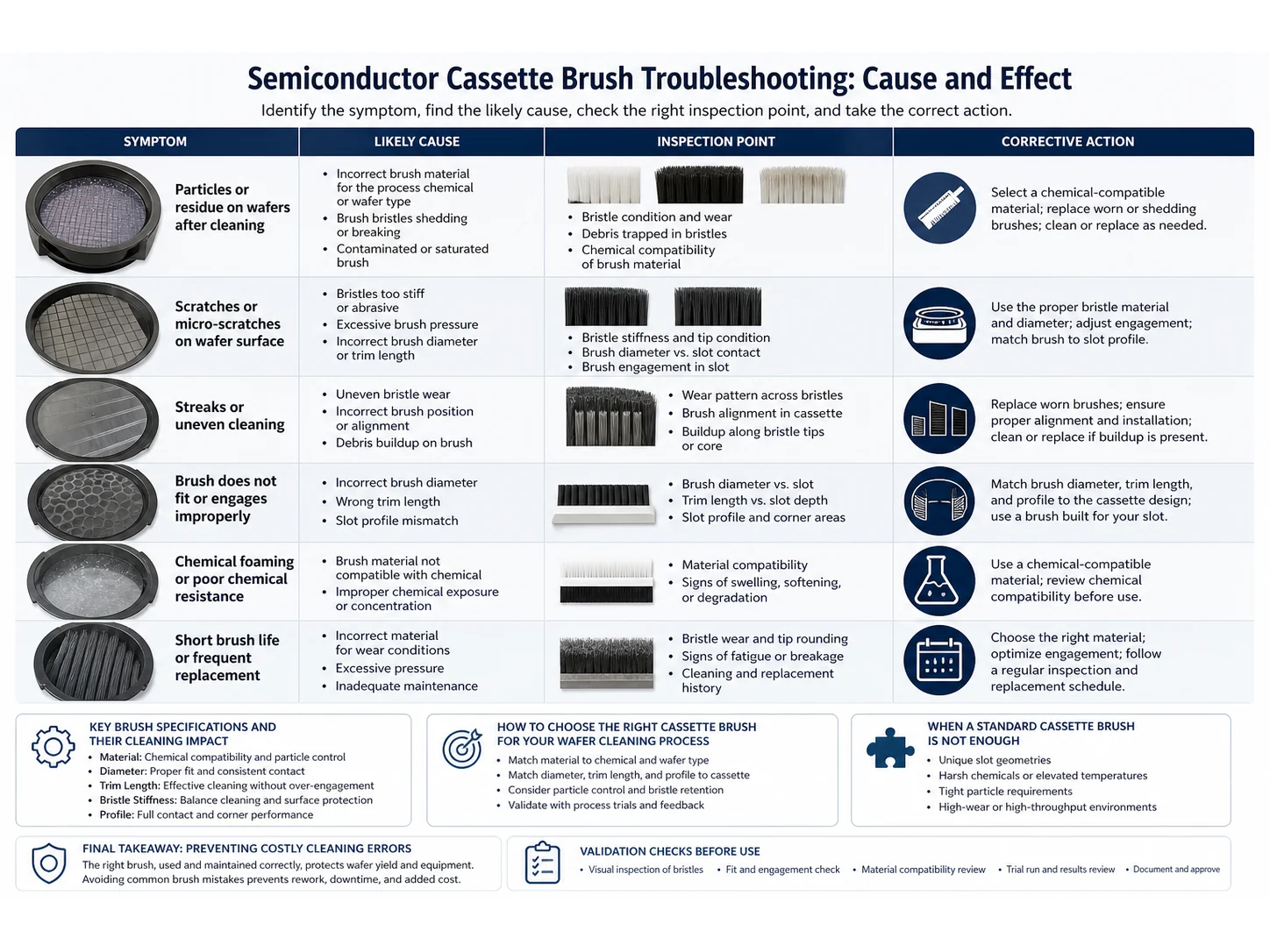
What Is a Semiconductor Cassette Brush?
A semiconductor cassette brush is a precision cleaning brush designed to contact the narrow slots and surfaces of wafer cassettes without damaging the carrier material or leaving fibers behind. Unlike general-purpose cleaning brushes, these brushes must meet strict cleanliness requirements for ultrapure water (UPW) rinse compatibility, chemical resistance, and particle shedding limits. They are typically mounted on automated or manual cleaning stations and can be cylindrical, disc-shaped, or custom-profile brushes that interface directly with the cassette geometry.
Common Types and Material Options
Most semiconductor cassette brushes fall into three categories based on construction and bristle material:
- PVA (Polyvinyl Alcohol) sponge brushes—highly absorbent, soft, and non-shedding, ideal for delicate cassette surfaces and post-CMP cleaning.
- Nylon bristle brushes—available in various diameters and stiffness grades, often used for more aggressive particle removal when the cassette material can tolerate abrasion.
- PTFE (Polytetrafluoroethylene) or conductive fiber brushes—used where static dissipation and chemical inertness are critical, such as in high-purity acid baths.
Core materials commonly include stainless steel, polypropylene, or PEEK, chosen for chemical compatibility and mechanical stability. Handles or mounting ends are often standardized to fit specific cleaning equipment, though custom designs are common.
Key Brush Specifications and Their Cleaning Impact
| Specification | Why It Matters | Common Mistake |
|---|---|---|
| Bristle diameter | Smaller diameters reach tighter slots; larger diameters provide more mechanical force. | Using a brush with bristles too thick for a narrow cassette pitch, causing insertion difficulty or breakage. |
| Stiffness (compression modulus) | Soft brushes conform to surfaces but may not remove stubborn stains; stiff brushes clean aggressively but can scratch. | Choosing the stiffest brush available without considering the cassette material hardness (e.g., PTFE vs. polycarbonate). |
| Core material | Stainless steel offers rigidity but can corrode in some chemicals; PEEK or PP are inert but may deflect under load. | Overlooking chemical exposure—a stainless core degrades in HCl or HF baths, causing metallic contamination. |
| Mounting/End fitting | Proper engagement with the drive mechanism prevents slippage and ensures repeatable cleaning. | Assuming a standard shank fits without checking the manufacturer instructions tool drawing; leads to off-center rotation and uneven wear. |
| Overall diameter | Must match the cassette slot width plus desired interference fit. | Ordering a brush diameter based on a nominal part number without confirming actual measurement requirements under wet or compressed conditions. |
How to Choose the Right Cassette Brush for Your Wafer Cleaning Process
Start by analyzing the specific residues you need to remove: dried slurry, organic films, or metal particles. Map your cassette material (e.g., polycarbonate, PTFE, quartz) to the maximum acceptable bristle hardness. Then define the cleaning interface: wet bench immersion, spray tool, or manual station. Key selection factors include:
- Chemical exposure: Verify bristle and core material compatibility with your cleaning chemistry (SC1, SC2, SPM, DHF, etc.).
- Particle shedding limit: Require brush suppliers to provide particle count data in UPW rinse tests (e.g., >0.2 µm particles).
- Hygiene and maintenance frequency: Determine if the brush is single-use, multi-cycle, or steam-autoclavable. Validate cleaning protocols.
- Equipment interface: Check drive torque, RPM range, and mounting tolerances against the tool manual.
- Custom geometry: For non-standard cassettes, request a supplier drawing review before production to confirm bristle trim length, core dimensions, and end sealing.
Common Mistakes When Selecting or Using Semiconductor Cassette Brushes
Many wafer cassette cleaning problems stem from avoidable errors in specification, handling, and maintenance:
- Mistake 1: Treating the brush as a generic consumable. Using an off-the-shelf brush without verifying particle shedding or chemical outgassing can introduce organic contamination to a clean wafer environment.
- Mistake 2: Ignoring the wet/dry behavior of brush materials. PVA brushes swell in water and change diameter; if not accounted for, the brush may jam in the cassette slot or fail to make contact.
- Mistake 3: Overlooking brush core sealing. Exposed metal cores can corrode and deposit metallic ions onto cassettes, leading to wafer-level contamination.
- Mistake 4: Using the same brush for different cleaning chemistries. Cross-contamination between chemistries reduces cleaning effectiveness and can create hazardous byproducts. Designate brushes per chemical bath or process step.
- Mistake 5: Skipping break-in and conditioning cycles. New brushes may release initial particle bursts; a pre-conditioning rinse in UPW with a prescribed RPM profile can prevent yield hits.
- Mistake 6: Relying on visual inspection for replacement. Bristle wear, core deformation, or loss of stiffness can be invisible. Use cycle count or pressure monitoring to schedule replacement.
- Mistake 7: Ordering by cost drivers or catalog number alone. A slightly cheaper brush that does not match the exact cassette geometry will cause rework costs, wafer scrap, and tool downtime far exceeding the purchase savings.
When a Standard Cassette Brush Is the Wrong Choice
Cassette brushes are effective for routine particle and film removal, but they have clear limitations. If you face deep embedded contamination in opaque materials, high-aspect-ratio crevices, or damage from aggressive chemistries, a standard brush may not suffice. Consider alternatives or supplementary steps:
- Ultrasonic or megasonic cleaning with specialized cassette fixtures when the brush cannot reach all surfaces.
- Custom-designed brush profiles validated through a sample cleaning test on actual used cassettes.
- Review by the brush supplier’s application engineering team with detailed drawings and process parameters when standard offerings do not meet cleaning specs.
Final Takeaway: Preventing Costly Cleaning Errors
Avoiding semiconductor cassette brush mistakes comes down to treating the brush as a precision tool rather than a commodity. Define your cleaning specifications clearly, validate material compatibility under process conditions, and establish a data-driven maintenance schedule. Engage your supplier early with cassette drawings and chemistry information, and always test a sample brush before committing to volume. This diligence reduces contamination-related rework and protects wafer yield.
Frequently Asked Questions
What materials are semiconductor cassette brushes typically made of?
The bristles are commonly PVA, nylon, or PTFE, while cores may be stainless steel, polypropylene, or PEEK. Material selection depends on chemical exposure and required stiffness.
Can I use the same brush for different cleaning chemicals?
No. Using a single brush across different chemistries can cause cross-contamination and unpredictable performance. Dedicate brushes to specific process baths and follow strict change-out protocols.
How do I know if a cassette brush is compatible with my cleaning tool?
Check the brush’s mounting dimensions, overall diameter, and length against your equipment manual. If the manufacturer instructions drawing is unavailable, request a dimensional spec sheet from the brush supplier and verify with a trial fit.
Why does my PVA brush swell after exposure to water?
PVA is hydrophilic and absorbs water, causing the bristles to expand. This swelling must be accounted for when specifying the dry brush diameter. A brush that is correct when dry may become too large when saturated.
How often should I replace a semiconductor cassette brush?
Replacement intervals depend on process intensity, but basing replacement on a fixed cycle count (e.g., 50,000 cycles) or monitored contact pressure is more reliable than visual inspection. Many fabs use particle contamination data to set limits.
What is the best way to store unused cassette brushes?
Store in a clean, dry environment away from direct UV light and airborne molecular contamination. PVA brushes should be kept in sealed packaging until use to prevent premature water absorption and microbial growth.
Can I clean and reuse a disposable cassette brush?
Disposable brushes are not designed for re-cleaning. Attempting to rinse and reuse them can introduce fibers, particles, or chemical residues. Always follow the supplier’s reuse rating if a multi-cycle brush is needed.
What should I do if residues remain after using a new brush?
First, run a series of blank cleaning cycles with UPW to condition the brush and evaluate particle performance. If residues persist, verify the brush material, diameter, and stiffness against your cassette type, and consider a more aggressive bristle or alternative cleaning method.
Technical References
- EOS/ESD Association — ESD Fundamentals
- EOS/ESD Association — Principles of ESD Control
- NISTIR 4653 — Metrology for the Semiconductor Industry
- ISO 14644-1 Cleanrooms and Associated Controlled Environments
Which steel wire grade fits this job — AISI 304 Stainless Steel Wire, AISI 316 Stainless Steel Wire or Carbon Steel Wire?
| Wire grade | Continuous temperature (°C) | Peak temperature (°C) | Water absorption | Hardness |
|---|---|---|---|---|
| AISI 304 Stainless Steel Wire | 400 | 500 | 0% | Rockwell B 70–95 depending on temper and cold work |
| AISI 316 Stainless Steel Wire | 400 | 500 | 0% | Rockwell B 70–95 depending on temper and cold work |
| Carbon Steel Wire | 200–300 | 350–450 | 0% | Rockwell C 40–60 |
| Galvanized Steel Wire | 150–200 | 250–300 | 0% | Rockwell B 70–100 |
Figures as published by Alleima; Material manufacturer TDS / ISO / ASTM / industry reference. Confirm the exact grade against the supplier datasheet before ordering.
What should replace AISI 304 Stainless Steel Wire for wafer cleaning?
- AISI 304 Stainless Steel Wire — Use AISI 316 stainless steel wire for chloride, marine, dairy, beverage, chemical washdown, or higher pitting-resistance requirements. Use carbon steel for dry aggressive cutting and brass or abrasive nylon for lower marking risk.
- Nylon PA — Compare Nylon PA with PP, PBT, PET. Change material when wet stiffness, temperature, chemical resistance, conductivity, particle shedding, or surface marking becomes the limiting factor.