
What Is a Thermos Cleaning Brush?
A thermos cleaning brush is a brush specifically designed for cleaning the interior cavities of thermos bottles, insulated flasks, and similar narrow-mouth containers. It typically features a long handle with a brush head of bristles arranged to conform to curved surfaces and reach deep into the bottle’s interior.
Unlike general-purpose bottle brushes, a thermos cleaning brush must address two specific challenges: the narrow opening restricts access, and the vacuum-insulated double-wall construction means abrasive tools can damage the inner liner. Effective brushes balance cleaning aggressiveness with surface protection, using materials that resist the chemicals commonly used in manual or automated washing systems.
Common Types and Material Options
Thermos cleaning brushes come in several variations. The most important differentiators are bristle material, brush shape, handle design, and mounting method. Understanding these helps avoid the first category of mistakes—ordering the wrong type for your application.
Bristle Materials:
- Nylon: Good general-purpose choice. Resistant to many chemicals, moderate stiffness, less likely to scratch glass or stainless steel. Avoid very abrasive filled-nylon grades unless the residue is especially stubborn.
- Polypropylene (PP): Softer, often used where surface protection is critical. Best for light cleaning or delicate liners.
- Natural fibers (e.g., tampico, horsehair): Soft, absorbent, and gentle. Suitable for polishing or applying cleaning agents, but may degrade faster with strong chemicals or high temperatures.
- Metal wire bristles (stainless steel, brass): Aggressive cleaning for heavy deposits, but can scratch metal or glass interiors. Use only when the liner material and tolerance for scratches are clearly established.
Brush Shapes and Fill Patterns:
- Spiral wound: Bristles wound around a central twisted wire core. Common for hand brushes. Flexible and conforms to curved walls.
- Radial disc or cylinder brush: Bristles arranged around a central hub. Often used in machine-driven cleaning systems where rotation provides consistent contact.
- Custom-shaped bristle pattern: For bottles with complex internal geometries (e.g., threads, shoulders), bespoke bristle layouts may be needed.
Handle and Core Options:
- Twisted wire handle: Integrated with a spiral brush. Simple, inexpensive, and can be made long.
- Plastic or metal stem with clamped bristles: More rigid, suitable for repeatable machine placement.
- Flexible shaft: For curved or angled access.
Mounting and Drive:
- Manual grip: Loop, straight, or ergonomic handle for hand cleaning.
- Machine mount: Shank ends for chuck, collet, or quick-coupling connection. Requires accurate diameter and tolerance for automated cleaning stations.
Comparing Thermos Cleaning Brush Options
The table below compares common brush configurations by performance and typical use case. Use this to quickly spot configurations that match your cleaning challenge.
| Brush Type | Bristle Material | Best For | Avoid When | Typical Stiffness | Chemical Resistance | Risk of Surface Damage |
|---|---|---|---|---|---|---|
| Spiral nylon brush | Nylon (various diameters) | Daily maintenance; removing coffee/tea stains from stainless steel liners | Extremely delicate coatings or heavy baked-on carbon | Medium | Good (avoid strong acids) | Low |
| Spiral PP brush | Polypropylene | Light cleaning of coated or painted interiors; glass liners | Heavy scrubbing of sticky residues | Low-Medium | Excellent (pH 1–14 range) | Very Low |
| Natural fiber brush | Tampico or horsehair | Polishing or applying cleaning agents; cosmetic finish protection | High-temperature wash or strong caustic cleaners | Low | Moderate (degrades in alkalines) | Very Low |
| Stainless steel wire brush | Stainless steel wire | Removing hardened scale, rust, or burnt-on residue from unlined stainless steel bottles | Glass-lined, coated, or polished interiors; any surface where scratches are unacceptable | High | Excellent (but may corrode with chlorides) | High |
| Machine-mount disc brush | Nylon/SiC-impregnated | Automated high-volume cleaning lines; consistent rotation and pressure | Low-budget manual operations; irregular bottle shapes without custom design | Adjustable | Varies by filament | Controlled if speed/pressure known |
How to Choose a Thermos Cleaning Brush
Selecting the right brush requires matching the tool to four key factors: the residue type, the liner material, the cleaning method, and the geometry of the bottle. Mistake avoidance starts here—many problems come from choosing based on cost drivers or generic “bottle brush” labels instead of analyzing these variables.
1. Residue Hardness and Chemistry:
- Sticky or oily residues (coffee, milk, protein shakes) need a bristle material that resists chemical cleaners and has enough stiffness to break the film without scratching. Nylon or filled-PP are often good.
- Mineral scale or hard-water deposits may require stiffer bristles or acid-resistant materials. Stainless steel wire can work but must be confirmed safe for the liner.
- Carbonized or burnt-on residues demand aggressive cleaning, but check if the bottle’s interior can tolerate mechanical abrasion.
2. Liner Material and Surface Sensitivity:
- Stainless steel (304, 316): Generally robust, but polished or electro-polished surfaces can be marred by metal bristles. Use nylon or tested natural fibers for daily cleaning.
- Glass-lined thermos: Extremely sensitive to scratching and thermal shock. Only use soft brushes (e.g., soft PP or natural fiber) and avoid metal contact.
- Coated or painted interiors: Abrasion will remove coatings. Specify soft bristles and confirm compatibility with the cleaning chemical.
3. Equipment Interface:
- Manual cleaning: Choose a handle length that reaches the bottle bottom with a comfortable grip. The brush diameter should be roughly 70–90% of the bottle’s inner diameter to allow full contact without jamming.
- Automated or semi-automated cleaning: The brush must have a mounting shank that fits the machine spindle. Concentricity, overall length, and bristle outer diameter tolerances become critical to avoid misalignment and uneven wear.
4. Chemical and Thermal Exposure:
- If the brush is used with hot water, steam, or aggressive detergents, verify the bristle material’s maximum service temperature and chemical resistance. Nylon can weaken above 80°C; PP is stable up to about 100°C but softer. Metal bristles handle high heat but may corrode.
5. Hygiene Requirements:
- For food-contact applications, bristles should be non-absorbent and easy to sanitize. Metal brush cores can trap moisture; sealed or continuous-strand designs may be preferred. Check that brush materials are FDA-compliant for indirect food contact if necessary.
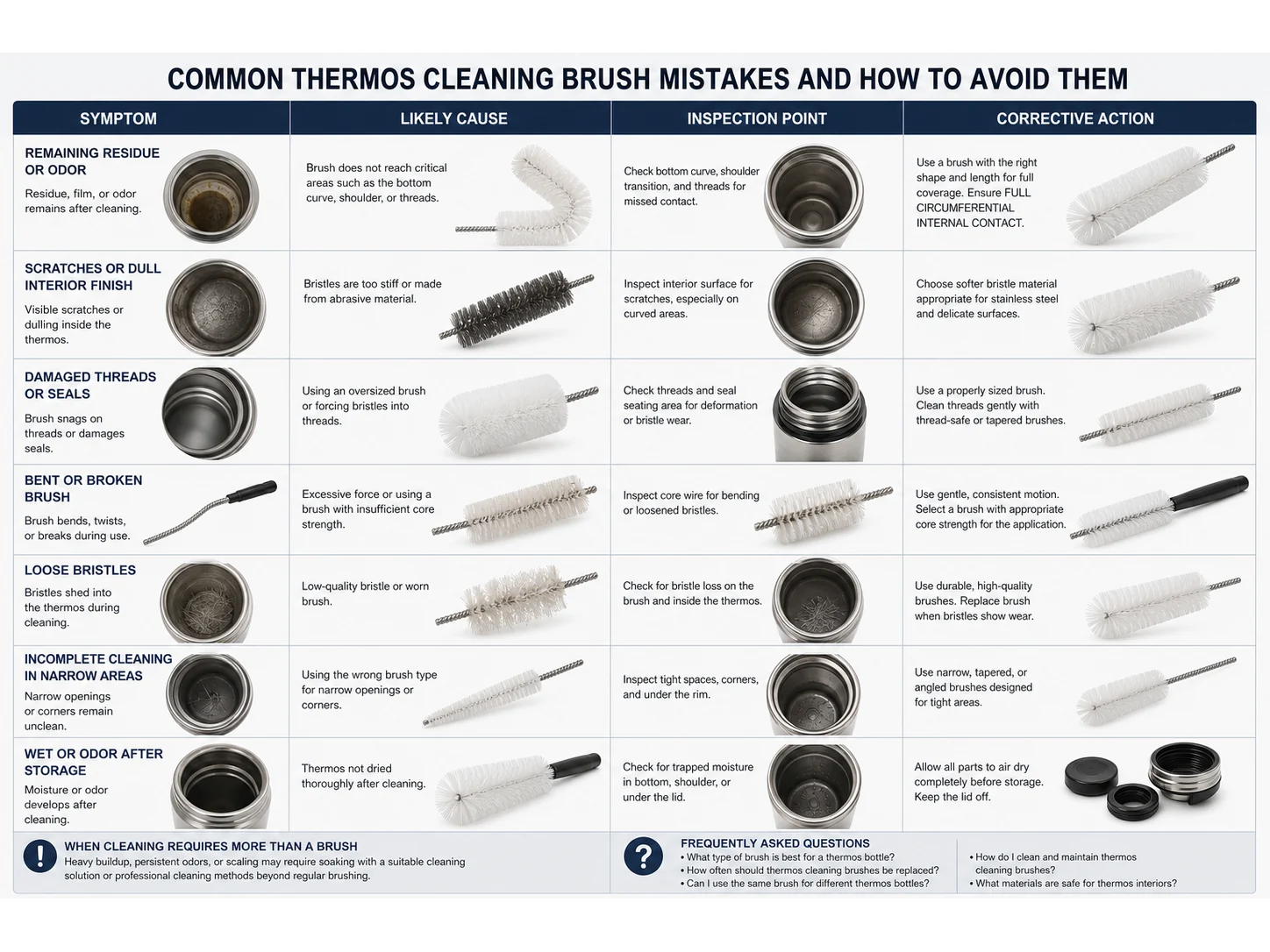
Common Mistakes When Using Thermos Cleaning Brushes
Even with the right brush, improper use leads to poor cleaning results, premature wear, or bottle damage. Below are common mistakes and how to prevent them.
- Mistake 1: Using an oversized brush. A brush too large in diameter can jam, bend the handle, or apply excessive pressure that scratches the interior. How to avoid: Measure the bottle’s neck and body diameters. Choose a brush that passes freely through the neck but fills the body width by about 70–80% for effective cleaning without jamming or causing excessive friction.
- Mistake 2: Selecting bristles that are too abrasive. Metal or stiff abrasive-filled nylon bristles can scour liners, especially glass or coated interiors. How to avoid: Match bristle hardness to liner sensitivity. Test on a small area or refer to manufacturer guidelines. For delicate surfaces, default to soft nylon or PP.
- Mistake 3: Failing to clean the brush itself. Residual debris and chemicals can degrade bristles and contaminate the next bottle. How to avoid: Rinse the brush thoroughly after each use and allow it to dry. Periodically sanitize according to hygiene protocols.
- Mistake 4: Applying excessive force during cleaning. Pushing too hard can bend the handle, splay bristles, or snap the brush. How to avoid: Use steady, rotary motions without heavy leverage. If stubborn residues persist, pre-soak or use a chemical soak instead of brute force.
- Mistake 5: Ignoring brush compatibility with cleaning chemicals. Some bristle materials swell, soften, or degrade when exposed to certain solvents or caustics. How to avoid: Verify chemical resistance charts for the brush material relative to your cleaning agents. When in doubt, test before full deployment.
- Mistake 6: Using a worn-out brush. Frayed, flattened, or missing bristles reduce cleaning effectiveness and may leave plastic fragments. How to avoid: Implement a regular inspection and replacement schedule. Replace brushes when bristles show visible wear or loss of shape.
By understanding these common mistakes and taking proactive steps, B2B operations can extend brush life, protect expensive thermos bottles, and maintain consistent hygiene standards. Proper selection, training, and maintenance turn a simple cleaning tool into a reliable part of your quality process.
When a Thermos Cleaning Brush Is the Wrong Choice
This brush is not enough when the main problem is blocked access, unsafe working conditions, damaged equipment, incompatible chemicals, or a process setting that keeps recreating the residue. In those cases, review access, residue type, surface sensitivity, brush stiffness, operating environment, and replacement routine and confirm the surrounding cleaning method before increasing brush stiffness or contact pressure.
Bottom Line
The best result comes from matching thermos cleaning brush mistakes in thermos bottles and how to avoid them to the real cleaning task rather than forcing one brush to solve every condition. Confirm access, residue, surface limits, and replacement routine first; then use a small trial or inspection step before scaling the method into daily work.
Frequently Asked Questions
What is the safest bristle material for glass-lined thermos bottles?
For glass-lined thermoses, use soft polypropylene (PP) or natural tampico bristles. These are gentle enough to avoid scratching and resist most cleaning chemicals. Never use metal-bristle brushes on glass interiors.
How often should industrial thermos cleaning brushes be replaced?
Replacement frequency depends on usage intensity, but a good rule of thumb is to inspect brushes weekly and replace them at the first signs of bristle splaying, loss of shape, or core corrosion. In high-volume operations, monthly replacement may be needed.
Can I use a thermos cleaning brush with an electric drill?
Only if the brush is specifically designed with a machine-ready shank and the bottle‘s interior can withstand rotational forces. Using a manual brush in a drill can lead to over-flexion, bristle loss, or bottle damage. Always follow the manufacturer’s specifications.
How do I clean and sanitize a thermos cleaning brush?
Rinse thoroughly with hot water after each use to remove debris. For sanitization, soak in a food-safe sanitizing solution per the chemical‘s instructions, then rinse and air-dry. Avoid leaving brushes in wet environments to prevent mold or bacterial growth.
What diameter brush should I choose for a narrow-neck thermos?
Measure the neck’s internal diameter and choose a brush that passes through with minimal resistance. The brush body diameter should be about 70–80% of the bottle’s widest internal diameter to allow effective cleaning without jamming. Custom-sized brushes are available for unusual geometries.
Technical References
- CDC — Preventing Food Poisoning
- eCFR — 21 CFR 177.1500 Nylon Resins
- eCFR — 21 CFR 177.1520 Olefin Polymers
- FDA — Food Safety in Your Kitchen
Which bristle material fits this job — Nylon PA, AISI 304 Stainless Steel Wire or Polypropylene PP?
| Material | Continuous temperature (°C) | Peak temperature (°C) | Water absorption | Hardness |
|---|---|---|---|---|
| Nylon PA | 93 | 121 | 0.3–9% by PA grade and conditioning | Medium to firm; filament diameter and trim length control bending force. |
| AISI 304 Stainless Steel Wire | 400 | 500 | 0% | Rockwell B 70–95 depending on temper and cold work |
| Polypropylene PP | 80–100 | 120–140 | ≤0.03% | Shore D 65–75 |
| Horsehair | 60–80 | 100–120 | 8–15% | — |
Figures as published by Brushtec / DuPont; Alleima; Perlon. Confirm the exact grade against the supplier datasheet before ordering.
What should replace Nylon PA when it stops working?
- Nylon PA — Compare Nylon PA with PP, PBT, PET. Change material when wet stiffness, temperature, chemical resistance, conductivity, particle shedding, or surface marking becomes the limiting factor.
- AISI 304 Stainless Steel Wire — Use AISI 316 stainless steel wire for chloride, marine, dairy, beverage, chemical washdown, or higher pitting-resistance requirements. Use carbon steel for dry aggressive cutting and brass or abrasive nylon for lower marking risk.
- Polypropylene PP — Compare Polypropylene PP with Nylon, PBT, PET. Change material when wet stiffness, temperature, chemical resistance, conductivity, particle shedding, or surface marking becomes the limiting factor.
- Horsehair — Compare Horsehair with Boar bristle, goat hair, microfiber. Change material when wet stiffness, temperature, chemical resistance, conductivity, particle shedding, or surface marking becomes the limiting factor.