
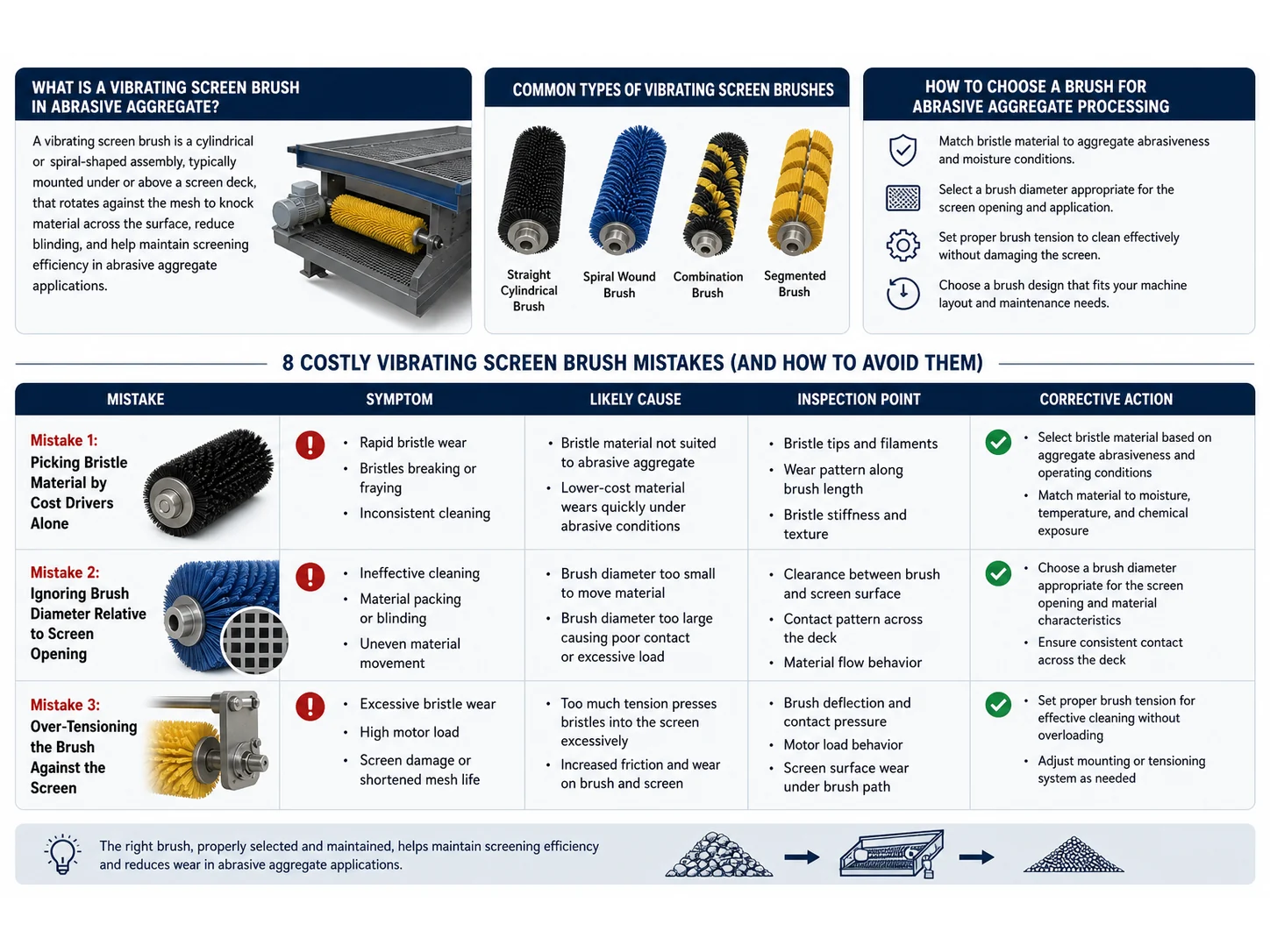
What Is a Vibrating Screen Brush in Abrasive Aggregate?
A vibrating screen brush is a cylindrical or spiral-shaped assembly, typically mounted under or above a screen deck, that rotates against the mesh to knock out lodged material. In abrasive aggregate – crushed stone, sand and gravel, recycled concrete – the brush works in a high-wear, high-dust environment. Its job is not just cleaning; the right brush also helps preserve screen cloth life by reducing the force needed to clear openings. The wrong brush can wear through a screen prematurely or fail to clean at all.
Common Types of Vibrating Screen Brushes
Brush manufacturers offer multiple configurations. The table below outlines types commonly encountered in aggregate plants and their intended use.
| Brush Type | Bristle Material | Best Suited For | Watch Out For |
|---|---|---|---|
| Standard Nylon | Nylon 6 or 6/6 | General dry cleaning, moderate temperatures | Softens in heat; poor abrasion resistance on sharp edges |
| Abrasive Nylon | Nylon with embedded grit (e.g., silicon carbide) | Removing stubborn, hardened residues | Can wear screen wire faster if over-tensioned |
| Polypropylene | Polypropylene | Wet screening, chemical resistance, USDA applications | Lower temperature ceiling; less stiff than nylon |
| Wire Brush | Stainless or carbon steel wire | Heavy crust removal, high-temperature duty | High risk of screen damage; not for fine mesh |
| Combination / Spiral Brush | Mixed bristle types in a spiral pattern | Variable cleaning action across the deck | Complex ordering if exact spec is unknown |
How to Choose a Brush for Abrasive Aggregate Processing
Start with the screen cloth aperture, wire diameter, and the type of residue you face – dry dust, sticky clay, or hardened aggregate fines. Then evaluate:
- Bristle stiffness vs. mesh strength. Coarse, heavy-duty wire screens can tolerate stiffer bristles; fine, high-tensile screens need softer or larger-diameter brushes that distribute load.
- Bristle diameter and fill density. For general cleaning, medium-fill nylon brushes are common. High fill density gives more contact points but increases drag and motor load.
- Core and mounting interface. The brush shaft diameter, end connections, and drive mechanism must match existing equipment. Mismatched bore or keyway stops the brush before it even runs.
- Wet or chemical exposure. If the process uses water spray or washdown chemicals, polypropylene or stainless steel core brushes hold up better than standard carbon steel cores.
- Rotation speed and direction. Brush speed should be set to avoid synchronizing with screen vibration frequency, which can cause resonant damage. Direction matters for material flow; counter-rotation is often preferred for discharging fines.
- Custom sizing. Most aggregate plants need brushes cut to exact deck width, usually between 3 feet and 8 feet. Verify the supplier can provide real custom lengths, not just stocked increments.
8 Costly Vibrating Screen Brush Mistakes (and How to Avoid Them)
Mistake 1: Picking Bristle Material by cost drivers Alone
Low-cost standard nylon wears out quickly in abrasive aggregate. Spending a little more on abrasive nylon or a blend designed for crushed stone often extends brush life 2-3 times. Compare wear-rate data or run a side-by-side test before committing to a large order.
Mistake 2: Ignoring Brush Diameter Relative to Screen Opening
A brush too small in diameter may not reach deep enough into the mesh; too large can cause excessive deflection and snagging. Measure the deck-to-brush clearance and the screen sag under load to choose the correct outside diameter.
Mistake 3: Over-Tensioning the Brush Against the Screen
Pressing the brush too hard into the screen may clean faster initially but will abrade the wire. Set tension so the bristle tips just penetrate or lightly graze the screen openings. Use adjustable mounts to find the sweet spot.
Mistake 4: Using Wire Brushes on Fine Mesh or Light-Gauge Screens
Metal bristles can cut through thin wire and widen openings. Reserve wire brushes for heavy-duty scalping decks with large, thick-wire screens (e.g., 2-inch openings). For mesh finer than 1/2 inch, stay with non-metallic bristles.
Mistake 5: Forgetting Wet-Screen Chemistry
Water plus fine aggregate creates a slurry that accelerates corrosion on ordinary steel cores and can soften certain nylons. Specify a polypropylene or stainless steel brush assembly and check the bristle resin grade for wet service.
Mistake 6: Running One Brush Type Across All Decks
A top deck scalping brush rarely works well on the bottom classifying screen. Different decks may need different bristle stiffness, diameter, or fill pattern. Plan brush sets per deck instead of a single plant-wide spec.
Mistake 7: Skipping Scheduled Inspection and Replacement
Worn-down brushes lose cleaning ability and cause blinding. Set a visual inspection every 100 operating hours and change brushes when bristle length is reduced by 30% or more. Keep a wear log per brush position.
Mistake 8: Ordering Without a Drawing or Sample
When you dictate dimensions over the phone or web form, small errors in overall length, shaft diameter, or keyway size can render the brush unusable. Always send a marked-up drawing or a sample of the old brush with the RFQ. Confirm the manufacturer’s drawing before production.
When a Vibrating Screen Brush Is the Wrong Choice
A brush cannot fix every blinding problem. If you have wet, sticky clay that smears across the mesh, a spray bar or water wash system may be needed ahead of mechanical cleaning. If pegboards are severely plugged with large, hard-to-dislodge stones, consider a vibrating ball deck or a different screen motion (e.g., elliptical vs. linear). Also, if the screen cloth itself is worn, destressed, or improperly tensioned, no brush will perform well – screen replacement must come first. For unusual conditions, ask a brush manufacturer to review your screen panel drawing and application data before assuming a standard brush will work.
Final Takeaway: A Better Approach to Brush Selection
Stop treating vibrating screen brushes as generic consumables. Define your residue type, measure your deck interface precisely, choose bristle material and stiffness that balance cleaning and screen wear, and establish a replacement interval based on actual wear, not just breakdowns. When you combine the right brush with the right mounting and operating settings, screen capacity stays higher, wire lasts longer, and plant uptime improves – without guesswork.
Frequently Asked Questions
What is the ideal bristle stiffness for abrasive aggregate screens?
There is no single ideal, but a medium-stiff abrasive nylon is a common starting point for crushed stone. If the aggregate is extremely angular, consider a softer bristle with a larger diameter to distribute contact pressure.
Can I use a standard drum brush on a vibrating screen?
Standard drum brushes often lack the end connector design that mates with vibrating screen drive shafts. Check the mounting interface before ordering. Purpose-built screen brushes usually have engineered hubs or quick-connect ends.
How do I know if my brush is causing screen wear?
Examine the wire near the brush path. If you see shiny spots, thinning, or flat sections on the wire crowns, the brush is too aggressive. Reduce tension or switch to a softer bristle.
What diameter brush should I order?
Measure the distance from the brush shaft centerline to the screen surface in its loaded, operating position. The brush diameter should be approximately 1/4 to 1/2 inch larger than that clearance, so the bristles just reach the mesh without excessive deflection.
How often should I replace vibrating screen brushes?
In abrasive aggregate, inspect every week. Replace when bristle length wears down by one-third or when you notice a drop in screen throughput or an increase in pegging, whichever comes first.
Is polypropylene always better for wet screens?
Polypropylene resists moisture absorption and chemical attack better than nylon, making it a strong choice for wet environments. However, it is less stiff, so check whether the bristles can still remove your specific residue at the available torque.
What information do I need to get an accurate quote?
Provide overall brush length, outside diameter, bristle material, bristle trim length, core material, shaft diameter, keyway or drive detail, and if possible, a photo or drawing of the existing brush and screen deck. The more you share, the fewer misquotes you’ll receive.
Technical References
- OSHA — Machine Guarding
- OSHA — Control of Hazardous Energy
- OSHA — Combustible Dust
- EPA — Particulate Matter Basics
- OSHA — Respirable Crystalline Silica
Which bristle material fits this job — Nylon PA, Abrasive Nylon or AISI 304 Stainless Steel Wire?
| Material | Continuous temperature (°C) | Peak temperature (°C) | Water absorption | Hardness |
|---|---|---|---|---|
| Nylon PA | 93 | 121 | 0.3–9% by PA grade and conditioning | Medium to firm; filament diameter and trim length control bending force. |
| Abrasive Nylon | 120 | 150 | 0.1–1.0% | Abrasive filament; stiffness and cutting level is controlled by PA base, grit type, grit size, filament diameter and trim height. |
| AISI 304 Stainless Steel Wire | 400 | 500 | 0% | Rockwell B 70–95 depending on temper and cold work |
| Carbon Steel Wire | 200–300 | 350–450 | 0% | Rockwell C 40–60 |
| Polypropylene PP | 80–100 | 120–140 | ≤0.03% | Shore D 65–75 |
Figures as published by Brushtec / DuPont; Perlon; Alleima. Confirm the exact grade against the supplier datasheet before ordering.
What should replace Strip Seal Brushes for vibrating screen brush?
- Strip Seal Brushes — Strip brushes create a linear barrier or guide; machine-table brush plates distribute load and support products over a broad area. Closest alternative: Machine Table Brush Plates.
- Handheld Detail Brushes — Handheld detail brushes cover general precision cleaning; auto-detailing brushes impose tighter controls for painted, polished, leather, display, and trim surfaces.
- Nylon PA — Compare Nylon PA with PP, PBT, PET. Change material when wet stiffness, temperature, chemical resistance, conductivity, particle shedding, or surface marking becomes the limiting factor.
- Abrasive Nylon — Compare Abrasive Nylon with PP, PBT, PET. Change material when wet stiffness, temperature, chemical resistance, conductivity, particle shedding, or surface marking becomes the limiting factor.