
Custom Cleaning Brush
Vibrating Screen Brush
Anti-blinding brush assemblies that sweep fines, fiber and wet residue from vibrating screen apertures while the deck keeps running.
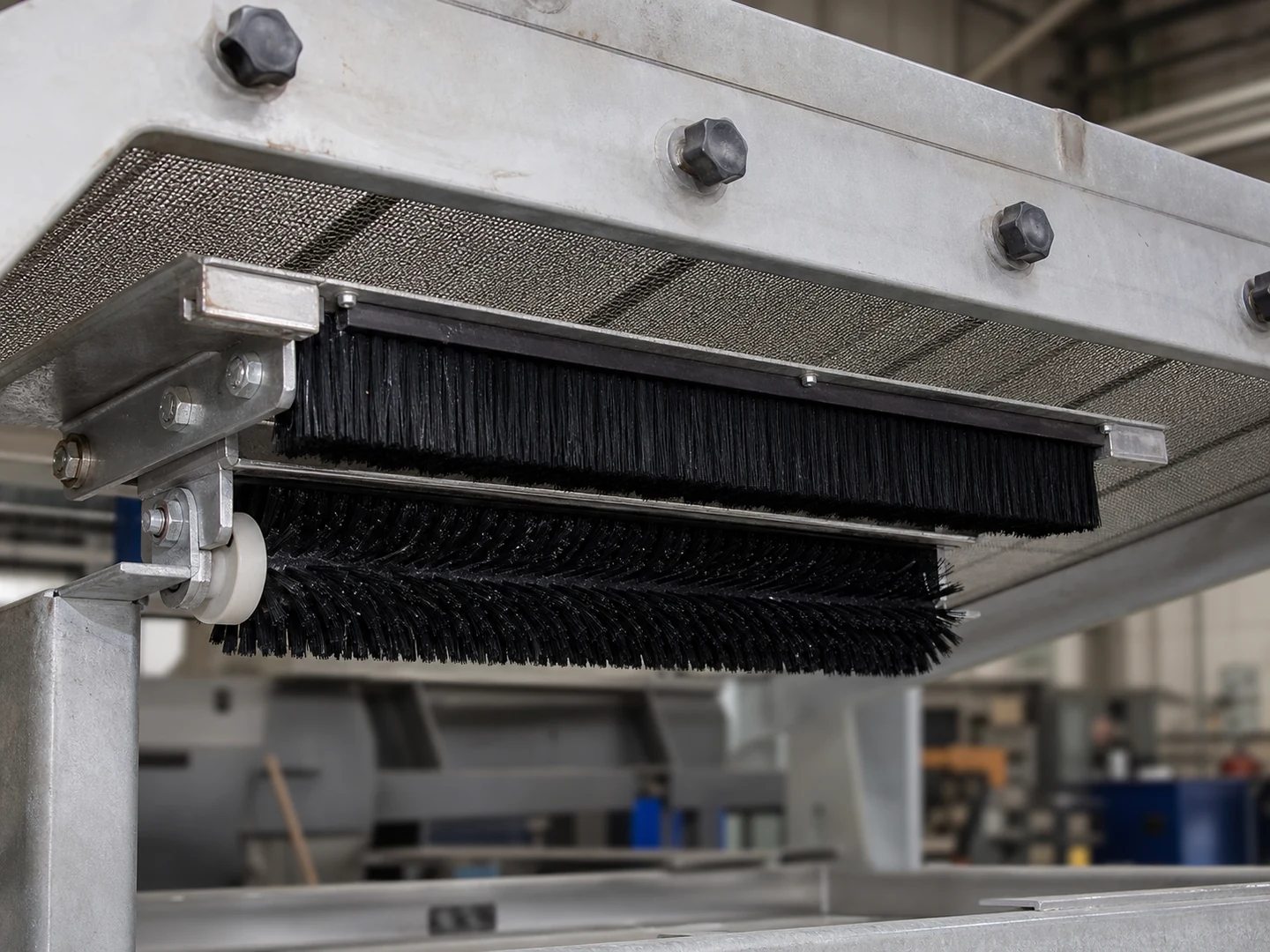
Large-format brush
100 pcs
Minimum order
Built one at a time on a core or channel: full-width rollers, sweeper brooms and long strip.
Production lead time, once the specification is confirmed
- Up to 100 pcsWithin 20 days
- 101–1,000 pcsWithin 30 days
- Over 1,000 pcsConfirmed with your quotation
Peak season can extend these times; the shipping date is confirmed in writing with your quotation. Sampling and shipping are quoted separately.
A mounted or free-rolling brush assembly that sweeps blinding fines, fibers, and wet residue from vibrating screen apertures while the screen keeps running. It is built around nylon and polypropylene filaments set to controlled contact across the working width, so the deck stays open without stopping production for manual cleaning.
What can this brush do for you?
Keeps the deck open while the screen runs
The brush rides against the screen underside or top surface and lets the machine’s own vibration or a driven shaft sweep particles out of the apertures continuously. This eliminates the shutdown cycles and manual deck scraping that fine sifting lines otherwise need when near-size fines build up in the mesh.
Tunable contact that clears blinding without tearing mesh
Installed contact is set at a controlled percentage of the free trim, not full compression of the filament. The tips flick material out of the opening instead of being forced through it, which keeps the wire cloth intact while the apertures stay clear. The result is less peening, less wire fatigue, and fewer unplanned mesh changes.
Handles the three blinding patterns that stop a screen
Dry fines wedge into the aperture, fibers wrap across the wires, and damp or sticky residue closes the openings from the underside. The filament diameter, trim length, and stiffness can be matched to the specific blinding mechanism, so the brush clears what is actually shutting the deck down rather than simply rubbing the surface.
Full-width contact, including the edge band
Blinding usually starts at the side skirts where material moves slowest. The brush is sized to cover the active screen working width plus 5 to 15 mm of overlap per side, so there is no unprotected band along the edge of the deck.
Worn sections are replaceable, not the whole assembly
For wide decks, the brush fill can be built in segments or removable strips. When one zone wears faster than the rest, only that section is replaced, which keeps spare parts cost and installation time down on multi-deck screening plants.
What is a Vibrating Screen Brush?
A Vibrating Screen Brush is a brush assembly installed on or adjacent to a vibrating screen deck to physically dislodge particles that lodge in the apertures. It can be built as a cylindrical brush rotating on a driven shaft, an idler brush that turns against the moving screen, or a fixed strip brush mounted along a rail. All three configurations use the same working principle: filament tips make light, continuous contact with the screen surface and push blinded material back out of the openings before it can set.
This is not a hand brush and not a wash-down brush. It works at the aperture level. The cleaning action comes from the relative motion between the screen and the brush, so the mounting method must be matched to the screen drive, stroke, and amplitude. On a linear-motion screen, a fixed rail brush can clear the mesh as the deck moves beneath it. On a circular or gyratory machine, a rotating or idler brush maintains contact across the circular screening area. On a wide deck with heavy blinding, a driven shaft gives positive rotation and more consistent clearing force across the full width.
A typical configuration consists of a steel or polymer core, nylon PA or polypropylene filaments set in a channel fill, and end plates or brackets that locate the brush relative to the screen surface. The free trim length and radial engagement are set at installation. The brush should follow the deck contour without fighting the vibration. Excessive radial preload accelerates filament and mesh wear; too little contact leaves the apertures closed.
The brush is a mechanical anti-blinding device, not a replacement for the screen washing, ultrasonic excitation, or air knockers that some processes require. It is most effective when the blinding is loose or lightly bonded: dry fines, fibrous wrap, damp powder, or material that forms a soft layer in the aperture.
Technical Specifications
The table shows the parameters we work to for vibrating screen brushes. Dimensions, materials, and mounting are configured per screen rather than supplied as one fixed size.
| Parameter | Value / Options |
|---|---|
| Screen working width | 100–3000 mm, matched to the active deck width plus side overlap |
| Brush outside diameter | 80–600 mm, selected for access clearance and the required contact arc |
| Free trim length | 25–200 mm |
| Filament diameter | 0.30–2.00 mm, finer for fine mesh, heavier for coarse plate and wedge wire |
| Filament material | Nylon PA, polypropylene PP, or project-specified polymer; mixed or color-coded fills available |
| Installed contact | 5–25% of free trim, matched to the screen motion and mesh condition |
| Radial engagement | 2–10 mm typical; set to follow deck deflection without heavy preload |
| Edge overlap | 5–15 mm per side beyond the active screen width |
| Fill pattern | Straight, spiral, staggered, or custom zone pattern; density adjusted to aperture size and blinding mechanism |
| Mounting | Fixed rail, driven shaft, idler roller, or screen-specific end plate and bracket |
| Core / backing | Carbon steel, stainless steel, aluminum channel, or polymer core; material selected for the process environment |
| Operating environment | Dry or wet service, washdown exposure, chemical contact, and temperature range; filament and hardware chosen to match |
| Brush type | Custom Strip Seal Brushes |
| How it is driven | Fixed in place, no drive of its own |
| Cleaning target | fine powder sifting and classification, mining and aggregate screening, and recycling and waste separation cleaning |
| Surface or part | screens, vibrating screens, rails, perforated plate, wedge wire, plates, wire mesh, and ceramic |
| Residue or debris | fines, powder, fiber, particles, blinding fines, wet residue, fine powder, and clay |
| Mounting / connection | Fixed rail, driven shaft, idler roller, or screen-specific end plate and bracket |
Where does this brush work best?
- Fine powder sifting and classification: sugar, starch, flour, ceramic powder, and pigment lines where fine mesh loses open area to wedged particles and throughput drops until the deck is cleaned.
- Mining and aggregate screening: scalping and sizing decks dealing with damp quarry fines, clay, or ore that blinds the underside of woven wire cloth.
- Food and pharmaceutical safety screening: rotary and gyratory sifters where blinded apertures force recirculation, reduce yield, and increase the load on downstream equipment.
- Recycling and waste separation: fibrous or stringy material that wraps across wire mesh and stops the screen from sorting by cut point.
- Fertilizer, chemical, and plastic pellet screening: sticky, hygroscopic, or static-charged granules that need continuous mechanical clearing to hold a stable cut size.
- Wedge wire and perforated plate separators: slotted or punched decks where fines pack into the openings and require tip-level contact to be pushed back out.
How do I choose the right one?
Start with the screen media and aperture
Fine woven mesh calls for smaller filament diameters, typically 0.30–0.60 mm, and softer, more flexible tufts so the tips can enter the apertures without peening the wires. Perforated plate and wedge wire decks can accept heavier filaments from 0.60 mm up to 2.00 mm, with a stiffer trim that applies more force to packed material.
Identify what is actually blinding the deck
Dry abrasive fines favor nylon PA for abrasion resistance and controlled stiffness. Wet, chemical, or high-humidity service often favors polypropylene for its low moisture absorption and chemical tolerance. Fibrous wrap needs longer, more aggressive trim that can comb the fibers off rather than just bending over them. If static is the main problem, conductive or anti-static filament options can be evaluated for the specific powder.
Choose the mounting method from the screen motion and available clearance
A fixed rail is the simplest and lowest-clearance option; it relies on the deck motion to create the working action and suits gyratory or small-amplitude linear screens. An idler roller turns against the moving screen and needs no drive, which works well when the screen already supplies enough relative speed. A driven shaft gives positive rotation and is the right choice for wide decks, heavy blinding, or slow-moving screens where the relative motion alone is not enough.
Set the contact carefully
Radial engagement should begin around 2–5 mm and installed contact around 10–15% of free trim, then be increased in small steps until the blinding clears. If tips fold over permanently, break, or the wire shows polished and impact marks, the brush is set too deep. A brush that is set too light will look fine but leave apertures closed; check the deck from underneath before accepting the setting.
Check the environment before selecting hardware
Wet or washdown service calls for stainless end plates, shafts, and hardware, along with bearings that tolerate the process conditions. If the screen runs in a dusty or corrosive plant, aluminum or plain carbon steel may fail quickly even when the filaments still look new. Specify the operating temperature and any chemical exposure so the core, backing, and filament grade are selected as a system.
When another approach makes more sense
If the material cakes, sets like cement, or reaches the screen already hardened, no brush will restore the apertures. That situation needs high-pressure washing, chemical cleaning, ultrasonic screening, or a change in upstream moisture control. For very heavy impact duty, such as coarse scalping with large rock, a brush under constant abuse will be destroyed before it helps; air knockers, water sprays, or self-cleaning media may be the better choice. The brush performs best where fines, fibers, and soft residue are the blinding problem.
Can I customize this brush?
Vibrating screen brushes are configured to the deck, not picked from a catalog. We need the screen make and model or a frame drawing, the working width, mesh type and aperture, distance from the mounting point to the screen surface, screen stroke or drive speed, and a description of the blinding material. Wet or dry service, temperature, and any chemical exposure complete the picture.
We can adjust:
- Working width and segmenting: exact deck coverage, edge overlap, and segmented construction for wide or multi-panel screens.
- Filament system: nylon PA or polypropylene, filament diameter, trim length, stiffness, density, spiral or staggered pattern, and mixed zone fills where blinding is localized.
- Core and end fittings: shaft diameter, keyway, flange, bearing arrangement, bolt pattern, or quick-release mounting to match the existing machine.
- Mounting frame and brackets: fixed rail, driven shaft, or idler roller; stainless, galvanized, or coated hardware; adjustable height or angle plates.
- Fill zones: different stiffness or density across the width when one side of the deck blinds faster than the other.
- Color coding and marking: filament color zones, printed or laser-marked identification, and wear indicators if visual replacement checks are part of your maintenance routine.
- Packaging: bulk, individual, or project-specific packing for plant spares or multi-site rollout.
If your project requires material documentation, food-contact declarations, inspection support, or third-party testing, we can assist with those requirements during the customization process.
Which filament survives the cleaning and still lasts on a vibrating screen brush?
How deep should the brush touch the screen?
Start with 2–5 mm of radial engagement and an installed contact around 10–15% of the free trim. Check whether the underside blinding clears after a short running period, then increase in small steps only if needed. If the filament tips fold over permanently or the wire shows polished or impact marks, the brush is set too deep.
Should the brush run on top of the screen or underneath?
For fine mesh where particles wedge into the apertures, the underside is the standard location because the brush pushes material back out the way it entered. The top side is used when the deck blinds from above or when material bed depth needs agitation. On slotted wedge wire decks, cleaning from the side opposite the flow typically gives better aperture clearing.
How can I tell when the filament needs replacement?
Inspect the brush during routine screen maintenance. Replace the fill when the trim length has worn below the minimum needed for engagement, when tips are melted, flattened, or splayed, or when clear bands of blinding return even after contact is adjusted. Keeping one new segment for visual comparison makes the wear decision faster.
Will the brush damage fine stainless wire cloth?
It should not if the filament diameter, stiffness, and engagement are matched to the mesh. Fine mesh needs fine, soft filaments and minimal engagement. A heavy, stiff filament set too deep can peen and abrade the wires. If wire wear marks appear, reduce the engagement and switch to a finer or softer filament before the cloth is damaged.
Does a vibrating screen brush replace sieve washing or ultrasonic cleaning?
No. The brush removes loose, near-surface blinding as it forms. Hard, caked, or chemically set material still needs washing, ultrasonic excitation, or another auxiliary cleaning method. In wet blinding service, a brush is often used alongside water spray, but the process chemistry and moisture control determine whether that combination will work.
Can the brush be installed on an existing screen without changing the drive?
In most cases, yes. Many screens can accept bolt-on brackets on the existing side plates or frame rails, and idler or fixed-rail configurations require no additional drive. The main checks are clearance between the deck and the support structure, screen stroke and amplitude, and access to both ends for future inspection. A frame drawing or opening dimensions are enough to confirm fit.
Guides that go deeper on this
Custom Manufacturing RFQ
Describe Your Application
For a custom quote, we need the key dimensions, surface or part, residue, material preference, quantity, and reference image or drawing.
Drawing or photo optional — it speeds things up, it does not gate the enquiry.
Custom Brush RFQ
Send Your Brush Project
Upload a drawing, product photo, or sample photo and provide the core dimensions and cleaning conditions.
“We need a brush to remove wet residue from a stainless steel conveyor, about 800mm wide. The current brush wears quickly. We can send photos.”
“We sell drinkware and need a cleaning brush to include with the product. Quantity around 5,000 pieces.”