
What Is a Screen Cleaning Brush?
A screen cleaning brush is a contact-based device designed to physically dislodge near-size particles stuck in screen apertures. It typically consists of a brush body with bristles that sweep or roll across the screen surface. In aggregate processing, waste recycling, and mining, these brushes reduce downtime and keep separation accurate.
Trommel vs Vibrating Screen Brush Systems
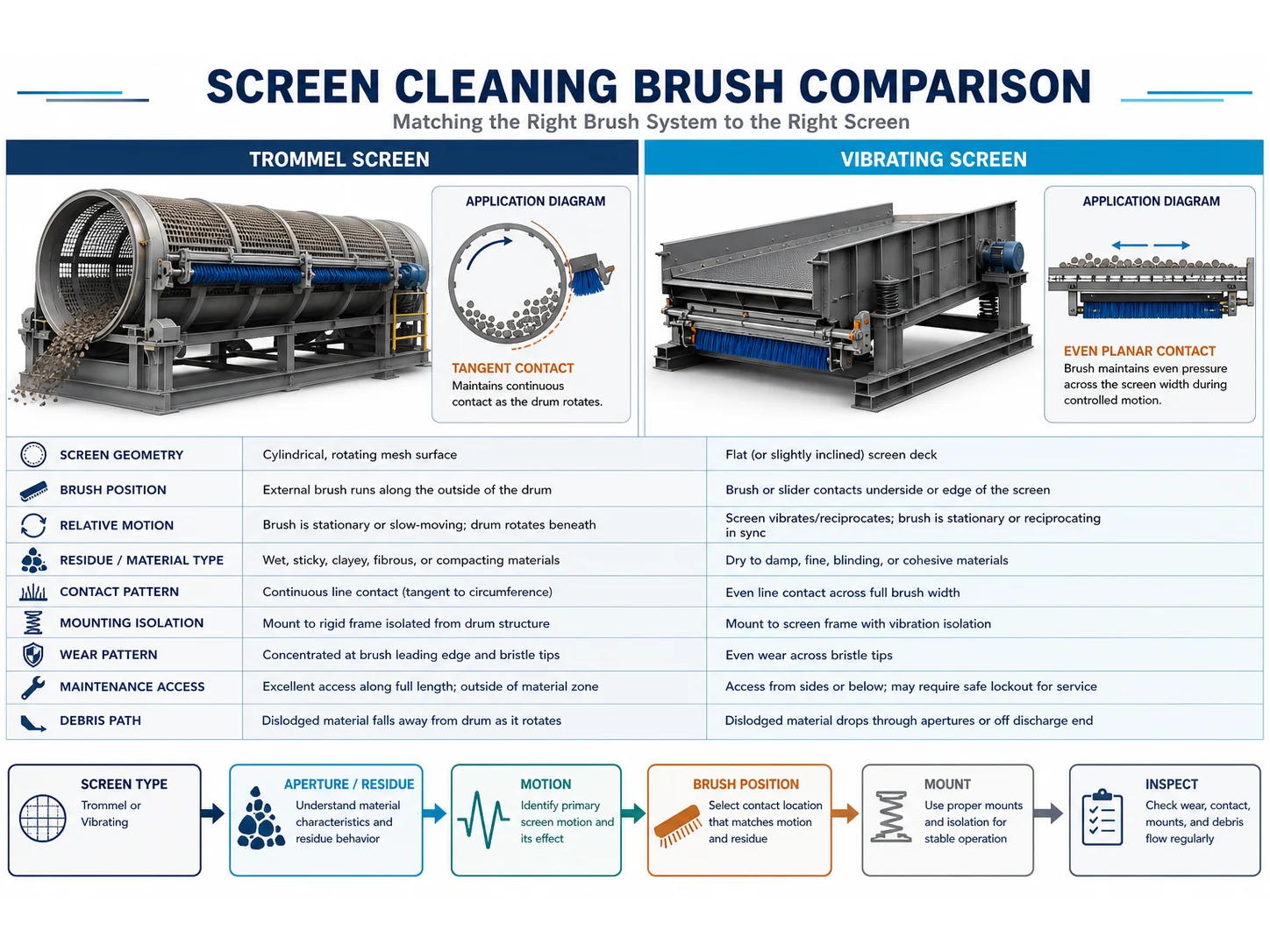
Brush design and motion differ fundamentally between the two screen types. Trommels rotate, so brushes are fixed externally or move incrementally along the drum axis. Vibrating screens typically use a traversing brush assembly that moves linearly under or over the screen panel. The table below highlights key differences.
| Feature | Trommel Brush System | Vibrating Screen Brush System |
|---|---|---|
| Brush Motion | Stationary or slow axial movement while screen rotates | Linear reciprocating or continuous travel across screen |
| Typical Brush Type | Cylinder brush or segment brush | Strip brush, roller brush, or brush belt |
| Contact Pattern | Continuous contact along a line; drum rotation does the work | Intermittent or continuous sweep depending on traverse speed |
| Common Applications | MSW, compost, trommel fines, recycling | Aggregate sizing, crushed stone, sand, ore screening |
| Brush Pressure Adjustment | Usually fixed; must be set precisely to avoid screen wear | Often adjustable via spring or pneumatic tensioners |
Nylon vs Wire Brush Materials
Choosing the right bristle material directly affects cleaning performance and risk of screen damage. Nylon and wire are the two most common families. The table below compares them.
| Material | Best For | Mesh Size Suitability | Risk to Screen | Wear Resistance | Typical Applications |
|---|---|---|---|---|---|
| Nylon (solid or abrasive-filled) | Fine to medium meshes, sticky or lightweight materials | 0.1 mm to 6 mm typical | Low – gentle on screen media | Moderate; abrasive types last longer | Municipal solid waste, compost, sand, light recycling |
| Stainless Steel Wire | Coarse meshes, abrasive heavy materials, severe blinding | 2 mm to 50 mm typical | Medium to high if pressure is excessive | High; resistant to abrasion | Aggregate, crushed rock, mining scalping |
| Brass Wire | non-sparking environments, moderate abrasion | 2 mm to 25 mm | Medium | Medium | Chemical plants, grain cleaning, some recycling |
How to Choose Based on Mesh Size and Material
Selection starts with the screen aperture and the material being processed. Use this decision logic:
- Mesh size below 1 mm: Nylon or soft abrasive-filled brushes are the safest choice. Wire risks puncturing or distorting fine mesh.
- Mesh between 1 mm and 6 mm: Consider abrasive nylon for sticky material; hard wire if blinding is persistent and the screen is robust (e.g., heavy wire cloth).
- Mesh above 6 mm: Wire brushes (stainless steel or brass) can be effective. Ensure brush pressure is controlled, especially on self-cleaning screens.
- Damp, sticky material (compost, biomass, clay): Nylon brushes with added abrasive grit often work best because they are less prone to bristle matting and corrosion.
- Hard, abrasive material (granite, slag, ore): Stainless steel wire withstands abrasion better but must be monitored for wear that could lead to screen surface grooves.
Common Mistakes When Using Screen Cleaning Brushes
Avoid these frequent errors to extend screen and brush life:
- Using the same brush for trommel and vibrating screens without design verification. The contact angle and motion differ, so a brush optimized for one may not work on the other.
- Choosing by cost rather than compatibility. A low-cost brush that damages expensive screen panels costs far more in downtime and replacement.
- Ignoring brush wear. Worn bristles lose contact pressure and soon a clean-looking brush does almost nothing to clear openings.
- Excessive brush pressure. Overly tight contact can wear the screen surface, enlarge apertures, and contaminate product with wire or nylon fragments.
- Not matching brush material to moisture level. Wet, sticky fines can pack into nylon bristles and turn the brush into a blunt sled.
When Ultrasonic Screen Cleaning Is the Better Choice
Ultrasonic cleaning systems use high-frequency vibration transmitted directly to the screen mesh to dislodge fine particles. They are ideal when:
- Mesh size is extremely fine (below 100 microns) and mechanical brushes could deform or tear the cloth.
- The product must remain completely free of bristle contamination, such as in food processing or high-purity chemicals.
- Material is so sticky or greasy that even soft nylon brushes quickly load up and become ineffective.
- Frequent brush changes are causing excessive maintenance downtime.
Ultrasonic systems are not a direct replacement for every screen cleaning brush application. They require additional capital investment and are most cost-justified on high-value product lines or when blinding losses outweigh equipment cost.
Final Takeaway
Match the brush system to the screen motion: rotary brush for trommels, linear brush assembly for vibrating screens. Then select bristle material based on mesh size and material aggressiveness—nylon for fine, damp or light materials; wire for coarse, abrasive ones. If blinding persists on very fine meshes, evaluate ultrasonic technology as an upgrade path.
Frequently Asked Questions
Can the same screen cleaning brush be used on both trommel and vibrating screens?
Usually not. Trommel brushes are often cylindrical and designed for continuous rotational contact, while vibrating screen brushes typically mount on a traversing mechanism. Using the wrong style can lead to poor cleaning and premature wear.
How often should screen cleaning brushes be replaced?
Replacement depends on material abrasiveness and operating hours. Inspect brushes weekly. When bristle length is reduced by 30–50% or you notice returning screen blinding, it is time for a new brush.
Does wire brush material damage polyurethane or rubber screen media?
Yes, steel wire brushes can cut or abrade polyurethane and rubber screens if pressure is too high or the screen lacks a protective top layer. For non-metallic screen surfaces, nylon brushes are almost always recommended.
What is the maximum mesh size for a nylon screen cleaning brush?
There is no strict upper limit, but nylon bristles become less effective as apertures exceed approximately 12 mm because the bristles may pass through large holes without dislodging trapped material. For very large openings, wire brushes are more practical.
When should I switch from mechanical brushes to ultrasonic cleaning?
Consider ultrasonic cleaning when mesh openings drop below 100–200 microns, when product purity prohibits bristle contact, or when sticky materials consistently clog even new brushes within hours of installation.
Do I need a screen cleaning brush on both the top and bottom side of the screen?
Most blinding occurs from particles wedging into openings from the topside, so top-side brush systems are most common. Under-side brushes can help for materials that extrude through and peg on the bottom face, especially in vibrating screens.
How do I set the correct brush pressure?
Start with the lightest pressure that still achieves acceptable cleaning. Run for a few hours, then check the screen surface for wear marks. Increase only if blinding remains. Always follow the brush manufacturer’s recommended interference guidelines.
Technical References
Which bristle material fits this job — Nylon PA, AISI 304 Stainless Steel Wire or Rubber?
| Material | Continuous temperature (°C) | Peak temperature (°C) | Water absorption | Hardness |
|---|---|---|---|---|
| Nylon PA | 93 | 121 | 0.3–9% by PA grade and conditioning | Medium to firm; filament diameter and trim length control bending force. |
| AISI 304 Stainless Steel Wire | 400 | 500 | 0% | Rockwell B 70–95 depending on temper and cold work |
| Rubber | 100 | 130 | very low | Specified by compound and Shore hardness; published TPE families can span roughly 50–80 Shore A, but that is a product-family example rather than a universal rubber range. |
| Abrasive Nylon | 120 | 150 | 0.1–1.0% | Abrasive filament; stiffness and cutting level is controlled by PA base, grit type, grit size, filament diameter and trim height. |
| Polypropylene PP | 80–100 | 120–140 | ≤0.03% | Shore D 65–75 |
Figures as published by Brushtec / DuPont; Alleima; Perlon. Confirm the exact grade against the supplier datasheet before ordering.
When are Handheld Detail Brushes the wrong choice for vibrating screen brush?
- Handheld Detail Brushes — Use a tube brush, powered brush, scraper, wipe, sponge, or vacuum when the target is internal, heavily bonded, or highly delicate.
- Strip Seal Brushes — Use rubber lips, foam, labyrinth seals, air curtains, or rigid scrapers when pressure sealing or liquid containment is required.
- Nylon PA — The nylon family spans several grades, so heat, moisture and chemical limits should follow the selected PA resin rather than a generic nylon value.
- AISI 304 Stainless Steel Wire — Avoid using AISI 304 as the default in marine, brine, hypochlorite, and persistent chloride environments; use AISI 316 when higher pitting and crevice-corrosion resistance is required.
What should replace Handheld Detail Brushes for vibrating screen brush?
- Handheld Detail Brushes — Handheld detail brushes cover general precision cleaning; auto-detailing brushes impose tighter controls for painted, polished, leather, display, and trim surfaces.
- Strip Seal Brushes — Strip brushes create a linear barrier or guide; machine-table brush plates distribute load and support products over a broad area. Closest alternative: Machine Table Brush Plates.
- Nylon PA — Compare Nylon PA with PP, PBT, PET. Change material when wet stiffness, temperature, chemical resistance, conductivity, particle shedding, or surface marking becomes the limiting factor.
- AISI 304 Stainless Steel Wire — Use AISI 316 stainless steel wire for chloride, marine, dairy, beverage, chemical washdown, or higher pitting-resistance requirements. Use carbon steel for dry aggressive cutting and brass or abrasive nylon for lower marking risk.