
Custom Cleaning Brush
Granulator Screen Brush
Nylon filament brush for clearing blinded granulator and sifter screens. Widths 100–3000 mm, adjustable contact, custom mounting options.
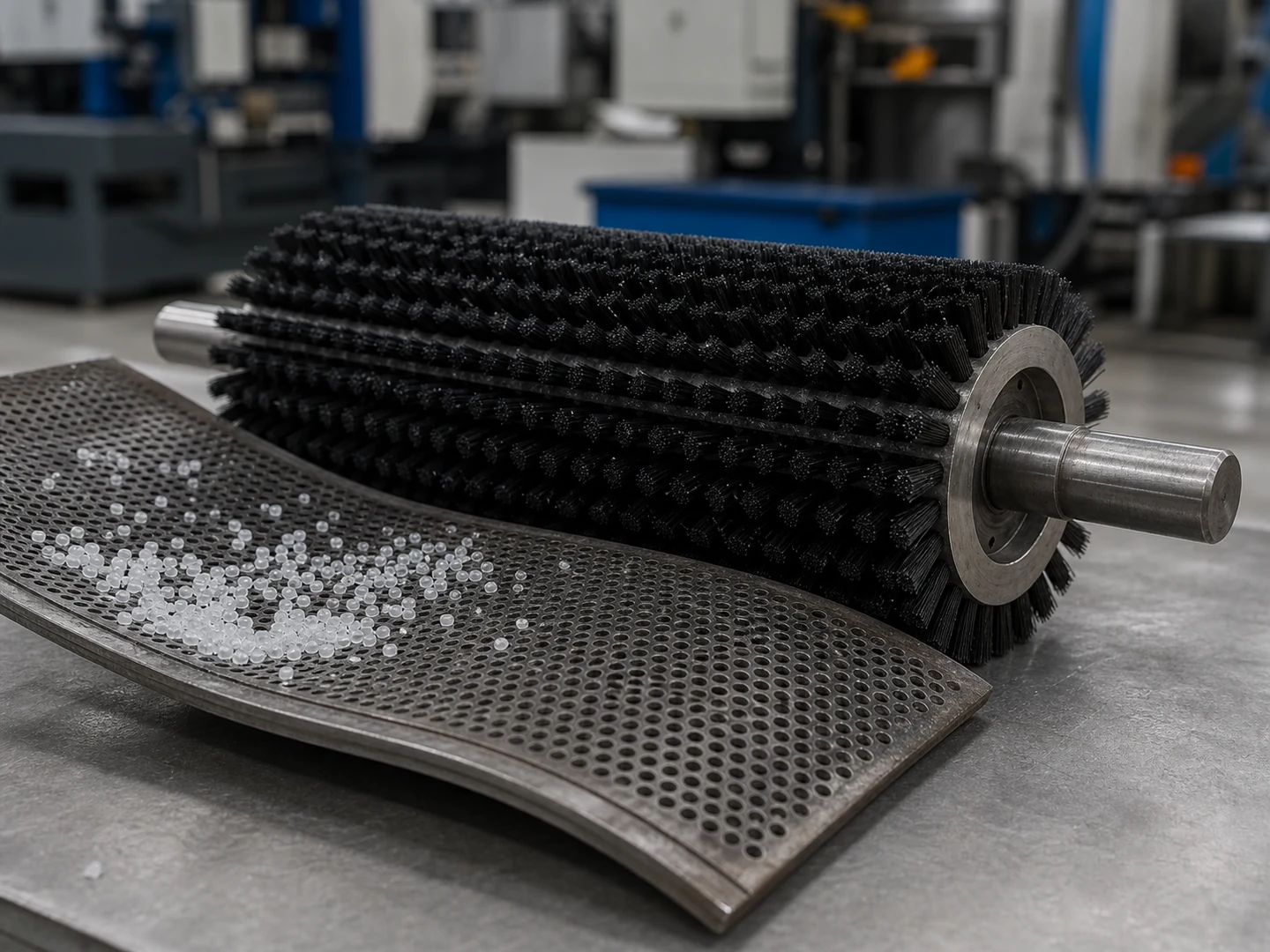
Large-format brush
100 pcs
Minimum order
Built one at a time on a core or channel: full-width rollers, sweeper brooms and long strip.
Production lead time, once the specification is confirmed
- Up to 100 pcsWithin 20 days
- 101–1,000 pcsWithin 30 days
- Over 1,000 pcsConfirmed with your quotation
Peak season can extend these times; the shipping date is confirmed in writing with your quotation. Sampling and shipping are quoted separately.
Continuous nylon-filament brush for clearing blinded apertures on granulator, sifter, and screener screens. Built to working widths from 100 to 3,000 mm with adjustable radial engagement, it keeps wire mesh, perforated plate, and wedge wire surfaces open during production.
What can this brush do for you?
Pushes Blinded Fines Back Out of the Apertures
Bristle tips enter the mesh openings at a controlled depth, flexing through each aperture to displace trapped powder, pellets, fibers, or wet residue. A granulator screen that runs open continues to classify and discharge at rate; one that blinds loses throughput. The brush restores open area in motion.
Cleans Without Stopping the Granulator or Sifter
The brush mounts to the machine frame, idler roller, or driven shaft and works while the screen rotates or vibrates. Operators do not need to stop production to scrape or wash down the screen; the brush performs a cleaning pass every revolution or vibration cycle.
Adjustable Contact That Protects the Screen Surface
Radial engagement is set between 2 and 10 mm, and only 5–25% of the free trim length is deflected at the screen face. This limited interference removes particles without sawing into wire surfaces or bending fine mesh. Nylon PA filaments are flexible enough to recover after each pass and tough enough to withstand abrasive fines.
One Assembly Covers the Full Working Width
Granulator and screener widths vary. The brush is built from 100 mm up to 3,000 mm to cover the complete aperture field, with 5–15 mm of edge overlap per side so no untreated band develops. For very wide machines, multi-roll or segmented cores can be supplied to control handling weight and mid-span deflection.
Wet, Sticky, and Fibrous Residue Doesn’t Pack the Brush
Nylon PA has low surface friction and resists most process moisture. Wet granulation residues and fibers release more readily than from natural-fiber brushes, and the smooth monofilament finish minimizes material wrapping around the core.
What is a Granulator Screen Brush?
A granulator screen brush is a filament assembly positioned against the working face of a granulator, sifter, or screener screen so the bristle tips sweep and penetrate the openings while the screen runs. It is built as a cylinder, strip, or rail-mounted brush with nylon PA filament fill selected for the aperture size, screen wire, and residue.
Two working arrangements are common. On rotary or centrifugal screens, a fixed or idler brush presses against the moving screen face and the screen’s own rotation carries each aperture past the bristles. On stationary screens, the brush is driven from a shaft or an oscillating rail and moves over the screen surface. In either case, the brush does not scrub the entire screen like a floor brush; it contacts just enough of the screen to push trapped particles back out or loosen them for discharge.
This is a mechanical blinding-control tool. With nylon PA, the brush is suited to ambient and mildly elevated temperatures and general chemical exposure, but not to high heat, strong acids, or sustained heavy abrasive wear. It works with the screen motion, not against it, and it is not a replacement for washdown or chemical cleaning of heavily fouled screens.
Technical Specifications
The values below describe the standard engineering envelope for this brush. For a specific machine, we use the screen drawing and process data to fix each parameter exactly.
| Parameter | Value / Options |
|---|---|
| Screen working width | 100–3,000 mm, built to the aperture field |
| Brush outside diameter | 80–600 mm, matched to screen curvature and clearance |
| Free trim length | 25–200 mm, selected for aperture depth and flexibility |
| Filament diameter | 0.30–2.00 mm, finer for small apertures, coarser for perforated plate |
| Installed contact | 5–25% of free trim length deflected at the screen face |
| Radial engagement | 2–10 mm into the screen face, set to residue and mesh strength |
| Edge coverage | 5–15 mm overlap beyond the working width on each side |
| Fill material | Nylon PA (grade selected for moisture and wear exposure) |
| Bristle configuration | Straight rows, spiral wrap, helical strip, or multi-row tufted |
| Mounting | Fixed rail, driven shaft, idler roller, or screen-specific bracket |
| Maximum operating speed | Project-matched to screen motion and brush core balance |
| Core / shaft | Plated steel, stainless steel, aluminum, or non-metallic option |
| Operating temperature | Typically up to about 80°C (176°F) dry; derate in wet or humid service |
| Brush type | Custom Roller and Conveyor Brushes |
| How it is driven | Machine-driven, mounted in the equipment |
| Cleaning target | dry granulation and pelletizing line, pharmaceutical and food sifter, and plastics recycling and regrind cleaning |
| Surface or part | screens, sifters, perforated plate, wedge wire, rails, wire mesh, baskets, and edges |
| Residue or debris | particles, fines, wet residue, pellets, powder, embedded particles, dust, and trapped particles |
| Mounting / connection | Fixed rail, driven shaft, idler roller, or screen-specific bracket |
Where does this brush work best?
- Dry granulation and pelletizing lines: Rotary granulator screens and perforated plates where fine undersize builds up and reduces open area.
- Pharmaceutical and food sifters: Vibratory and gyratory sifters handling sticky or fibrous powders that lodge in mesh openings.
- Plastics recycling and regrind: Granulator discharge screens clogged with film fines, dust, and melted specks.
- Minerals and chemical processing: Wedge wire and perforated classification screens carrying wet residue or embedded particles.
- Extrusion and pelletizing: Water-ring or strand pelletizer screens where pellets and fines blind the plate during cutting.
- Basket and dewatering screens: Rotating basket screens that coat with wet fines and need continuous wipe-off.
How do I choose the right one?
Start with the screen and the apertures
Measure the screen type, aperture size, wire diameter, and the width that actually carries product. The filament diameter must be small enough to enter the openings but stiff enough to push the residue out. For fine mesh, 0.30–0.60 mm filaments are typical; for perforated plate and coarse wedge wire, 0.80–2.00 mm filaments apply more force.
Match the brush motion to the screen motion
If the screen itself rotates or moves, a fixed or idler brush can contact the moving face without a separate drive. If the screen is stationary or only vibrates linearly, the brush needs its own driven shaft or oscillating rail. Surface speed direction matters: the brush should work with the screen’s travel, not comb against leading edges.
Set the right amount of contact
Start at the low end of the 2–10 mm radial engagement range and verify that blinding clears. Increase engagement only until the apertures stay open, then stop. A brush that compresses more than about 25% of its free trim length wears fast and can bend fine wire; a brush that barely grazes the surface will polish the residue but not dislodge it.
Consider moisture, temperature, and chemicals
Nylon PA absorbs moisture from wet processes, which softens the filament and makes it swell slightly. For consistently wet service, request a moisture-stabilized grade or consider a polyester or PBT alternative. For process temperatures above about 80°C or exposure to strong acids, select a different filament material and a corrosion-resistant core. Specify washdown chemicals early so the core and filament grade match the actual environment.
Know when nylon is not the answer
If the screen carries hard mineral scale, very abrasive slurry, or runs above nylon’s temperature limit, a stainless steel wire brush or a different cleaning method may be more suitable. If the apertures are finer than any practical filament diameter, a brush cannot penetrate them; consider an air knife, vacuum pickup, or ultrasonic bath instead. Use this brush for mechanical blinding control of granular and powdery residues within nylon’s limits.
Can I customize this brush?
This screen brush is configured to the screen geometry, mounting points, and process conditions rather than supplied as a fixed off-the-shelf item. To define the correct build, we need the screen type, aperture size, wire diameter, overall working width, available mounting space, screen motion, speed and direction, temperature, moisture, and the current cleaning problem. A drawing, photo, or worn brush sample will shorten the specification cycle.
- Working width and edge overlap: Cut to the exact aperture field with 5–15 mm overlap per side.
- Outer diameter and free trim length: Matched to screen curvature, mounting clearance, and required contact depth.
- Filament diameter and density: Selected per aperture size and residue; available in straight rows, spiral wrap, helical strip, or multi-row tufted patterns.
- Core and shaft: Material, diameter, keyway, bearing seats, and flange patterns matched to the machine interface.
- Mounting interface: Fixed rail, idler roller with bearings, driven shaft with coupling, custom bracket pattern, or slotted adjustment rail.
- Contact adjustment: Spring-loaded idler, eccentric mounts, or slotted rails to control radial engagement in service.
- Color and marking: Filament color for line identification, shaft marking, or batch coding as required.
- Packaging: Bulk, individually sleeved, matched sets, or project-specific packing.
If the installation requires material declarations, food-contact documentation, inspection plans, or third-party testing, we can coordinate those requirements during the customization stage.
Which filament and running speed suit a granulator screen brush?
How can I tell if the contact engagement is set correctly?
After a short run, inspect the screen face and brush tips. If apertures remain clear and the bristle tips show only a light wear polish, the setting is about right. If product packs into the brush base or the brush deflects more than about 25% of its free trim, engagement is too deep. If apertures blind while the brush runs, engagement is too shallow or the filament diameter is too large to enter the openings.
Does the brush run in either rotation direction?
Not always. A spiral or helical filament layout is directional; reversing rotation lays the bristles the wrong way and reduces cleaning. Specify the rotation or travel direction when ordering. If the brush must work in both directions, request a symmetrical straight-row filament layout.
How should spare brushes be stored?
Keep them dry and away from sunlight and heat sources. Nylon PA absorbs moisture from humid air, which temporarily softens the filaments and changes their length. Store spares in polyethylene wrap or a dry room, and allow the brush to condition for a day after moving from a cold warehouse to a warm process area before setting final contact.
What is the most common cause of premature bristle failure?
Excessive deflection. When the brush is set too deep or the filament is too stiff for the screen wire, tips break at the aperture edges or fold over permanently. Reduce engagement, switch to a finer filament, or check the screen for burrs from previous wear. Also verify the brush face runs parallel to the screen; misalignment concentrates wear along one edge.
When should we switch from nylon to a wire brush?
Move to stainless wire when the deposit is hard, mineralized, or baked on, when the screen runs above nylon’s temperature limit, or when nylon wears out in days instead of weeks. Wire penetrates harder residue but increases screen wear. For fine or fragile mesh where wire is too aggressive, consider a softer filament, lower contact, or a non-contact cleaning method.
Guides that go deeper on this
Custom Manufacturing RFQ
Describe Your Application
For a custom quote, we need the key dimensions, surface or part, residue, material preference, quantity, and reference image or drawing.
Drawing or photo optional — it speeds things up, it does not gate the enquiry.
Custom Brush RFQ
Send Your Brush Project
Upload a drawing, product photo, or sample photo and provide the core dimensions and cleaning conditions.
“We need a brush to remove wet residue from a stainless steel conveyor, about 800mm wide. The current brush wears quickly. We can send photos.”
“We sell drinkware and need a cleaning brush to include with the product. Quantity around 5,000 pieces.”