
Custom Cleaning Brush
Trommel Screen Brush
Custom trommel screen brushes with nylon PA filaments clear aperture blinding on rotating screens. Adjustable contact and mounting, built to your trommel.
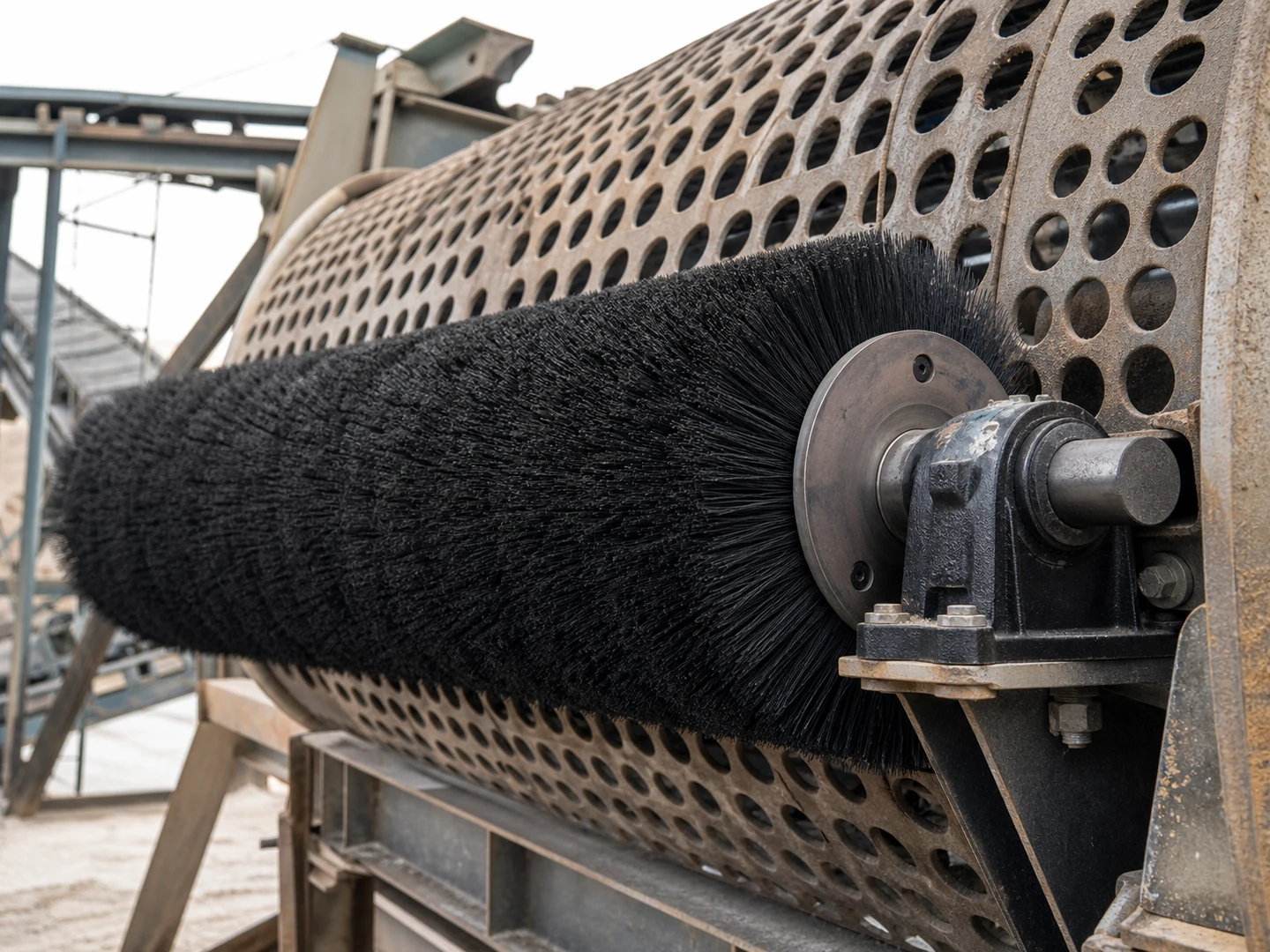
Large-format brush
100 pcs
Minimum order
Built one at a time on a core or channel: full-width rollers, sweeper brooms and long strip.
Production lead time, once the specification is confirmed
- Up to 100 pcsWithin 20 days
- 101–1,000 pcsWithin 30 days
- Over 1,000 pcsConfirmed with your quotation
Peak season can extend these times; the shipping date is confirmed in writing with your quotation. Sampling and shipping are quoted separately.
A continuously mounted rotary brush that sweeps the surface of a trommel screen to dislodge blinding material from apertures, keeping screening capacity stable and extending run time between manual cleanings.
What can this brush do for you?
Keeps apertures open during continuous rotation
As the trommel rotates, the brush filament tips wipe across the screen surface and flick blinded particles back into the material stream. Nylon PA filaments recover their shape after each pass, so contact remains effective even when the screen flexes slightly under load.
Cleans wire mesh, perforated plate, and wedge wire without damaging the media
The filament ends are rounded and flexible. They work into apertures to dislodge near-size particles and wet fines without scratching or deforming steel or polyurethane screen panels. This makes the brush safe for expensive screen media while still delivering aggressive enough action to restore open area.
Adjustable engagement controls cleaning intensity
The radial contact setting can be set from a light kiss to a firm sweep (2–10 mm typical). Light engagement extends filament life on fine screens; firmer engagement works for sticky or fibrous blinding. The setting is tuned once during installation and checked during routine inspection.
Mounts to existing trommel frames or a driven shaft
Choose a fixed rail, idler roller, or independently driven shaft mounting. A driven brush can counter-rotate against the screen for stronger flicking action, while a fixed brush relies on screen rotation. Brackets are matched to the trommel drive side, hopper opening, or screen support structure.
Replaceable fill strips keep maintenance simple
The brush body accepts individual nylon fill strips, so when the filament wears down after extended service, only the worn strip is replaced instead of the entire roller. This reduces spare parts inventory and makes brush changes a short, scheduled task.
What is a Trommel Screen Brush?
A trommel screen brush is a rotary or linear brush assembly that rides against the surface of a trommel screen to prevent aperture blinding. Trommel screens use a rotating cylindrical drum with perforated or woven screen media to separate material by size. As the drum turns, particles close to the aperture size wedge into the holes, and wet or fibrous material smears across the openings. Without continuous cleaning, the effective open area drops, throughput falls, and the operator must stop the trommel to clear the screen by hand.
The brush solves this by maintaining filament contact across the full working width of the screen. Depending on the installation, the brush can be stationary while the screen rotates past it, or it can be driven to rotate against the screen surface. The filament tips penetrate slightly into the apertures, pushing blinding material back into the material stream while the screen remains in service.
A trommel screen brush is not a heavy scraper or a substitute for screen washing. It is a continuous-contact cleaning device that works best on partially blinded screens and on materials that respond to mechanical flicking: wet dirt, clay, fibrous compost, plastic film, and flat particles that bridge across holes. For hard, cemented deposits or extremely fine mesh, other cleaning methods may be required.
Technical Specifications
| Parameter | Value / Options |
|---|---|
| Screen working width | 100–3000 mm, matched to the active screening area |
| Brush outside diameter | 80–600 mm, selected for the trommel diameter and mounting space |
| Free trim length | 25–200 mm, determined by required filament flex and aperture penetration |
| Filament diameter | 0.30–2.00 mm, finer for small apertures, coarser for heavy particles |
| Filament material | Nylon PA (standard); other materials on request |
| Installed contact | 5–25% of free trim, adjusted to screen motion and residue type |
| Mounting | Fixed rail, driven shaft, idler roller, or custom screen-specific brackets |
| Contact setting | 2–10 mm radial engagement; 5–15 mm edge overlap per side of the working width |
| Core / shaft material | Steel, stainless steel, aluminum, or polymer core based on environment and load |
| Operating temperature | Up to 80°C continuous for standard nylon PA; higher-temperature filaments available on request |
| Brush type | Custom Roller and Conveyor Brushes |
| How it is driven | Machine-driven, mounted in the equipment |
| Cleaning target | aggregate and mineral trommel, compost and mulch screening, and construction and demolition recycling line cleaning |
| Surface or part | screens, holes, drums, plastic, panels, stone, wood, and roller |
| Residue or debris | particles, clay, fines, chips, and fiber |
| Mounting / connection | Fixed rail, driven shaft, idler roller, or custom screen-specific brackets |
All dimensions and materials can be adjusted to the specific trommel geometry and screening process. Provide the screen drawing, aperture size, and material details for a confirmed fit.
Where does this brush work best?
- Aggregate and mineral trommels where wet clay, dirt, and near-size stone plug the deck during continuous operation.
- Compost and mulch screening where fibrous material, twigs, and wet organics blind the drum surface.
- Construction and demolition recycling lines where plastic film, paper, and flat particles bridge across screen holes.
- Wood processing trommels that separate fines from chips and bark, where wet fiber smears the screen panels.
- Soil remediation and topsoil production where sticky fines reduce throughput on rotating screens.
- Municipal solid waste and single-stream recycling trommels where flexible contaminants wrap around screen media.
How do I choose the right one?
Measure the screen working width and diameter
The brush must cover the full active screening width plus 5–15 mm of overlap on each side. The outer diameter is selected to fit within the trommel shell or on the outside of the screen while leaving enough clearance for the material layer.
Match filament diameter to aperture size and residue
Fine apertures (below 3 mm) typically require filament diameters of 0.30–0.80 mm so the tips can enter the holes without bending. Coarse apertures and heavy, sticky residues benefit from 1.00–2.00 mm filaments that provide more stiffness and flicking force.
Decide on static or driven brushing
A fixed or idler-roller brush relies on the trommel rotation to move the screen past the filaments. This is simplest and requires no additional drive. A driven brush that rotates against the screen provides stronger cleaning action and is preferred for heavy blinding or sticky material. The drive can be the trommel shaft through a coupling or an independent motor.
Set the contact engagement carefully
Start with the lower end of the 2–10 mm radial engagement range and increase only if blinding persists. Excessive engagement accelerates filament wear and can create drag that reduces trommel speed. The installed contact should not exceed 25% of free trim length.
Consider the process environment
Wet, dusty, or corrosive conditions influence core material and filament choice. Stainless steel cores and shafts are preferred for wet or outdoor trommels. Nylon PA is resistant to many common process chemicals and abrasion, but for high heat above 80°C or aggressive chemical exposure, alternative filament materials should be discussed.
When a trommel screen brush is not the right solution
If the screen apertures are extremely fine (below 0.5 mm) or the blinding material is hard, cemented scale, a brush may not remove it effectively. In those cases, air knives, high-pressure spray bars, or ultrasonic screen cleaners may be more suitable. Similarly, if the trommel operates at very high speed or the screen surface is fragile, a lighter-contact solution may be needed.
Can I customize this brush?
Trommel screen brushes are built to the specific trommel dimensions and process. To quote a custom brush, we need the screen working width, trommel inside/outside diameter, aperture size and pattern, material being screened, wet or dry condition, and preferred mounting method. A drawing or photo of the trommel is helpful.
We can adjust:
- Overall length and brush outside diameter to match the screen and available space
- Core or shaft material: steel, stainless steel, aluminum, or polymer; with bearing journals or end connections as needed
- Filament material: nylon PA standard; PBT, polypropylene, anti-static, or abrasive-impregnated options for special environments
- Filament diameter, trim length, and density per row to tune cleaning aggressiveness
- Mounting system: fixed rail brackets, shaft-mounted pillow blocks, idler roller supports, or custom brackets welded to the trommel frame
- Drive integration: shaft coupling, sprocket, or direct motor mount for driven brush configurations
- Adjustment mechanism: radial position screws, spring-loaded contact, or shim plates for setting engagement
- Color coding, marking, and packaging for identification and replacement programs
For projects requiring material documentation, inspection reports, or third-party testing, we can support those requirements as part of the customization process.
How do you confirm a trommel screen brush has actually cleaned the surface?
How do I know when the brush is no longer cleaning effectively?
Monitor screen open area and throughput. If blinding returns within a short time after cleaning, or if visible material remains packed in apertures while the trommel is running, the brush is likely worn or engagement has changed. Inspect filament tips for flattening, breakage, or permanent deformation, and check that the radial contact is still within the set range.
Can the brush direction of rotation be changed after installation?
For driven brushes, yes, but the rotation direction affects cleaning action. Counter-rotation against the screen surface produces a stronger flicking effect and is generally preferred for heavy or sticky blinding. Co-rotation is gentler and may be used on fine screens to reduce wear. The direction should be confirmed during commissioning and not changed without checking filament contact.
Does the brush scratch or damage the screen media?
Nylon PA filaments are softer than steel screen wire and most polyurethane screen panels. Under normal contact settings, they will not score or deform the screen. However, if the brush is set with excessive engagement or if foreign objects become trapped between the brush and screen, damage can occur. Regular inspection of both brush and screen is recommended.
How often should I inspect the brush?
Inspection frequency depends on operating hours and material abrasiveness. For continuous production, a weekly visual check of filament condition, shaft bearings, and mounting hardware is a good starting point. In high-wear applications, daily checks may be needed. The key is to catch filament wear before it reduces cleaning performance to the point where the screen blinds.
Can the brush be used on a vibrating screen instead of a trommel?
The standard trommel screen brush is designed for a rotating cylindrical screen. Some configurations, particularly fixed rail brushes, can be adapted to a vibrating screen deck if the brush is properly supported and the contact setting accommodates the vibratory motion. However, the cleaning mechanism and motion path differ, so a dedicated vibrating screen brush design is usually preferable.
What happens if the trommel screen has a joint or seam?
Screen seams and panel joints create a step that the brush must pass over. The filament free trim and mounting system must allow enough flex to ride over the seam without lifting away from the screen or catching. When specifying the brush, note the location and height of any seams so the mounting brackets and contact setting can be designed accordingly.
Guides that go deeper on this
Custom Manufacturing RFQ
Describe Your Application
An accurate custom quote starts with the dimensions, working surface, residue, material choice, connection, quantity, and reference files.
Drawing or photo optional — it speeds things up, it does not gate the enquiry.
Custom Brush RFQ
Send Your Brush Project
Upload a drawing, product photo, or sample photo and provide the core dimensions and cleaning conditions.
“We need a brush to remove wet residue from a stainless steel conveyor, about 800mm wide. The current brush wears quickly. We can send photos.”
“We sell drinkware and need a cleaning brush to include with the product. Quantity around 5,000 pieces.”