
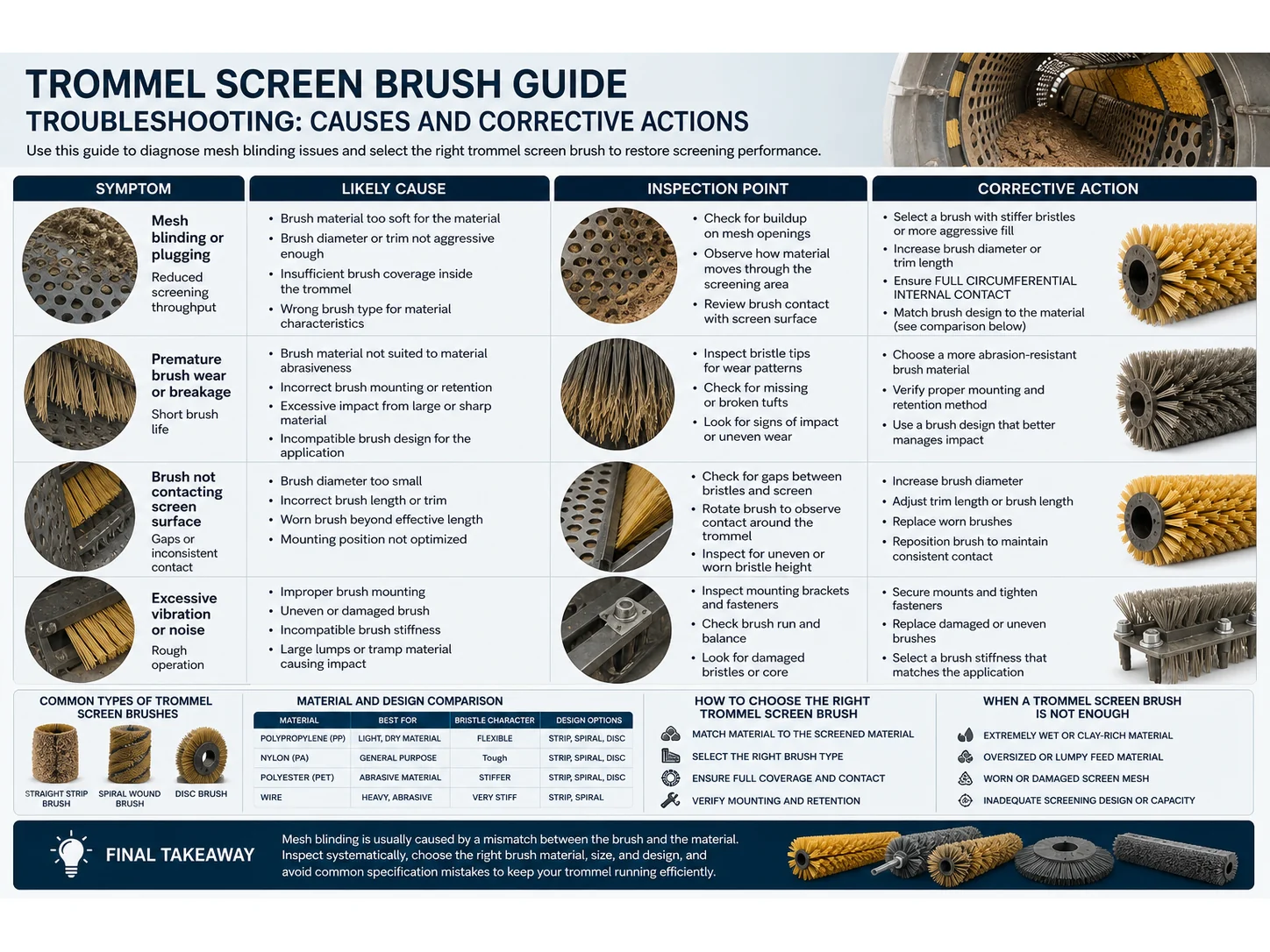
What Is a Trommel Screen Brush?
A trommel screen brush is a bristled element, usually strip, spiral, or block form, installed inside or outside a rotating trommel screen. Its bristles penetrate, sweep, or tap the screen surface to release material wedged in the mesh. The brush can be stationary (the rotating screen moves past it) or rotary (driven independently). This simple mechanical action prevents material buildup that would otherwise blind the screen.
Common Types of Trommel Screen Brushes
Choosing the right configuration depends on the trommel design, residue type, and operating environment. Main variations include:
- Strip brushes: Straight lengths mounted in holders, often adjustable for wear. Common for internal cleaning along the drum length.
- Spiral-wound brushes: Continuous helical bristle strips wrapped around a core. Provides even contact and often used in rotating brush assemblies.
- Brush blocks: Modular sections that can be individually replaced. Useful where wear patterns are uneven.
- Rotary brush rollers: Full-length cylinders with bristles, driven independently. Effective for aggressive cleaning on robust screens.
Each type can be made with different bristle materials and mounting hardware, as described below.
Material and Design Comparison
| Bristle Material | Typical Use Case | Stiffness & Abrasion | Moisture/Chemical Resistance | Considerations |
|---|---|---|---|---|
| Nylon (standard) | General dry screening, low abrasion | Medium; gentle on mesh | Good moisture resistance; avoid strong acids/alkalis | Good balance of cost and life; can be filled with abrasive grit for added aggression |
| Polypropylene | Wet screening, acidic or caustic environments | Medium; similar to nylon | Excellent chemical resistance; less water absorption | Often preferred in wastewater, mining slurries, and food prep areas |
| Stainless steel wire | Heavy-duty, abrasive materials (minerals, scrap) | High; can wear screen if too stiff | Excellent corrosion resistance (304 or 316 grades) | Use crimped or straight wire depending on cleaning action needed; avoid on fine mesh unless carefully specified |
| Brass wire | Gentle cleaning, non-sparking requirements | Medium; softer than steel | Good corrosion resistance; not for ammonia or certain chemicals | Often used in grain, wood chips, or where spark risk exists |
| Abrasive nylon (grit-filled) | Sticky or stubborn residues | Medium-high with abrasive particles | Similar to nylon; grit adds cleaning power | Effective for fibrous materials, light scale, or resinous buildup; avoid delicate screens |
How to Choose the Right Trommel Screen Brush
The starting point is the material you’re screening. Ask:
- Is the residue fine, fibrous, sticky, or abrasive?
- What is the moisture content and chemistry (pH, solvents)?
- What is the screen mesh opening and wire diameter?
- What is the operating temperature?
Then match a bristle material that can withstand the environment without damaging the mesh. For example, a fine screen (below 2 mm) usually demands softer bristles like nylon or polypropylene to avoid deformation. Stubborn, abrasive residues may require wire or abrasive nylon, but only on robust screens.
Brush size—diameter, length, and bristle trim length—must fit the trommel geometry. A common mistake is ordering a brush that is too short or with too little interference (bristle overlap with the screen). Provide the supplier with:
- Trommel inside diameter (or outside if external brush)
- Screen panel length and mesh count
- Residue description and photos if possible
- Mounting style (bolt-on, clamp, quick-release)
Many suppliers offer sample test pieces; testing a short section can prevent a full-order mismatch.
Common Mistakes When Selecting a Trommel Screen Brush
- Choosing by cost drivers alone: A low-cost nylon brush may fail quickly in a hot, acidic environment, costing more in downtime.
- Ignoring width tolerance: A brush slightly narrower than the screen panel leaves uncontacted zones that blind quickly.
- Excessive stiffness: Wire brushes on fine screens can stretch or tear the mesh, leading to screen replacement.
- Not considering corrosion: Mild steel cores or brass in wet, acidic conditions corrode and shed metal fragments.
- Neglecting maintenance intervals: A worn brush loses contact. Set a replacement schedule based on measured wear or visual inspection.
- Assuming one brush fits all: Different sections of a trommel (e.g., feed vs. discharge end) may experience different blinding mechanisms and benefit from different brush types.
When a Trommel Screen Brush Is the Wrong Choice
A trommel screen brush addresses mechanical blinding but has limits. Consider other solutions when:
- Sticky, clay-like materials build up faster than bristles can remove. Combination systems (spray bars + brushes) or scraper blades may be needed.
- Screen mesh is worn or damaged. Brushes cannot fix holes or stretched panels; replace the screen first.
- Production throughput exceeds screen capacity. No brush can compensate for undersized equipment.
- Hygiene requires clean-in-place (CIP) or aseptic design. Standard brush materials may not meet FDA or 3-A sanitary standards. Seek specialized food-grade or sealed cleaning solutions.
- Frequent brush changes disrupt production. Investigate automated tensioning, self-adjusting brush holders, or alternative cleaning methods (ultrasonic, air knives).
Final Takeaway
The right trommel screen brush is a low-cost way to keep screening operations running at rated capacity. Define the cause of blinding, specify material and dimensions precisely, and involve a knowledgeable supplier early. Treat the brush as a critical wear component, not an afterthought, and you’ll avoid most common specification mistakes.
Frequently Asked Questions
What exactly is screen mesh blinding?
Blinding happens when particles wedge into screen openings instead of passing through, progressively reducing effective open area. It lowers throughput, forces the screen to work harder, and can lead to motor overload or product quality issues.
Can a trommel screen brush damage my screen mesh?
Yes, if bristles are too stiff, too large, or misaligned. Wire brushes in particular can abrade or deform fine mesh. Always match bristle stiffness and filament diameter to the screen wire diameter and opening size.
How do I measure my trommel for a replacement brush?
Measure the inside diameter where the brush will sit, the length of the screen section, and the available mounting space. Note the brush holder style and any clearance constraints. Share photos and sketches with the supplier to avoid errors.
What bristle material works best for wood chips or bark?
For wood chips, nylon or polypropylene is often sufficient because the residue is fibrous but not highly abrasive. Brass wire brushes are an alternative if spark risk is a concern. Avoid steel wire as it may cause excessive wear on the screen.
How often should trommel screen brushes be replaced?
Replacement frequency depends on material abrasiveness, brush material, and contact pressure. Conduct weekly visual checks and set a replacement interval when bristle length reduces by 30–50% or when cleaning performance noticeably drops.
Can one brush work for both wet and dry screening?
Possibly, but moisture changes the blinding mechanism. Wet, sticky materials may need polypropylene or abrasive nylon, while dry fines might blind with static-laden dust. A brush optimized for wet conditions often uses materials that resist water absorption and chemical attack, so evaluate both states.
What is better: a strip brush or a spiral brush?
Strip brushes are simpler to install and segment for differential wear. Spiral brushes provide continuous, even contact across the screen length and can convey loosened material toward the discharge. Your choice depends on mounting geometry and desired cleaning pattern.
Do I need a completely custom brush or can I use a standard size?
Many applications can use standard brush profiles with trimmed length. Custom is necessary when the screen curvature, diameter, or mounting interface is non-standard. Start with a dimensional drawing to see if standard components fit before commissioning a custom design.
Technical References
Which bristle material fits this job — Nylon PA, Abrasive Nylon or Brass Wire?
| Material | Continuous temperature (°C) | Peak temperature (°C) | Water absorption | Hardness |
|---|---|---|---|---|
| Nylon PA | 93 | 121 | 0.3–9% by PA grade and conditioning | Medium to firm; filament diameter and trim length control bending force. |
| Abrasive Nylon | 120 | 150 | 0.1–1.0% | Abrasive filament; stiffness and cutting level is controlled by PA base, grit type, grit size, filament diameter and trim height. |
| Brass Wire | 150–200 | 250–300 | 0% | Rockwell B 40–90 |
| AISI 304 Stainless Steel Wire | 400 | 500 | 0% | Rockwell B 70–95 depending on temper and cold work |
| PA6 Nylon | 80–100 | 130–160 | 1.5–3.0% | Shore D 75–85 |
Figures as published by Brushtec / DuPont; Perlon; Alleima. Confirm the exact grade against the supplier datasheet before ordering.
What should replace Roller and Conveyor Brushes for trommel screen brush?
- Roller and Conveyor Brushes — Roller and conveyor brushes hold cylindrical line contact across a working width, including helix-wound builds where the filament path is set to move loosened material toward one side; a strip brush holds the same line without rotating, so it seals or wipes but cannot carry residue along the width.
- Handheld Detail Brushes — Handheld detail brushes cover general precision cleaning; auto-detailing brushes impose tighter controls for painted, polished, leather, display, and trim surfaces.
- Nylon PA — Compare Nylon PA with PP, PBT, PET. Change material when wet stiffness, temperature, chemical resistance, conductivity, particle shedding, or surface marking becomes the limiting factor.
- Abrasive Nylon — Compare Abrasive Nylon with PP, PBT, PET. Change material when wet stiffness, temperature, chemical resistance, conductivity, particle shedding, or surface marking becomes the limiting factor.