
Custom Cleaning Brush
Handheld Industrial Screen Cleaning Brush
Handheld industrial screen cleaning brushes for filter screens, sieves, and apertured media. Nylon PA or PET fill, 50–300 mm heads, configurable trim.
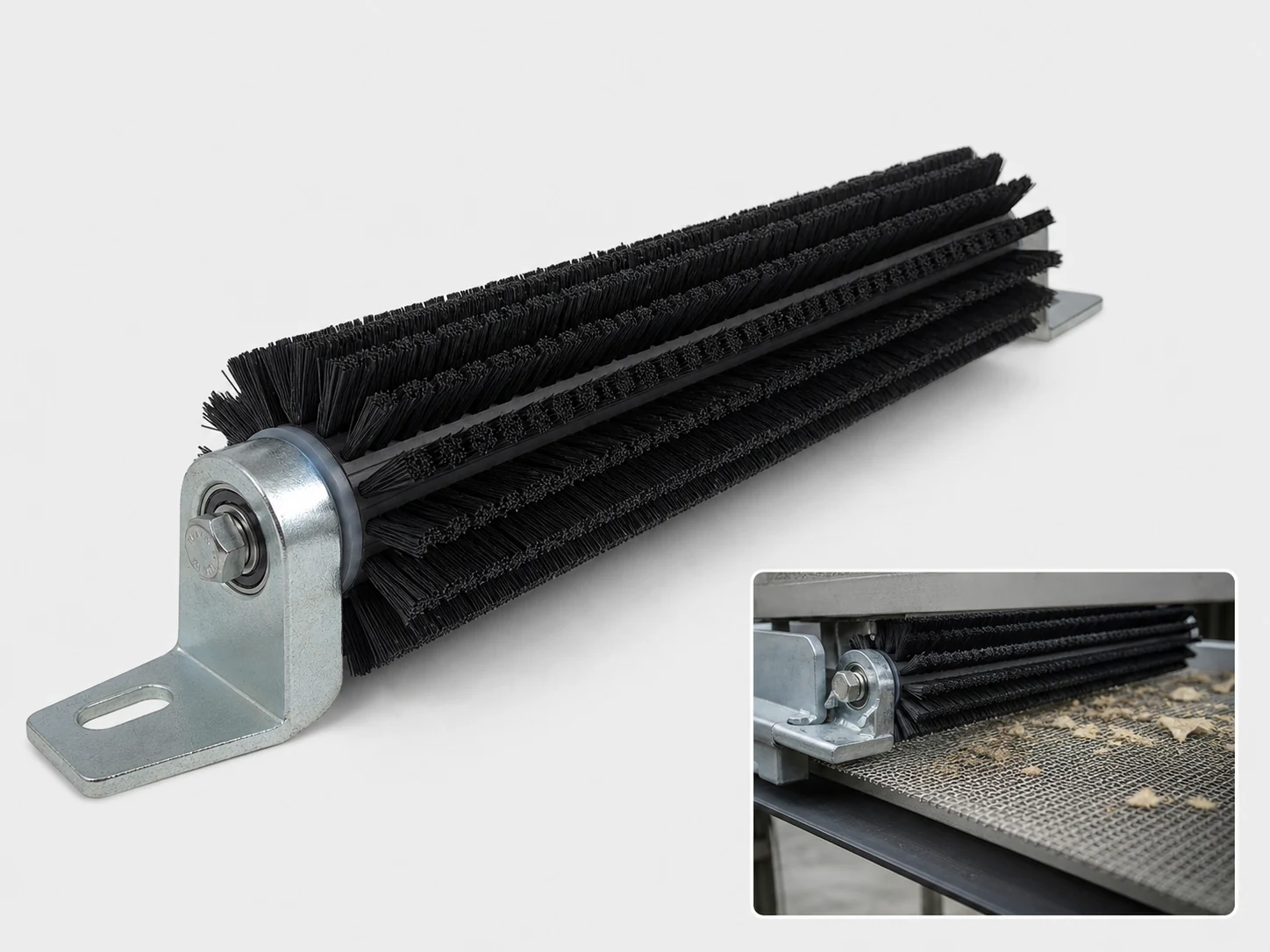
Medium brush
100 pcs
Minimum order
Worked with two hands or on a pole: chimney, gutter and pond-filter brushes, discs, cups and tank brushes.
Production lead time, once the specification is confirmed
- Up to 100 pcsWithin 7 days
- 101–5,000 pcsWithin 14 days
- 5,001–50,000 pcsWithin 21 days
- Over 50,000 pcsConfirmed with your quotation
Peak season can extend these times; the shipping date is confirmed in writing with your quotation. Sampling and shipping are quoted separately.
A hand-guided industrial brush for dislodging dust cake, powder residue, fibers, and light oil films from filter screens, sieves, and apertured filter media. The wide filament face and spring-back nylon fill clear plugged openings without tearing fine mesh or distorting screen frames.
What can this brush do for you?
Clears plugged apertures instead of smearing residue across the surface
The filament tips are selected to enter the screen openings, not ride over them. When an operator sweeps the brush across a blinded sieve deck, individual tips flex into the apertures, lift out compacted powder and trapped fibers, then snap back to their original alignment. The result is a screen that is open again at the aperture level, not one that merely looks clean on the surface.
Covers large screen areas with fewer passes
Head widths of 50–300 mm put rows of working filament across a broad chord of the screen deck in a single stroke. For a 600 mm vibratory sieve, a wide head lets the operator cover the full face in a few controlled passes rather than working spot-by-spot with a narrow brush. Shorter head widths from 50–100 mm are available for narrow frames and pleated sections, which helps reduce downtime during batch changeovers.
Protects fine wire cloth and filter media supports
Nylon PA filaments bend under load before they can cut into fine mesh. Because the working pressure is distributed across many individual tips, the screen wire and support bars are not deformed during routine cleaning. This is the difference between a tool that maintains aperture uniformity and one that gradually turns a precision screen into distorted openings.
Works with dry powders, wet residues, and light oil films
The same brush line can be configured for dry dust cake, damp process particles, or a light oil film on dewatering screens. Moisture-resistant PET fill is available for continuous wet applications, while nylon PA remains the standard for fine dry screening where a controlled flex profile matters most.
Reduces operator strain during scheduled screen maintenance
Overall lengths from 150 mm to 400 mm and handle forms are matched to the sifter height and operator position. A hanging hole or bracket cuts misplaced-tool time, and the brush weight is kept low enough for repeated passes across multiple decks without fatiguing the wrist.
What is a Handheld Industrial Screen Cleaning Brush?
A Handheld Industrial Screen Cleaning Brush is a manually operated cleaning tool built around a rigid head block set with two or more parallel rows of nylon or PET filament. The operator holds the brush by the handle, angles the working face against the screen, and moves it in overlapping strokes so the filament tips enter the apertures and release retained material. It is used on vibratory sieve decks, filter screens, sifter frames, centrifuge screens, and rigid apertured filter media where the surface must be opened up without changing the aperture geometry.
The brush is part of a screen maintenance sequence, not a complete cleaning process by itself. It dislodges material that is stuck in or lightly bonded to the apertures; loosened powder, fibers, and scale then fall away or are removed by vacuum, rinse, or blow-down. On dry powder lines, operators often use the brush between production runs or during changeover before a deeper CIP or washing step. On wet processes, the brush can serve as the final manual dislodging step before the rinse.
Pressure matters. The brush is designed to work with moderate sweeping force; aggressive scrubbing or stabbing movements can fold filaments, bend fine wires, or drive debris deeper into the screen. For hardened scale, carbonized deposits, or heavy adhesive films, the nylon fill will wear or deform, and a harder filament, wire brush, or chemical and mechanical cleaning method becomes the correct choice instead.
Technical Specifications
The ranges below are the project-standard starting points. Head width, trim length, filament diameter, material, handle, and overall length are adjusted to the customer’s screen size, aperture, residue, and operator station.
| Parameter | Value / Options |
|---|---|
| Product form | Handheld screen/sieve cleaning brush |
| Head width | 50–300 mm |
| Overall length | 150–400 mm (head plus handle) |
| Trim length | 20–60 mm |
| Fill material | Nylon PA 6 or PA 6/6; PET option for wet or food-processing lines |
| Filament diameter | 0.10–0.50 mm, selected to aperture width and residue hardness |
| Filament stiffness | Adjusted by filament diameter, trim length, and row packing density |
| Head material | PP, beechwood, stainless steel, or antistatic polymer per environment |
| Handle | Straight, D-grip, loop, or ergonomic grip; hanging hole optional |
| Rows per head | 3–8 parallel rows typical; row spacing matched to screen and debris release |
| Trim profile | Straight, angled, contoured, or stepped rows for frames and recessed faces |
| Operating environment | Dry powder, wet screening, light oil film; chemical exposure reviewed by project |
| Temperature limit | Nylon PA and PET fills for continuous dry use up to approximately 100°C; verify for wet or chemical service |
| Brush type | Custom Handheld Detail Brushes |
| How it is driven | Hand-guided |
| Cleaning target | vibratory sieve and sifter deck, pharmaceutical and nutraceutical granulation screen, and rigid wire-mesh filter element and screen frame cleaning |
| Surface or part | screens, filters, frames, sifters, media supports, metal, edges, and pads |
| Residue or debris | powder, oil film, dust cake, scale, fiber, light oil film, powder residue, and light scale |
| Mounting / connection | Shaft-Mounted / Fixed |
If your mesh aperture is below 0.15 mm or your residue includes abrasive particles, specify this early so we select a filament that clears the screen without shortening screen life.
Where does this brush work best?
- Vibratory sieve and sifter decks in milling, sugar, starch, flour, and powder processing where dust cake blinds the mesh between batches.
- Pharmaceutical and nutraceutical granulation screens that need aperture-level clearing without metal fill contamination or screen damage.
- Centrifuge and dewatering screens carrying light scale, oil film, or damp product residue that must be dislodged before washing.
- Rigid wire-mesh filter elements and screen frames in dry collection or liquid filtration where metal wire media is robust enough for filament contact.
- Inspection sieves and QC laboratory screens that must be returned to original aperture condition between samples.
- Screen frames, media supports, and edges where product accumulates outside the active apertures and a wide hand brush restores free drainage or flow area.
For soft nonwoven filter media, membrane surfaces, or delicate pleated filter cloth, a softer pad, vacuum, or air blow-down is usually safer than a filament brush.
How do I choose the right one?
Start with the smallest aperture, not the screen diameter. The filament tip diameter determines how far the bristle can enter the opening. If the filament is thicker than the aperture, it bends across the mesh and cleans only the surface. If it is much thinner than the aperture, it can slip through without carrying enough force to dislodge embedded particles. A practical starting point is a filament diameter of roughly 50–70% of the smallest aperture in the mesh, adjusted after testing on a sample screen.
Check how deep the screen sits below the frame or media support. Trim length needs to reach the bottom of the apertures plus the free space above the plane, but not so long that rows flop sideways or hit the support bar. Short 20–30 mm trims give more direct control on flat faces; 40–60 mm trims are better when the screen is recessed or the operator needs clearance around clamps and frames.
Match head width to deck geometry and operator reach. Use a wide head near 200–300 mm on large flat sieve decks where coverage matters more than precision. Use 50–100 mm on circular screens, narrow filter frames, or areas around discharge chutes where the operator needs to follow the edge. Oversizing the head on a small frame makes the tool hard to control and forces the operator to press unevenly.
Select fill material by the process environment.
- Nylon PA is the standard for fine and delicate mesh in dry powder screening, where a controlled flex profile keeps wire cloth intact.
- PET is a better candidate for continuous wet screening, food-grade process areas, and low-moisture-absorption requirements.
- If the screen regularly carries hard scale, cured adhesives, or embedded metal particles, nylon and PET wear too quickly. A harder filament, stainless wire brush, or a non-mechanical cleaning method becomes the better choice.
Confirm handle form before volume production. Operator height, sifter deck spacing, and grip style affect how much force the user can apply without strain. A D-grip or loop handle improves control for angled passes; a straight handle suits vertical or flat deck work. If the brush is stored at the machine, add a hanging hole or bracket.
| Screen condition | Suggested configuration |
|---|---|
| Fine mesh under 0.25 mm aperture | Nylon PA, 0.10–0.20 mm filament, 20–30 mm trim |
| Standard sieve 0.25–1.0 mm | Nylon PA, 0.20–0.35 mm filament, 25–40 mm trim |
| Coarse screen 1.0–3.0 mm | Nylon PA or PET, 0.30–0.50 mm filament, 30–50 mm trim |
| Aperture over 3.0 mm or hard scale | Project-specific harder fill or wire brush; review screen material first |
| Wet or food-processing line | PET fill, stainless or food-suitable head and handle |
These are starting points. The final value should be validated on a scrap screen or a small production trial before large-volume rollout.
When to choose a different cleaning method. Nylon and PET screen brushes are for dislodging loosely held or lightly bonded residue. They do not replace ultrasonic cleaning, CIP spray washing, solvent immersion, or compressed-air purging for fully cured deposits. If the screen is soft filter media or membrane, use a non-contact or low-contact method. If the process is food or pharma with strict contamination control, the brush should be issued per line and replaced on a defined inspection schedule, not shared between incompatible products.
Can I customize this brush?
Yes. Handheld industrial screen brushes are generally configured to the screen, mesh, and work station rather than sold as fixed stock items. We can adjust:
- Filament system — diameter, stiffness, row spacing, trim length, trim profile, color, and material (PA6, PA6/6, PET, or project-specified blend).
- Head geometry — width, depth, curved or angled face, side rows for frames, rounded corners, and multiple trim levels for recessed screens.
- Head material — PP, beechwood, stainless steel, antistatic polymer, or other materials for washdown, chemical, or static-sensitive environments.
- Handle — length, straight/D-grip/loop/ergonomic shape, overmolded grip, detachable handle, hanging hole, or bracket.
- Interface and marking — company color, molded-in mark, pad print, laser marking, or identification coding for line assignment.
- Packaging — bulk, individual bag, retail sleeve, spare-parts kit, or project-specific packing.
To build the correct configuration, provide the screen aperture size, wire diameter, mesh material, frame depth, free space around the screen, residue type, wet and dry process, cleaning chemical or temperature if any, head width preference, and handle form. A photo or drawing of the sifter deck speeds up the layout.
If your project requires material declarations, inspection documentation, or third-party testing for a specific regulated process, we can support those requirements during the customization phase.
Which filament belongs on a handheld industrial screen cleaning brush, and how is that verified?
How do I check whether the filament diameter is correct for my mesh?
Test on a spare screen or an unobtrusive edge. Hold the brush at 30–45 degrees and sweep with normal operator force. The tips should flex into the openings and spring back without hanging up on the wire, passing fully through the mesh, or snapping off. If the bristles slide across the surface without entering the apertures, the filament is too thick or too stiff. If many filaments break or pull through, the diameter is too thin for the aperture.
Will the brush damage fine wire cloth?
Not when the fill is matched to the aperture and the operator uses moderate sweeping pressure. Damage occurs when the filament is too stiff for the wire diameter, when the brush is scrubbed aggressively in one spot, or when a worn brush with split and hooked tips is used past its service life. Always trial on scrap mesh and inspect the screen after the first use.
What should be done before brushing the screen?
Stop the machine and follow lockout and tagout procedures if the screen is on powered equipment. Remove loose product from the frame, clear any clamps or brackets that block the brush path, and clean the frame edge separately if required. Brushing should happen before the residue hardens or dries when possible, because fresh dust cake releases more easily than cured material.
How can I verify the brush actually opened the apertures?
After brushing, hold the screen up to a light or inspect it against a clean background. Blinded openings show as dark or filled areas. Wipe a section with a clean finger or lint-free cloth; if product still transfers or the mesh pattern is not visible, repeat the passes or test a slightly finer or stiffer filament configuration on a sample before changing the production tool.
How should the brush be cleaned and stored?
Remove trapped fibers and powder from between the rows after each shift with a pick or a second brush, then rinse or wipe the fill according to the process chemical. Do not allow wet product to dry and harden in the fill, since the cured residue becomes the next screen contaminant. Store the brush hanging by the hole at the sifter station, away from washdown spray if the handle is wood.
When should the brush be replaced?
Inspect the filament tips weekly or per the site’s brush policy. Look for flat, split, curled, or missing bristles and for rows that no longer spring back after flexing. In food, pharma, or color-sensitive processes, treat the brush as a controlled tool with a defined change interval; do not wait until visual damage appears.
Guides that go deeper on this
Trommel Screen Brush vs Standard Brushes: Sticky Fines
Read this guideGuideTrommel Screen Brush: Material and Size Against Blinding
Read this guideGuideTrommel Screen Brush: Specs for Abrasive Aggregate
Read this guideGuideVibrating Screen Brush Mistakes in Abrasive Aggregate
Read this guideGuideVibrating Screen Brush: What Stops Mesh Blinding?
Read this guideGuideWhen to Use a Vibrating Screen Brush on Sticky Fines
Read this guideGuideCleaning, Drying, and Storing Industrial Brushes
Read this guideGuideFilter and Screen Cleaning Brush Design
Read this guideCustom Manufacturing RFQ
Describe Your Application
Please share the brush dimensions, working area, residue type, material direction, quantity, and a drawing or photo for quotation.
Drawing or photo optional — it speeds things up, it does not gate the enquiry.
Custom Brush RFQ
Send Your Brush Project
Upload a drawing, product photo, or sample photo and provide the core dimensions and cleaning conditions.
“We need a brush to remove wet residue from a stainless steel conveyor, about 800mm wide. The current brush wears quickly. We can send photos.”
“We sell drinkware and need a cleaning brush to include with the product. Quantity around 5,000 pieces.”