
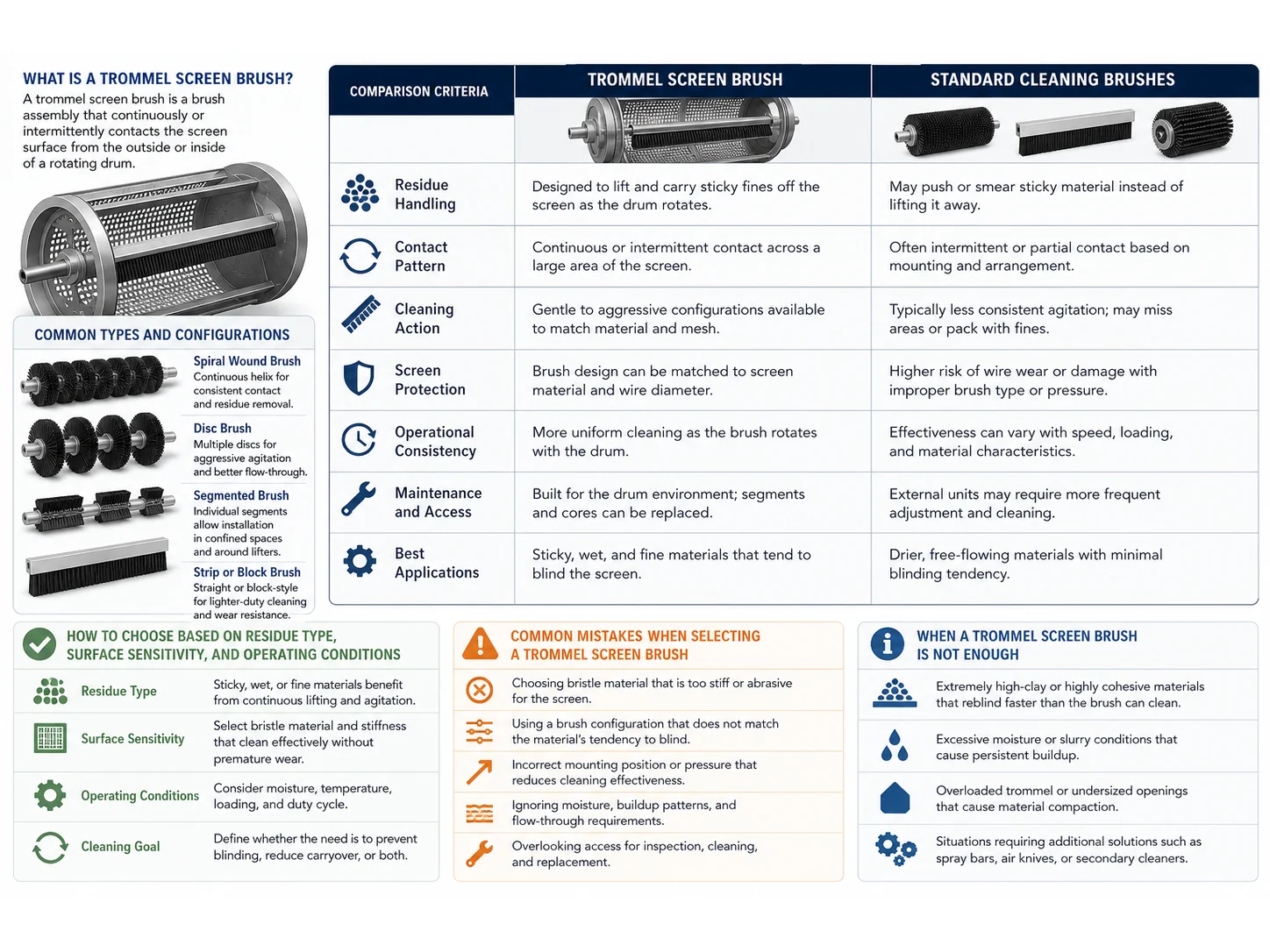
What Is a Trommel Screen Brush?
A trommel screen brush is a brush assembly that continuously or intermittently contacts the screen surface from the outside or inside of a rotating drum. Its primary job is to dislodge particles that cling to screen openings, restoring throughput without stopping the machine. Unlike manual or occasional-use brushes, trommel screen brushes are engineered for sustained contact, uniform wear, and compatibility with drum rotation speeds and environmental conditions.
Common Types and Configurations
Not all trommel screen brushes are alike. The right choice depends on your screen size, material being processed, and operating environment. Key variables include:
- Filament material: Polypropylene, nylon, abrasive-impregnated nylon, polyester, or natural fiber. Each offers different stiffness, chemical resistance, and temperature tolerance.
- Diameter and density: Brush diameter must match the trommel dimensions; filament density affects cleaning aggression and clog resistance.
- Backing/core: Channel back (slotted metal or plastic strip), spiral wound, or molded cores. Channel back allows easy filament replacement; spiral designs provide continuous contact.
- Mounting: Fixed brush bars, adjustable tension assemblies, or spring-loaded holders. Fixed mounts are simpler; adjustable ones compensate for wear.
Trommel Screen Brush vs Standard Cleaning Brushes: Practical Comparison
| Characteristic | Trommel Screen Brush | Standard Cleaning Brush |
|---|---|---|
| Primary Design | Engineered for continuous rotary screen contact | General-purpose scrub brush for intermittent use |
| Filament Behavior | Stiff, durable filaments resist bending or matting | Often softer, may deform under constant pressure |
| Mounting | Integrated into the machine frame, often rigid or spring‑loaded | Handheld or simple bracket-mount |
| Dust/Sticky Material Handling | Specifically designed to break through sticky layers | Can cake up quickly, losing effectiveness |
| Wear Profile | Uniform wear with predictable replacement intervals | Uneven wear, often replaced piecemeal |
| Cost & Complexity | Higher initial investment, but lower downtime | Lower upfront cost, but can cause more frequent shutdowns |
How to Choose Based on Residue Type, Surface Sensitivity, and Operating Conditions
Start with the fines that cause blinding. Then assess your screen material and environment:
- Residue type: Abrasive fines (silica, crushed rock) need harder, abrasion‑resistant filaments. Organic sticky fines (compost, wet wood chips) may need wider filament spacing to avoid matting.
- Surface sensitivity: Stainless steel screens tolerate aggressive nylon or abrasive‑impregnated brushes; more delicate screen materials (e.g., certain polyurethane panels) may require softer polypropylene.
- Wet or chemical exposure: Acidic or caustic environments demand chemically resistant filaments like nylon 612 or polypropylene. Wet conditions can cause filament swelling in natural fibers.
- Temperature: High‑heat applications (hot aggregate, asphalt) may need heat‑resistant materials such as nylon 6/6 or specialty plastics.
- Hygiene and washdown: Food‑processing trommels often require FDA‑compliant filaments and stainless steel cores.
- Maintenance frequency: If access is difficult, consider longer‑wear materials or adjustable mounts that reduce the need for frequent replacement.
- Custom size requirements: Trommel diameter, brush length, and mounting slots vary. Always verify dimensions against existing hardware before ordering.
Common Mistakes When Selecting a Trommel Screen Brush
- Choosing by cost drivers alone: The lowest-cost brush may wear out four times faster, leading to higher long‑term costs and more downtime.
- Ignoring filament gauge and density: Too fine filaments can mat; too coarse filaments may not enter small apertures.
- Over‑stiffening the brush: Excessive stiffness can damage screens or increase motor load, especially on older trommels.
- Neglecting mounting adjustment: Fixed mounts that cannot compensate for wear lead to lost contact and cleaning gaps.
- Assuming one brush fits all screens: Different screen sections (e.g., fine‑mesh vs coarse sections) may need different brush configurations.
When a Trommel Screen Brush Is the Wrong Choice
A brush alone cannot solve every blinding problem. Consider additional measures if:
- Screen design is fundamentally wrong: If the aperture size is too small for the material, brushes will only provide temporary relief. A screen replacement may be the real answer.
- Material moisture exceeds thresholds: Excessively wet material can cause catastrophic blinding regardless of brushing. Pre‑drying or de‑watering steps may be required upstream.
- Static charge causes fine adhesion: In dusty, dry conditions, static can bond fines to screens. Brushes may help, but adding grounding or ionizing bars could be more effective.
- Brush wear outpaces replacement schedule: If brushes wear in days instead of weeks, the filament material or density is likely mismatched. A sample test or supplier drawing review may be necessary.
Final Takeaway
Match the brush to your specific trommel and fines, not the other way around. Compare filament material, stiffness, mounting, and wear tolerance against your worst material conditions. When sticky fines cause recurrent blinding, a purpose‑built trommel screen brush almost always outperforms generic cleaning brushes—but only when correctly specified for the duty cycle and environment.
Frequently Asked Questions
Can I use a standard push broom as a trommel screen brush?
No. Standard push brooms lack the filament density, stiffness, and mounting hardware needed for continuous contact with a rotating drum. They will wear rapidly, often becoming a safety hazard.
How do I measure for a replacement trommel screen brush?
Measure the overall length, width, and backing strip dimensions. Also note filament length, diameter, and the spacing of mounting slots or holes. Provide these details to your supplier to avoid fitment issues.
What filament material is best for sticky clay fines?
Abrasion‑resistant nylon with a medium stiffness and slightly wider filament spacing often works well. It resists matting while still penetrating clogged apertures. In some cases, polypropylene with added grip agents can be effective.
Should I choose a fixed or spring‑loaded brush mount?
A spring‑loaded or adjustable mount is preferred when you need consistent contact pressure as filaments wear. Fixed mounts are simpler but require more frequent manual adjustment to maintain cleaning effectiveness.
Can a trommel screen brush operate in wet, acidic environments?
Yes, but the filament and core must be chemically resistant. Stainless steel cores (304 or 316 grade) and polypropylene or acid‑resistant nylon filaments are typical choices. Verify compatibility with your specific chemical exposure.
How often should I replace a trommel screen brush?
Replacement intervals vary widely—from a few hundred hours in abrasive mining to several thousand hours in less aggressive applications. Monitor cleaning efficiency and inspect wear weekly until a pattern is established.
What if my trommel has both fine and coarse screen sections?
You may need different brush configurations for each section. A finer screen with small apertures benefits from finer, higher‑density filaments, while a coarse section often needs thicker, stiffer filaments to dislodge larger particles.
Technical References
- OSHA — Machine Guarding
- OSHA — Control of Hazardous Energy
- OSHA — Combustible Dust
- EPA — Particulate Matter Basics
Which bristle material fits this job — Nylon PA, AISI 304 Stainless Steel Wire or PA6 Nylon?
| Material | Continuous temperature (°C) | Peak temperature (°C) | Water absorption | Hardness |
|---|---|---|---|---|
| Nylon PA | 93 | 121 | 0.3–9% by PA grade and conditioning | Medium to firm; filament diameter and trim length control bending force. |
| AISI 304 Stainless Steel Wire | 400 | 500 | 0% | Rockwell B 70–95 depending on temper and cold work |
| PA6 Nylon | 80–100 | 130–160 | 1.5–3.0% | Shore D 75–85 |
Figures as published by Brushtec / DuPont; Alleima. Confirm the exact grade against the supplier datasheet before ordering.
What should replace Roller and Conveyor Brushes for trommel screen brush?
- Roller and Conveyor Brushes — Roller and conveyor brushes hold cylindrical line contact across a working width, including helix-wound builds where the filament path is set to move loosened material toward one side; a strip brush holds the same line without rotating, so it seals or wipes but cannot carry residue along the width.
- Handheld Detail Brushes — Handheld detail brushes cover general precision cleaning; auto-detailing brushes impose tighter controls for painted, polished, leather, display, and trim surfaces.
- Nylon PA — Compare Nylon PA with PP, PBT, PET. Change material when wet stiffness, temperature, chemical resistance, conductivity, particle shedding, or surface marking becomes the limiting factor.
- AISI 304 Stainless Steel Wire — Use AISI 316 stainless steel wire for chloride, marine, dairy, beverage, chemical washdown, or higher pitting-resistance requirements. Use carbon steel for dry aggressive cutting and brass or abrasive nylon for lower marking risk.