
Application
Flour Mill Equipment Cleaning
For Flour Mill Equipment Cleaning, the brush must reach the working area, disturb or collect fine dust/adhered powder/fibers, and release it without creating unacceptable surface damage or process interference. The brush structure must match the access path, contact movement, and cleaning process.
At a glance
- Cleaning target
- Fine Dust/Adhered Powder/Fibers
- Working environment
- Dry Indoor Area / Hazardous Area
- Cleaning method
- Dry Brushing / Wet Brushing
- Requirements to check
- Food-Contact Requirements; Combustible-Dust Explosion Protection; HACCP
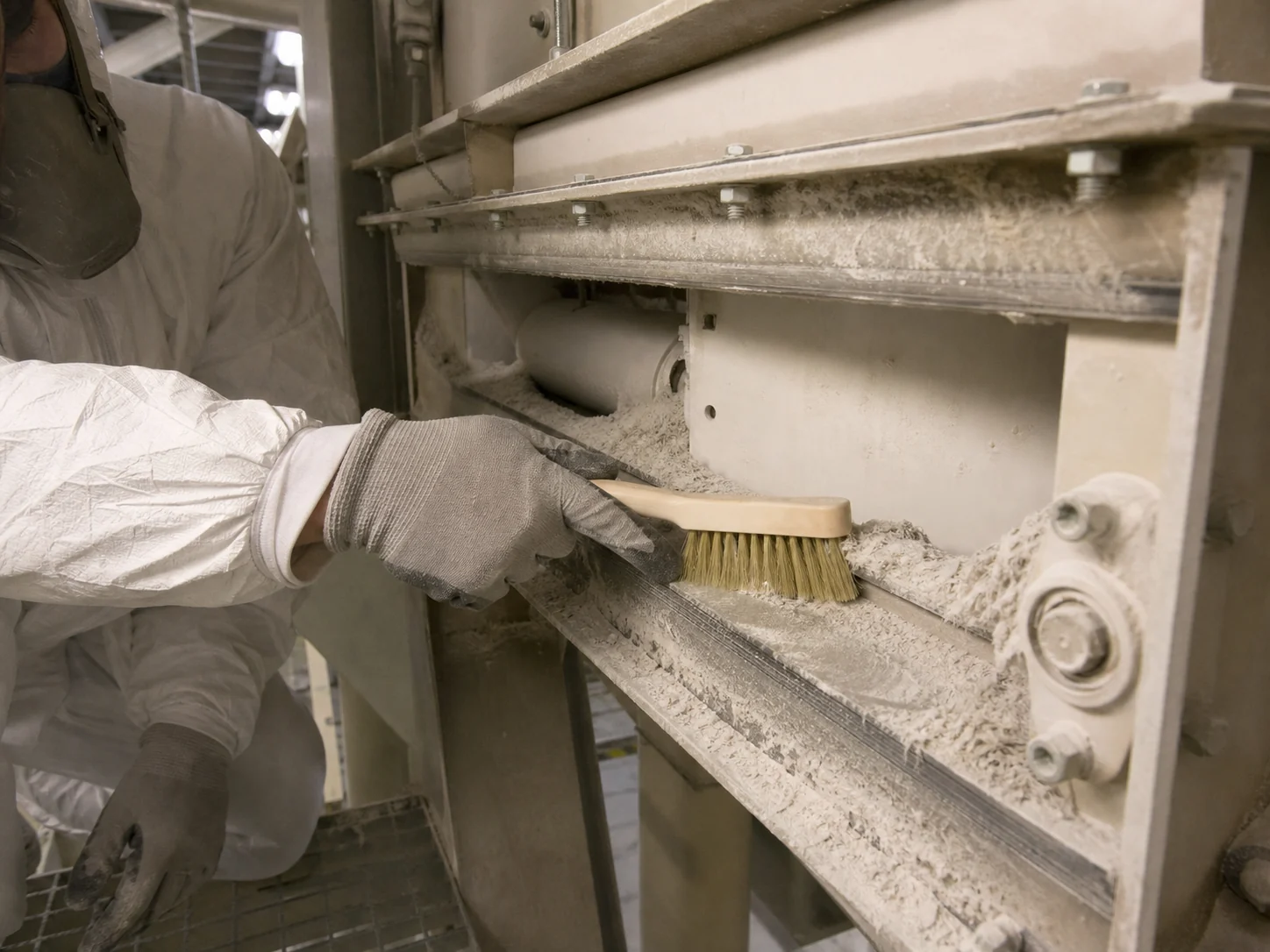
Flour packs into sieve mesh and roller flutes rather than resting on them, so mill brushes work inside the plansifter and along the rolls, where compacted powder blinds the process.
What makes Flour Mill Equipment Cleaning different from other food and beverage cleaning?
The task is to remove Fine Dust/Adhered Powder/Fibers while controlling surface damage, residue carryover, brush shedding and chemical or temperature degradation.
The work happens in dry indoor area and hazardous area against fine dust, adhered powder and fibers.
The part people get wrong: this is not one job. The same equipment carries several targets, each with a different opening and a different residue, and one brush rarely covers them all.
What are the most common cleaning targets in Flour Mill Equipment Cleaning?
There are 5 distinct targets here, and the brush that suits one will usually not reach another.
| Part or area | Residue type | Cleaning requirement |
|---|---|---|
| Plansifter and Sieve | Fine Dust, Adhered Powder, Fibers | The tips must enter the apertures far enough to push lodged material back out, without wedging in the openings. |
| Roller-Mill | The head must reach the working face and apply even contact without marking the surface. | |
| Pneumatic-Transport Line | The brush must pass the full length of the passage and hold contact with the wall without folding over at the far end. | |
| Conveyor and Elevator | The head must reach the working face and apply even contact without marking the surface. | |
| Flour-Dust Surface | Dust, powder and compacted fines | The face must stay flat against the surface so the whole working width contacts, with filament soft enough not to mark it. |
The dimensional envelope those targets impose on the brush:
| Parameter | Typical range |
|---|---|
| Contaminant | Fine Dust/Adhered Powder/Fibers |
| Required hardness | Medium |
| Maximum temperature | 80°C |
| Chemical exposure | No Added Medium or Neutral Detergent |
| Cleaning method | Dry Brushing/Wet Brushing |
| Environment | Dry Indoor Area/Hazardous Area |
Which brush types work for each cleaning target?
Select hand, tube, strip, roller, disc or machine-mounted geometry from access and motion.
| Cleaning target | Recommended brush type | Why it fits |
|---|---|---|
| Plansifter and Sieve | Handheld Detail Brushes | A sifter screen blinds from below, so a hand head with tips fine enough to enter the mesh pushes the lodged product back out without stretching the cloth. |
| Roller-Mill | The roll surface is fluted and must not be dressed by cleaning, so a hand-guided head runs along the flutes and takes packed flour out of them. | |
| Pneumatic-Transport Line | Tube & Pipe Bore Brushes | Spouting builds a wall layer that goes rancid or harbours insects, so a hand brush on a rod is worked into the accessible runs at strip-down. |
| Conveyor and Elevator | Handheld Detail Brushes | Elevator boots and belt returns hold packed flour where the infestation risk starts, so a hand head is used to bring it out of those corners. |
| Flour-Dust Surface | Mill housekeeping is mostly flat horizontal surfaces holding dust, so a flat head that keeps its full width down clears the largest area per stroke. |
All hand work between batches with the mill stopped. A driven brush inside a flour stream is a dust-ignition question before it is a cleaning one.
In practical brush terms: reach first, then residue. A brush that fits but is too soft can be stiffened; a brush that does not fit is simply the wrong tool.
What filament materials work best for Flour Mill Equipment Cleaning?
Horsehair for sieve and plansifter faces, where a synthetic fill packs the mesh instead of clearing it; nylon or PP everywhere the fill is washed and dried between shifts.
| If the condition is… | Filament to start with | Why |
|---|---|---|
| Sieve and plansifter mesh | Horsehair | clears the mesh rather than packing it |
| Adhered powder on roller-mill surfaces | Nylon PA | stiff enough to break a caked film |
| Fill washed and dried between shifts | Polypropylene PP | holds no moisture that would cake the next batch |
The constraints this application puts on the filament:
| Constraint | Value for this application |
|---|---|
| Filament hardness | Medium |
| Maximum service temperature | 80°C |
| Chemical exposure | No Added Medium or Neutral Detergent |
| Cleaning method | Dry Brushing, Wet Brushing |
How do I choose the right brush for my flour mill equipment equipment?
Start with medium fill, an 80°C ceiling and no medium or a neutral detergent, then size to the sieve frame, the mesh aperture and the roll flutes.
The order that avoids rework:
- Identify the target part and measure the access opening or clearance
- Describe the residue: what it is, how thick it sits, and how strongly it holds
- Choose the construction that can physically reach that target
- Set the filament from surface risk, working temperature and cleaning chemistry
- Fix filament diameter, free trim length and density for the contact pressure you need
- Run one cycle and check the result before committing to a production quantity
Before you commit to a quantity, send the sieve frame dimensions, the mesh aperture, and the roll length and flute pattern.
When is a flour mill equipment brush the wrong tool?
Sieve cleaners running inside the plansifter frame keep mesh open continuously, which is a design solution rather than a maintenance one. Aspiration handles airborne flour, and dry brushing in a dust-laden mill raises a hygiene and an explosion concern at once.
What common mistakes should I avoid in Flour Mill Equipment Cleaning?
- Giving sifter size instead of mesh aperture and frame dimensions
- Changing the filament while leaving excessive engagement, poor alignment or no discharge path unchanged
- Copying a worn brush without first recording its motion, direction, mounting and original working diameter
When a brush is running but not cleaning, start here rather than adding pressure:
| Symptom | What to change |
|---|---|
| Residue remains | Increase discharge or relative motion before adding pressure |
| Surface marks | Reduce engagement and use finer/softer fill |
| Rapid wear | Check alignment, temperature and chemical attack |
| Redeposition | Add wash, vacuum or collection path |
Questions this page is asked
What makes brush cleaning of flour equipment a controlled dry-cleaning step?
Use small deliberate strokes toward an authorized collection point or hazard-rated capture system so flour is removed rather than thrown into the room. Sequence work from upper and internal surfaces toward collection, monitor dust accumulation, and stop if the method produces an uncontrolled airborne cloud.
How should flour-cleaning brushes be managed across product or allergen changes?
Dedicate or positively identify tools by the site's cross-contact risk assessment and keep them separated during cleaning, storage and transport. At a changeover, use the documented line-clearance method and release evidence rather than assuming that visible dust removal eliminates retained product or allergen residue.
What should be checked after brushing a flour sieve or screen?
Inspect the complete mesh for blocked openings, abrasion, broken wires, loosened fragments and residue at frames or seals after the approved cleaning sequence. Account for brush filaments and release the sieve only when its integrity and cleanliness meet the mill's documented acceptance criteria.
Guides that go deeper on this
We have not written a guide specific to this one yet. The material that covers selection, filament, dimensions, maintenance and sourcing is collected in the technical resources library.
No catalogue item for this yet
Every brush here is made to order, and this one has no catalogue entry so far. Send the working surface, the residue, the access opening and the quantity, and it is quoted through the same specification route as the rest of the range.
Custom Manufacturing RFQ
Discuss This Application
Share the working surface, residue, dimensions, material direction, interface, quantity and drawing or sample photo.
Custom Brush RFQ
Request a Custom Cleaning Brush Quote
Upload a drawing, product photo, or sample photo and provide the core dimensions and cleaning conditions.
“We need a brush to remove wet residue from a stainless steel conveyor, about 800mm wide. The current brush wears quickly. We can send photos.”
“We sell drinkware and need a cleaning brush to include with the product. Quantity around 5,000 pieces.”