
Custom Cleaning Brush
180x1200mm PA66 Screen Cleaning Roller Brush
180 x 1200 mm PA66 roller brush for aggregate screen cleaning clears blinding fines, fibers, and wet residue from wire mesh and wedge wire.
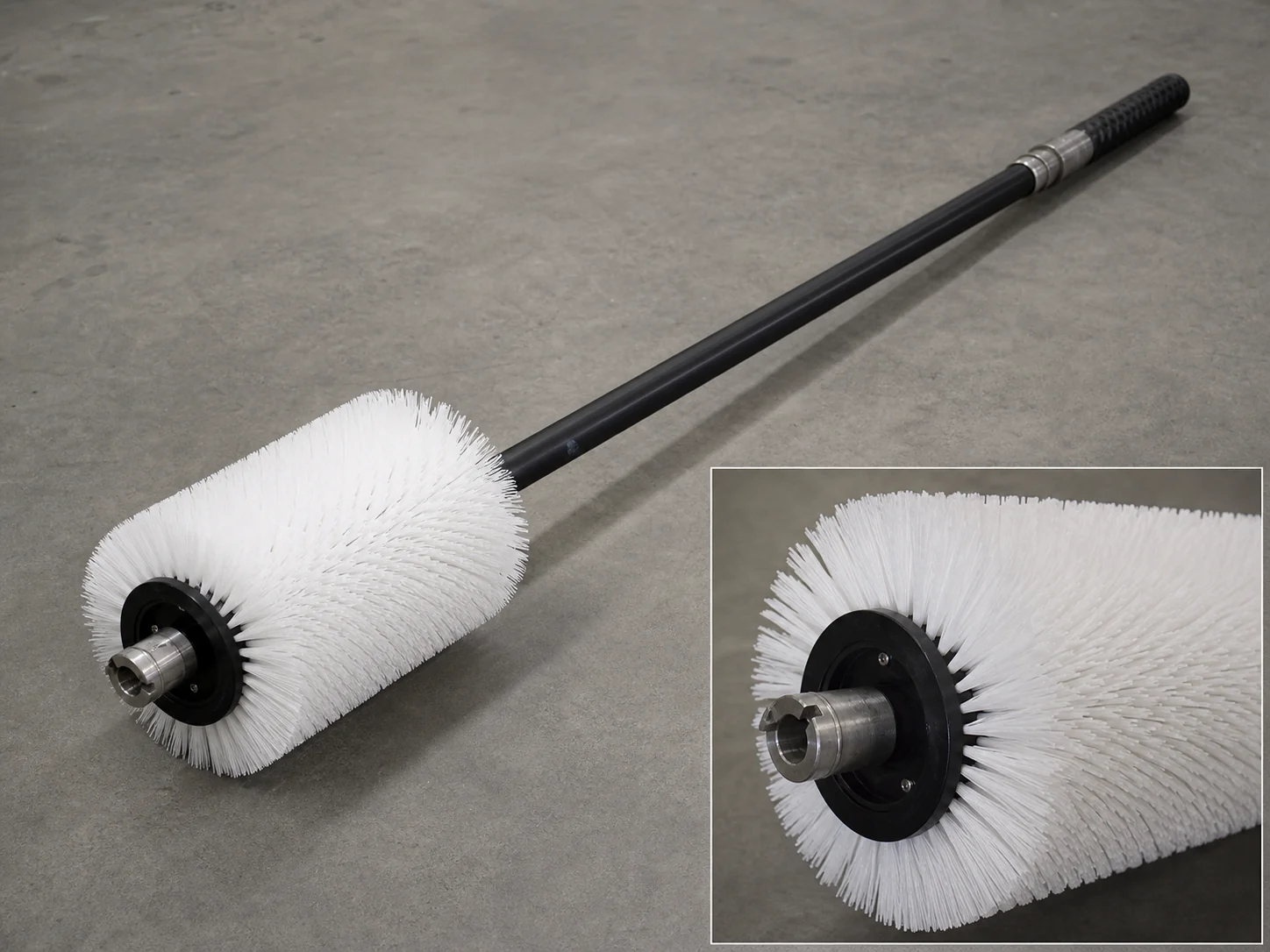
Medium brush
100 pcs
Minimum order
Worked with two hands or on a pole: chimney, gutter and pond-filter brushes, discs, cups and tank brushes.
Production lead time, once the specification is confirmed
- Up to 100 pcsWithin 7 days
- 101–5,000 pcsWithin 14 days
- 5,001–50,000 pcsWithin 21 days
- Over 50,000 pcsConfirmed with your quotation
Peak season can extend these times; the shipping date is confirmed in writing with your quotation. Sampling and shipping are quoted separately.
A 180 mm outer-diameter, 1,200 mm face-length roller brush filled with PA66 nylon filament for continuous mechanical clearing of blinded aggregate screens. It reaches across the full screening face to dislodge blinding fines, fibers, powders, pellets, and wet residue from wire mesh, perforated plate, and wedge wire decks.
What can this brush do for you?
Clears the full 1,200 mm screen face without dead lanes
The face length is filled with PA66 filament in a spiral or staggered layout, so every section of the brush passes over the screen surface during rotation. Bristles contact the screening area from edge to edge instead of leaving untreated bands where near-size particles can wedge.
Uses the 180 mm diameter to reach into apertures, not just sweep the surface
The outer diameter and trim length give the filament tips enough projection to enter wire mesh openings, wedge wire gaps, and perforated plate holes. This lifts particles that sit below the surface plane while the brush body keeps a consistent contact zone against the deck.
PA66 filament recovers after every deflection
Nylon 66 offers flex fatigue resistance and abrasion resistance suited to dusty, wet aggregate screening. Bristles bend as they pass over the screen, then spring back to their original position, so contact pressure stays repeatable over long running hours instead of collapsing into a flattened mat.
Quick-change coupling keeps screen downtime short
The roller mounts through a quick-change coupling on the drive side. A worn brush can be exchanged without dismantling the drive assembly or rethreading the shaft, which matters when the screen has to return to service quickly.
Machine-driven core removes dependence on operator pressure
This is not a hand brush. A powder-coated carbon steel core and end construction keep the roller concentric under rotation, and the brush follows the screen movement with controlled deflection instead of relying on an operator pressing into the deck.
What is a 180x1200mm PA66 Screen Cleaning Roller Brush?
A 180x1200mm PA66 Screen Cleaning Roller Brush is a driven cylindrical brush with a nominal outer diameter of 180 mm and a face length of 1,200 mm, filamented with PA66 nylon. It mounts on a rotating shaft or powered arbor in screening equipment and rotates against the screen surface to mechanically break loose material that has blinded the openings.
The brush works by sweeping filament tips across the screen at a controlled deflection. On a vibrating screen, rotating trommel, or screen basket, the tips enter the openings enough to dislodge fines, wet residue, fibers, or embedded particles, then flex back as the screen passes. The core and quick-change coupling are matched to the customer’s drive shaft, so there is no operator handle in the assembly.
PA66 nylon is chosen because it holds stiffness in typical aggregate environments, resists abrasive contact with rock fines, and tolerates splash and process moisture better than many lower-cost thermoplastics. The standard build uses a powder-coated carbon steel core or flange; stainless steel construction is available for continuous wet exposure or corrosive process water.
This brush is not a high-pressure scrubbing tool for locked-on mineral scale, and it is not a replacement for water spray bars where sticky clay needs continuous fluidization. It is a mechanical clearing element for screens that suffer from blinding due to particle size, shape, moisture, or fibrous contamination.
Technical Specifications
| Parameter | Value / Option |
|---|---|
| Overall diameter | 180 mm nominal |
| Face length | 1,200 mm |
| Bristle material | PA66 nylon filament |
| Filament diameter | 0.50–0.80 mm, selected by screen aperture and residue type |
| Filament layout | Spiral wound, straight strip, or sectional segments; spiral is standard for continuous clearing |
| Core / flange material | Powder-coated carbon steel (standard); stainless steel options available for wet or corrosive duty |
| Drive interface | Quick-change coupling; shaft diameter, keyway, and flange pattern matched to equipment drawing |
| Mounting | Direct shaft mount; no operator handle |
| Trim length | Configurable to control bristle deflection and aperture penetration |
| Operating environment | Wet or dry aggregate screening; powder coating resists splash, stainless option for continuous water contact |
| Maximum continuous dry temperature | About 90°C for PA66; confirm for wet or chemical conditions |
| Brush type | Custom Roller and Conveyor Brushes |
| How it is driven | Machine-driven, mounted in the equipment |
| Cleaning target | vibrating quarry screen, wedge wire and perforated plate deck, and screen basket and rotary sieve cleaning |
| Surface or part | screens, perforated plate, wire mesh, roller, wedge wire, baskets, carbon steel, and drums |
| Residue or debris | fines, particles, pellets, powder, clay, wet residue, fiber, and embedded particles |
| Mounting / connection | Quick-change coupling; shaft diameter, keyway, and flange pattern matched to equipment drawing; Direct shaft mount; no operator handle |
The above values describe the standard configuration. Face length, outer diameter, bristle gauge, density, trim pattern, core diameter, and coupling style can be adjusted to the screening equipment.
Where does this brush work best?
- Vibrating quarry screens where sand, gravel, and crushed stone produce near-size particles that wedge into woven wire mesh openings.
- Rotating trommel and drum screens handling aggregate, crushed rock, compost, or construction debris; wet fines blind perforated plate and screen cloth during rotation.
- Washing and dewatering screens where sand, silt, and clay paste fill wire mesh or polyurethane panel openings and need mechanical removal between spray cycles.
- Wedge wire and perforated plate decks in mineral processing, aggregate washing, and recycling plants that carry fine or fibrous contamination.
- Screen baskets and rotary sieves where powders, pellets, or embedded particles accumulate in apertures and reduce open screening area.
How do I choose the right one?
Match face length to the screen width first
Measure the active screening width the brush must cover. The 1,200 mm face length should equal or slightly exceed the deck width so the edges receive the same clearing action as the center. If the screen is wider, plan for multiple rollers or request a custom face length rather than leaving an uncovered band.
Confirm the drive coupling before ordering
The quick-change coupling is only useful if it fits the existing shaft or drive arbor. Provide the shaft diameter, keyway size, flange bolt circle, and any axial stop detail. A mismatched coupling will create vibration or require field modification.
Select filament diameter for the aperture and residue
Finer mesh and fibrous or powdery residues usually call for lighter filament in the 0.50–0.60 mm range so the tips do not push material deeper into the openings. Coarse woven screens, perforated plate, or wet sticky fines work better with stiffer 0.70–0.80 mm filament that can carry enough tip force to break the bond.
Set the deflection, not just the brush diameter
The 180 mm roller must be positioned so bristles deflect against the screen during rotation. A typical starting point is 2–5 mm of tip deflection at the centerline, adjusted so the bristles sweep openings without bottoming out. Too little deflection leaves fines behind; too much increases filament wear, drive load, and screen surface abrasion.
Plan for wet operation and chemical exposure
PA66 tolerates splash and process moisture, but continuous immersion softens the filament over time and can accelerate corrosion of the powder-coated steel core. If your screen runs under water sprays or in acidic or caustic process fluid, choose a stainless steel core and confirm chemical compatibility before committing to PA66.
When to use a different brush
If the blinding material is hardened scale, thick clay, or rock fragments welded into the screen, a steel wire or abrasive-filled roller may be needed because PA66 cannot generate enough cutting force. If the screen surface cannot tolerate nylon contact, a softer PA6 or polypropylene filament may be more appropriate. For continuous temperatures above about 90–100°C, switch to a PBT or high-temperature filament instead of PA66.
Can I customize this brush?
The 180x1200mm dimensions are a reference configuration, not a fixed stock product. Most installations require at least some adjustment to the drive interface or filament arrangement.
We can modify:
- Dimensions — face length, outer diameter, and trim length to suit the screen deck and access space.
- Filament system — bristle diameter, trim density, filament length, and layout pattern including continuous spiral, segmented sections, or custom stagger.
- Core and drive interface — shaft diameter, bore, keyway, flange plate, bearing journals, and coupling style. Powder-coated carbon steel, galvanized, 304 stainless, or 316 stainless construction.
- Material alternatives — PA6, PBT, or other filament materials if operating conditions require different stiffness, temperature tolerance, or chemical resistance.
- End treatments — sealed ends, balancing weights, wear sleeves, or protective caps for shaft threading.
- Marking and identification — color coding on flanges, part marking, or packaged labeling for maintenance stock.
- Packaging — bulk crating, individual protective wraps, or project-specific packing for replacement brush kits.
To define the correct build, share the screen type and aperture size, screen width and movement, residue description, wet or dry environment, operating temperature, rotation speed and direction, and a shaft or drive drawing if available. If your project requires material declarations, inspection documentation, or third-party testing support, we can assist with those requirements during the customization process.
How long does a 180x1200mm PA66 screen cleaning roller brush last, and how is it cleaned between runs?
How can I tell whether the brush is contacting the screen correctly?
Run the brush at low speed or rotate it manually over the screen and watch the bristle tips. They should deflect visibly but not flatten completely, and the deflection should be consistent across the full face. If you see an untreated stripe or the bristles skip over a section, adjust the mounting height or check for core runout. On a stopped screen, a white chalk mark across a few bristle rows can reveal whether the contact band is even.
Does rotation direction affect cleaning performance?
Yes. On most screen-cleaning stations the brush should rotate so the bristle tips move against the direction of screen travel or material flow at the contact point. This lifts blinded material out of the apertures instead of brushing it forward and packing it under the filament. If results drop after reversing the drive, check the direction first.
Can this roller be used on a continuously wet screen?
It can, but the core material must match the duty. The standard powder-coated carbon steel core resists occasional splash but is not intended for continuous immersion. For screens with constant water sprays or process immersion, specify a stainless steel core and hardware. PA66 will absorb some moisture, which can slightly reduce stiffness; this is usually acceptable in wet aggregate screening but should be confirmed for the specific moisture level.
How do I know when the brush needs replacement?
Measure the remaining filament length at several points across the face. When the bristles have lost roughly 25–30% of the original trim length, show flattened or splayed sections, or leave visible blinding on the screen at the same speed and deflection, replace the roller. Also inspect the core for corrosion, cracks in the powder coating, and looseness in the quick-change coupling during each maintenance window.
Can I use this brush on a fine micro-mesh screen?
Only if you select the lightest filament gauge and set a shallow deflection. PA66 in heavier gauges can push fine particles deeper into very small apertures. For delicate fine mesh, a softer PA6 or polypropylene filament often provides enough clearing action with lower surface stress. Test one roller section on a scrap panel before full installation.
Will brushing remove all blinding, or do I still need water sprays?
A roller brush removes mechanically attached fines, fibers, powder, and embedded particles, but it may not remove every wet clay smear on its own. On washing screens, the brush is usually paired with spray bars: the brush breaks the plug loose and the spray flushes it out. Brushing is part of the clearing sequence, not a replacement for fluidization in heavy wet-screening applications.
Guides that go deeper on this
Custom Manufacturing RFQ
Describe Your Application
To prepare the correct quotation, provide the dimensions, cleaning task, residue, material, mounting details, quantity, and a drawing or photo.
Drawing or photo optional — it speeds things up, it does not gate the enquiry.
Custom Brush RFQ
Send Your Brush Project
Upload a drawing, product photo, or sample photo and provide the core dimensions and cleaning conditions.
“We need a brush to remove wet residue from a stainless steel conveyor, about 800mm wide. The current brush wears quickly. We can send photos.”
“We sell drinkware and need a cleaning brush to include with the product. Quantity around 5,000 pieces.”