
Custom Cleaning Brush
100x500mm PA66 Conveyor Roller Brush
100x500mm PA66 conveyor roller brush removes powder, chips, fibers, labels, and sticky carryback from conveyor belts.
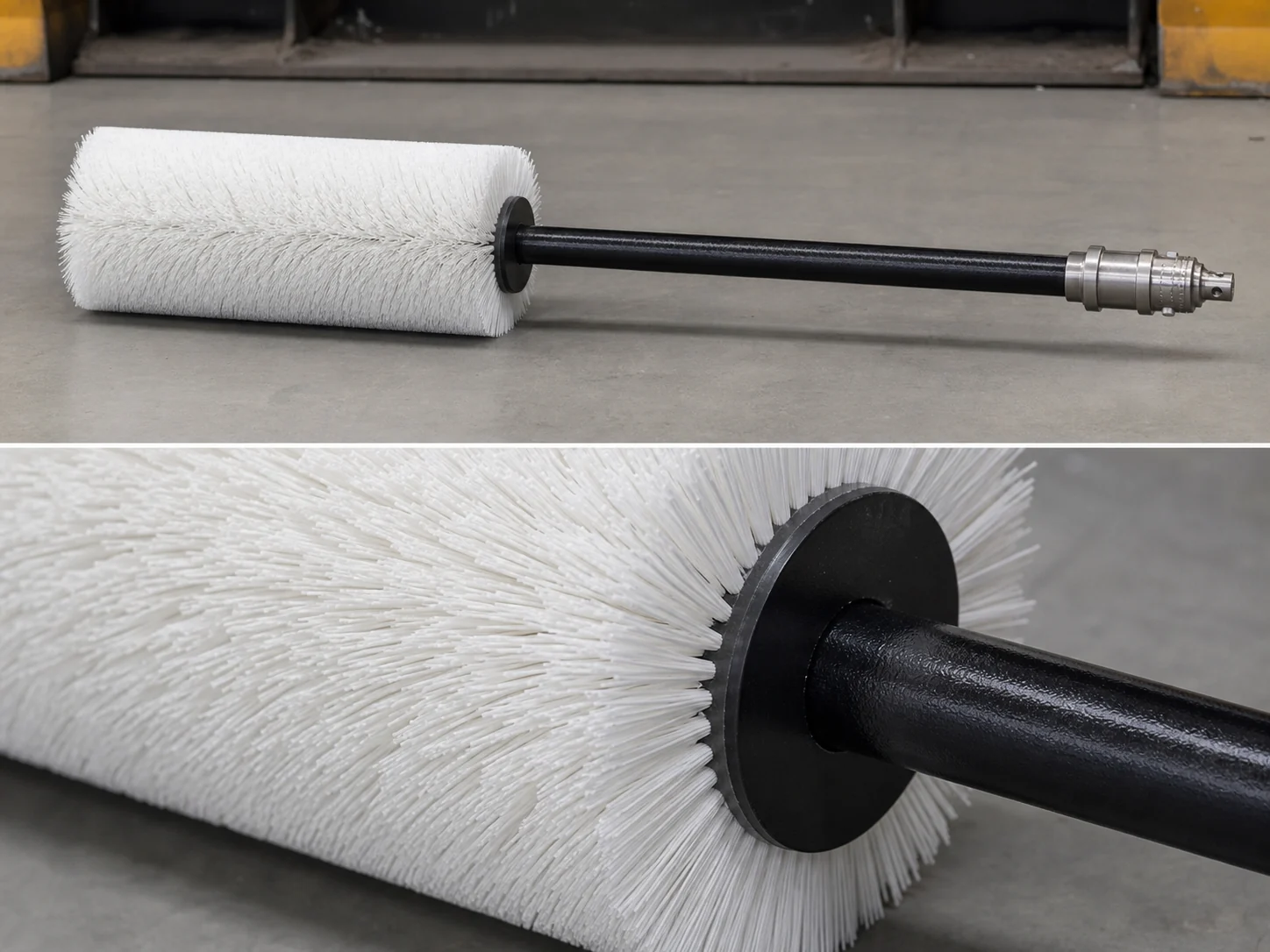
Medium brush
100 pcs
Minimum order
Worked with two hands or on a pole: chimney, gutter and pond-filter brushes, discs, cups and tank brushes.
Production lead time, once the specification is confirmed
- Up to 100 pcsWithin 7 days
- 101–5,000 pcsWithin 14 days
- 5,001–50,000 pcsWithin 21 days
- Over 50,000 pcsConfirmed with your quotation
Peak season can extend these times; the shipping date is confirmed in writing with your quotation. Sampling and shipping are quoted separately.
The 100x500mm PA66 Conveyor Roller Brush is a rotating roller brush designed to continuously remove powder, crumbs, fibers, chips, labels, film fragments, and sticky carryback from conveyor belts, rollers, and transfer points. Its 100 mm diameter and 500 mm face length provide full-width contact on common belt sections while the quick-change coupling allows fast roller swaps during maintenance.
What can this brush do for you?
Continuous cleaning without stopping the line
The cylindrical PA66 filament face rotates against the moving belt or product stream, so loose debris is swept away during production instead of accumulating until a scheduled cleanup. Each filament tip flexes and then snaps back, flicking particles off the surface rather than smearing them into the belt.
Full 500 mm coverage across the belt width
Many light- and medium-duty conveyors run belts up to 500 mm wide. This roller brush puts one uninterrupted filament contact zone across that width, leaving no unprotected edge strips. For wider belts, two or more roller brushes can be mounted end-to-end, or the face length can be extended.
Quick-change coupling reduces replacement time
The roller mounts through a quick-change coupling instead of a permanently pressed or welded shaft assembly. When the filaments wear, the roller can be dropped out and a replacement fitted without disassembling the bearing housings or drive train—turning what is often a scheduled shutdown task into a short exchange.
PA66 nylon handles moisture, oil, and repeated flexing
PA66 filament holds its stiffness in damp environments and resists oils, greases, and many mild cleaning agents. Unlike natural fiber or wire brushes, the nylon does not rust and does not soak up process water the same way, so contact pressure stays more consistent across shifts.
Rigid powder-coated core keeps the roller running true
The carbon steel core is powder coated to resist ambient moisture and light splash, and its rigidity keeps the bristle circle concentric at speed. That prevents the brush from flapping or running out of contact on one side, which would leave strips of uncleaned belt.
What is a 100x500mm PA66 Conveyor Roller Brush?
A 100x500mm PA66 Conveyor Roller Brush is a cylindrical brush roll built for automatic conveyor cleaning. The size designation refers to a 100 mm outside diameter and a 500 mm usable brush face, not including shaft stub ends. PA66 nylon filaments are anchored into a powder-coated carbon steel core, and the assembly mounts through a quick-change coupling onto a driven or idler shaft.
In operation, the roller is positioned across a belt, return run, pulley, or transfer point so the filament tips contact the moving surface. The brush can rotate in the same direction as the belt for gentle sweeping, or against the belt for more aggressive flicking and debris removal. Most installations place the roller just after the belt discharge at the head pulley, under the return strand, or beside a product path where spillage and dust collect.
This product is intended for loose, dry, or lightly tacky debris that can be knocked off by mechanical brushing. It is not a scraper for hardened deposits, and it does not replace a wash station for heavy wet carryback. In many plants it works alongside a belt scraper or spray system as the first mechanical stage of the belt cleaning sequence.
Technical Specifications
The table below lists the standard configuration. Dimensions and materials marked as adjustable can be changed to match your conveyor geometry, drive, and cleaning requirements.
| Parameter | Value / Options |
|---|---|
| Brush outside diameter | 100 mm |
| Brush face length | 500 mm |
| Filament material | PA66 nylon, straight or crimped |
| Filament diameter | 0.30–0.80 mm, selected for debris size and stiffness |
| Filament trim length | Set from core diameter to achieve 100 mm OD |
| Core material | Powder-coated carbon steel (stainless steel optional) |
| Connection | Quick-change coupling; interface matched to drive and bearing dimensions |
| Shaft ends / journals | Machined to customer bearing and mounting requirements |
| Operating speed | Up to 300 RPM typical; higher speeds require engineering confirmation |
| Recommended engagement depth | 2–5 mm into the belt or product surface |
| Max continuous operating temperature | 80°C (176°F) for PA66 filament |
| Chemical resistance | Good for oils, greases, dilute acids/alkalis, and moisture; avoid strong oxidizing acids and phenols |
| Brush type | Custom Roller and Conveyor Brushes |
| How it is driven | Machine-driven, mounted in the equipment |
| Cleaning target | bulk material, food and bakery line, and packaging and carton operation cleaning |
| Surface or part | belts, roller, conveyors, transfer points, carbon steel, guides, machine guides, and frames |
| Residue or debris | fiber, chips, dust, crumbs, powder, sticky carryback, film fragments, and carbon |
| Mounting / connection | Quick-change coupling; interface matched to drive and bearing dimensions |
Shaft diameter, keyway, bearing journal size, and rotation direction are specified at order time so the roller drops directly into your existing conveyor assembly.
Where does this brush work best?
- Bulk material handling conveyors — removes carryback of aggregate, sand, grain, wood chips, and recycled material from the belt return side before it accumulates under the frame.
- Food and bakery lines — sweeps flour, sugar, crumbs, seeds, and small product fragments from belts, especially before product contact or before the return run.
- Packaging and carton operations — clears paper dust, label fragments, film scraps, and boxboard fibers that can interfere with seals or contaminate product.
- Textile and web converting lines — removes lint, fibers, and dust from rollers, guide surfaces, and transfer points.
- Return belt and pulley sections — mounted below the belt or against the head/drive pulley to knock off material before it builds up.
- Transfer points and machine guides — positioned to sweep loose debris from rails, guides, and support surfaces near material drops.
How do I choose the right one?
Start with the mounting envelope. Measure the clearance between the belt or product surface and the nearest obstruction. The 100 mm OD needs at least about 105–110 mm of space including runout and mounting brackets. Face length should match the belt width or the contact zone you need; if the belt is wider than 500 mm, use two or more roller brushes or request a longer face.
Next, match the filament to the debris. Fine dry dust and powder usually call for 0.30–0.50 mm filaments in a higher-density fill, giving many fine tips for gentle surface brushing. Chips, fibers, label pieces, and film fragments benefit from 0.50–0.80 mm or crimped filaments that provide a stiffer, more aggressive flick. Sticky carryback may require the stiffer side and a stripper bar to prevent the brush from loading up.
Select the core and interface for the environment. Powder-coated carbon steel is the standard choice for dry or mildly humid ambient conditions. For washdown areas, food processing, or corrosive exposure, specify a stainless steel core and compatible end fittings. Confirm the quick-change coupling type and shaft dimensions against your existing drive before ordering.
Set operating parameters deliberately. Engagement depth of 2–5 mm gives effective cleaning without excessive filament wear. Opposite rotation relative to belt travel produces better debris removal; same-direction rotation is a gentler sweeping action. If the process temperature exceeds 80°C continuously, PA66 may soften or lose stiffness, and a higher-temperature filament material should be considered.
Use the following decision table as a quick reference:
| Condition | Recommended configuration |
|---|---|
| Dry powder or fine dust | Fine PA66 filaments, high density, idler rotation with belt |
| Chips, fibers, label fragments | Medium or heavy PA66, opposite rotation, optional stripper bar |
| Wet or sticky carryback | Stiff crimped PA66 plus belt scraper or wash station; stainless core |
| Continuous temperature above 80°C | Confirm filament upgrade or alternative material |
| Belt wider than 500 mm | Multiple rollers end-to-end or custom longer face |
| Hard scale, cured adhesive, or abrasive grit | Use a belt scraper, wire brush, or other scraping method instead |
Can I customize this brush?
The 100x500mm configuration is a common stock size, but almost every dimension and material can be adjusted. When you request a custom roller brush, the most helpful information to provide is belt width, belt speed, debris type, wet or dry conditions, process temperature, available clearance, and the drive or bearing interface dimensions.
Common customization options include:
- Dimensions — face length from shorter than 500 mm to 2000 mm or longer, outside diameter from 60 mm to 200 mm or more, core diameter and wall thickness.
- Filament — diameter from 0.10 mm to 1.00 mm, straight or crimped style, trim length, density, filament color, and hardness variations within the PA66 family.
- Core and shaft — powder-coated carbon steel, stainless steel 304/316, keyed bore, plain bore, stub shafts, bearing journals, or drive flats as required.
- Connection — quick-change coupling type, shaft end geometry, and mating dimensions matched to your existing drive components.
- Optional features — stripper bar or comb, end discs, balancing for high-speed service, mounting brackets, and filament color coding for identification.
- Packaging and marking — bulk packing, individually wrapped rolls to protect filament shape, labels, tags, or barcoding for warehouse handling.
If your project requires material documentation, inspection reports, or third-party testing for the filament or core materials, we can support those requirements during the customization process.
How do you tell when a 100x500mm PA66 conveyor roller brush is worn out?
How do I confirm the 100 mm OD will fit my conveyor?
Measure the distance from the belt or product surface to the closest fixed structure. The roller needs about 105–110 mm of clear space including bracket and runout allowance. If clearance is tighter, choose a smaller outside diameter or reposition the roller to a section with more room.
Should the roller brush rotate with the belt or against it?
Opposite rotation, where the filament tips move against belt travel, is usually better for dislodging and throwing debris clear of the surface. Same-direction rotation creates a gentler sweeping or dusting action. The drive direction can be set either way, but tell us which you prefer when specifying the coupling.
What should I check during routine inspection?
Look for filament breakage, flattening, or uneven wear across the 500 mm face. Check that the powder coating on the core is intact and the quick-change coupling is fully seated. Confirm the roller still makes even contact with the belt; a leaning or vibrating roller often indicates shaft misalignment or worn bearings.
How do I know when to replace the roller brush?
Replace the roller when the outside diameter has worn down by roughly 5–10 mm, when large bare spots appear from filament breakage, or when the belt is no longer coming clean at the same settings. Because the quick-change coupling allows fast exchange, many plants keep a spare roller on the shelf.
Will this brush remove heavy or baked-on deposits?
No. The PA66 filament is intended for loose, dry, or lightly tacky debris. Hard scale, cured adhesive, or thick sticky carryback requires a belt scraper, wash station, wire brush, or a combined system. The roller brush works best as one stage in a cleaning sequence, not as a full replacement for scraping.
What if filament loss could contaminate the product?
If broken filaments could enter the product stream, specify the contamination risk during ordering. We can discuss filament materials, containment/stripper arrangements, and core options that fit your detection or material requirements, and provide material documentation or testing support if your project requires it.
Guides that go deeper on this
Abrasive Nylon Grit and Filament Selection
Read this guideGuideBrush Roller Conveyor Mistakes with Dry Dust
Read this guideGuideBrush Speed, Engagement, and Heat
Read this guideGuideConveyor Belt Cleaning Brush Design
Read this guideGuideConveyor Brush Pressure: Residue Removal Without Belt Damage
Read this guideCustom Manufacturing RFQ
Describe Your Application
To quote this brush accurately, send the size, material, cleaning target, residue, quantity, and any available drawing or sample photo.
Drawing or photo optional — it speeds things up, it does not gate the enquiry.
Custom Brush RFQ
Send Your Brush Project
Upload a drawing, product photo, or sample photo and provide the core dimensions and cleaning conditions.
“We need a brush to remove wet residue from a stainless steel conveyor, about 800mm wide. The current brush wears quickly. We can send photos.”
“We sell drinkware and need a cleaning brush to include with the product. Quantity around 5,000 pieces.”