
Custom Cleaning Brush
150x1400mm PA66 Paper Machine Roller Brush
150mm x 1400mm PA66 roller brush on 304 stainless steel core for forming fabric, press felt, and roll cleaning. Quick-change coupling for fast replacement.
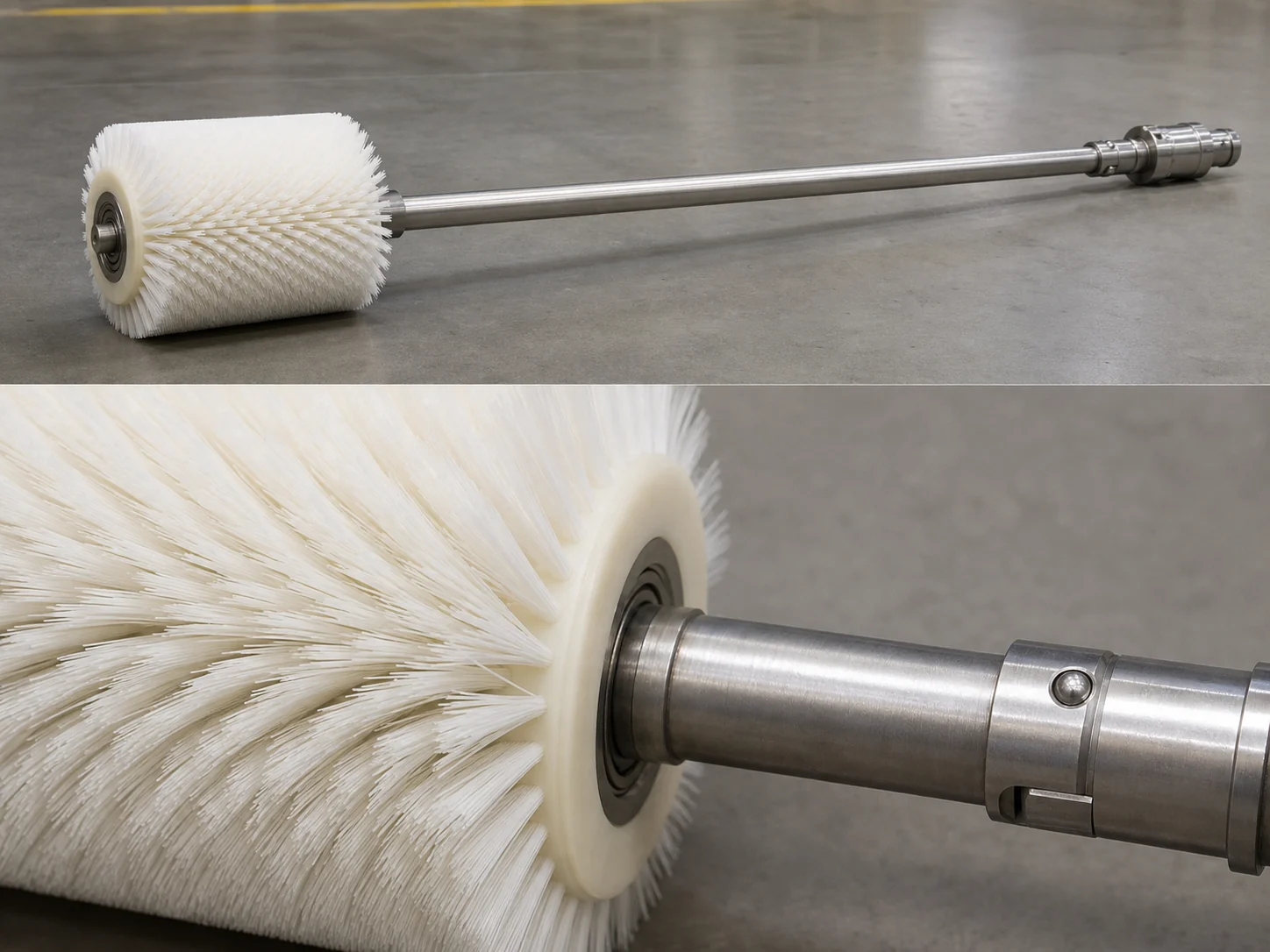
Large-format brush
100 pcs
Minimum order
Built one at a time on a core or channel: full-width rollers, sweeper brooms and long strip.
Production lead time, once the specification is confirmed
- Up to 100 pcsWithin 20 days
- 101–1,000 pcsWithin 30 days
- Over 1,000 pcsConfirmed with your quotation
Peak season can extend these times; the shipping date is confirmed in writing with your quotation. Sampling and shipping are quoted separately.
The 150x1400mm PA66 paper machine roller brush combines a 150 mm outside diameter with a 1400 mm face length to provide continuous rotary cleaning of forming fabrics, press felts, and roll surfaces in the wet end of a paper machine. Its PA66 nylon filament and AISI 304 stainless steel core are matched to wet operating conditions where pulp fiber, filler, pitch, and adhesive residues must be removed without damaging the fabric or interrupting production.
What can this brush do for you?
Provides a full 1400 mm cleaning face instead of a short contact patch
The long face length lets the brush cover one complete lane of a forming fabric or press felt in a single position. On wider machines, multiple units can be mounted end to end across the machine width. The 150 mm outside diameter maintains a stable contact arc between the filament tips and the moving surface, so the cleaning action stays consistent from edge to edge rather than fading in the middle of the face.
Keeps sweeping power when the filament is saturated
PA66 absorbs water and process liquids, yet recovers its shape after each deflection through the contact zone. Unlike some fibers that soften permanently in continuous wet service, the PA66 filament continues to spring back and release deposits through a full production shift. This is the central reason the material is selected for wet-end cleaning rather than for dry or high-temperature applications.
Reduces downtime with a quick-change coupling
The brush core is supplied with a quick-change coupling so a worn brush can be removed and replaced as an assembly without disconnecting the drive or realigning the whole shaft. A maintenance crew can exchange a 1400 mm brush during a short planned stop, which keeps fabric cleaning schedules independent of long drive rebuilds.
Keeps the core dimensionally stable in wet and chemical service
The AISI 304 stainless steel core resists the water, paper machine chemicals, and cleaning showers present in the forming and press sections. It does not rust or pit like a carbon steel shaft, so the brush continues to rotate true and does not transfer corrosion products onto the fabric surface.
Lifts deposits without digging into the fabric weave
The round brush profile and trimmed PA66 filament are designed to sweep fiber, filler, and pitch off the fabric surface rather than forcing the filament tips deep into the weave. This controlled tip pressure protects felt permeability and fabric life while still removing process deposits that would otherwise harden and affect sheet quality.
What is a 150x1400mm PA66 Paper Machine Roller Brush?
A 150x1400mm PA66 paper machine roller brush is a cylindrical rotary cleaning tool built on a stainless steel core with PA66 nylon filament filled around it. The outside diameter of the finished brush is 150 mm, measured across the filament tips, and the filled face length is 1400 mm. One or both ends carry a quick-change coupling that connects the brush to the machine drive and support bearings.
In operation, the brush rotates against a moving forming fabric, press felt, or roll surface. Depending on the cleaning objective, it may rotate with or against the fabric travel direction. The filament tips continuously sweep the surface to loosen pulp fiber, filler, pitch, stickies, and other process deposits before they consolidate. Water showers are typically used in front of or above the brush to wet the contact zone and carry the loosened material away.
This is a wet-end and press-section cleaning component. PA66 filament is selected for its predictable recovery in water and moderate-temperature process conditions. It is not a dryer-section brush and is not intended for baked-on scale, embedded abrasive particles, or heavy metal debris.
Because the face length is 1400 mm, the brush often functions as a module within a wider fabric cleaning system. A narrow machine may need only one brush; a wide machine may combine several units across the sheet width. The quick-change coupling and stainless core support that modular replacement strategy during planned maintenance.
Technical Specifications
The table lists the standard configuration for this roller brush. Face length, diameter, filament layout, and coupling details can be adjusted to the project during customization.
| Parameter | Specification / Options |
|---|---|
| Brush outside diameter | 150 mm |
| Face length | 1400 mm |
| Filament material | PA66 nylon |
| Filament diameter | 0.50–0.80 mm, selected by deposit type and fabric sensitivity |
| Filament trim length | Typically 30–40 mm; adjusted to contact arc and expected wear life |
| Fill pattern | Multi-spiral or channel fill for even contact and debris release |
| Core / shaft material | AISI 304 stainless steel |
| Connection | Quick-change coupling |
| Recommended environment | Forming and press sections, roll cleaning, wet or moist surfaces |
| Practical continuous temperature limit | Approx. 85°C for PA66; higher-temperature sections require PBT, PPS, or metal filament |
| Rotation | Bidirectional; direction relative to fabric travel set during commissioning |
| Brush type | Custom Roller and Conveyor Brushes |
| How it is driven | Machine-driven, mounted in the equipment |
| Cleaning target | forming fabric and wire return roll, and doctor zone and sheet edge cleaning |
| Surface or part | forming fabrics, sheets, roller, rolls, metal, edges, and doctor zones |
| Residue or debris | fiber, pitch, filler, pulp fiber, adhesive, scale, process deposits, and particles |
| Mounting / connection | Quick-change coupling; Bidirectional; direction relative to fabric travel set during commissioning |
Where does this brush work best?
- Forming fabrics and wire return rolls — removes wet pulp fiber, fines, filler, and light stickies from the wire and return run before they reduce drainage or mark the sheet.
- Press felts and press rolls — sweeps fiber, filler, pitch, and adhesive buildup from felt surfaces and roll covers in combination with felt showers and vacuum systems.
- Doctor zones and sheet edges — collects sticky deposits that accumulate behind doctor blades and along edge trim areas where chemical additives concentrate.
- Couch rolls, guide rolls, and transfer rolls — cleans cylindrical surfaces that carry fiber and coating residues back into the sheet path.
Typical residues handled by this brush include pulp fiber, calcium carbonate and clay filler, pitch, stickies, and light process deposits. The brush is intended for routine preventive contact cleaning, not for removing hardened mineral scale, burned-on coatings, or embedded metal particles.
How do I choose the right one?
First, confirm the cleaning width and mounting envelope. Check that the 1400 mm face length covers one cleaning lane or that your layout allows multiple brushes without gaps or excessive overlap. Verify the 150 mm outside diameter against the available space around the roll or fabric run, including shower piping, frame members, and doctor supports. The brush must rotate through its full arc without striking fixed parts.
Next, match the PA66 filament to the deposit and fabric. PA66 is the correct choice for moderate-temperature wet sections where deposits are still soft or lightly consolidated. For light deposits on sensitive fabrics, use a smaller filament diameter and a longer trim for gentler contact. For heavier fiber mats, pitch, or stickies, use a larger filament diameter and a shorter trim for firmer sweeping pressure.
Confirm the coupling interface before ordering. Quick-change couplings are not universal. Pilot diameter, bolt circle, keyway, engagement depth, and torque rating must match the existing drive and support assembly. For legacy installations, provide the machine drawing or a sample end fitting so the core journals can be machined to match rather than adding an adapter.
Set rotation direction and speed only after installation. The brush should sweep deposits off the fabric surface without generating excessive fabric flutter or heat. Position the conditioning shower ahead of or above the contact zone so loosened debris is carried away instead of redeposited downstream.
| Condition | What to change |
|---|---|
| Light deposit, delicate fabric | Smaller filament diameter, longer trim, lower contact pressure |
| Heavy fiber mat or pitch | Larger filament diameter, shorter trim, higher contact pressure |
| Section temperature above about 85°C | Switch filament from PA66 to PBT or PPS |
| Uneven wear across the face | Check bearing alignment, fabric tracking, and shower pattern before changing the brush |
Choose a different brush when the section runs too hot for PA66, when the deposit is hard mineral scale or embedded abrasive material, or when the fabric cannot tolerate the contact pressure of a rotating brush. For high-temperature dryer fabrics or heavy scale, a PBT, PPS, or metal filament brush is the safer fit. For dry dust and static charges, a fixed brush or vacuum system may be more effective.
Can I customize this brush?
This roller brush is normally configured to the specific paper machine rather than ordered as a fixed stock part. Core dimensions, filament layout, and coupling interface are adjusted to the actual installation.
To define the configuration, we need:
- Machine section, fabric or roll type, and machine speed
- Available diameter clearance and mounting envelope around the brush position
- Existing coupling drawing or dimensions: pilot, bolt circle, keyway, and torque rating
- Operating temperature, water chemistry, and shower arrangement
- Deposit description: fiber type, filler, pitch, stickies, or other residues
- Rotation direction and target operating speed
Configurable items include:
- Face length and diameter — the 150 mm diameter and 1400 mm face length can be resized to match the machine width and roll geometry.
- Filament — PA66 diameter, trim length, fill density, and pattern; alternative polymers such as PBT or PPS where process temperature requires.
- Core and journals — AISI 304 or 316 stainless steel, shaft length, bearing seats, keyways, and end details machined to your drawing.
- Coupling — quick-change, keyed, flanged, or a custom interface matched to the existing drive.
- Marking and color — identification bands, part numbers, or section color coding for inventory control.
- Packaging — protective wrapping for shaft journals, individual crating, or multi-unit sets for a machine-width order.
If the project requires material declarations, inspection reports, or third-party testing support, we can assist with those requirements during the customization process.
Which filament survives the cleaning and still lasts on a 150x1400mm PA66 paper machine roller brush?
How do I confirm the quick-change coupling is compatible with my machine?
Do not rely on the nominal size. Compare the pilot diameter, bolt circle, keyway, engagement depth, and torque rating against the machine drawing. If the machine has a legacy fitting, send the drawing or a sample end cap so the core journals can be machined to the exact interface.
The PA66 filament seems to soften after it gets wet for the first time. Is that normal?
Yes. PA66 absorbs water and swells slightly, which changes the initial tip stiffness. Let the brush run wet for a short conditioning period, then recheck the contact pressure and adjust the nip position. This is a property of nylon in wet service, not a manufacturing defect. If the stiffness change is too large for your deposit, we can specify a larger filament diameter or a different trim length.
How do I know when the roller brush needs replacing?
Record the initial filament trim length and inspect it during planned stops. Replace the brush when the trim length is reduced by about 25–30%, when filament is cracking or shedding, or when the core shows visible runout. Uneven wear across the face usually points to bearing alignment or fabric tracking, so correct that before installing a replacement.
Can this brush be used in the dryer section?
No. PA66 has a practical continuous temperature limit around 85°C. Dryer fabrics and hot rolls exceed that temperature, and the filament will soften and lose its sweep. For dryer-section cleaning, select a PBT, PPS, or metal filament brush.
Does the roller brush replace felt conditioning or chemical cleaning?
No. The brush is one mechanical element in the cleaning system. Showers, chemical conditioning, and vacuum or uhle box dewatering still perform their own functions. The brush loosens and removes deposits so those downstream systems can work more effectively.
How should I store spare roller brushes?
Support the brush by the shaft journals at both ends, keep the coupling surfaces protected, and store it indoors away from direct sunlight, ozone sources, and heavy mechanical contact. Do not stack other objects on the filament face. PA66 can be stored at normal warehouse conditions, but wetting and drying cycles during storage should be avoided.
Guides that go deeper on this
Abrasive Nylon Grit and Filament Selection
Read this guideGuideBrush Roller Conveyor Mistakes with Dry Dust
Read this guideGuideBrush Speed, Engagement, and Heat
Read this guideGuideCapsule Polishing Machine Brushes: Selection and Maintenance
Read this guideGuideConveyor Belt Cleaning Brush Design
Read this guideCustom Manufacturing RFQ
Describe Your Application
Please share the brush dimensions, working area, residue type, material direction, quantity, and a drawing or photo for quotation.
Drawing or photo optional — it speeds things up, it does not gate the enquiry.
Custom Brush RFQ
Send Your Brush Project
Upload a drawing, product photo, or sample photo and provide the core dimensions and cleaning conditions.
“We need a brush to remove wet residue from a stainless steel conveyor, about 800mm wide. The current brush wears quickly. We can send photos.”
“We sell drinkware and need a cleaning brush to include with the product. Quantity around 5,000 pieces.”