
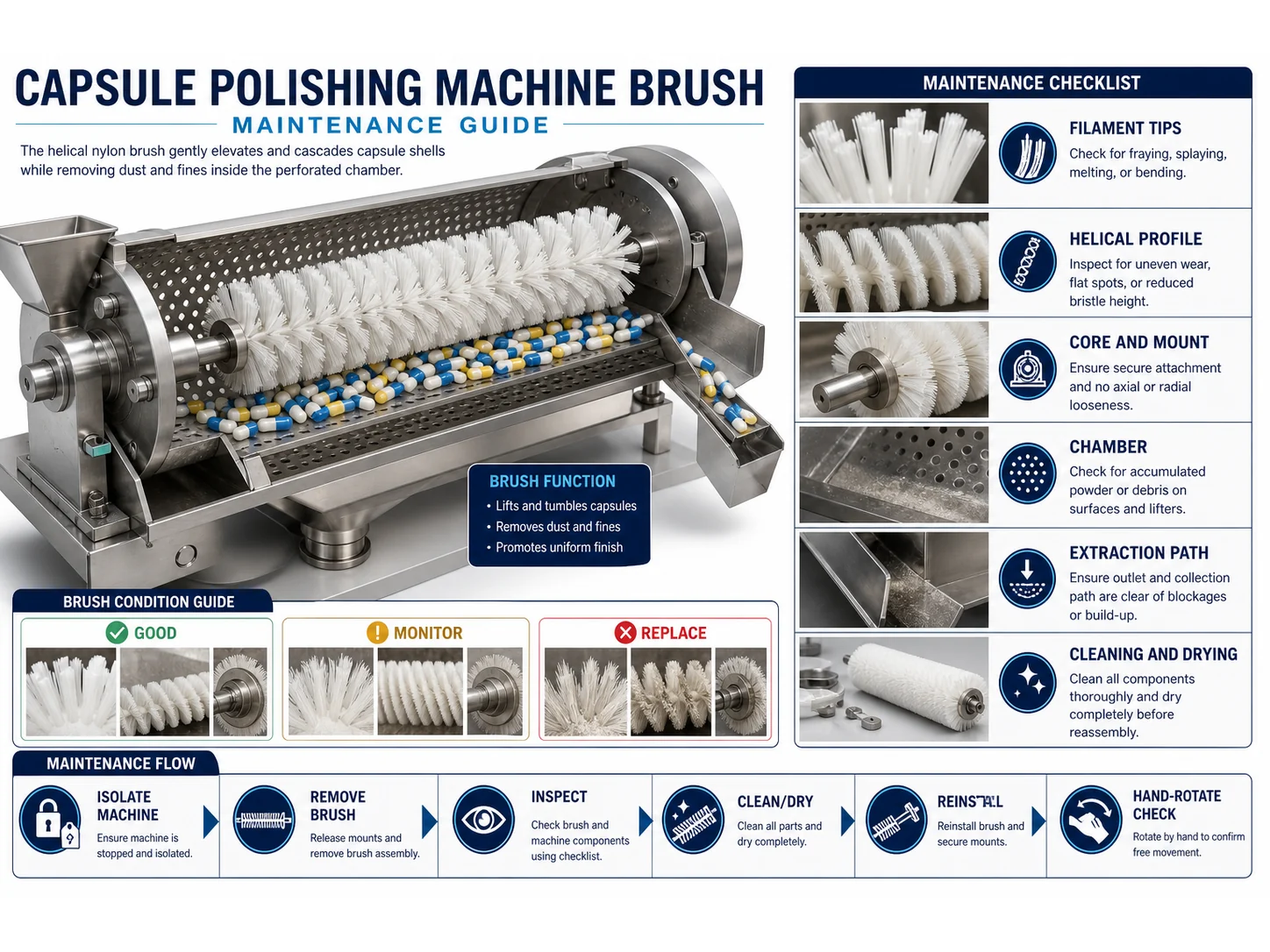
What Is a Capsule Polishing Brush?
A capsule polishing brush is a rotating or stationary component inside a capsule polishing machine that mechanically lifts and removes surface debris from capsules. As capsules pass over or between the brushes, fine bristles sweep away residual powder and dust without damaging the capsule shell. The process improves visual appearance, aids downstream packaging, and helps meet pharmaceutical cleanliness standards.
Common Types of Capsule Polishing Brushes
Three primary brush configurations are used in capsule polishing equipment. Each suits different production volumes, capsule types, and cleaning demands.
- Spiral‑Wound Brushes: Cylindrical brushes with bristles wound in a helical pattern around a core. They provide even contact across the capsule surface and are common in inline polishing stations.
- Panel‑Mounted Brushes: Flat or curved panels fitted with bristle strips. These are often used in polishing tunnels where capsules slide against a stationary brush surface. Easy to replace and maintain.
- Roller Brushes: Rotating cylindrical brushes that actively move capsules through the polishing area. Roller brushes offer adjustable rotation speed and can handle higher throughput.
Spiral-Wound vs. Panel-Mounted vs. Roller: Comparison at a Glance
| Brush Type | Typical Arrangement | Best For | Cleaning Action | Maintenance Complexity |
|---|---|---|---|---|
| Spiral‑Wound | Rotating shaft with helical bristles | Uniform polishing of round capsules at moderate speed | Gentle all‑around contact | Moderate; entire brush replaced as a unit |
| Panel‑Mounted | Stationary bristle panels inside a channel | Low‑volume or dedicated capsule shapes; easy access | Friction‑based as capsules pass over | Low; individual panels can be swapped |
| Roller | Powered rotating cylinders | High‑speed production lines; adjustable pressure | Active brushing with speed control | Higher; motorized components, bearings |
FDA-Grade Material Requirements and Bristle Selection
Brush materials that contact capsules must comply with FDA regulations for food‑grade or pharmaceutical‑grade materials. PA612 (Nylon 6/12) is widely used because it offers high chemical resistance, low moisture absorption, and compliance with FDA 21 CFR requirements. Its mechanical properties remain stable under typical cleaning conditions and capsule friction.
Bristle stiffness is selected based on capsule hardness:
- Soft capsules (e.g., softgels, low‑hardness gelatin): Use softer, finer bristles to avoid scratching or deforming the shell.
- Hard capsules (e.g., HPMC, high‑bloom gelatin): Medium to firm bristles can be used to effectively remove stubborn powder without damaging the surface.
- Extra‑firm or abrasive capsules: Stiffer bristles may be acceptable, but always verify shell integrity through testing.
Bristle density, filament diameter, and overall brush dimensions also affect performance. A higher bristle density provides more contact points but may increase friction heating.
Wear Indicators and Replacement Frequency
Regular inspection helps maintain consistent polishing and prevents damage. Common wear indicators include:
- Frayed, bent, or missing bristles
- Uneven bristle length across the brush surface
- Debris accumulation that cannot be cleaned
- Reduced polishing efficiency (visible dust remaining on capsules)
- Scratches or abrasion marks on capsule shells
Replacement frequency depends on production volume, capsule abrasiveness, and cleaning protocols. In a typical medium‑volume operation, brushes may need replacement based on wear condition, operating load, and the equipment maintenance plan. High‑speed lines running abrasive powder formulations may require more frequent changes. Keep a log of brush condition during line clearance and preventive maintenance checks.
Common Mistakes in Brush Selection and Maintenance
- Choosing the wrong bristle stiffness: Too soft leaves powder behind; too hard risks capsule damage.
- Ignoring material compliance: Non‑FDA‑compliant materials can lead to regulatory findings.
- Neglecting regular inspection: Small bristle defects worsen quickly and reduce cleaning quality.
- Using damaged brushes beyond their useful life: Worn brushes carry cross‑contamination risk and may shed bristles into product.
- Mismatching brush type to capsule shape: Some brush geometries work better for specific capsule forms; testing is essential.
- Applying the same pressure/ speed for all capsule types: Adjustable parameters must be optimized per product.
When a Polishing Brush Isn’t Enough: The Role of Inspection Systems
Capsule polishing brushes are designed to remove surface dust and powder. They do not detect or reject structural defects such as cracks, dents, open caps, or internal voids. When critical quality attributes are at risk, a polishing step must be combined with an automated inspection or rejection system. Common technologies include vision systems, weight checkers, and size grading. These systems identify defective capsules that a brush cannot correct. Relying solely on polishing for quality assurance creates a false sense of security and can lead to product recalls.
Final Takeaway
Select a brush configuration that matches your production speed and capsule characteristics. Use FDA‑grade PA612 bristles with appropriate stiffness for the capsule hardness you process. Establish a routine inspection schedule and log wear data to optimize brush life. Always pair polishing with a proper defect inspection system when product quality demands it. With the right brush and good maintenance practices, you protect both capsule appearance and compliance.
Frequently Asked Questions
How do I know if my brush bristles are supported by food-contact documentation?
Request a material certificate from the brush supplier showing compliance with FDA 21 CFR for indirect food contact. PA612 (Nylon 6/12) is a common choice with well‑documented approvals. Always verify that the specific filament grade and any embedded additives meet current regulatory requirements.
Can one brush type handle all capsule sizes and materials?
Not reliably. Capsule diameter, length, shape, and shell hardness affect how the bristles engage the surface. A brush optimized for size 0 hard gelatin capsules may perform poorly on smaller softgels or oblong shapes. Run tests whenever you change products.
What are signs that a brush needs immediate replacement?
Missing or severely bent bristles, bristle shedding onto capsules, visible scratches on capsule shells, and a sudden drop in dust removal efficiency are all critical signs. If cleaning the brush does not restore performance, replace it before the next production run.
How does capsule hardness influence bristle stiffness choice?
Harder capsules can tolerate stiffer bristles that provide more aggressive cleaning. Softer capsules require gentler bristles to prevent abrasion or deformation. Match bristle stiffness to the capsule’s hardness range through empirical testing, not just a supplier’s general recommendation.
Is it possible to clean and reuse worn polishing brushes?
Brushes can be cleaned with approved solvents or ultrasonic baths to remove accumulated powder, but physical wear like bristle deformation or loss is irreversible. Once bristles are permanently bent or missing, the brush should be retired. Reusing significantly worn brushes risks product contamination and poor polishing.
Why is PA612 often recommended for capsule polishing?
PA612 combines low moisture absorption (maintains stiffness in humid washdown environments), good chemical resistance to cleaning agents, and a track record of FDA compliance for food and pharma contact. It offers a reliable balance of durability, safety, and cost.
What happens if I continue using a worn-out brush?
Polishing efficiency drops, residual powder remains on capsules, and the risk of bristle fragments entering the product stream increases. Inconsistent cleaning can also lead to cosmetic rejects and potential regulatory observations. Replace worn brushes on schedule to avoid these problems.
Do I always need an automatic inspection system with a polishing brush?
Not in every case. Simple cosmetic polishing for dust removal alone may not require inspection. However, if product quality attributes include defect detection (cracks, open caps), a vision or weight‑based inspection system is necessary because a brush cannot identify or remove defective capsules.
Technical References
- eCFR — 21 CFR 211.67 Equipment Cleaning and Maintenance
- eCFR — 21 CFR Part 211 Finished Pharmaceutical CGMP
Which nylon grade fits this job — PA612 Nylon, Nylon PA or PA6 Nylon?
| Grade | Continuous temperature (°C) | Peak temperature (°C) | Water absorption | Hardness |
|---|---|---|---|---|
| PA612 Nylon | 90–110 | 130–150 | 0.3–0.7% | Shore D 70–80 |
| Nylon PA | 93 | 121 | 0.3–9% by PA grade and conditioning | Medium to firm; filament diameter and trim length control bending force. |
| PA6 Nylon | 80–100 | 130–160 | 1.5–3.0% | Shore D 75–85 |
| PA66 Nylon | 100–120 | 150–180 | 1.0–1.8% | Shore D 80–88 |
| PA610 Nylon | 90–110 | 130–150 | 0.5–1.0% | Shore D 72–82 |
Figures as published by Brushtec / DuPont. Confirm the exact grade against the supplier datasheet before ordering.
When are Roller and Conveyor Brushes the wrong choice for polishing?
- Roller and Conveyor Brushes — Use a stationary strip brush for a fixed linear seal or wipe, or another process when rotating line contact interferes with the product or cannot discharge the residue safely.
- PA612 Nylon — PA612 costs more than general PA6 and should be used where its wet stability, recovery or wear life creates a real process benefit.
- Nylon PA — The nylon family spans several grades, so heat, moisture and chemical limits should follow the selected PA resin rather than a generic nylon value.
What should replace Roller and Conveyor Brushes for polishing?
- Roller and Conveyor Brushes — Roller and conveyor brushes hold cylindrical line contact across a working width, including helix-wound builds where the filament path is set to move loosened material toward one side; a strip brush holds the same line without rotating, so it seals or wipes but cannot carry residue along the width.
- PA612 Nylon — Compare PA612 Nylon with PA66, PP, PBT. Change material when wet stiffness, temperature, chemical resistance, conductivity, particle shedding, or surface marking becomes the limiting factor.
- Nylon PA — Compare Nylon PA with PP, PBT, PET. Change material when wet stiffness, temperature, chemical resistance, conductivity, particle shedding, or surface marking becomes the limiting factor.