
Application
Paper Machine Fabric Cleaning
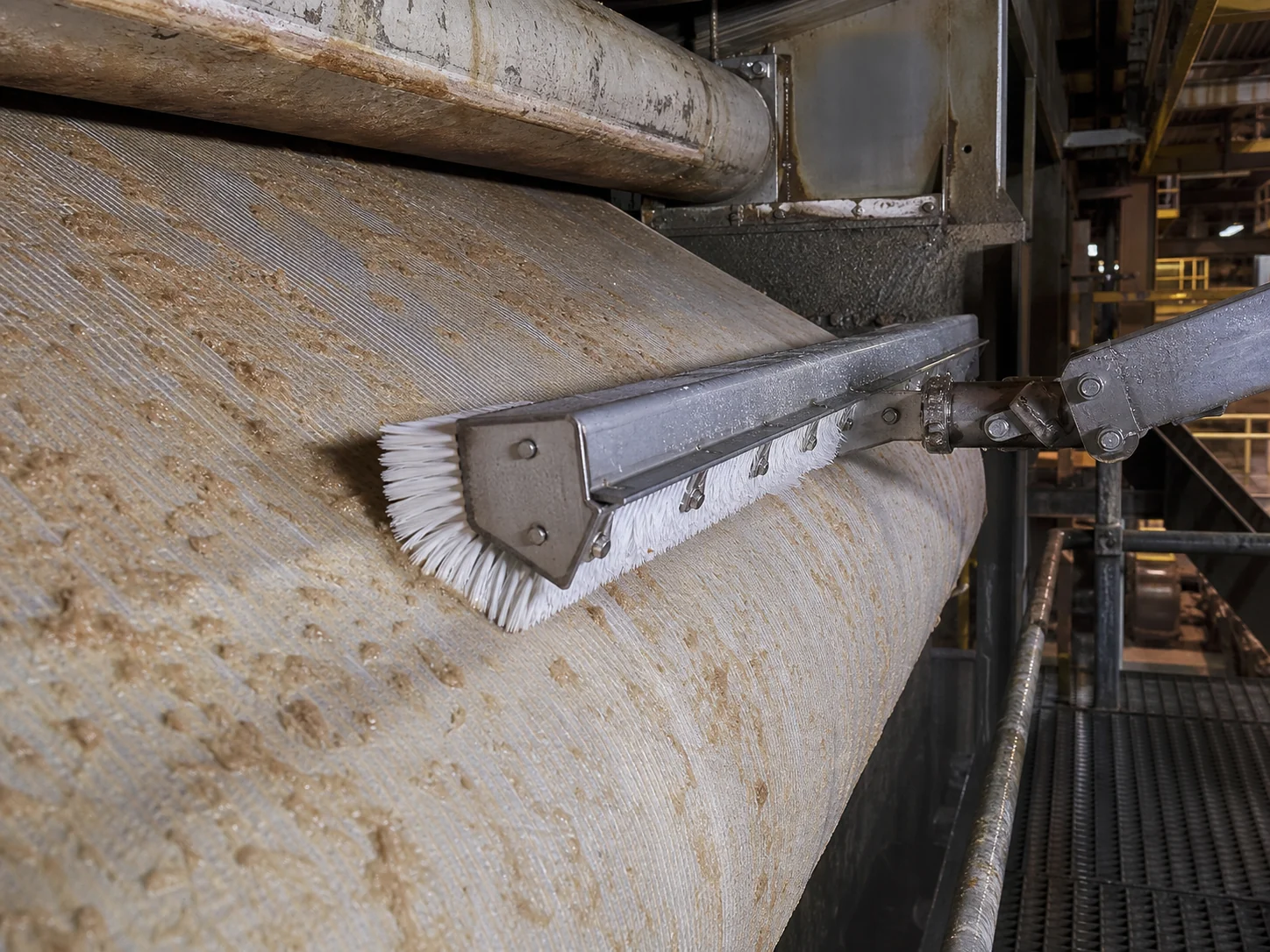
For Paper Machine Fabric Cleaning, the brush must reach the working area, disturb or collect pulp fibers/fillers/adhesive residue, and release it without creating unacceptable surface damage or process interference. Choose the brush structure from the available access, contact direction, and cleaning process.
At a glance
- Cleaning target
- Pulp Fibers/Fillers/Adhesive Residue
- Working environment
- Wet Indoor Area
- Cleaning method
- Wet Brushing
- Requirements to check
- Equipment-Maintenance SOP; Hydrolysis- and Chemical-Resistance Requirements
Paper machine fabrics are cleaned while running, so the brush has to open the weave from the correct side at machine speed without damaging the fabric it is there to protect.
What makes Paper Machine Fabric Cleaning different from other industrial and manufacturing cleaning?
The task is to remove Pulp Fibers/Fillers/Adhesive Residue while controlling surface damage, residue carryover, brush shedding and chemical or temperature degradation.
The work happens in wet indoor area against pulp fibers, fillers and adhesive residue.
The part people get wrong: the surface, the residue and the access opening decide the brush together. Fix on any one of them alone and the geometry comes out wrong.
What are the most common cleaning targets in Paper Machine Fabric Cleaning?
The work breaks into 5 targets. They look similar from outside the machine and behave nothing alike at the brush.
| Part or area | Residue type | Cleaning requirement |
|---|---|---|
| Forming-Fabric | Pulp Fibers, Fillers, Adhesive Residue | The head must reach the working face and apply even contact without marking the surface. |
| Press-Felt | ||
| Dryer-Screen | The tips must enter the apertures far enough to push lodged material back out, without wedging in the openings. | |
| Roll and Doctor-Area | The head must reach the working face and apply even contact without marking the surface. | |
| Edge and Seam | The brush must span the working width and hold even contact along the whole face while the surface moves under it. |
What the equipment leaves you to work inside:
| Parameter | Typical range |
|---|---|
| Contaminant | Pulp Fibers/Fillers/Adhesive Residue |
| Required hardness | Medium |
| Maximum temperature | 100°C |
| Chemical exposure | Water; Alkaline Cleaning Solution pH 9–12; Resin Cleaner |
| Cleaning method | Wet Brushing |
| Environment | Wet Indoor Area |
Which brush types work for each cleaning target?
Select hand, tube, strip, roller, disc or machine-mounted geometry from access and motion.
| Cleaning target | Recommended brush type | Why it fits |
|---|---|---|
| Forming-Fabric | Roller and Conveyor Brushes | A forming fabric has to keep draining, so a full-width brush is mounted against it to stop the drainage openings plugging with fines. |
| Press-Felt | A felt is compressible and cleaned while it runs, so a brush loaded lightly across the full width works fines out of the batt without crushing it. | |
| Dryer-Screen | A dryer screen plugs in the openings themselves, so the brush is sized for its tips to enter the mesh and push the fill back out. | |
| Roll and Doctor-Area | The doctor area is where sheet and coating build on the roll, so a brush riding the roll takes it off before it prints back into the sheet. | |
| Edge and Seam | The fabric edge and the seam carry the heaviest build-up, so a narrower brush is set at that band rather than treating the whole width the same. |
All five are machine-mounted brush rolls running against the fabric, normally with a shower above and a save-all beneath to carry off what they release.
In practical brush terms: match the construction to the access before anything else. A geometry that cannot reach the target will not be rescued by a better filament.
What filament materials work best for Paper Machine Fabric Cleaning?
PA66 is the working fill here — it recovers its bend after every pass across a moving fabric and holds up to alkaline resin cleaner at machine temperature.
| If the condition is… | Filament to start with | Why |
|---|---|---|
| Continuous passes across a moving fabric | PA66 Nylon | recovers its bend at machine speed |
| Alkaline resin cleaner at pH 9–12 | PA66 Nylon | holds up to the cleaner at fabric temperature |
What the duty rules out before you start comparing grades:
| Constraint | Value for this application |
|---|---|
| Filament hardness | Medium |
| Maximum service temperature | 100°C |
| Chemical exposure | Water; Alkaline Cleaning Solution pH 9–12; Resin Cleaner |
| Cleaning method | Wet Brushing |
How do I choose the right brush for my paper machine fabric equipment?
Start with medium fill, a 100°C ceiling and water, then size to fabric width and machine speed, working from the side the showers do not cover.
The sequence that gets a usable sample first time:
- Identify the target part and measure the access opening or clearance
- Describe the residue: what it is, how thick it sits, and how strongly it holds
- Choose the construction that can physically reach that target
- Set the filament from surface risk, working temperature and cleaning chemistry
- Fix filament diameter, free trim length and density for the contact pressure you need
- Run one cycle and check the result before committing to a production quantity
Before you commit to a quantity, send the fabric width, the machine speed, the shower arrangement, and which side the brush works from.
When is a paper machine fabric brush the wrong tool?
High-pressure oscillating showers are the primary fabric-cleaning method, with chemical boil-outs for deposits the showers do not shift. A fabric with a damaged seam or an opened weave is changed, because brushing accelerates the failure.
What common mistakes should I avoid in Paper Machine Fabric Cleaning?
- Specifying fabric width without machine speed and the side the brush has to work from
- Changing the filament while leaving excessive engagement, poor alignment or no discharge path unchanged
- Copying a worn brush without first recording its motion, direction, mounting and original working diameter
If the brush is already in service and the result is wrong, work from the symptom:
| Symptom | What to change |
|---|---|
| Residue remains | Increase discharge or relative motion before adding pressure |
| Surface marks | Reduce engagement and use finer/softer fill |
| Rapid wear | Check alignment, temperature and chemical attack |
| Redeposition | Add wash, vacuum or collection path |
Questions this page is asked
What must be identified before testing a contact brush on paper-machine fabric?
Define the machine section, fabric construction and side, speed, tension, temperature and dominant contaminant before selecting a contact system. A setting developed for a forming fabric, press felt or dryer fabric cannot be transferred to another section without a controlled engineering trial.
Which observations determine whether a paper-fabric cleaning trial is acceptable?
Compare the defined baseline and trial for deposit removal, fabric permeability or dewatering response, sheet defects, runnability, residual water, mist and fabric wear. Accept the process only within the mill's operating limits and inspect across the full machine width because a locally clean strip can hide nonuniform contact.
When must a paper-machine fabric brush be inspected offline?
Use the machine's isolated service condition for filament replacement, wrapped-fiber removal, alignment work or any inspection that enters a nip, drive or moving-fabric zone. Before restart, account for parts, restore guards, verify clearance and rotation, and complete the authorized low-risk functional check.
Guides that go deeper on this
No catalogue item for this yet
Every brush here is made to order, and this one has no catalogue entry so far. Send the working surface, the residue, the access opening and the quantity, and it is quoted through the same specification route as the rest of the range.
Custom Manufacturing RFQ
Discuss This Application
Share the working surface, residue, dimensions, material direction, interface, quantity and drawing or sample photo.
Custom Brush RFQ
Request a Custom Cleaning Brush Quote
Upload a drawing, product photo, or sample photo and provide the core dimensions and cleaning conditions.
“We need a brush to remove wet residue from a stainless steel conveyor, about 800mm wide. The current brush wears quickly. We can send photos.”
“We sell drinkware and need a cleaning brush to include with the product. Quantity around 5,000 pieces.”