
Custom Cleaning Brush
Cleaning Brush Paper Making
Filaments set so only the tips engage the moving fabric, clearing fiber, coating residue and pitch from formers, press felts, dryer fabrics and rolls.
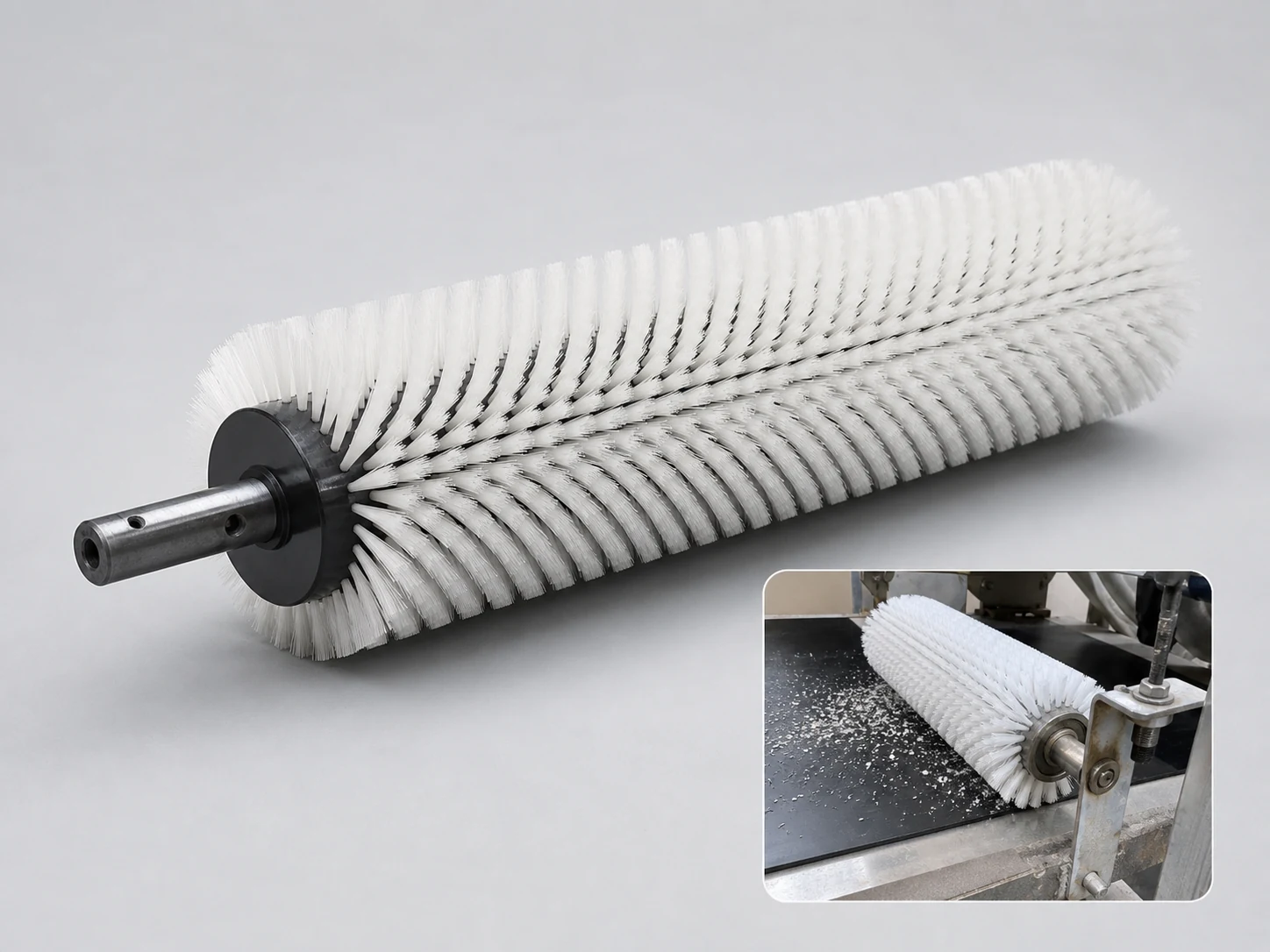
Large-format brush
100 pcs
Minimum order
Built one at a time on a core or channel: full-width rollers, sweeper brooms and long strip.
Production lead time, once the specification is confirmed
- Up to 100 pcsWithin 20 days
- 101–1,000 pcsWithin 30 days
- Over 1,000 pcsConfirmed with your quotation
Peak season can extend these times; the shipping date is confirmed in writing with your quotation. Sampling and shipping are quoted separately.
A configurable cleaning brush for paper machine formers, press felts, dryer fabrics, and rolls. It removes fiber, coating residue, and pitch with controlled filament-tip contact, and the holder, fill material, trim, and mounting are engineered to the exact position on your machine.
What can this brush do for you?
Controlled tip contact preserves fabric life
Filaments are set so only the tips engage the moving fabric or roll. That dislodges loose fibers and fines without the side scrubbing that abrades forming and dryer fabrics. The result is continuous surface cleaning during production runs, not fabric replacement.
Full-width coverage with no skipped lanes
Strip versions can be built to continuous working lengths up to 5,000 mm, and roller segments are butted at the joints to avoid untreated bands across the sheet width. The brush sweeps the entire cleaning zone instead of leaving fiber lines behind.
Fill material matched to section conditions
Wet-end positions run nylon PA for moisture and wear resistance. Dryer sections use PBT for heat and chemical stability. Delicate web-dusting positions can use horsehair, while hard roll surfaces accept abrasive nylon for built-up coating. The filament is chosen for the temperature, chemistry, and surface in that position.
Forms that mount to existing machine structure
Hand, strip, plate, roller, wheel, disc, and tube brushes are all possible configurations. Mounting can be adapted to existing doctor holders, bracket rails, bearing journals, or quick-clamp strips, so the new brush drops into the cleaning position you already have.
Replaceable fill keeps scheduled maintenance short
Strip brushes can be supplied as segmented sections and rotary brushes with refillable cores or replacement sleeve sections. When filaments wear flat or lose tip stiffness, you swap the fill rather than the whole assembly, which shortens shutdown time.
What is a Cleaning Brush Paper Making?
A cleaning brush for paper making is a custom-engineered brush that sits against or near a moving fabric, roll, or web surface on a paper machine and removes loose contaminants through controlled filament-tip contact. It may be a stationary strip bearing on a rotating roll or fabric, a rotating roller brush against a web, or a hand brush for local cleanup during maintenance.
The brush works by presenting many fine filament tips to the surface. The tips catch loose fibers, fines, coating particles, and pitch-like deposits and carry or flick them away as the surface moves. The key is that the contact load stays on the filament ends, not on the sides. That lets the brush clean continuously without scrubbing the weave or glazing the roll.
This is a surface-cleaning tool, not a scraping device. It removes material that is loose or lightly adhered. Thick scale, hard baked coating, or heavy pitch coatings should be handled by doctoring, showers, or other mechanical methods first. The cleaning brush finishes the job and keeps surfaces clear between washes.
Technical Specifications
The working dimensions below are configured per project. Use them as selection ranges, not fixed catalog values.
| Parameter | Configuration / Range |
|---|---|
| Brush form | Hand, strip, plate, roller, wheel, disc, or tube — selected from the actual cleaning zone and available mounting space |
| Working face / roller diameter | Roller diameter 25–800 mm; strip working length 100–5,000 mm (full-width or segmented); plate/disc dimensions set by the contact area |
| Trim length | 10–80 mm, adjusted to reach the fabric or roll without excessive filament deflection at line speed |
| Fill materials | Nylon PA6/6.6, PBT, PP, horsehair, or abrasive nylon — matched to temperature, moisture, chemical exposure, and surface sensitivity |
| Filament diameter | Nylon 0.05–1.2 mm; PP 0.07–2.0 mm; PBT 0.15–0.2 mm; horsehair and abrasive grades specified by application |
| Fill pattern / density | Straight, offset, spiral, or cluster tufting to provide steady coverage and let debris release from the fill |
| Holder / core / shaft | Steel, stainless steel, aluminum, or polymer; tube, channel, plate, or shaft with end fittings to match the existing mounting |
| Operating environment | Wet-end moisture, elevated dryer-section temperatures, and chemical exposure handled through filament and holder material grade |
| Contact configuration | Controlled filament-tip engagement only; engagement depth is set against actual surface speed, fabric tension, and residue type |
| Mounting interface | Doctor-holder brackets, rail clamps, bearing journals, keyed shafts, or quick-clamp strips — specified to fit the existing machine position |
| Brush type | Custom Roller and Conveyor Brushes |
| How it is driven | Machine-driven, mounted in the equipment |
| Cleaning target | forming section, coating and size press, and converting and winding cleaning |
| Surface or part | rolls, sheets, roller, edges, webs, forming fabrics, tubes, and joints |
| Residue or debris | fiber, loose fibers, coating residue, fines, pitch, scale, particles, and filler |
| Mounting / connection | Doctor-holder brackets, rail clamps, bearing journals, keyed shafts, or quick-clamp strips — specified to fit the existing machine position |
Where does this brush work best?
- Forming section: Cleaning the return run of forming fabrics and wire to remove fibers, filler fines, and stickies before they re-enter the forming zone.
- Press section: Keeping felt surfaces open and press rolls free of fiber bundles, coating carryback, and sheet-edge debris.
- Dryer section: Cleaning dryer fabrics and roll surfaces where heat-stable PBT or nylon fill removes loose fibers and pitch-like deposits before they mark the sheet.
- Coating and size press: Removing coating residue, lumps, and edge trim from transfer rolls and backing rolls to prevent streaks and sheet breaks.
- Converting and winding: Dusting the sheet or removing edge fibers and loose lint at the winder or sheet cutter before final product packaging.
How do I choose the right one?
Begin with the section of the machine and the surface you need to clean. Fabrics cannot take side scrubbing or heavy filament pressure, while hard roll surfaces can accept stiffer or abrasive fill. Then match the fill material to the operating conditions.
| Condition at the cleaning point | Recommended fill | Reason |
|---|---|---|
| Wet end, moisture, loose fiber | Nylon PA | Good wet strength and abrasion resistance for continuous fabric cleaning. |
| Dryer section heat and chemistry | PBT | Retains stiffness at elevated temperature and resists common dryer-section chemicals. |
| Delicate web or dusting position | Horsehair | Soft, fine tips remove loose particles without marking the sheet. |
| Hard roll with built-up coating | Abrasive nylon | Adds light cutting action for attached residue on steel or hard rubber rolls. |
| Steel roll only, heavy scale | Wire (with caution) | Never use wire on forming or dryer fabrics; only on solid metal rolls where scratching is acceptable. |
After the fill material, confirm the mounting and contact space. Measure the gap between the brush holder and the surface, the available bracket pattern, and the fabric or roll width. Full-width strip brushes are the usual choice for fabric return runs; rotary roller brushes throw debris away from the sheet path and are easier to collect from. Choose the longest trim that still stays upright at your line speed — too long a trim will fold over and scrub with the filament sides.
If the deposit is thick scale or hard baked coating, a cleaning brush is the wrong tool. Use a doctor blade or high-pressure shower to break the deposit first. If the surface is a forming or dryer fabric, do not substitute wire fill. If the cleaning zone is a narrow internal passage rather than an open run, a tube brush may be the only form that fits.
Can I customize this brush?
Yes. Every paper machine position has its own width, clearance, temperature, and residue mix, so the brush is configured to the job rather than selected from a fixed catalog. Provide the machine section, fabric or roll type, width, line speed, temperature, moisture or chemical exposure, available mounting, and a drawing or sample of the current brush if one exists.
We can adjust:
- Brush form and working dimensions — strip, roller, tube, plate, disc, wheel, or hand-held; working length, diameter, face width, and trim length set for the cleaning zone.
- Filament system — material, diameter, trim, density, tuft pattern, and tip treatment for the residue and surface.
- Holder, core, and end fittings — steel, stainless steel, aluminum, or polymer; brackets, journals, keyways, quick clamps, and segmented joints matched to the machine.
- Color and marking — position coding, mill identification, pad print or laser marking on holders.
- Packaging — bulk, crate, individual section wrapping, or project-specific packing for shutdown delivery.
If your project also requires material documentation, installation drawings, inspection records, or third-party testing support, we can arrange that as part of the custom order.
Which filament belongs on a cleaning brush paper making, and how is that verified?
How can I tell whether the filament tips are contacting the fabric at the right pressure?
Run the brush for one shift, then stop and inspect the tips under a light. The tips should show light even rounding with no sideways bend. If the filament sides are polished or the holder area shows wear, contact is too heavy. If the tips are untouched but residue remains, engagement is too light or the trim is too short.
What should I check before installing the brush on the paper machine?
Confirm the holder is parallel to the roll or fabric axis, there is no interference with fabric seams, sheet edges, or fasteners, and rotary brushes turn in the direction that throws debris toward your collection point. Check that quick-clamp ends are fully seated before restarting the section.
Does this brush replace high-pressure showers or doctoring?
No. The brush dislodges and carries away loose material. Showers rinse fine particles and keep the fabric open. Doctors scrape heavy or attached deposits. These tools work in sequence: scrape, brush, rinse. Skipping the brush step often leaves shower nozzles plugging or fabric void volume loss.
Which brush form works best for a dryer fabric versus a dryer roll?
A fixed full-width strip brush bearing on the fabric return run cleans the entire fabric width with minimal moving parts. A rotating roller brush against a roll can throw detached fibers and coating particles clear of the sheet path and is easier to connect to a collection hood. Use the strip on fabrics, the roller on rolls.
How do I inspect the brush during scheduled maintenance?
Look for flat-sided filaments, missing tufts, rust or corrosion on the holder, and movement at the end fittings. Uneven tip wear across the width usually means the holder is out of parallel or the density is wrong for that position. Any of these findings should trigger replacement or re-alignment before the next production run.
When should I avoid horsehair and switch to PBT or nylon?
Use horsehair only in low-temperature, dry, or very delicate positions. In wet-end conditions with continuous moisture, or in dryer sections with sustained elevated temperatures and chemical exposure, horsehair loses shape and breaks down quickly. Switch to nylon for wet-end durability or PBT for heat and chemical resistance.
Guides that go deeper on this
Custom Manufacturing RFQ
Describe Your Application
To quote this brush accurately, send the size, material, cleaning target, residue, quantity, and any available drawing or sample photo.
Drawing or photo optional — it speeds things up, it does not gate the enquiry.
Custom Brush RFQ
Send Your Brush Project
Upload a drawing, product photo, or sample photo and provide the core dimensions and cleaning conditions.
“We need a brush to remove wet residue from a stainless steel conveyor, about 800mm wide. The current brush wears quickly. We can send photos.”
“We sell drinkware and need a cleaning brush to include with the product. Quantity around 5,000 pieces.”