
Custom Cleaning Brush
Nylon Brush Roller Paper Making
Rotating nylon brush rollers for paper machine forming fabrics, press felts, dryer screens and rolls. Working widths 200–5,000 mm; custom core and fill.
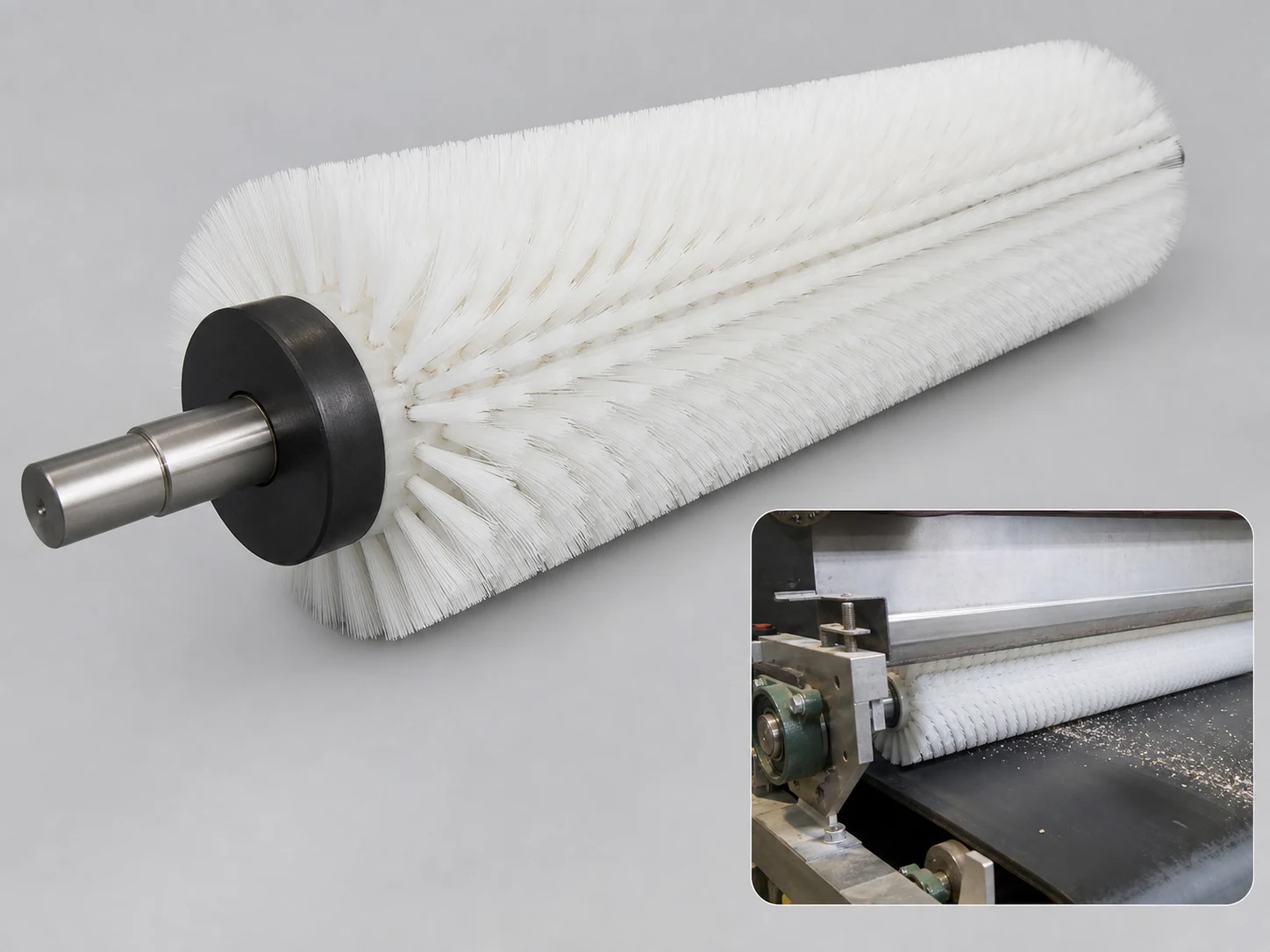
Large-format brush
100 pcs
Minimum order
Built one at a time on a core or channel: full-width rollers, sweeper brooms and long strip.
Production lead time, once the specification is confirmed
- Up to 100 pcsWithin 20 days
- 101–1,000 pcsWithin 30 days
- Over 1,000 pcsConfirmed with your quotation
Peak season can extend these times; the shipping date is confirmed in writing with your quotation. Sampling and shipping are quoted separately.
A rotating nylon-filled brush roller engineered for continuous cleaning of paper machine forming fabrics, press felts, dryer screens, and web-contact rolls. The nylon filament face removes paper fibers, fines, stickies, and process deposits across the full working width with consistent mechanical contact and without hand brushing.
What can this brush do for you?
Continuous full-width cleaning in one pass
A driven brush roller spans the entire working face of the fabric, felt, screen, or roll, so every point across the machine width receives the same rotating filament contact on every pass. There are no manually brushed lanes, skipped edges, or uneven wear zones, and the cleaning rate follows line speed instead of operator availability.
Nylon fill that keeps its shape in wet and chemical conditions
Nylon PA filament retains flex recovery and tip contact under moisture, papermaking pH, and routine wash chemicals. It does not corrode like steel fill, so wet-end and press-section brushes keep a uniform working face instead of rusting, breaking, or losing tip pressure after short service.
Penetration matched to fabric or roll surface
Trim length, filament diameter, and fill density are set to the contact target. Longer, finer filament tips work into forming fabric and felt interstices to lift embedded fibers and fines; shorter, denser fill scrubs roll faces and dryer screens without catching seams or wrapping. The same roller family can be configured for multiple positions.
Balanced core for wide machines and higher line speeds
The core, shaft, and fill are dynamically balanced so tip pressure stays even from edge to edge. This reduces shaft deflection, bearing load, and vibration across wide paper machines and helps every filament row do the same amount of work.
Predictable wear instead of fabric damage
Nylon tips deflect around fabric knuckles, seams, and surface irregularities. Filament loss is gradual and measurable, so maintenance can be scheduled from wear instead of unplanned fabric damage or sheet defects caused by broken metal fill.
What is a Nylon Brush Roller Paper Making?
A nylon brush roller for paper making is a cylindrical brush assembly mounted on a driven shaft and installed across a paper machine or converting line. The outer face is filled with nylon filament in a spiral, straight, or staggered pattern, and the roller rotates so the filament tips sweep the moving forming fabric, press felt, dryer screen, or roll surface to dislodge attached material.
In a paper machine, the brush is normally part of a cleaning loop rather than a standalone solution. It performs the mechanical work of loosening fibers, fines, fillers, stickies, pitch, coating residue, or dust. Showers or air systems then carry loosened material away, and vacuum or drainage systems remove it. The brush keeps contact surfaces clean so dewatering, doctoring, coating, and heat-transfer components can work properly.
This is an engineered machine element, not a hand brush. It is specified by face width, outside diameter, core and shaft design, trim length, filament grade, fill density, rotation direction, and operating speed. The wrong combination may clean poorly, overload the drive, or wear the fabric.
Technical Specifications
The values below are standard project ranges for nylon brush rollers used in paper machine cleaning positions. Dimensions, fill pattern, and mounting details are confirmed against your machine layout before production.
| Parameter | Value / Options |
|---|---|
| Brush form | Cylindrical nylon roller brush, straight or spiral fill |
| Working width / face length | 200–5,000 mm, matched to fabric or roll face |
| Overall outside diameter | 80–350 mm |
| Core diameter | 20–200 mm, sized for stiffness and deflection control |
| Trim length | 10–80 mm, selected for fabric penetration or roll scrubbing |
| Filament material | Nylon PA6 or PA6.6, untreated, heat-stabilized, or anti-static grade |
| Filament diameter | 0.15–0.80 mm, finer for forming fabric, heavier for dryer screens |
| Fill pattern | Spiral, chevron, straight row, or staggered; density set per application |
| Core / shaft | Carbon steel, 304/316 stainless steel, aluminum, or composite; through-shaft or stub shaft |
| Mounting interface | Bearing journals, keyed shaft, flange, or coupling per existing drive |
| Rotation and speed | Direction and tip speed set to line speed and cleaning position |
| Operating environment | Wet end, press, dryer, size press, coater, or converting; specify temperature, pH, and chemicals |
| Brush type | Custom Roller and Conveyor Brushes |
| How it is driven | Machine-driven, mounted in the equipment |
| Cleaning target | forming section, return roll, and size press cleaning |
| Surface or part | roller, forming fabrics, screens, rolls, webs, sheets, edges, and seams |
| Residue or debris | fiber, fines, dust, filler, pitch, paper fibers, process deposits, and starch |
| Mounting / connection | Bearing journals, keyed shaft, flange, or coupling per existing drive; Direction and tip speed set to line speed and cleaning position |
Where does this brush work best?
Each position has a different contact surface and residue, so the roller is configured to the section rather than used as one universal design.
- Forming section: cleaning forming fabric or wire before it returns to the forming loop. Removes fiber, fines, and filler trapped in the mesh, helps maintain drainage, and reduces pinholes and sheet marking.
- Press section: conditioning press felts and pick-up felts by lifting the surface fiber and filler mat, often in combination with high-pressure showers. The brush keeps felt voids open so water removal remains stable.
- Dryer section: brushing dryer fabrics and screens to control stickies, dust, and fiber deposits that can mark the sheet or lower heat transfer.
- Guide, spreader, and return rolls: preventing fiber and dust buildup on roll surfaces that causes wrinkles, web breaks, or transfer defects.
- Size press, coater, and calender areas: gentle removal of starch, coating, and soft residues from rolls where a doctor blade would be too aggressive.
- Converting and finishing lines: corrugators, sheeters, winders, and folder-gluers where paper dust, trim debris, and edge fiber must be removed continuously from web contact points.
How do I choose the right one?
Start with the contact target: fabric or roll
For forming fabrics and press felts, the filament tips should enter the surface openings. Choose a longer trim with finer filament and moderate density so individual tips work into the mesh instead of bridging across the knuckles. For roll faces and dryer screens, choose shorter trim with higher density, which puts more working tips on the surface and avoids catching or wrapping.
Set the width and support from the machine
Measure the fabric or roll face, bearing center distance, and available clearance above the surface. Core diameter and material must be large enough to control deflection across full width. If a wide machine creates excessive sag, split rollers or intermediate support should be considered instead of increasing core weight beyond the drive capacity.
Match the nylon grade and filament diameter to the environment
PA6.6 is stiffer and more heat-resistant than PA6, heat-stabilized nylon is preferred in dryer sections, and anti-static or conductive grades help control dust accumulation in dry-end positions. Finer filaments protect fine forming fabric mesh; heavier filaments provide more aggressive action on press felts and dryer screens. Wet operation softens nylon slightly through moisture absorption, so wet-end trim and diameter are not always interchangeable with dry-end settings.
Relate tip speed to line speed
A tip speed slightly different from fabric or web speed creates a wiping differential. Too little differential produces weak cleaning; too much differential increases heat, filament wear, and drive load. Confirm rotation direction so the tips do not work edge-on into a fabric seam or roll surface irregularity.
When a different material or method is the better choice
Use a non-nylon or more aggressive filament when the residue is hardened mineral scale, cured pitch, tar, baked-on coating, or heavy adhesive buildup that nylon only polishes. For those deposits, steel wire, brass wire, or abrasive-filled nylon usually performs better. If the job is only airborne dust removal, an air knife or vacuum system may be more practical. If operating temperature exceeds the selected nylon grade’s continuous limit, polyester or PBT fill may be a better match.
Can I customize this brush?
Every nylon brush roller for paper making is built to the machine position, not taken from shelf stock. Share the face width, bearing centers, existing core or shaft dimensions, rotation direction, line speed, fabric or roll type, residue, and operating temperature. A dimensional drawing or the worn roller itself speeds up engineering.
We can adjust:
- Roller geometry: overall diameter, working width, core diameter, trim length, end journal dimensions, and strip or channel fill construction.
- Nylon fill: PA6 or PA6.6, heat-stabilized, anti-static, or colored identification filament; straight or crimped filament; filament diameter, fill density, spiral pitch, chevron direction, or straight rows.
- Core and shaft: carbon steel, stainless steel, aluminum, or composite; through-shaft or stub shaft; keyways, flats, set screws, and machined journals.
- Mounting and drive interface: bearing journals, flanges, sprocket or pulley ends, couplings, and rotation arrows.
- Balance and speed rating: dynamic balancing to the required grade and marking the maximum operating speed on the core.
- Marking and packaging: project numbers, position labels, protective filament wrapping, and export crates for long rollers.
- Project support: material declarations, dimensional inspection, and third-party testing can be arranged when your project requires them.
Which filament lasts longest on a nylon brush roller paper making?
Should the brush run with or against fabric travel?
Usually against the fabric travel direction so the tips shear deposits away rather than sliding over them. Follow the machine supplier’s setting for the specific position, and make sure the roller has a clear rotation arrow. Running the tips edge-on into a fabric seam can hook and tear filaments.
How do I know whether the trim length is correct for a forming fabric?
Check filament tip wear after a short run. If wear appears only on the outer end of the tips and the fabric still shows embedded fines between knuckles, the trim is too short or the bristle is too stiff. If filaments flatten and the fill packs with fibers, the trim is too long or the density is too high for the fabric structure.
Does this roller brush need a shower to work?
In wet-end and press positions, a shower improves cleaning and extends filament life because the brush loosens material and the water carries it out of the fabric structure. Dry-end dust removal can work without a shower, but a periodic air blow-off or vacuum pickup keeps the brush face from packing with fine dust.
What should be checked when installing a new roller brush?
Check shaft runout, bearing seating, and the full-width clearance between the brush face and the fabric or roll. Rotate the roller by hand before start-up to confirm there is no end-collar interference and that the filament tips only make design contact. After start-up, inspect the fabric or roll for marks and look for uneven filament wear across the width.
Can a worn roller be reconditioned?
Yes, in most cases the roller can be re-filled or re-trimmed if the core and shaft are still straight and undamaged. The existing mounting interface can be reused, and the fill can be updated to a revised trim or filament grade at the same time. Reconditioning is often faster than replacing the complete assembly.
When is a brush with stainless steel or wire fill the better option?
If the deposit is mineral scale, heavy pitch, or cured adhesive that nylon is not removing, a steel or brass wire roller may be required. Nylon is the right choice for fiber, fines, stickies, soft deposits, and fabric-safe cleaning; it is not a substitute for aggressive mechanical cleaning where surface damage is acceptable.
Guides that go deeper on this
Abrasive Nylon Grit and Filament Selection
Read this guideGuideBrush Roller Conveyor Mistakes with Dry Dust
Read this guideGuideBrush Speed, Engagement, and Heat
Read this guideGuideConveyor Belt Cleaning Brush Design
Read this guideGuideFloor Scrubber Brush Selection: Disc Brush vs Roller Brush
Read this guideCustom Manufacturing RFQ
Describe Your Application
To quote this brush accurately, send the size, material, cleaning target, residue, quantity, and any available drawing or sample photo.
Drawing or photo optional — it speeds things up, it does not gate the enquiry.
Custom Brush RFQ
Send Your Brush Project
Upload a drawing, product photo, or sample photo and provide the core dimensions and cleaning conditions.
“We need a brush to remove wet residue from a stainless steel conveyor, about 800mm wide. The current brush wears quickly. We can send photos.”
“We sell drinkware and need a cleaning brush to include with the product. Quantity around 5,000 pieces.”