
Custom Cleaning Brush
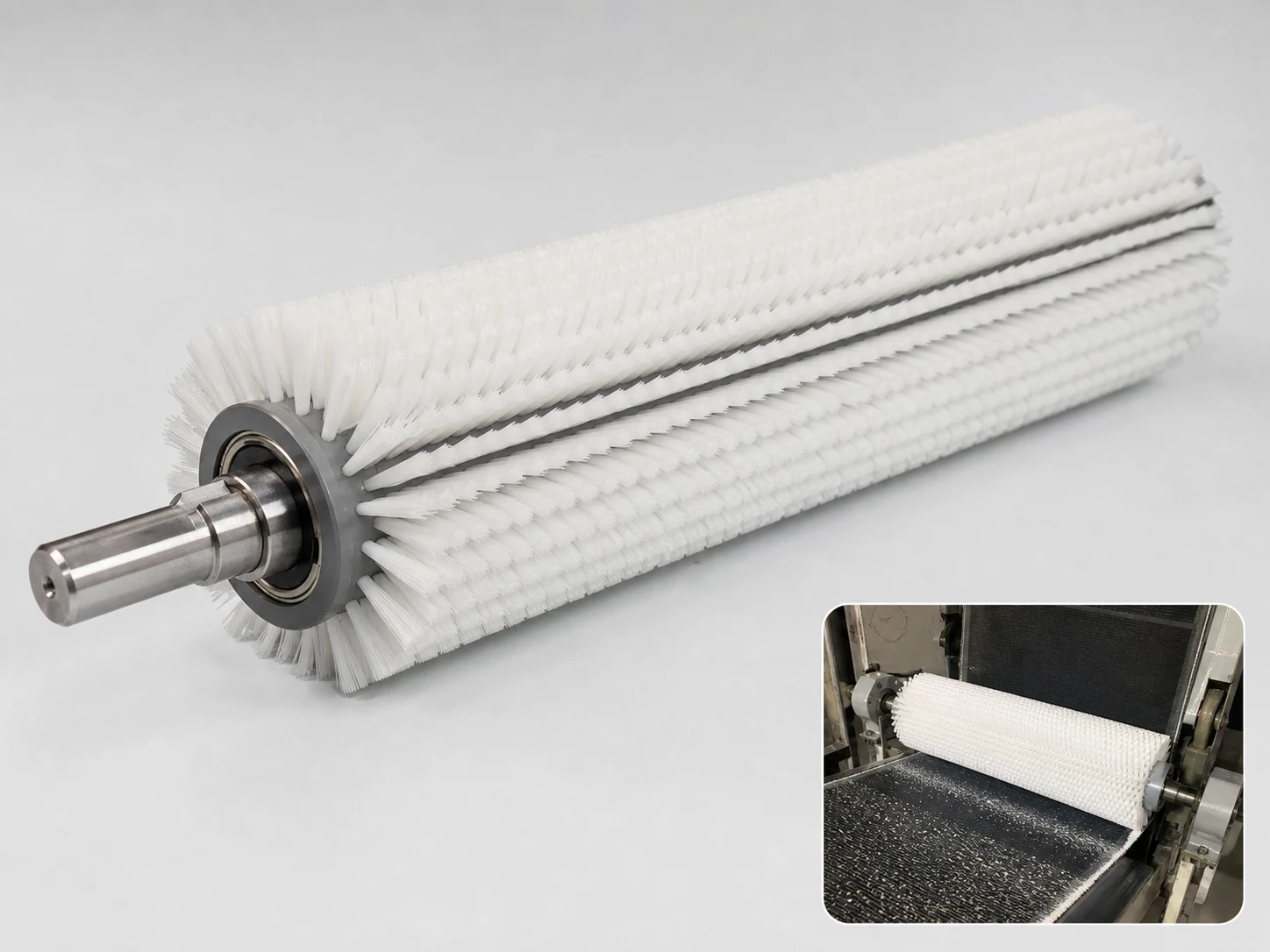
Nylon Roller Brush
Custom nylon roller brushes for conveyor, web, and production-line cleaning. Nylon PA filament, 35–600 mm diameter, 100–3000 mm working length.
Large-format brush
100 pcs
Minimum order
Built one at a time on a core or channel: full-width rollers, sweeper brooms and long strip.
Production lead time, once the specification is confirmed
- Up to 100 pcsWithin 20 days
- 101–1,000 pcsWithin 30 days
- Over 1,000 pcsConfirmed with your quotation
Peak season can extend these times; the shipping date is confirmed in writing with your quotation. Sampling and shipping are quoted separately.
A continuous-contact cleaning solution for conveyor and production lines. This cylindrical roller brush uses nylon PA filament fill to remove powder, crumbs, fibers, chips, oil, labels, film fragments, and sticky carryback from belts, rollers, chains, rails, transfer points, web paths, and machine guides.
What can this brush do for you?
Full-width, continuous contact for inline cleaning
The cylindrical construction places filament across the entire working length, so cleaning happens on every inch of substrate that passes. No operator needs to stop the line or manually scrub because the brush works continuously while the conveyor or web moves.
Nylon PA filament scrubs without scratching
Nylon filaments are stiff enough to dislodge dried powder, chips, and film fragments yet compliant enough to avoid gouging metal, plastic, or coated surfaces. The filament tips flex, then spring back, maintaining contact without digging into your equipment.
Open fill patterns keep debris moving
Full, spiral, or tufted fills can be specified to match the debris. Spiral and tufted patterns create channels that let loose particles fall or be flung away instead of packing into the brush face, reducing re-deposition on the line.
Matched to your machine, not a compromise
Working length, roller diameter, core diameter, trim length, shaft ends, and fill pattern are built from your machine drawing. The brush drops into the existing mount and follows the original contact geometry, so you don’t modify the line to fit a brush.
Long flex life under repeated loading
Nylon PA resists fatigue and maintains filament shape over millions of contact cycles. Unlike some natural or lower-cost plastics, it does not permanently flatten quickly, keeping cleaning effective between scheduled replacements.
What is a Nylon Roller Brush?
A Nylon Roller Brush is a cylindrical brush with nylon PA filaments anchored radially around a central core, mounted on a shaft or journals, and used to contact a moving surface for cleaning, dusting, wiping, or product positioning. It is typically mounted across a conveyor belt, web path, or machine guide, either as a stationary brush that the substrate passes over, or as a driven brush that rotates against the product.
The brush works by filament tip contact: as the surface moves, nylon filaments sweep, wipe, or scrub off loose and lightly adhered debris. The brush can be run dry for dust and powder, or with light moisture for sticky residues, depending on the environment. It is not a paint roller or hand tool; it is an industrial component designed to integrate into production equipment.
This product is typically used as a replacement part for OEM cleaning stations, or as a new installation for lines that need continuous contact cleaning. Key operating considerations include filament engagement depth, rotation direction relative to substrate travel, and environmental conditions such as temperature and humidity because nylon’s stiffness changes with moisture absorption.
Technical Specifications
The specifications below are the working envelope for a custom Nylon Roller Brush. Final dimensions are confirmed from your machine drawing and application data.
| Parameter | Value / Options |
|---|---|
| Brush form | Cylindrical roller brush |
| Fill material | Nylon PA (PA6, PA66, PA612, or application-specific grade) |
| Roller diameter | 35–600 mm, matched to mount space and contact requirements |
| Working length | 100–3000 mm, custom to substrate width |
| Core diameter | 10–50 mm, based on rigidity and shaft interface |
| Trim length | 10–100 mm, from core surface to filament tip |
| Filament diameter | 0.15–1.50 mm, selected for scrubbing force vs. surface sensitivity |
| Fill pattern | Full, spiral, tufted, or custom tuft spacing |
| Shaft / journals | Through-shaft, stub shafts, bored core, keyway, or custom end features |
| Core material | Steel, stainless steel, aluminum, or engineering plastic |
| Operating temperature | Ambient to about 100°C dry; higher temperatures may require alternative material |
| Moisture sensitivity | Nylon absorbs moisture and softens slightly; stabilized or coated grades available |
| Brush type | Custom Roller and Conveyor Brushes |
| How it is driven | Machine-driven, mounted in the equipment |
| Cleaning target | conveyor belt, roller and pulley, and web path cleaning |
| Surface or part | roller, conveyors, webs, belts, machine guides, web paths, chains, and rails |
| Residue or debris | powder, chips, fiber, crumbs, dust, film fragments, oil, and sticky carryback |
| Mounting / connection | Shaft ends, bearing journals, keyed shaft, set-screw bore, flange, or customer drawing; Free-running or motor-driven; direction, speed, and balancing set from installation |
All dimensions and materials can be changed to suit the specific conveyor, web, or machine. If you have an existing brush drawing or a failed sample, we can match the critical fit dimensions first and then adjust filament for the cleaning duty.
Where does this brush work best?
These are the production environments where a nylon roller brush fits the cleaning job well:
- Conveyor belt cleaning – removing carryback, crumbs, powder, and product buildup from the belt surface or return side before it reaches rollers or pulleys.
- Roller and pulley cleaning – wiping drive rollers, idler rollers, and guide rollers where debris causes tracking errors or uneven tension.
- Web path cleaning – dusting and wiping film, paper, foil, and textile webs in printing, packaging, coating, and laminating lines.
- Chain and rail cleaning – sweeping chips, lubricant carryover, and particles from chain links, guide rails, and linear motion surfaces.
- Transfer point cleaning – preventing material accumulation where product transfers between conveyors or into filling, scanning, or inspection stations.
- Machine guide cleaning – keeping linear guides, tracks, and slides free of fibers and dust that cause jamming or misalignment.
Nylon is the right choice when the residue is loose to lightly adhered and the surface must not be scratched. For heavy scale, weld spatter, or burnt deposits, a wire or abrasive roller is more appropriate.
How do I choose the right one?
Selecting a nylon roller brush is a matter of matching the brush to the machine, the surface, and the debris. The following steps will narrow the configuration.
Start with the machine fit
Measure the space available for the brush: roller diameter that will fit between obstructions, working length that covers the full substrate width, core diameter that fits your shaft or bearing mounts, and the shaft/journal details from the existing mounting. If replacing an existing brush, send us the old part or the machine drawing; we can reverse-engineer the fit.
Match the filament to the residue
For fine powder, dust, and light fibers, use a smaller filament diameter (0.15–0.40 mm) with higher density for soft contact and complete coverage. For chips, film fragments, and sticky carryback, use a larger filament diameter (0.50–1.50 mm) with lower density or an open pattern so debris can release. Nylon PA works well dry and in moderate humidity; if the line runs wet with water or oil, specify a moisture-stabilized grade or consider polypropylene or polyester for better wet stiffness.
Choose the fill pattern for the cleaning action
- Full fill – maximum filament density for complete sweeping contact; best for fine dust and surface wiping.
- Spiral fill – continuous diagonal pattern that guides debris to one side; ideal for self-cleaning on conveyors.
- Tufted fill – discrete tufts with channels between them; good for sticky or thick debris that would clog a dense brush face.
Confirm the operating conditions
Check the highest temperature at the cleaning point, the presence of water, oil, or cleaning chemicals, and the expected contact pressure. Nylon softens above about 100°C dry and absorbs moisture, which reduces stiffness slightly. If the environment exceeds these limits, choose a polypropylene, polyester, Tampico, or wire brush instead. Nylon is also not recommended for highly abrasive environments where grit will strip the filament quickly; in that case, abrasive-filled nylon or metal filament may last longer.
When nylon is not the right choice
Use a steel or stainless steel wire roller brush for heavy scale, rust, weld cleanup, or very high temperatures. Use a natural fiber or Tampico roller for very soft surfaces or gentle polishing. Use a channel or spiral brush for removal of large debris that needs directed ejection. Nylon is the best balance of stiffness, resilience, and surface friendliness for general production-line cleaning.
Can I customize this brush?
Yes. Every nylon roller brush we build is produced to order from your machine and process data. To start, provide the following: machine type, location of the brush, substrate width and speed, residue type and amount, environment (temperature, moisture, chemicals), existing brush dimensions or drawing, and any mounting photos.
Based on that, we can adjust:
- Geometry – roller diameter, working length, overall length, core diameter, trim length, and any step or taper in the profile.
- Filament – diameter, material grade (PA6, PA66, PA612, abrasive-filled, conductive), color, length, density, and pattern (full, spiral, tufted, custom spacing).
- Core and shaft – core material (steel, stainless steel, aluminum, plastic), shaft-through or stub journals, keyways, drive sprockets, pulleys, or end caps.
- Interface – bearings, flanges, threaded ends, set-screw locking, or custom mount features to match your existing holders.
- Marking and packaging – part number marking, barcode labels, individual poly bags, bulk cartons, or custom packaging for installation kits.
If your project requires material documentation, inspection reports, or third-party testing for food contact, conductivity, or other specifications, we can support those requirements during the quoting and engineering phase.
Which filament survives the cleaning and still lasts on a nylon roller brush?
How do I know if a nylon roller brush will fit my machine without seeing it in person?
Send us the existing brush, the machine drawing, or a dimensioned sketch of the mounting area. The critical fit points are: distance between bearing centers, shaft diameter, available roller diameter clearance, and working length relative to the substrate width. If you can provide photos of the brush installed, that also helps.
What is the difference between a full fill and a spiral fill for conveyor cleaning?
A full fill gives the densest filament coverage and the most uniform sweeping contact, which is best for fine dust or light film. A spiral fill uses a continuous diagonal pattern that channels debris toward the edge of the roller, so larger particles and sticky carryback don’t pack into the brush face. Choose full fill for maximum contact, spiral for self-cleaning with heavier debris.
Can this brush run in a wet or washdown environment?
Standard nylon absorbs moisture and becomes slightly softer, but it will still clean. For continuous wet use, specify a moisture-stabilized nylon grade or consider a polypropylene or polyester brush that keeps stiffness in water. Let us know the cleaning chemicals used, because some acidic or alkaline solutions can degrade nylon over time.
How can I tell when the brush needs replacement?
Inspect for filament wear, flattening, or permanent bending. If the filament tips no longer contact the substrate evenly, or if cleaning performance drops while the machine is unchanged, the brush is worn. Also check the core for cracks or corrosion, and the shaft for runout. Replacement is due when filament length has shortened by about 25–30% from the original trim, or when tufts pull out.
Does the brush need any special maintenance?
No special maintenance is required. Keep the brush clean of accumulated debris that doesn’t release, check shaft alignment periodically, and ensure the brush rotates or is positioned correctly. If debris packs into the filament face, clean it with compressed air or a stiff hand brush — not with solvents that may damage nylon.
What is the maximum operating temperature for a nylon roller brush?
Continuous dry use is typically fine up to about 100°C, but nylon begins to soften and lose stiffness above that. If the cleaning location is hotter, choose a material like polypropylene (up to ~100°C), polyester (up to ~130°C), or stainless steel wire for higher temperatures. Also consider that heat plus load accelerates filament deformation.
Guides that go deeper on this
Custom Manufacturing RFQ
Describe Your Application
To quote this brush accurately, send the size, material, cleaning target, residue, quantity, and any available drawing or sample photo.
Drawing or photo optional — it speeds things up, it does not gate the enquiry.
Custom Brush RFQ
Send Your Brush Project
Upload a drawing, product photo, or sample photo and provide the core dimensions and cleaning conditions.
“We need a brush to remove wet residue from a stainless steel conveyor, about 800mm wide. The current brush wears quickly. We can send photos.”
“We sell drinkware and need a cleaning brush to include with the product. Quantity around 5,000 pieces.”