
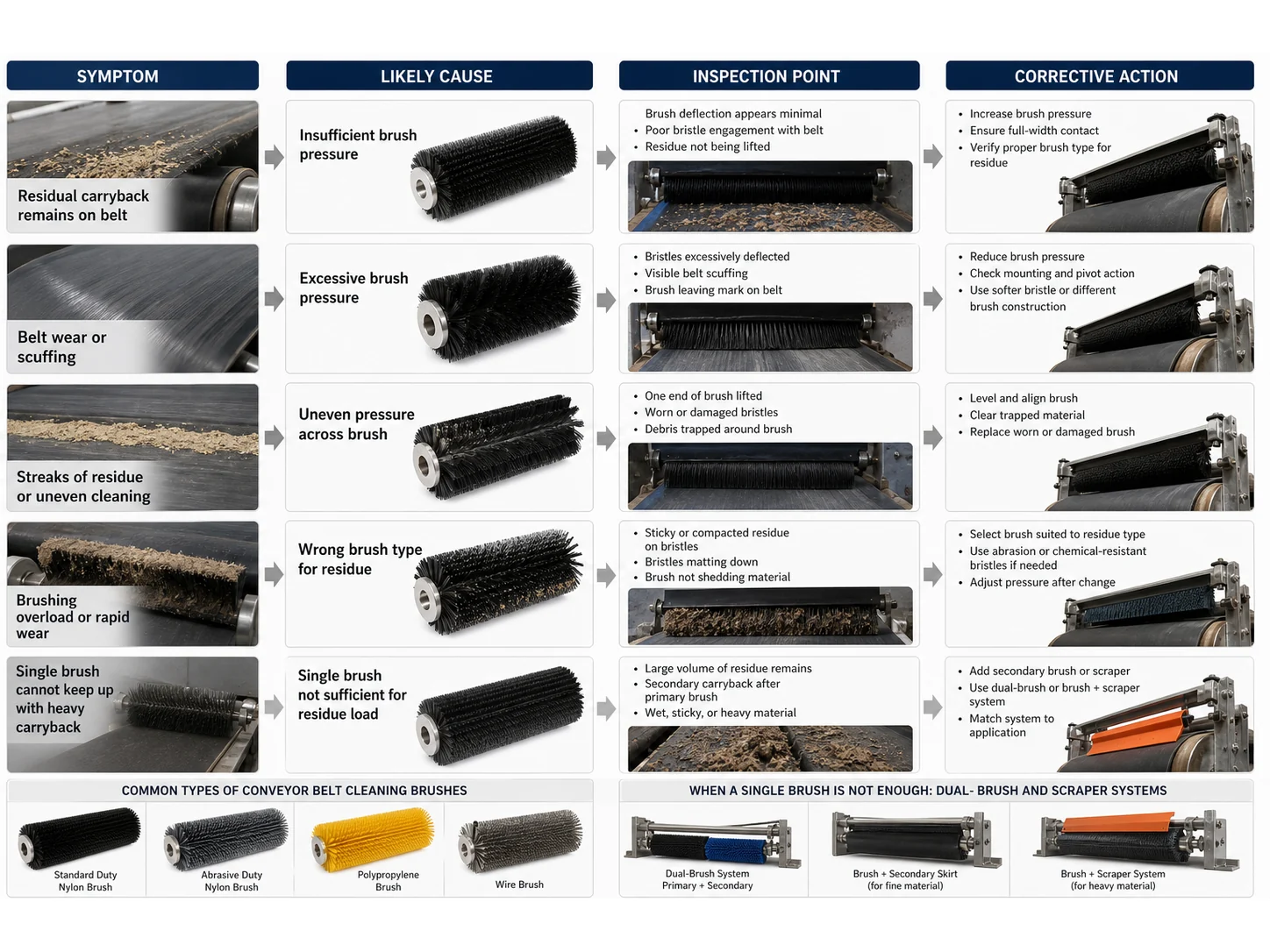
What Is Conveyor Brush Pressure?
Conveyor brush pressure is the force per unit area (typically expressed in N/m²) that a cleaning brush applies against the conveyor belt surface. It governs the friction and contact between brush filaments and the belt, directly affecting carryback removal without excessive abrasion. Incorrect pressure can lead to poor cleaning, premature belt wear, or brush damage.
Common Types of Conveyor Belt Cleaning Brushes
Before setting pressure, it helps to know the main brush types, as each may require different pressure ranges:
- Cylindrical roller brushes: Full-width rotary brushes used for general belt cleaning.
- Spiral wound brushes: Continuous spiral filament pattern for even contact and reduced vibration.
- Strip brushes: Individual brush strips mounted on a shaft, easier to replace in sections.
- Brush materials: Nylon, abrasive-filled nylon, polypropylene, or wire; each has different pressure tolerance and belt impact.
How Conveyor Brush Pressure Affects Cleaning and Belt Wear
The relationship between pressure, cleaning effectiveness, and belt wear is non-linear. The table below provides a general framework for matching pressure levels to application needs. Actual values depend on belt composition, brush filament type, and operating conditions.
| Pressure Level (N/m²) | Cleaning Effectiveness | Belt Wear Risk | Typical Use Case |
|---|---|---|---|
| Low (< 100 N/m²) | Insufficient for sticky or hard residues; light dust only | Minimal | Delicate belt surfaces, light-duty packaging lines |
| Medium (100–250 N/m²) | Good for most dry dust and some sticky residues | Moderate, safe for standard belts | Bulk handling, food processing, general material transport |
| High (>250 N/m²) | Effective for hard, baked-on residues | Significant; risk of belt surface abrasion and filament damage | Mining, aggregate, heavy‑duty industrial; requires hardened belt and brush |
Setting Pressure Based on Residue Type
Different residues demand different brush pressure strategies. Consider the following as starting points, then adjust based on actual cleaning results and wear patterns:
- Dusty residues (dry, loose): Low to medium pressure. Excessive pressure only increases friction without improving removal.
- Sticky residues (wet, hygroscopic): Medium pressure, often paired with a water spray to soften the buildup. Too high a pressure may simply smear the residue.
- Hard, baked-on residues (caked, compacted): High pressure, possibly with an abrasive brush material. Monitor belt surface closely for glazing or scoring.
Belt speed, temperature, and humidity also influence the optimal setting. A faster belt may require slightly higher pressure to achieve the same dwell time, but this must not exceed the brush or belt tolerance.
Pressure Measurement Methods
Reliable pressure setting starts with measurement. Common field methods include:
- Spring scale deflection: Pull the brush away from the belt with a spring scale, record the force at a known displacement, and calculate pressure based on contact area.
- Load cell measurement: Install temporary load cells under brush bearing housings to directly measure reaction force. This is the most accurate method.
- Contact patch method: Apply a transfer medium (ink, carbon paper) to the brush or belt, run the system briefly, then measure the contact patch area and relate it to known applied force.
- Manufacturer curves: Some brush systems provide pressure vs. mounting force charts. Use these as a reference only; verify on site.
Always record baseline pressure and periodic readings to track trends and anticipate brush or belt replacement.
Common Mistakes in Brush Pressure Setting
- Over‑pressuring to compensate for worn filaments. Replace filaments; do not simply increase force.
- Ignoring belt irregularities. Splices, repairs, or uneven wear create pressure spikes that accelerate damage.
- Static settings. Not adjusting pressure as filaments wear or as residue characteristics change with seasons or product mix.
- Same pressure for all residue types. Does not account for actual cleaning difficulty and leads to either under‑cleaning or unnecessary wear.
- Reliance on feel. Setting pressure without measurement tools almost always results in sub‑optimal performance.
When a Single Brush Is the Wrong Choice: Dual‑Brush and Scraper Systems
A single brush may reach its limit when:
- Residue is extremely sticky and a brush alone smears instead of cleans.
- High belt speeds require staged cleaning (e.g., a coarse scraper first, then a finishing brush).
- The belt surface is delicate but the residue is hard, requiring a gentle scraper for the bulk and a low‑pressure brush for final polishing.
- Wash‑down environments need better moisture removal, and dual brushes improve drying.
In these cases, evaluate a dual‑brush setup (coarse/fine) or a brush‑plus‑scraper combination. The investment protects both belt life and product quality.
Final Takeaway
Setting conveyor brush pressure is a balancing act. Start with medium pressure based on residue type, measure residue removal and belt wear, and incrementally adjust. Use measurement tools, not guesswork, and recognize when a single brush hits its performance boundary. The right pressure keeps both your belt and your bottom line healthy.
Frequently Asked Questions
What is the ideal conveyor brush pressure for general applications?
A starting range of 100–250 N/m² often works for general dry dust applications, but it must be fine‑tuned based on belt speed, residue type, and brush material.
How often should I check brush pressure?
Inspect at least weekly; for high‑wear environments, daily checks are recommended. Also check after any belt splice or major maintenance event.
Can I use the same pressure for a nylon brush and a wire brush?
No. Wire brushes can tolerate higher pressure but can damage belts more quickly. Nylon brushes require lower pressure and are gentler. Always match pressure to the brush material.
What happens if brush pressure is too low?
Carryback remains, causing material buildup, belt mistracking, and increased maintenance. It may also lead to product contamination.
When should I switch from a single brush to a dual‑brush system?
If a single brush at maximum safe pressure still leaves significant residue, or if the residue type requires both scraping and polishing actions, a dual‑brush or brush‑plus‑scraper setup is warranted.
Does water spray change the required pressure?
Yes, water can help soften sticky residues, allowing lower brush pressure. However, ensure the belt material can handle moisture and that the spray system does not create slip hazards.
Can brush pressure be controlled automatically?
Some advanced systems use pneumatic or spring‑loaded tensioners with feedback, but most plants rely on manual adjustment and periodic inspection.
Technical References
- OSHA — Machine Guarding
- OSHA — Control of Hazardous Energy
- OSHA — Combustible Dust
- EPA — Particulate Matter Basics
Which nylon grade fits this job — Nylon PA, PA6 Nylon or PA66 Nylon?
| Grade | Continuous temperature (°C) | Peak temperature (°C) | Water absorption | Hardness |
|---|---|---|---|---|
| Nylon PA | 93 | 121 | 0.3–9% by PA grade and conditioning | Medium to firm; filament diameter and trim length control bending force. |
| PA6 Nylon | 80–100 | 130–160 | 1.5–3.0% | Shore D 75–85 |
| PA66 Nylon | 100–120 | 150–180 | 1.0–1.8% | Shore D 80–88 |
| PA610 Nylon | 90–110 | 130–150 | 0.5–1.0% | Shore D 72–82 |
| PA612 Nylon | 90–110 | 130–150 | 0.3–0.7% | Shore D 70–80 |
Figures as published by Brushtec / DuPont. Confirm the exact grade against the supplier datasheet before ordering.
What should replace Strip Seal Brushes for conveyor belt?
- Strip Seal Brushes — Strip brushes create a linear barrier or guide; machine-table brush plates distribute load and support products over a broad area. Closest alternative: Machine Table Brush Plates.
- Roller and Conveyor Brushes — Roller and conveyor brushes hold cylindrical line contact across a working width, including helix-wound builds where the filament path is set to move loosened material toward one side; a strip brush holds the same line without rotating, so it seals or wipes but cannot carry residue along the width.
- Nylon PA — Compare Nylon PA with PP, PBT, PET. Change material when wet stiffness, temperature, chemical resistance, conductivity, particle shedding, or surface marking becomes the limiting factor.
- Polypropylene PP — Compare Polypropylene PP with Nylon, PBT, PET. Change material when wet stiffness, temperature, chemical resistance, conductivity, particle shedding, or surface marking becomes the limiting factor.