
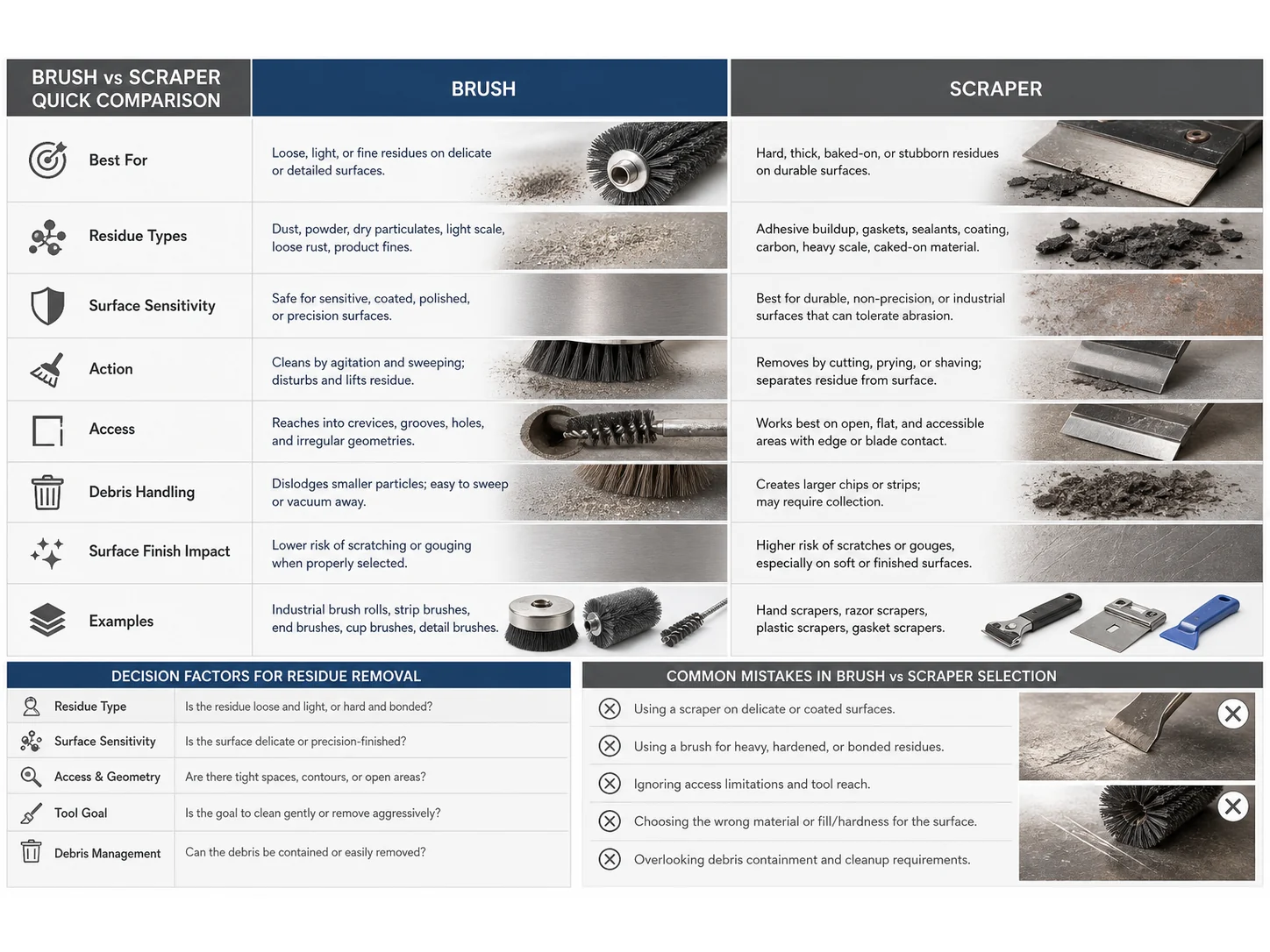
Defining the Tools: Brush and Scraper
A brush removes residue using bristles—these can be soft, medium, or stiff, made from materials like nylon, brass, or steel. Brushes excel at lifting, sweeping, and scrubbing without gouging the surface. A scraper relies on a rigid blade to shear off hardened material. Blades may be metal, plastic, or composite, and they are far more aggressive than bristles.
For deburring, edge finishing, brush/scraper choice, burr control, and replace-vs-recondition decisions, this article cites LaRoux K. Gillespie — Deburring and Edge Finishing Handbook, Society of Manufacturing Engineers, 1999; deburring process selection and edge-finishing sections.
For industrial parts-cleaning process selection, contaminant classes, mechanical cleaning systems, and residue removal, this article cites ASM International — Choosing a Cleaning Process, ASM International, 1996; contaminant classes and mechanical cleaning process selection.
When to Choose a Brush
Brushes work best when residue is loose, powdery, sticky, or semi-soft. Because bristles conform to surface contours, they can clean irregular shapes, corners, and textured areas without scratching. Common brush-friendly scenarios include:
- Removing dust, flour, or light food particles from processing belts.
- Cleaning soot or soft carbon from boiler tubes.
- Sweeping dried coolant from machined parts where surface finish must be preserved.
- Applying cleaning solution to a large area while scrubbing.
Bristle type matters: soft nylon for sensitive surfaces, medium polypropylene for general cleaning, stainless steel wire for rust or stubborn deposits on hard metals.
When to Choose a Scraper
Scrapers are the go‑to for hard, dry, or tightly adhered residue. When bristles can’t bite—think baked‑on carbon, hardened grease, paint, or thick scale—a blade can peel it away. Scrapers provide high force concentration, making them essential for:
- Removing baked-on food residues from grills and oven surfaces.
- Stripping old gaskets, adhesives, or sealants from maintenance surfaces.
- Chipping away heavy rust or mill scale before painting or welding.
- Cleaning flat molds or platens where uniform scraping avoids bristle shedding.
Blade material selection is critical: stainless steel resists corrosion, brass or plastic blades reduce risk of sparking or scratching on delicate substrates.
Brush vs Scraper: Quick Comparison
| Factor | Brush | Scraper | When to Prefer |
|---|---|---|---|
| Residue type | Soft, sticky, loose, fibrous | Hard, dry, baked-on, bonded | Brush for powders; scraper for crusts |
| Surface sensitivity | Low risk with soft/nylon bristles | Higher risk; can scratch or gouge | Brush on painted or polished surfaces |
| Aggressiveness | Low to medium | High | Scraper when significant force needed |
| Geometry handling | Conforms to curves, threads, holes | Best for flat or slightly curved areas | Brush for complex shapes |
| Contamination risk | Bristle shedding possible | Blade wear or breakage minimal | Scraper where foreign particles cannot be tolerated |
| Speed of removal | Slower for thick buildup | Fast for bulk removal | Scraper first, then brush for finishing |
Decision Factors for Residue Removal
Beyond a simple yes/no, several operational factors guide the brush vs. scraper selection:
- Residue thickness and hardness: thin, soft films may brush away; thick, hard layers often need scraping.
- Substrate material: aluminum, plastic, or painted parts demand non‑marring brushes or plastic scrapers.
- Cleaning frequency: in daily wipe‑downs, a brush may suffice; periodic deep cleaning might call for scrapers.
- Accessibility: deep recesses, internal bores, or pipe ID’s are brush territory. Flat, open faces suit scrapers.
- Hygiene and contamination control: in food or pharma, brush bristle loss is a hazard; full‑metal scrapers may be preferred, or brushes with FDA‑compliant filaments.
- Operator safety: scrapers require careful handling to avoid blade injuries; brushes are generally safer.
Common Mistakes in Brush vs Scraper Selection
- Using a wire brush on a sensitive surface: even a brass brush can scratch aluminum or stainless steel cosmetic finishes.
- Relying on a scraper alone for final cleaning: scrapers often leave fine residue or smear; a brush is needed for finishing.
- Ignoring bristle material: not all nylon brushes handle solvents or high temperatures. Check chemical compatibility.
- Forgetting blade sharpness: dull scrapers require more force, increasing the chance of slipping and damaging the surface or operator.
- Overlooking dual‑tool workflows: stubborn residue often yields to a scraper‑first, brush‑second approach.
- Selecting by cost alone: low-cost brushes shed bristles; low-cost scrapers dull quickly. Balance cost with operational risk.
When Both Tools Are Needed
Many residue challenges cannot be solved with one tool. A common boundary scenario is heavy, layered buildup: use a scraper to remove the bulk, then a brush to clean the remaining film, and finally a wipe or rinse. For internal threads or blind holes, a scraper might dislodge large chunks, while a brush fetches debris from the bottom. In food plants, scrapers remove baked-on material, and brushes sanitize the underlying surface. Recognizing this boundary prevents incomplete cleaning and rework.
Final Takeaway
Match the tool to both the residue and the surface. Brushes are ideal for soft, loose, or sticky residues and for protecting sensitive substrates. Scrapers handle hard, dry, bonded deposits where force is required. For thorough residue removal, especially in critical maintenance or processing environments, plan your sequence: scraper for bulk, brush for detail, and always verify surface integrity after cleaning.
When a Brush vs Scraper Is the Wrong Choice
This brush is not enough when the main problem is blocked access, unsafe working conditions, damaged equipment, incompatible chemicals, or a process setting that keeps recreating the residue. In those cases, review access, residue type, surface sensitivity, brush stiffness, operating environment, and replacement routine and confirm the surrounding cleaning method before increasing brush stiffness or contact pressure.
Frequently Asked Questions
Can I use a wire brush on stainless steel without scratching?
Stainless steel can be scratched by wire brushes, especially if the bristles are carbon steel. Use a stainless steel bristle brush or a non‑metallic abrasive pad to avoid introducing rust spots or marring the finish.
What type of brush is best for removing soft, sticky food residue?
A medium‑stiff nylon brush works well because it can scrub without scratching and resists most food acids and cleaning chemicals. For high‑temperature surfaces, check the nylon’s heat rating.
When should I replace a scraper blade?
Replace the blade when it becomes dull, chipped, or fails to remove residue with normal pressure. A dull blade can slip, causing injury or surface damage.
Can a scraper damage the underlying metal surface?
Yes. A metal scraper used at an incorrect angle or with too much force can gouge, scratch, or distort soft metals. Always test on a small, inconspicuous area first.
Is it better to use a brush or scraper for rust removal?
For light, powdery rust, a stiff wire brush is often sufficient. For thick, flaking rust, start with a scraper to break off scale, then use a wire brush to clean the remaining surface before further treatment.
What’s the best way to clean a brush after use?
Rinse the brush immediately with a compatible solvent or detergent, shake out excess liquid, and hang to dry with bristles facing down to prevent water from accumulating in the ferrule.
Can I combine a brush and scraper in one tool?
Yes, some combination tools exist but they are often compromises. For thorough cleaning, using separate, well‑chosen brush and scraper typically gives better results and control.
Technical References
Which steel wire grade fits this job — AISI 304 Stainless Steel Wire, AISI 316 Stainless Steel Wire or Carbon Steel Wire?
| Wire grade | Continuous temperature (°C) | Peak temperature (°C) | Water absorption | Hardness |
|---|---|---|---|---|
| AISI 304 Stainless Steel Wire | 400 | 500 | 0% | Rockwell B 70–95 depending on temper and cold work |
| AISI 316 Stainless Steel Wire | 400 | 500 | 0% | Rockwell B 70–95 depending on temper and cold work |
| Carbon Steel Wire | 200–300 | 350–450 | 0% | Rockwell C 40–60 |
| Galvanized Steel Wire | 150–200 | 250–300 | 0% | Rockwell B 70–100 |
Figures as published by Alleima; Material manufacturer TDS / ISO / ASTM / industry reference. Confirm the exact grade against the supplier datasheet before ordering.
What should replace AISI 304 Stainless Steel Wire for residue removal?
- AISI 304 Stainless Steel Wire — Use AISI 316 stainless steel wire for chloride, marine, dairy, beverage, chemical washdown, or higher pitting-resistance requirements. Use carbon steel for dry aggressive cutting and brass or abrasive nylon for lower marking risk.
- Nylon PA — Compare Nylon PA with PP, PBT, PET. Change material when wet stiffness, temperature, chemical resistance, conductivity, particle shedding, or surface marking becomes the limiting factor.