
Custom Cleaning Brush
Pellet Screen Cleaning Brush
Custom pellet screen cleaning brushes for wire mesh, perforated plate and wedge-wire screens.
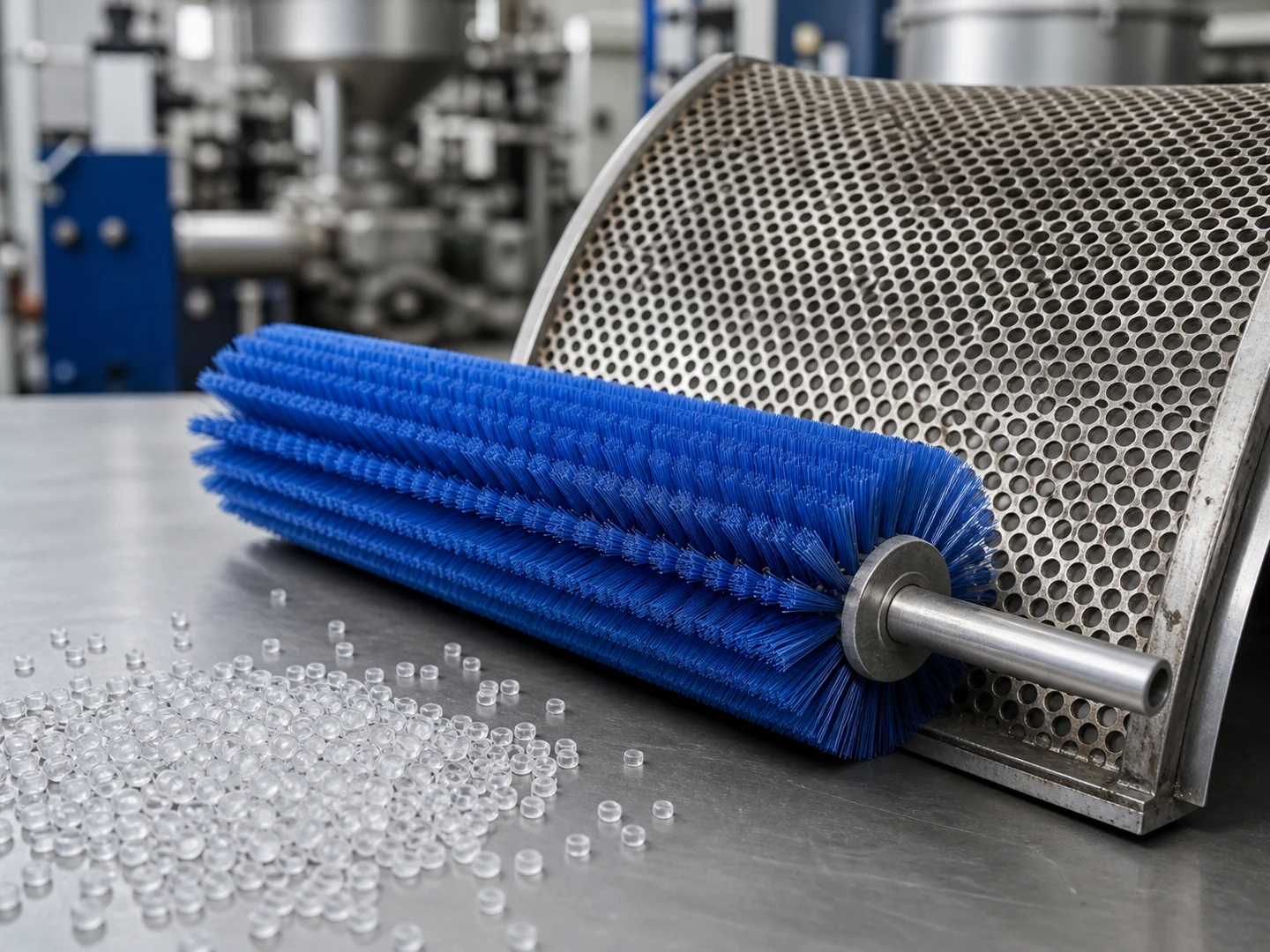
Medium brush
100 pcs
Minimum order
Worked with two hands or on a pole: chimney, gutter and pond-filter brushes, discs, cups and tank brushes.
Production lead time, once the specification is confirmed
- Up to 100 pcsWithin 7 days
- 101–5,000 pcsWithin 14 days
- 5,001–50,000 pcsWithin 21 days
- Over 50,000 pcsConfirmed with your quotation
Peak season can extend these times; the shipping date is confirmed in writing with your quotation. Sampling and shipping are quoted separately.
Pellet screening and classification lines lose throughput when fines, fibers, and deformed pellets blind the apertures. This brush keeps wire mesh, perforated plate, and wedge-wire screens open while the line runs, supplied as a strip, roller, or screen-cleaner form matched to your screen geometry and motion.
What can this brush do for you?
Clears blinding without stopping the screen
The filament tips sweep across the screen surface and dip into the openings as the screen or brush moves, lifting fines, short fibers, dust, and trapped pellets out of the apertures. You get continuous aperture recovery instead of scheduled stops for manual screen cleaning.
Follows the real screen surface
Wire mesh, perforated plate, and wedge-wire decks are not perfectly flat, and screen panels often differ across the width. Trim length, filament diameter, and density are set so the tips flex over high points and still reach the bottom of the openings, which prevents the common pattern where a rigid brush cleans only the top wires.
Cleans with resilient contact, not abrasion
Nylon and polypropylene filaments remove blinding fines and soft debris by flexing and flicking, not by grinding the screen. This protects wire diameter, slot edges, and plate thickness, and also avoids crushing soft or brittle pellets that can be damaged by heavy metal contact.
Works in wet and dry pellet circuits
Nylon retains stiffness and recovers its shape in moisture and process water, while polypropylene adds broad chemical resistance. Backing and core materials are selected for the operating environment so the brush does not become the first component to fail on a wet pellet screen.
Drops into existing screen-cleaner equipment
The holder profile, mounting holes, core diameter, and shaft interface are matched to the brush you are replacing. A new brush installs into the existing channel, clamp, or drive without reworking the screen frame or cleaner frame.
What is a Pellet Screen Cleaning Brush?
A Pellet Screen Cleaning Brush is a machine-mounted cleaning element used on pellet screening, classification, drying, and dewatering equipment. It runs against the screen to clear apertures that would otherwise blind with process fines. The brush is not a manual hand brush for occasional clean-up; it is a process consumable that works continuously or intermittently as part of the screening operation.
The most common configurations are a stationary strip brush held against a rotating drum or trommel screen, and a rotating or traversing roller brush that cleans a fixed or vibrating screen deck. In each case, controlled filament interference with the apertures does the work. The tips penetrate the openings a set distance, release trapped particles, and then recover as the brush moves to the next row of apertures.
Useful performance depends on three relationships: filament diameter against aperture size, trim length against available engagement space, and tip pressure against pellet hardness and screen strength. Over-engagement bends the tips permanently and accelerates wear on both the brush and the screen. Under-engagement leaves centers of the openings blinded. The right configuration is therefore determined by the screen geometry and the pellet stream, not by a standard size chart alone.
Technical Specifications
| Parameter | Value / Options |
|---|---|
| Brush form | Strip brush, coiled/roller brush, rotary screen cleaner, or segmented screen-cleaner arrangement |
| Filament material | Nylon 6, nylon 6.6, nylon 612, or polypropylene; other polymers by process review |
| Filament diameter | 0.15–1.2 mm (0.006–0.047 in); finer filaments for fine mesh, heavier filaments for coarse perforated plate or wedge wire |
| Trim length | 10–60 mm (0.4–2.4 in) from holder face, adjusted to engagement space and screen profile |
| Brush width / profile | 10–150 mm (0.4–5.9 in) or profiled to the screen panel width and running track |
| Backing / holder | Steel, stainless steel, aluminum, rigid polymer, or segmented plastic channel; bolt-on, snap-in, or clamped |
| Core for roller form | 20–80 mm (0.8–3.1 in) diameter; solid or hollow core with plain ends, keyway, or flange per drive |
| Tip engagement | Set 1–5 mm (0.04–0.2 in) into the openings for typical pellet screens; adjusted on site for wear and throughput |
| Operating environment | Wet or dry service; temperature and chemical exposure define filament and backing grade |
| Replacement interface | Matched to existing holder, mounting holes, shaft, or channel so new brushes install without rework |
| Brush type | Custom Strip Seal Brushes |
| How it is driven | Fixed in place, no drive of its own |
| Cleaning target | pellet mill screening deck, vibrating pellet classifier and separator, and rotary drum and trommel pellet screen cleaning |
| Surface or part | screens, perforated plate, roller, drums, holes, slots, wire mesh, and profiles |
| Residue or debris | pellets, fines, fiber, dust, trapped particles, and leaves |
| Mounting / connection | Matched to existing holder, mounting holes, shaft, or channel so new brushes install without rework |
Dimensions and filament selections are configured for each screen rather than fixed to a single catalog value. If the installed brush is a replacement, a drawing or sample of the current brush shortens the matching process.
Where does this brush work best?
- Pellet mill screening decks where fines and broken pellets blind mesh around the product stream.
- Vibrating pellet classifiers and separators that remove undersize, oversize, or dust from cut pellets.
- Rotary drum and trommel pellet screens where a fixed strip brush cleans the screen as the drum rotates.
- Underwater pelletizer and strand pelletizer dewatering screens where wet fines, fibers, and dust pack into slots and holes.
- Feed, wood, biomass, plastics compounding, and masterbatch pellet lines with continuous screening or classification.
- Wedge-wire and perforated plate decks in dryers, coolers, and post-pelletizing finishing equipment.
How do I choose the right one?
Match filaments to the aperture and residue
Measure the opening width, opening shape, and screen thickness first. Fine mesh with openings under about 1 mm usually needs thinner, more flexible nylon filaments that can enter the aperture without wedging. Coarse perforated plate or wedge-wire slots can carry larger-diameter, stiffer filaments that apply more removal force. Wet, sticky, or chemically treated pellet streams point toward nylon or polypropylene grades selected for the process liquid and temperature.
Select the brush form from the screen motion
| Screen movement | Preferred brush form |
|---|---|
| Rotating drum or trommel | Stationary strip brush held against the moving screen surface |
| Linear or elliptical vibrating deck | Oscillating strip, fixed strip, or driven roller brush depending on access |
| Static or slow-moving screen panel | Rotating or traversing roller/coil brush |
Set engagement to clean without damaging the screen
Start with the brush tips entering the openings about 1–3 mm for most pellet screens. If blind spots remain in the aperture centers, increase engagement in small steps. If the filament tips stay bent after contact, the screen wire shows polishing, or the screen begins to move under the brush, engagement is too deep. The target is tip recovery with each pass, not constant full deflection.
Respect pellet hardness
Soft or brittle pellets require longer, finer, or lower-density filaments to reduce contact pressure. Harder pellets tolerate firmer trim and higher filament density. If pellets are fracturing at the screen surface or the brush face, the brush is likely too aggressive for the product.
Confirm the holder and core interface
For a replacement brushes, provide the old brush or a dimensioned drawing. Holder profile, hole pattern, core diameter, keyway, and segment length all need to match the existing screen cleaner. For a new installation, supply the available mounting space, screen panel layout, and drive details.
When another cleaning method makes more sense
Nylon and polypropylene brushes remove loose and lightly adhered blinding. They are the wrong tool for hardened, fused, or calcified build-up that requires grinding or scraping action; in those cases, a wire or abrasive cleaning element may be needed. If the residue is a sticky paste that smears and re-blinds the screen immediately, brushing works best together with spray, air assist, or periodic chemical washout rather than as the only cleaning step.
Can I customize this brush?
Pellet screen cleaning brushes are built to the screen, not selected from a fixed range. To define the configuration, provide the aperture size and shape, screen material and thickness, screen motion and speed, available engagement space, existing holder or core details, process temperature and chemicals, and the pellet type and hardness. A sample of the current brush or a screen drawing helps match the interface quickly.
Common adjustment areas include:
- Brush form and dimensions: strip, roller, or screen-cleaner layout; width, profile, segment count, and trim length
- Filament set: material, diameter, stiffness, trim pattern, density, and straight or crimped filament construction
- Backing and holder: material, thickness, hole pattern, profile, and wear strip or guide features
- Roller core: diameter, length, shaft ends, keyway, flanges, or drive coupling
- Mounting accessories: spacers, end brackets, clamps, and alignment guides
- Color, identification marking, and packaging for inventory tracking
If your project requires material declarations, documented inspection, or third-party testing support, those requirements can be addressed during the customization process.
When is a pellet screen cleaning brush worn out rather than just dirty?
How can I tell whether the brush engagement is too deep?
Look at the filament tips after a short run. If tips are permanently bent, flattened, or shiny at the contact face, and the screen wire or plate shows polished streaks, engagement is too deep. Reduce the interference until the tips recover after each pass. If the centers of the apertures stay blinded, engagement is too light.
Will the brush remove sticky wet pellets from fine mesh?
It clears loosely attached and lightly adhered particles, but highly sticky or paste-like residue can smear and re-blind the screen. In those lines, the brush is usually one part of the cleaning sequence and works best alongside water spray, air assist, or scheduled washout.
What should I check during routine brush inspection?
Inspect trim wear for evenness across the full width, check for lost or loose filaments, and look at backing corrosion, mount tightness, core straightness, and segment alignment. When trim length reaches the point where engagement can no longer be maintained within the recommended range, replace the brush.
Can one brush handle a screen with mixed aperture sizes or multiple zones?
Yes. The brush can be zoned with different filament diameter, density, or trim length across the width to match sections of the screen that have different openings or carry different loads. Supply the zone widths and the aperture detail for each zone.
How can I verify the cleaning result without stopping the line?
Watch screen differential pressure, throughput, and the fines or oversize pattern on downstream equipment. If throughput recovers after brush installation or replacement and the blinding pattern disappears from the apertures at the next scheduled stop, engagement and coverage are working.
Does brushing replace manual screen washing or deep cleaning?
No. Brushing removes surface and aperture blinding during normal operation. It does not remove accumulated build-up in corners, under clamps, or inside screen supports. Periodic manual washing, high-pressure cleaning, or chemical cleaning of the screen deck is still part of a complete maintenance routine.
Guides that go deeper on this
Custom Manufacturing RFQ
Describe Your Application
Send the key measurements, cleaning requirement, residue, material direction, mounting method, quantity, and drawing or photo.
Drawing or photo optional — it speeds things up, it does not gate the enquiry.
Custom Brush RFQ
Send Your Brush Project
Upload a drawing, product photo, or sample photo and provide the core dimensions and cleaning conditions.
“We need a brush to remove wet residue from a stainless steel conveyor, about 800mm wide. The current brush wears quickly. We can send photos.”
“We sell drinkware and need a cleaning brush to include with the product. Quantity around 5,000 pieces.”