
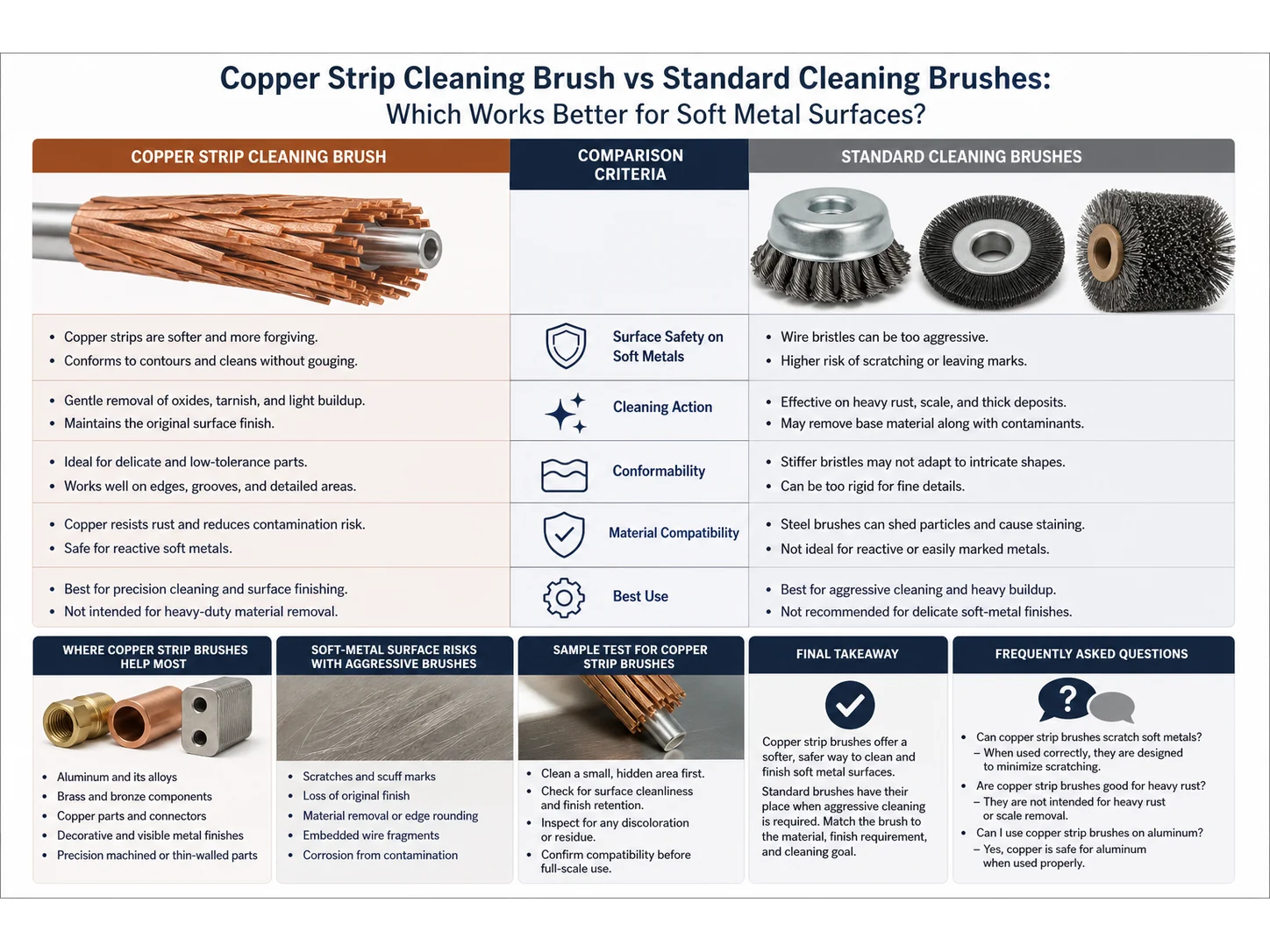
What Is a Copper Strip Cleaning Brush?
A copper strip cleaning brush is a brush assembly that uses copper wire bristles set into a metal or plastic backing strip. Unlike spot brushes, a strip brush is mounted along a channel or holder, making it suited for continuous cleaning applications such as metal coil lines, sheet cleaning, or conveyorized part cleaning. Copper bristles are softer than steel and less likely to scratch or gall soft metals. They are often used dry or with mild cleaners to remove light oxides, dust, and smut from surfaces like copper bus bars, brass fittings, aluminum panels, and printed circuit boards.
Common Types of Cleaning Brushes for Soft Metals
- Copper wire strip brushes: continuous brush strips with copper bristles, available in various densities and bristle diameters.
- Copper-impregnated nylon brushes: nylon bristles embedded with copper particles, providing gentle cleaning with built-in anti-static properties.
- Soft nylon brushes: non-abrasive, used for wet cleaning or applying mild chemicals.
- Stainless steel wire brushes: aggressive, high risk of scratching and embedding particles; not recommended for most soft metals.
- Abrasive filament brushes: contain silicon carbide or aluminum oxide; remove material, not suited for simple cleaning.
Copper Strip Brush vs Standard Cleaning Brush: Key Differences
| Factor | Copper Strip Brush | Standard Steel Wire Brush | Soft Nylon Brush |
|---|---|---|---|
| Bristle Material | Copper or copper alloy | Carbon steel or stainless steel | Nylon 6.6 or 6.12, with or without abrasive |
| Hardness | Soft (less than steel) | High | Very low (flexible) |
| Risk of Surface Scratching | Low (non-galling) | High on aluminum, copper, brass | Minimal |
| Corrosion Potential | Noble to soft metals; minimizes galvanic risk | Can cause galvanic corrosion on aluminum or brass | Non-corrosive |
| Residue Removal | Effective for light oxides, smut, dust | Heavy rust, weld spatter, thick scale | Light dust, liquids |
| Typical Strip Form | Available in channel back, punched back, or custom extrusions | Commonly in wire wheels or cup brushes; strip less common | Strip and tube brushes widely available |
| Service Life | Wear depends on load; bristle breakage possible | Long, may harden or fracture | Good in wet environments; may degrade in high heat |
| Best Application | Inline cleaning of copper, brass, aluminum coils, sheets, or PCBs | Mill scale removal on steel; not for soft metals | Wet cleaning, dust removal, light chemical application |
How to Choose the Right Brush for Your Soft Metal Application
- Surface sensitivity: If the metal is easily scratched, copper or nylon is safer. If harder metals like steel, steel brushes may be acceptable.
- Type of residue: For oxides and smut, copper is effective. For grease, nylon with a solvent may be better. For heavy rust, a more aggressive brush is needed but may require secondary processing.
- Wet or chemical exposure: Copper can oxidize in some chemicals. Consider stainless steel or nylon if chemicals are aggressive. Check material compatibility.
- Equipment interface: Strip brushes need to fit a specific channel or holder. Standard off-the-shelf brushes may not fit. Custom strip brushes can be built to match channel dimensions and mounting patterns.
- Maintenance frequency: Copper brushes wear faster than steel but are gentler. Factor inspection and replacement intervals.
- Custom requirements: If you need a non-standard length, bristle density, or backing profile, a custom strip brush may be necessary. Provide a drawing or sample.
Common Mistakes When Cleaning Soft Metal Surfaces
- Using steel wire brushes on aluminum or copper: This can embed steel particles, leading to rust spots or galvanic corrosion.
- Ignoring bristle stiffness selection: Too stiff a bristle (even copper) can still scratch if the wire diameter is too large or trim length too short.
- Not matching brush backing to the machine channel: A loose fit causes vibration and uneven wear; too tight makes installation difficult.
- Overlooking chemical compatibility: Some cleaners attack copper bristles. Test on a small area first.
- Choosing by cost drivers alone: The lowest-cost brush may wear out quickly or damage the surface, raising overall cost.
When a Copper Strip Cleaning Brush Is the Wrong Choice
Copper strip brushes excel at light cleaning, but they cannot replace:
- Heavy material removal processes like grinding or sanding.
- Chemical etching or pickling lines where strong acids are used.
- Applications requiring a high-gloss polish; copper may leave a matte finish.
- If the residue is thick, baked-on, or contains abrasive particles, a multi-stage cleaning system with different brush types or chemical prep may be needed.
In such cases, consult a brush manufacturer or perform a sample test to validate performance.
Final Takeaway
Choosing between a copper strip brush and a standard cleaning brush comes down to surface sensitivity and cleaning goals. For soft metals, copper strip brushes reduce the risk of scratching and galvanic damage, making them the safer inline cleaning option. Standard steel brushes are too aggressive for most non-ferrous surfaces, while soft nylon is better for light dusting and wet applications. Whenever possible, test a sample brush against your specific residue and surface to confirm compatibility before placing a production order.
Frequently Asked Questions
Can I use a copper strip brush on aluminum?
Yes, copper brushes are commonly used on aluminum because they are softer than steel and less likely to scratch. However, ensure the bristle diameter and stiffness are appropriate for the aluminum grade to avoid any marks.
What is the difference between a copper strip brush and a copper wire brush?
A copper wire brush is a general term for a brush with copper bristles, often a hand brush. A copper strip brush specifically refers to a continuous brush strip with a backing (metal or plastic) designed for mounting in a channel for inline or automated cleaning systems.
How do I specify the size of a copper strip brush for my machine?
You need to measure the channel slot width and depth, overall brush length, and the desired bristle length (trim length). Providing a drawing or sample to a brush supplier ensures a proper fit.
Will copper bristles rust or corrode over time?
Copper does not rust like steel, but it can tarnish or form a patina in humid or chemically aggressive environments. This typically does not affect cleaning performance, but if the brush is used with corrosive chemicals, consider a different material like stainless steel or nylon.
How often should I replace a copper strip brush?
Replacement frequency depends on usage, pressure, and the abrasiveness of the residue. Signs of wear include reduced bristle length, uneven cleaning, or bristle breakage. Regular inspection every few hundred hours of operation is recommended.
Is a copper brush safe for food contact surfaces?
Copper can be used in food processing areas but must meet applicable regulations. However, copper can react with acidic foods, so for direct food contact surfaces, stainless steel or food-grade nylon brushes are often preferred.
Can I get a custom strip brush with copper bristles and a specific backing shape?
Yes, many brush manufacturers offer custom strip brushes where you can specify the backing material (e.g., galvanized steel, stainless steel, aluminum), bristle density, and length. A drawing or sample is typically required for a quote.
What is a metal back strip brush?
A metal back strip brush has a reinforcing metal strip or channel along the top of the backing, providing rigidity. This is common in industrial strip brushes, including copper versions, for secure mounting in high-speed or heavy-duty applications.
Technical References
- Copper Development Association — Electrical Conductivity of Copper
- World Stainless — Corrosion Resistance of Stainless Steels
Which bristle material fits this job — Nylon PA, AISI 304 Stainless Steel Wire or Copper Wire?
| Material | Continuous temperature (°C) | Peak temperature (°C) | Water absorption | Hardness |
|---|---|---|---|---|
| Nylon PA | 93 | 121 | 0.3–9% by PA grade and conditioning | Medium to firm; filament diameter and trim length control bending force. |
| AISI 304 Stainless Steel Wire | 400 | 500 | 0% | Rockwell B 70–95 depending on temper and cold work |
| Copper Wire | 150–200 | 250–300 | 0% | Rockwell B 20–80 |
Figures as published by Brushtec / DuPont; Alleima. Confirm the exact grade against the supplier datasheet before ordering.
What should replace Nylon PA when it stops working?
- Nylon PA — Compare Nylon PA with PP, PBT, PET. Change material when wet stiffness, temperature, chemical resistance, conductivity, particle shedding, or surface marking becomes the limiting factor.
- AISI 304 Stainless Steel Wire — Use AISI 316 stainless steel wire for chloride, marine, dairy, beverage, chemical washdown, or higher pitting-resistance requirements. Use carbon steel for dry aggressive cutting and brass or abrasive nylon for lower marking risk.
- Copper Wire — Compare Copper Wire with Compare with brass for greater spring and wear, phosphor bronze for resilience and stainless steel for aggressive corrosion-resistant cutting. Change material when wet stiffness, temperature, chemical resistance, conductivity, particle shedding, or surface marking becomes the limiting factor.