
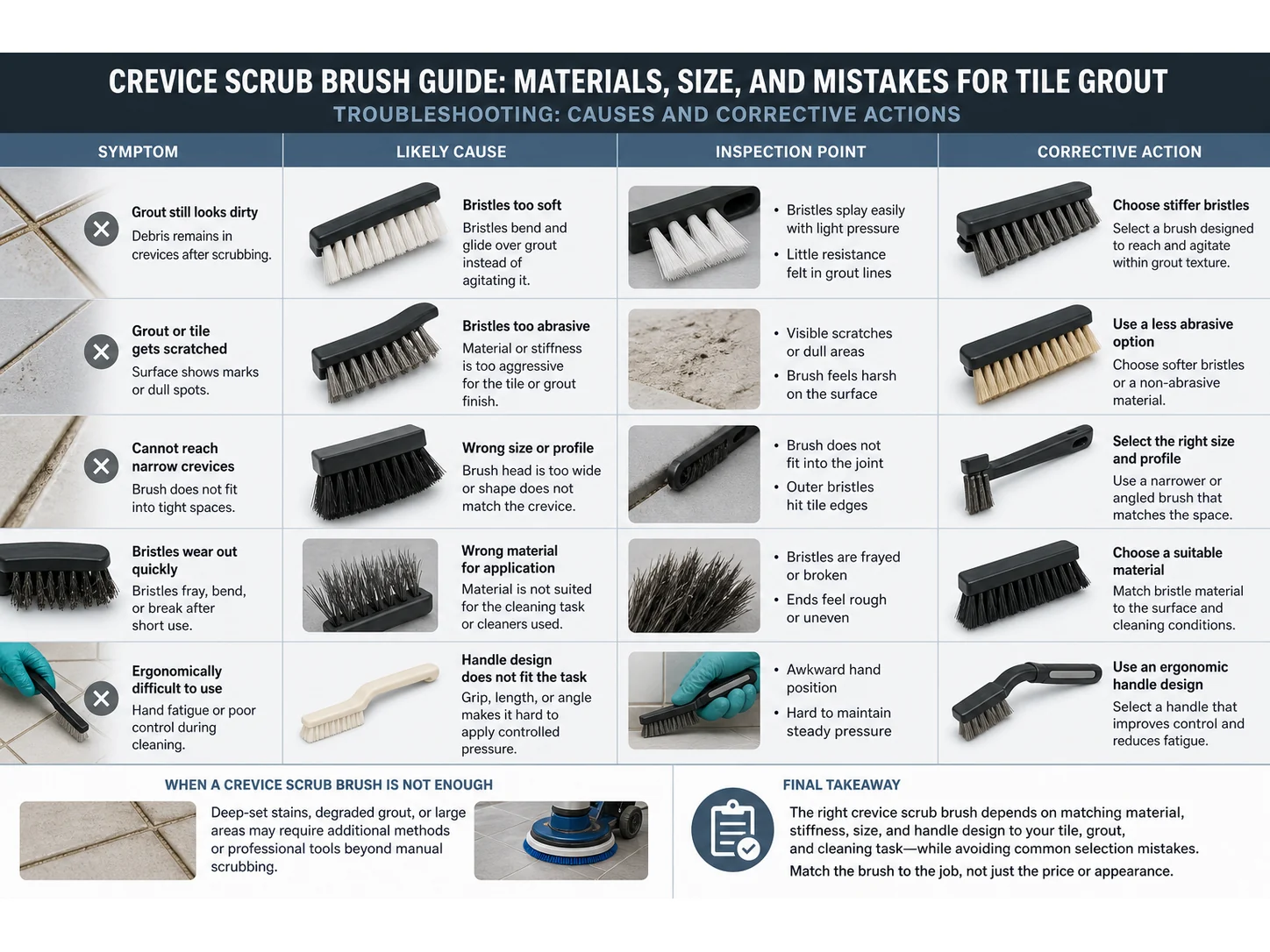
What Is a Crevice Scrub Brush?
A crevice scrub brush is a small-profile cleaning brush with bristles configured to penetrate narrow recesses, typically less than ¼ inch wide. Unlike general-purpose scrub brushes, its design focuses on concentrating filament pressure inside grout lines, tile edges, shower corners, and tight fixture gaps. The best models combine a comfortable grip with durable, chemically compatible filaments that won’t scratch the surface or break down during repeated use.
Common Types of Crevice Scrub Brushes
Brushes in this category vary primarily by material, bristle stiffness, brush head shape, and handle or mounting style. The most common options include:
- Material: Nylon, polyester, polypropylene, brass, stainless steel, and natural fibers like tampico or palmyra.
- Stiffness: Soft, medium, firm, or extra-stiff (often indicated by filament gauge or color coding).
- Brush Head Profile: Straight, angled, pointed tip, or wedge-shaped for different grout contours.
- Handle / Mounting: Handheld with ergonomic grip, long-handle for standing work, drill-mounted rotary heads, or machine-compatible shank mounts for power scrubbers.
- Size: Width from approximately 1 mm (needle-line) to 12 mm (wide joint brush); bristle trim length typically 10–25 mm.
Material, Stiffness and Size Comparison
The table below compares typical material options for crevice scrub brushes used on tile grout. Actual specifications vary by manufacturer.
| Material | Typical Stiffness | Best For | Avoid On | Notes |
|---|---|---|---|---|
| Nylon | Medium to firm | Glazed ceramic, porcelain, everyday grout lines | Natural stone (can scratch if filled with abrasive) | Good chemical resistance; most common |
| Polypropylene | Firm to extra-stiff | Heavy soap scum, hard water deposits, unglazed tile | Delicate antique or hand-painted tile | Excellent acid and alkali resistance |
| Brass | Stiff, but with slight flexibility | Unglazed quarry tile, deep-set stains, outdoor grout | Glazed or polished surfaces, light-colored grout (may leave marks) | Conductive; avoid in electrical areas |
| Stainless Steel | Extra-stiff, minimal flex | Rust removal, industrial tile floors, baked-on residues | Any surface that can scratch; grout may be damaged if too aggressive | High heat and chemical tolerance |
| Tampico (natural fiber) | Soft to medium | Polished marble, limestone, sensitive grout, light duty | Heavy grease or thick buildup | Biodegradable; poor acid resistance |
Size selection centers on grout width. Measure the grout line; the brush head should be slightly narrower than the joint so bristles can thoroughly scrub both sides without wedging. Common sizes: 1–3 mm for thin grout lines, 4–6 mm for standard residential grout, 8 mm+ for wide, rustic-style joints.
How to Choose the Right Crevice Scrub Brush
Match the brush to the specific cleaning challenge by running through these decision factors:
- Residue type: Soap scum responds to medium nylon; hard mineral buildup needs acid-resistant polypropylene; rust or heavy oxidation may need brass or stainless steel — but verify surface compatibility first.
- Surface sensitivity: Glazed tile tolerates firm nylon or polypropylene. Natural stone (marble, granite, slate) requires non-metallic, softer filaments to avoid etching or scratching. When in doubt, test in an inconspicuous area.
- Equipment interface: Handheld brushes suit small jobs and touch-ups. Drill-attached brushes save time on large areas but increase the risk of heat buildup and grout erosion if used incorrectly. Check shank diameter (typically ¼” hex) and maximum RPM before purchasing a power brush.
- Wet or chemical exposure: If you use bleach, hydrogen peroxide, or acidic cleaners, confirm the brush material—including the core and epoxy—can withstand the chemical without degradation. Polypropylene and stainless steel excel here; natural fibers swell and break down.
- Hygiene expectations: In food-prep or healthcare settings, crevice brushes must withstand high-temperature washdowns or steam sanitization. Look for sealed-body designs without crevices that trap bacteria.
- Maintenance frequency: Daily use demands a durable, quick-drying filament and a robust handle. Consider replaceable head systems if you clean large commercial floors regularly.
- Custom size requirements: If standard off-the-shelf brushes do not fit your grout width or machine, custom brush manufacturers can produce specific diameter, trim length, and filament density. Provide a detailed drawing for accurate quoting.
Common Mistakes When Selecting a Crevice Scrub Brush
Even experienced buyers overlook critical details that lead to poor cleaning results or surface damage. Avoid these pitfalls:
- Choosing by stiffness alone: Stiffer is not always better. Too stiff a brush on soft grout can erode the joint or leave permanent scratches. Match stiffness to the stain, not the surface.
- Ignoring the grout joint width: A brush too wide won’t reach the bottom of the grout line; too narrow slows progress. Always measure actual grout joint width before ordering.
- Neglecting chemical compatibility: Many cleaning chemicals attack nylon or dissolve natural bristles. Check a chemical resistance chart or test a sample before large-scale use.
- Overlooking handle ergonomics: A short, thin handle causes hand fatigue during extended cleaning. Look for non-slip, cushioned grips, and consider a long handle if you clean while standing.
- Buying by cost drivers without material spec: Generic “grout brush” listings may not specify filament material. An unspecified plastic could soften in hot water or wear out in days.
- Assuming all metal brushes are safe: Brass and steel brushes can discolor white grout or leave micro-scratches that attract dirt. Use them only when you fully understand the risk.
When a Crevice Scrub Brush Is the Wrong Choice
There are limits to what a crevice brush can accomplish, even with the ideal material and size:
- Deep-set organic stains: Mold or mildew penetrating porous grout may need a steam cleaner or oxygen bleach soak rather than mechanical scrubbing.
- Crumbling or missing grout: No brush can fix structural grout failure. Regrouting or professional repair is required before detailing.
- Very large areas: For hundred-square-foot commercial floors, a handheld crevice brush is too slow. A floor scrubber with cylindrical brush rolls or a rotary deck brush is more efficient.
- Custom manufacturer instructions brushes: If you are designing a proprietary cleaning tool, off-the-shelf crevice brushes may not meet volume, filament density, or mounting requirements. Work with a supplier to review detailed CAD drawings and validate samples before production.
- High-temperature applications: Near ovens or grills where surface temps exceed 200°F, standard plastic filaments soften. Special high-temperature filaments (e.g., PEEK, PTFE) may be needed.
Final Takeaway
Selecting a crevice scrub brush is a balance of material, size, and stiffness relative to the surface and residue. Start by measuring the grout width, identifying the stain type, and choosing a filament that solves the problem without damaging the tile. For most households, a medium-firm nylon brush with a comfortable handle covers 80% of cleaning needs. For specialty applications, request a sample and test on a small patch before committing to a bulk order.
Frequently Asked Questions
Can I use a wire brush on all tile?
No. Wire brushes, especially steel or brass, can scratch glazed tile and discolor light-colored grout. Use them only on unglazed, heavy-duty surfaces like quarry tile or outdoor brick, and always test first.
What size brush do I need for standard grout lines?
Standard residential grout lines are typically 1/8 inch (3 mm) wide during installation, though they may widen slightly with wear. A brush head 2–3 mm wide usually works well. For thinner 1/16 inch grout, look for a detail brush under 2 mm.
How do I clean and maintain a crevice brush?
Rinse thoroughly with water after each use to remove cleaning agents and debris. Hang or store bristles down so they dry completely. Periodically comb out trapped fibers or hair. If used with harsh chemicals, check the core for cracking and replace the brush annually or sooner if bristles lose shape.
Are there crevice brushes that attach to power tools?
Yes. Many rotary crevice brushes use a ¼-inch hex shank for drill or impact driver attachment. They speed up cleaning but can generate heat and friction; avoid staying in one spot and use low speed on delicate surfaces.
Can a crevice brush remove mold from grout?
A brush can remove surface mold and biofilm from grout, but if the mold has penetrated deeply, brushing alone won’t kill the roots. You need an antimicrobial treatment or steam cleaning to address the underlying issue.
What’s the difference between a crevice brush and a toothbrush?
While both are small, a crevice brush typically has stiffer, more durable bristles, a longer handle, and a specifically shaped head for grout lines. A toothbrush may work in a pinch but wears out quickly and lacks the leverage for deep scrubbing.
When should I replace my crevice brush?
Replace when bristles are permanently bent, splayed, or soft, or when the brush no longer cleans effectively. In commercial use, replace every 3–6 months for consistent performance.
Are there bamboo or eco-friendly options?
Yes. Some manufacturers offer crevice brushes with bamboo handles and natural tampico or sisal bristles. These are biodegradable and suitable for light cleaning but may not withstand strong chemicals or heavy scrubbing.
Technical References
Which nylon grade fits this job — Nylon PA, PA6 Nylon or PA66 Nylon?
| Grade | Continuous temperature (°C) | Peak temperature (°C) | Water absorption | Hardness |
|---|---|---|---|---|
| Nylon PA | 93 | 121 | 0.3–9% by PA grade and conditioning | Medium to firm; filament diameter and trim length control bending force. |
| PA6 Nylon | 80–100 | 130–160 | 1.5–3.0% | Shore D 75–85 |
| PA66 Nylon | 100–120 | 150–180 | 1.0–1.8% | Shore D 80–88 |
| PA610 Nylon | 90–110 | 130–150 | 0.5–1.0% | Shore D 72–82 |
| PA612 Nylon | 90–110 | 130–150 | 0.3–0.7% | Shore D 70–80 |
Figures as published by Brushtec / DuPont. Confirm the exact grade against the supplier datasheet before ordering.
What should replace Nylon PA for tile grout?
- Nylon PA — Compare Nylon PA with PP, PBT, PET. Change material when wet stiffness, temperature, chemical resistance, conductivity, particle shedding, or surface marking becomes the limiting factor.
- AISI 304 Stainless Steel Wire — Use AISI 316 stainless steel wire for chloride, marine, dairy, beverage, chemical washdown, or higher pitting-resistance requirements. Use carbon steel for dry aggressive cutting and brass or abrasive nylon for lower marking risk.